5.3 TABLE OF GROUPS OF SMALL ORDER
5.3 小阶群的表格
At this point we can give a table of the isomorphism types for most of the groups of small order.
在这一点上,我们可以给出大多数小阶群的同构类型的表格。
Each of the unfamiliar non-abelian groups in the table on the following page will be constructed in Section 5 on semidirect products (which will also explain the notation used for them). For the present we give generators and relations for each of them (i.e., presentations of them).
在下一页表格中出现的每个不熟悉的非阿贝尔群都将在第5节关于半直积的内容中构建(这将解释用于它们的符号)。目前,我们给出它们的生成元和关系(即它们的表示)。
The group Z3⋊Z4 of order 12 can be described by the generators and relations:
阶为12的群 Z3⋊Z4 可以通过生成元和关系来描述:
⟨x,y∣x4=y3=1,x−1yx=y−1⟩,
namely,it has a normal Sylow 3-subgroup (⟨y⟩) which is inverted by an element of order 4(x) acting by conjugation (x2 centralizes y) .
即,它有一个正规 Sylow 3-子群 (⟨y⟩) ,该子群被一个阶为 4(x) 的元素通过共轭作用反转 (x2 centralized y) 。
The group (Z3×Z3)⋊Z2 has generators and relations:
群 (Z3×Z3)⋊Z2 有生成元和关系:
⟨x,y,z∣x2=y3=z3=1,yz=zy,x−1yx=y−1,x−1zx=z−1⟩,
namely,it has a normal Sylow 3-subgroup isomorphic to Z3×Z3(⟨y,z⟩) inverted by an element of order 2(x) acting by conjugation.
即,它有一个正规 Sylow 3-子群同构于 Z3×Z3(⟨y,z⟩) ,被一个阶为 2(x) 的元素通过共轭作用反转。
The group Z5⋊Z4 of order 20 has generators and relations:
阶为20的群 Z5⋊Z4 有生成元和关系:
⟨x,y∣x4=y5=1,x−1yx=y−1⟩,
namely,it has a normal Sylow5-subgroup (⟨y⟩) which is inverted by an element of order 4(x) acting by conjugation (x2 centralizes y) .
即,它有一个正规 Sylow 5-子群 (⟨y⟩) ,该子群被一个阶为 4(x) 的元素通过共轭作用反转 (x2 centralized y) 。
| 7 | 1 | ${Z}_{7}$ | none |
|---|
| 8 | 5 | ${\mathbb{Z}}_{8},{\mathbb{Z}}_{4} \times {\mathbb{Z}}_{2}$ ${\mathbb{Z}}_{2} \times {\mathbb{Z}}_{2} \times {\mathbb{Z}}_{2}$ | ${D}_{8},{Q}_{8}$ |
| 9 | 2 | ${Z}_{9},{Z}_{3} \times {Z}_{3}$ | none |
| 10 | 2 | ${Z}_{10}$ | ${D}_{10}$ |
| 11 | 1 | ${Z}_{11}$ | none |
| 12 | 5 | ${Z}_{12},{Z}_{6} \times {Z}_{2}$ | ${A}_{4},{D}_{12},{\mathbb{Z}}_{3} \rtimes {\mathbb{Z}}_{4}$ |
| 13 | 1 | ${Z}_{13}$ | none |
| 14 | 2 | ${Z}_{14}$ | ${D}_{14}$ |
| 15 | 1 | ${Z}_{15}$ | none |
| 16 | 14 | ${Z}_{16},{Z}_{8} \times {Z}_{2}$ ${\mathbb{Z}}_{4} \times {\mathbb{Z}}_{4},\;{\mathbb{Z}}_{4} \times {\mathbb{Z}}_{2} \times {\mathbb{Z}}_{2},$ ${\mathbb{Z}}_{2} \times {\mathbb{Z}}_{2} \times {\mathbb{Z}}_{2} \times {\mathbb{Z}}_{2}$ | not listed |
| 17 | 1 | ${Z}_{17}$ | none |
| 18 | 5 | ${Z}_{18},{Z}_{6} \times {Z}_{3}$ | ${D}_{18},{S}_{3} \times {Z}_{3}$ , $\left( {{\mathbb{Z}}_{3} \times {\mathbb{Z}}_{3}}\right) \rtimes {\mathbb{Z}}_{2}$ |
| 19 | 1 | ${Z}_{19}$ | none |
| 20 | 5 | ${Z}_{20},{Z}_{10} \times {Z}_{2}$ | ${D}_{20}$ ${Z}_{5} \rtimes {Z}_{4},{F}_{20}$ |
The group F20 of order 20 has generators and relations:
阶为20的群 F20 有生成元和关系:
⟨x,y∣x4=y5=1,xyx−1=y2⟩,
x mely,it has a normal Sylow5-subgroup (⟨y⟩) which is squared by an element of order (x) acting by conjugation. One can check that this group occurs as the normalizer of Sylow 5-subgroup in S5 ,e.g.,
x 即,它有一个正规 Sylow 5-子群 (⟨y⟩) ,该子群被一个阶为 (x) 的元素通过共轭作用平方。可以验证这个群作为 S5 中 Sylow 5-子群的正规化出现,例如,
F20=⟨(2354),(12345)⟩.
his group is called the Frobenius group of order 20 .
这个群被称为阶为20的Frobenius群。
EXERCISE
练习
-
Prove that D16,Z2×D8,Z2×Q8,Z4∗D8,QD16 and M are nonisomorphic non-abelian groups of order 16 (where Z4∗D8 is described in Exercise 12,Section 1 and QD16 and M are described in the exercises in Section 2.5).
-
证明 D16,Z2×D8,Z2×Q8,Z4∗D8,QD16 和 M 是非同构的非阿贝尔群,它们的阶为16(其中 Z4∗D8 在练习12中描述,位于第1节,而 QD16 和 M 在第2.5节的练习中描述)。
5.4 RECOGNIZING DIRECT PRODUCTS
5.4 识别直积
So far we have seen that direct products may be used to both construct “larger” groups from “smaller” ones and to decompose finitely generated abelian groups into cyclic factors. Even certain non-abelian groups, which may be given in some other form, may be decomposed as direct products of smaller groups. The purpose of this section is to indicate a criterion to recognize when a group is the direct product of some of its subgroups and to illustrate the criterion with some examples.
到目前为止,我们已经看到,直积可以用来从“较小的”群构造“较大的”群,也可以用来分解有限生成的阿贝尔群为循环因子。甚至某些可能以其他形式给出的非阿贝尔群,也可以分解为较小群的直积。本节的目的是指出一个标准,用于识别一个群何时是其某些子群的直积,并用一些例子来说明这个标准。
Before doing so we introduce some standard notation and elementary results on commutators which will streamline the presentation and which will be used again in Chapter 6 when we consider nilpotent groups.
在此之前,我们引入一些标准的记号和关于换位子的一些基本结果,这将使论述更加简洁,并在第6章考虑幂零群时再次使用。
Definition. Let G be a group,let x,y∈G and let A,B be nonempty subsets of G .
定义。设 G 是一个群,x,y∈G 和 A,B 是 G 的非空子集。
(1) Define [x,y]=x−1y−1xy ,called the commutator of x and y .
(1) 定义 [x,y]=x−1y−1xy,称为 x 和 y 的换位子。
(2) Define [A,B]=⟨[a,b]∣a∈A,b∈B⟩ ,the group generated by commutators of elements from A and from B .
(2) 定义 [A,B]=⟨[a,b]∣a∈A,b∈B⟩,由 A 和 B 中元素的换位子生成的群。
(3) Define G′=⟨[x,y]∣x,y∈G⟩ ,the subgroup of G generated by commutators of elements from G ,called the commutator subgroup of G .
(3) 定义 G′=⟨[x,y]∣x,y∈G⟩,是 G 中由 G 的元素的换位子生成的子群,称为 G 的换位子群。
The commutator of x and y is 1 if and only if x and y commute,which explains the terminology. The following proposition shows how commutators measure the “difference” in G between xy and yx .
x 和 y 的换位子为1当且仅当 x 和 y 可交换,这解释了术语的使用。以下命题展示了换位子如何衡量 G 中 xy 与 yx 之间的“差异”。
Proposition 7. Let G be a group,let x,y∈G and let H≤G . Then
命题7。设 G 为一个群,令 x,y∈G 并且令 H≤G 。
(1) xy=yx[x,y] (in particular, xy=yx if and only if [x,y]=1 ).
(1) xy=yx[x,y] (特别地,当且仅当 xy=yx )。
(2) H⊴G if and only if [H,G]≤H .
(2) H⊴G 当且仅当 [H,G]≤H 。
(3) σ[x,y]=[σ(x),σ(y)] for any automorphism σ of G,G′ char G and G/G′ is abelian.
(3) 对任何 σ[x,y]=[σ(x),σ(y)] 的自同构 σ ,若 G,G′ 的特征 G 并且 G/G′ 是阿贝尔群。
(4) G/G′ is the largest abelian quotient of G in the sense that if H⊴G and G/H is abelian,then G′≤H . Conversely,if G′≤H ,then H⊴G and G/H is abelian.
(4) G/G′ 是 G 的最大阿贝尔商群,在以下意义上:如果 H⊴G 并且 G/H 是阿贝尔群,那么 G′≤H 。反之,如果 G′≤H ,那么 H⊴G 并且 G/H 是阿贝尔群。
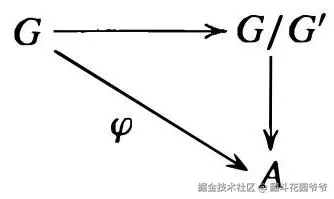
(5) If φ:G→A is any homomorphism of G into an abelian group A ,then φ factors through G′ i.e., G′≤kerφ and the following diagram commutes:
(5) 如果 φ:G→A 是 G 到阿贝尔群 A 的任意同态,那么 φ 通过 G′ 分解,即 G′≤kerφ ,并且以下图表可交换:
Proof: (1) This is immediate from the definition of [x,y] .
证明:(1) 这直接来自 [x,y] 的定义。
(2) By definition, H⊴G if and only if g−1hg∈H for all g∈G and all h∈H . For h∈H,g−1hg∈H if and only if h−1g−1hg∈H ,so that H⊴G if and only if [h,g]∈H for all h∈H and all g∈G . Thus H⊴G if and only if [H,G]≤H, which is (2).
(2) 根据定义, H⊴G 当且仅当对所有 g−1hg∈H 和所有 g∈G 。对于 h∈H 当且仅当 h∈H,g−1hg∈H ,因此 H⊴G 当且仅当对所有 g∈G 和所有 h∈H 。因此 H⊴G 当且仅当 h−1g−1hg∈H ,即 (2)。
(3) Let σ∈Aut(G) be an automorphism of G and let x,y∈G . Then
(3) 令 σ∈Aut(G) 是 G 的自同构,且令 x,y∈G 。那么
σ([x,y])=σ(x−1y−1xy)
=σ(x)−1σ(y)−1σ(x)σ(y)
=[σ(x),σ(y)]
Thus for every commutator [x,y] of G′,σ([x,y]) is again a commutator. Since σ has a 2-sided inverse, it follows that it maps the set of commutators bijectively onto itself. Since the commutators are a generating set for G′,σ(G′)=G′ ,that is, G′ char G .
因此,对于 G′,σ([x,y]) 的每一个交换子 [x,y] ,它仍然是一个交换子。由于 σ 有一个两边逆元,因此它将交换子的集合双射到其自身。由于交换子是 G′,σ(G′)=G′ 的生成集,即 G′ 拉丁字母 G 。
To see that G/G′ is abelian,let xG′ and yG′ be arbitrary elements of G/G′ . By definition of the group operation in G/G′ and since [x,y]∈G′ we have
为了看出 G/G′ 是阿贝尔群,令 xG′ 和 yG′ 是 G/G′ 的任意元素。根据 G/G′ 中群运算的定义,并且由于 [x,y]∈G′ ,我们有
(xG′)(yG′)=(xy)G′
=(yx[x,y])G′
=(yx)G′=(yG′)(xG′),
which completes the proof of (3).
这完成了 (3) 的证明。
(4) Suppose H≤G and G/H is abelian. Then for all x,y∈G we have (xH)(yH)=(yH)(xH) ,so
(4) 假设 H≤G 并且 G/H 是阿贝尔群。那么对于所有的 x,y∈G ,我们有 (xH)(yH)=(yH)(xH) ,所以
1H=(xH)−1(yH)−1(xH)(yH)
=x−1y−1xyH
=[x,y]H.
Thus [x,y]∈H for all x,y∈G ,so that G′≤H .
因此 [x,y]∈H 对于所有的 x,y∈G ,所以 G′≤H 。
Conversely,if G′≤H ,then since G/G′ is abelian by (3),every subgroup of G/G′ is normal. In particular, H/G′⊴G/G′ . By the Lattice Isomorphism Theorem H⊴G . By the Third Isomorphism Theorem
反之,如果 G′≤H ,那么由于 (3) 中的 G/G′ 是阿贝尔群,G/G′ 的每个子群都是正规子群。特别地,H/G′⊴G/G′ 。根据格同构定理 H⊴G 。根据第三同构定理
G/H≅(G/G′)/(H/G′)
hence G/H is abelian (being isomorphic to a quotient of the abelian group G/G′ ). This proves (4).
因此 G/H 是阿贝尔群(与阿贝尔群 G/G′ 的商群同构)。这证明了 (4)。
(5) This is (4) phrased in terms of homomorphisms.
(5) 这是用同态的术语重述的 (4)。
Passing to the quotient by the commutator subgroup of G collapses all commutators to the identity so that all elements in the quotient group commute. As (4) indicates, a strong converse to this also holds: a quotient of G by H is abelian if and only if the commutator subgroup is contained in H (i.e.,if and only if G′ is mapped to the identity in the quotient G/H ).
通过对 G 的换位子群取商,将所有换位子压缩成单位元,使得商群中的所有元素都交换。正如(4)所示,这也具有一个强烈的逆命题:G 关于 H 的商是阿贝尔群当且仅当换位子群包含在 H 中(即当且仅当 G′ 在商 G/H 中映射为单位元)。
We shall exhibit a group (of order 96) in the next section with the property that one of the elements of its commutator subgroup cannot be written as a single commutator [x,y] for any x and y . Thus G′ does not necessarily consist only of the set of (single) commutators (but is the group generated by these elements).
我们将在下一节展示一个阶数为96的群,其性质是它的换位子群中的一个元素不能写成单一的换位子 [x,y] 对于任意的 x 和 y 。因此 G′ 不一定仅由(单一的)换位子集合构成(但由这些元素生成的群)。
Examples
示例
(1) A group G is abelian if and only if G′=1 .
(1)一个群 G 是阿贝尔群当且仅当 G′=1 。
(2) Sometimes it is possible to compute the commutator subgroup of a group without actually calculating commutators explicitly. For instance,if G=D8 ,then since Z(D8)=⟨r2⟩⊴D8 and D8/Z(D8) is abelian (the Klein 4-group),the commutator subgroup D8′ is a subgroup of Z(D8) . Since D8 is not itself abelian its commutator subgroup is nontrivial. The only possibility is that D8′=Z(D8) . By a similar argument, Q8′=Z(Q8)=⟨−1⟩ . More generally,if G is any non-abelian group of order p3 ,where p is a prime, G′=Z(G) and ∣G′∣=p (Exercise 7).
(2)有时可以在不显式计算换位子的情况下计算出群的换位子群。例如,如果 G=D8 ,那么由于 Z(D8)=⟨r2⟩⊴D8 且 D8/Z(D8) 是阿贝尔群(克莱因四元群),换位子群 D8′ 是 Z(D8) 的子群。由于 D8 本身不是阿贝尔群,其换位子群是非平凡的。唯一可能的情况是 D8′=Z(D8) 。通过类似的论证, Q8′=Z(Q8)=⟨−1⟩ 。更一般地,如果 G 是任意一个阶数为 p3 的非阿贝尔群,其中 p 是一个素数, G′=Z(G) 且 ∣G′∣=p (练习7)。
(3) Let D2n=⟨r,s∣rn=s2=1,s−1rs=r−1⟩ . Since [r,s]=r−2 ,we have ⟨r−2⟩=⟨r2⟩≤D2n′ . Furthermore, ⟨r2⟩≤D2n and the images of r and s in D2n/⟨r2⟩ generate this quotient. They are commuting elements of order ≤2 ,so the quotient is abelian and D2n′≤⟨r2⟩ . Thus D2n′=⟨r2⟩ . Finally,note that if n(=∣r∣) is odd, ⟨r2⟩=⟨r⟩ whereas if n is even, ⟨r2⟩ is of index2in ⟨r⟩ . Hence D2n′ is of index 2 or 4 in D2n according to whether n is odd or even,respectively.
(3) 设 D2n=⟨r,s∣rn=s2=1,s−1rs=r−1⟩ 。由于 [r,s]=r−2 ,我们有 ⟨r−2⟩=⟨r2⟩≤D2n′ 。此外,⟨r2⟩≤D2n 并且 r 和 s 在 D2n/⟨r2⟩ 中的像生成了这个商。它们是阶为 ≤2 的交换元素,所以商是阿贝尔群且 D2n′≤⟨r2⟩ 。因此 D2n′=⟨r2⟩ 。最后,注意如果 n(=∣r∣) 是奇数,则 ⟨r2⟩=⟨r⟩ ;而如果 n 是偶数,则 ⟨r2⟩ 在 ⟨r⟩ 中的指数为2。因此,根据 n 是奇数还是偶数,D2n′ 在 D2n 中的指数为2或4。
(4) Since conjugation by g∈G is an automorphism of G,[ag,bg]=[a,b]g for all a,b∈ G by (3) of the proposition, i.e., conjugates of commutators are also commutators. For example,once we exhibit an element of one cycle type in Sn as a commutator, every element of the same cycle type is also a commutator (cf. Section 4.3). For example,every 5-cycle is a commutator in S5 as follows: labelling the vertices of a pentagon as 1,…,5 we see that D10≤S5 (a subgroup of A5 in fact). By the preceding example an element of order 5 is a commutator in D10 ,hence also in S5 . Explicitly, (14253)=[(12345),(25)(43)].
(4) 由于由 g∈G 的共轭是 G,[ag,bg]=[a,b]g 的自同构,对所有 a,b∈ G 成立,根据命题中的(3),即共轭的换位子也是换位子。例如,一旦我们在 Sn 中展示了一个作为换位子的一个循环类型的元素,那么具有相同循环类型的每个元素也是换位子(参见第4.3节)。例如,每个5-循环在 S5 中都是换位子,如下所示:将五边形的顶点标记为 1,…,5 ,我们看到 D10≤S5 (实际上是 A5 的一个子群)。根据前一个例子,阶为5的元素在 D10 中是换位子,因此在 S5 中也是。具体来说,(14253)=[(12345),(25)(43)].
The next result actually follows from the proof of Proposition 3.13 but we isolate it explicitly for reference:
下一个结果实际上是从命题3.13的证明中得出的,但我们明确地将其分离出来以供参考:
Proposition 8. Let H and K be subgroups of the group G . The number of distinct ways of writing each element of the set HK in the form hk ,for some h∈H and k∈K is ∣H∩K∣ . In particular,if H∩K=1 ,then each element of HK can be written uniquely as a product hk ,for some h∈H and k∈K .
命题 8. 设 H 和 K 是群 G 的子群。将集合 HK 的每个元素写成形式 hk 的不同方法数,对于某些 h∈H 和 k∈K 是 ∣H∩K∣。特别地,如果 H∩K=1,那么集合 HK 的每个元素都可以唯一地写成乘积 hk 的形式,对于某些 h∈H 和 k∈K。
Proof: Exercise.
证明:练习。
The main result of this section is the following recognition theorem.
本节的主要结果是以下识别定理。
Theorem 9. Suppose G is a group with subgroups H and K such that
定理 9. 假设 G 是一个具有子群 H 和 K 的群,使得
(1) H and K are normal in G ,and
(1) H 和 K 在 G 中是正规子群,并且
(2) H∩K=1 .
(2) H∩K=1。
Then HK≅H×K .
那么 HK≅H×K。
Proof: Observe that by hypothesis (1),HK is a subgroup of G (see Corollary 3.15). Let h∈H and let k∈K . Since H⊴G,k−1hk∈H ,so that h−1(k−1hk)∈H . Similarly, (h−1k−1h)k∈K . Since H∩K=1 it follows that h−1k−1hk=1 ,i.e., hk=kh so that every element of H commutes with every element of K .
Proof: Observe that by hypothesis (1),HK is a subgroup of G (see Corollary 3.15). 设 h∈H 并且 k∈K。由于 H⊴G,k−1hk∈H,因此 h−1(k−1hk)∈H。类似地,(h−1k−1h)k∈K。由于 H∩K=1,因此 h−1k−1hk=1,即 hk=kh,因此 H 的每个元素都与 K 的每个元素交换。
By the preceding proposition each element of HK can be written uniquely as a product hk ,with h∈H and k∈K . Thus the map
根据前面的命题,HK 的每个元素都可以唯一地写成乘积 hk 的形式,其中 h∈H 和 k∈K。因此映射
φ:HK→H×K
hk↦(h,k)
is well defined. To see that φ is a homomorphism note that if h1,h2∈H and k1,k2∈K , then we have seen that h2 and k1 commute. Thus
是良定义的。为了看到 φ 是同态,注意如果 h1,h2∈H 和 k1,k2∈K,那么我们已经看到 h2 和 k1 是交换的。因此
(h1k1)(h2k2)=(h1h2)(k1k2)
and the latter product is the unique way of writing (h1k1)(h2k2) in the form hk with h∈H and k∈K . This shows that
后者的乘积是将 (h1k1)(h2k2) 写成形式 hk 的唯一方式,其中 h∈H 和 k∈K。这表明
φ(h1k1h2k2)=φ(h1h2k1k2)
=(h1h2,k1k2)
=(h1,k1)(h2,k2)=φ(h1k1)φ(h2k2)
so that φ is a homomorphism. The homomorphism φ is a bijection since the representation of each element of HK as a product of the form hk is unique,which proves that φ is an isomorphism.
使得 φ 是一个同态。因为每个元素 HK 表示为形式 hk 的乘积是唯一的,所以同态 φ 是一个双射,这证明了 φ 是一个同构。
Definition. If G is a group and H and K are normal subgroups of G with H∩K=1 , we call HK the internal direct product of H and K. We shall (when emphasis is called for) call H×K the external direct product of H and K .
定义。如果 G 是一个群,且 H 和 K 是 G 的正规子群,并且满足 H∩K=1 ,我们称 HK 为 H 和 K. 的内直积。我们将(在需要强调时)称 H×K 为 H 和 K 的外直积。
The distinction between internal and external direct product is (by Theorem 9) purely notational: the elements of the internal direct product are written in the form hk ,whereas those of the external direct product are written as ordered pairs(h,k). We have in previous instances passed between these. For example,when Zn=⟨a⟩ and Zm=⟨b⟩ we wrote x=(a,1) and y=(1,b) so that every element of Zn×Zm was written in the form xrys .
内直积和外直积之间的区别(由定理9得出)纯粹是符号上的:内直积的元素写成形式 hk ,而外直积的元素写成有序对 (h,k)。我们在之前的例子中在这些之间进行了转换。例如,当 Zn=⟨a⟩ 和 Zm=⟨b⟩ 时,我们写成 x=(a,1) 和 y=(1,b) ,以便 Zn×Zm 的每个元素都写成 xrys 的形式。
Examples
示例
(1) If n is a positive odd integer,we show D4n≅D2n×Z2 . To see this let
(1)如果 n 是一个正奇数,我们证明 D4n≅D2n×Z2 。为了看到这一点,让
D4n=⟨r,s∣r2n=s2=1,srs=r−1⟩
be the usual presentation of D4n . Let H=⟨s,r2⟩ and let K=⟨rn⟩ . Geometrically, if D4n is the group of symmetries of a regular 2n -gon, H is the group of symmetries of the regular n -gon inscribed in the 2n -gon by joining vertex 2i to vertex 2i+2 ,for all imod2n (and if one lets r1=r2,H has the usual presentation of the dihedral group of order 2n with generators r1 and s ). Note that H⊴D4n (it has index 2). Since ∣r∣=2n,∣rn∣=2 . Since srs=r−1 ,we have srns=r−n=rn ,that is, s centralizes rn . Since clearly r centralizes rn,K≤Z(D4n) . Thus K⊴D4n . Finally, KH since r2 has odd order (or because rn sends vertex i into vertex i+n ,hence does not preserve the set of even vertices of the 2n -gon). Thus H∩K=1 by Lagrange. Theorem 9 now completes the proof.
通常是 D4n 的表示。设 H=⟨s,r2⟩ 并且设 K=⟨rn⟩ 。几何上,如果 D4n 是正 2n 边形的对称群,H 是通过连接顶点 2i 到顶点 2i+2 内接于 2n 边形中的正 n 边形的对称群,对于所有 imod2n(如果设 r1=r2,H 则具有阶 2n 的二面体群的通常表示,生成元为 r1 和 s)。注意 H⊴D4n(它的指数为 2)。由于 ∣r∣=2n,∣rn∣=2。由于 srs=r−1,我们有 srns=r−n=rn,即 s 使 rn居中。显然 r 使 rn,K≤Z(D4n) 居中。因此 K⊴D4n。最后,KH,因为 r2 有奇数阶(或者因为 rn 将顶点 i 映射到顶点 i+n,因此不保留 2n 边形的偶数顶点集)。因此 H∩K=1 由拉格朗日定理得出。定理 9 现在完成了证明。
(2) Let I be a subset of {1,2,…,n} and let G be the setwise stabilizer of I in Sn ,i.e.,
(2) 设 I 是 {1,2,…,n} 的一个子集,并且设 G 是 I 在 Sn 中的集合稳定子,即,
G={σ∈Sn∣σ(i)∈I for all i∈I}.
Let J={1,2,…,n}−I be the complement of I and note that G is also the setwise stabilizer of J . Let H be the pointwise stabilizer of I and let K be the pointwise stabilizer of {1,2,…,n}−I ,i.e.,
设 J={1,2,…,n}−I 是 I 的补集,并且注意到 G 也是 J 的集合稳定子。设 H 是 I 的点稳定子,并且设 K 是 {1,2,…,n}−I 的点稳定子,即,
H={σ∈G∣σ(i)=i for all i∈I}
K={τ∈G∣τ(j)=j for all j∈J}.
It is easy to see that H and K are normal subgroups of G (in fact they are kernels of the actions of G on I and J ,respectively). Since any element of H∩K fixes all of {1,2,…,n} ,we have H∩K=1 . Finally,since every element σ of G stabilizes the sets I and J ,each cycle in the cycle decomposition of σ involves only elements of I or only elements of J . Thus σ may be written as a product σIσJ ,where σI∈H and σJ∈K . This proves G=HK . By Theorem 9, G≅H×K . Now any permutation of J can be extended to a permutation in Sn by letting it act as the identity on I . These are precisely the permutations in H (and similarly the permutations in K are the permutations of I which are the identity on J ),so
很容易看出 H 和 K 是 G 的正规子群(实际上它们分别是 G 对 I 和 J 的作用的核)。由于 H∩K 的任何元素都固定了 {1,2,…,n} 的所有元素,所以我们有 H∩K=1 。最后,由于 G 的每个元素 σ 都使集合 I 和 J 稳定,因此 σ 的循环分解中的每个循环仅涉及 I 或仅涉及 J 的元素。因此 σ 可以写成乘积 σIσJ ,其中 σI∈H 和 σJ∈K 。这证明了 G=HK 。根据定理9, G≅H×K 。现在,J 的任何排列都可以通过让它在对 I 上的作用为恒等映射来扩展为 Sn 中的排列。这些正是 H 中的排列(同样地,K 中的排列是 I 上的恒等排列,在 J 上为恒等映射),所以
H≅SJK≅SI and G≅Sm×Sn−m,
where m=∣J∣ (and,by convention, S∅=1 ).
其中 m=∣J∣(按照惯例,还有 S∅=1)。
-
Let σ∈Sn and let I be the subset of {1,2,…,n} fixed pointwise by σ :
-
设 σ∈Sn 并且让 I 是 {1,2,…,n} 中被 σ 点固定不变的子集:
I={i∈{1,2,…,n}∣σ(i)=i}.
If C=CSn(σ) ,then by Exercise 18 of Section 4.3, C stabilizes the set I and its complement J . By the preceding example, C is isomorphic to a subgroup of H×K , where H is the subgroup of all permutations in Sn fixing I pointwise and K is the set of all permutations fixing J pointwise. Note that σ∈H . Thus each element, α ,of C can be written (uniquely) as α=αIαJ ,for some αI∈H and αJ∈K . Note further that if τ is any permutation of {1,2,…,n} which fixes each j∈J (i.e.,any element of K ),then σ and τ commute (since they move no common integers). Thus C contains all such τ ,i.e., C contains the subgroup K . This proves that the group C consists of all elements αIαJ∈H×K such that αJ is arbitrary in K and αI commutes with σ in H :
如果 C=CSn(σ) ,那么根据第4.3节的练习18,C 稳定了集合 I 及其补集 J 。根据前一个例子,C 同构于 H×K 的一个子群,其中 H 是 Sn 中固定 I 的所有排列的子群,而 K 是固定 J 的所有排列的集合。注意 σ∈H 。因此,C 的每个元素 α 都可以唯一地写成 α=αIαJ ,对于某些 αI∈H 和 αJ∈K 。进一步注意,如果 τ 是 {1,2,…,n} 的任何排列,它固定每个 j∈J(即 K 的任何元素),那么 σ 和 τ 可交换(因为它们不移动任何共同的整数)。因此 C 包含所有这样的 τ ,即 C 包含子群 K 。这证明了群 C 由所有满足 αJ 在 K 中是任意的,且 αI 在 H 中与 σ 可交换的元素 αIαJ∈H×K 组成:
CSn(σ)=CH(σ)×K
≅CSJ(σ)×SI.
In particular,if σ is an m -cycle in Sn ,
特别地,如果 σ 是 Sn 中的一个 m -循环,
CSn(σ)=⟨σ⟩×Sn−m.
The latter group has order m(n−m) !,as computed in Section 4.3.
后者的阶为 m(n−m) !,如第4.3节所计算。
EXERCISES
练习
Let G be a group.
设 G 是一个群。
-
Prove that if x,y∈G then [y,x]=[x,y]−1 . Deduce that for any subsets A and B of G , [A,B]=[B,A] (recall that [A,B] is the subgroup of G generated by the commutators [a,b] ).
-
证明如果 x,y∈G 则 [y,x]=[x,y]−1 。推导出对于任何 G 的子集 A 和 B ,都有 [A,B]=[B,A](请记住 [A,B] 是由 G 的换位子 [a,b] 生成的子群)。
-
Prove that a subgroup H of G is normal if and only if [G,H]≤H .
-
证明一个子群 H 在 G 中是正规子群当且仅当 [G,H]≤H 。
-
Let a,b,c∈G . Prove that
-
设 a,b,c∈G 。证明
(a) [a,bc]=[a,c](c−1[a,b]c)
(a) [a,bc]=[a,c](c−1[a,b]c)
(b) [ab,c]=(b−1[a,c]b)[b,c] .
-
Find the commutator subgroups of S4 and A4 .
-
Prove that An is the commutator subgroup of Sn for all n≥5 .
-
Exhibit a representative of each cycle type of A5 as a commutator in S5 .
-
Prove that if p is a prime and P is a non-abelian group of order p3 then P′=Z(P) .
-
Assume x,y∈G and both x and y commute with [x,y] . Prove that for all n∈Z+ , (yx)n=ynxn[y,x]2n(n−1).
-
Prove that if p is an odd prime and P is a group of order p3 then the pth power map x↦xp is a homomorphism of P into Z(P) . If P is not cyclic,show that the kernel of the pth power map has order p2 or p3 . Is the squaring map a homomorphism in non-abelian groups of order 8? Where is the oddness of p needed in the above proof? [Use Exercise 8.]
-
Prove that a finite abelian group is the direct product of its Sylow subgroups.
-
Prove that if G=HK where H and K are characteristic subgroups of G with H∩K=1 then Aut(G)≅Aut(H)×Aut(K) . Deduce that if G is an abelian group of finite order then Aut(G) is isomorphic to the direct product of the automorphism groups of its Sylow subgroups.
-
Use Theorem 4.17 to describe the automorphism group of a finite cyclic group.
-
Prove that D8n is not isomorphic to D4n×Z2 .
-
Let G={(aij)∈GLn(F)∣aij=0 if i>j, and a11=a22=⋯=ann} ,where F is a field, be the group of upper triangular matrices all of whose diagonal entries are equal. Prove that G≅D×U ,where D is the group of all nonzero multiples of the identity matrix and U is the group of upper triangular matrices with 1 ’s down the diagonal.
-
If A and B are normal subgroups of G such that G/A and G/B are both abelian,prove that G/(A∩B) is abelian.
-
Prove that if K is a normal subgroup of G then K′⊴G .
-
If K is a normal subgroup of G and K is cyclic,prove that G′≤CG(K) . [Recall that the automorphism group of a cyclic group is abelian.]
-
Let K1,K2,…,Kn be non-abelian simple groups and let G=K1×K2×⋯×Kn . Prove that every normal subgroup of G is of the form GI for some subset I of {1,2,…,n} (where GI is defined in Exercise 2 of Section 1). [If N⊴G and x=(a1,…,an)∈N with some ai=1 ,then show that there is some gi∈Gi not commuting with ai . Show [(1,…,gi,…,1),x]∈Ki∩N and deduce Ki≤N.
-
A group H is called perfect if H′=H (i.e., H equals its own commutator subgroup).
(a) Prove that every non-abelian simple group is perfect.
(b) Prove that if H and K are perfect subgroups of a group G then ⟨H,K⟩ is also perfect. Extend this to show that the subgroup of G generated by any collection of perfect subgroups is perfect.
(c) Prove that any conjugate of a perfect subgroup is perfect.
(d) Prove that any group G has a unique maximal perfect subgroup and that this subgroup is normal.
- Let H(F) be the Heisenberg group over the field F ,cf. Exercise 11 of Section 1.4. Find an explicit formula for the commutator [X,Y] ,where X,Y∈H(F) ,and show that the commutator subgroup of H(F) equals the center of H(F) (cf. Section 2.2,Exercise 14).