线索化二叉树
在二叉树的结点上加上线索的二叉树称为线索二叉树,对二叉树以某种遍历方式(如先序、中序、后序或层次等)进行遍历,使其变为线索二叉树的过程称为对二叉树进行线索化。
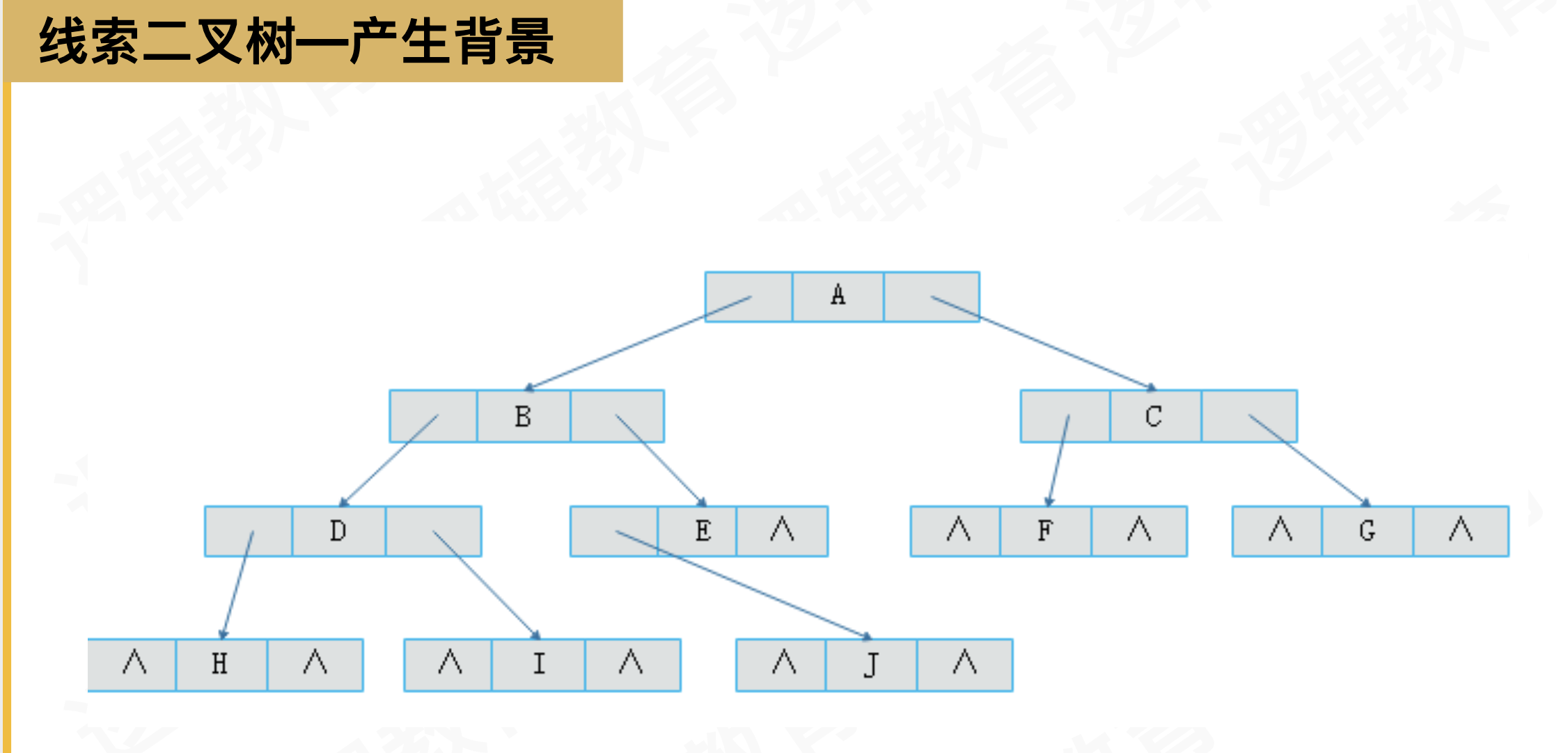
线索化的规则
- 1 结点左子树为空,利用左孩子指针指向它的前驱结点
- 2 结点右子树为空,利用右孩子的指针指向它的后继结点
- 所有的前驱和后继必须按照某一种逻辑遍历(如中序遍历)
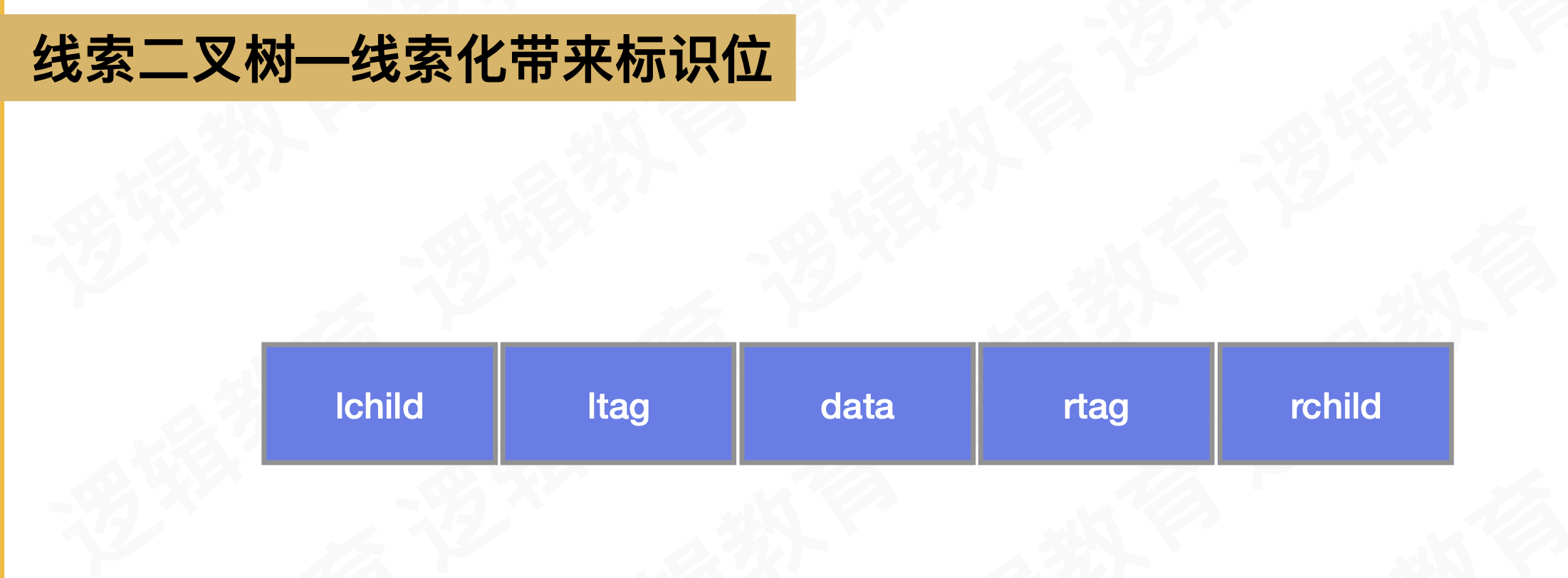
/* Link==0表示指向左右孩子指针, */
/* Thread==1表示指向前驱或后继的线索 */
typedef enum {Link,Thread} PointerTag;
/* 线索二叉树存储结点结构*/
typedef struct BiThrNode{

    //数据
    CElemType data;

    //左右孩子指针
    struct BiThrNode *lchild,*rchild;

    //左右标记
    PointerTag LTag;
    PointerTag RTag;

}BiThrNode,*BiThrTree;

/*
 8.3 构造二叉树
 按照前序输入线索二叉树结点的值,构造二叉树T
 */

Status CreateBiThrTree(BiThrTree *T){

    CElemType h;
    //scanf("%c",&h);
    //获取字符
    h = str[indexs++];

    if (h == Nil) {
        *T = NULL;
    }else{
        *T = (BiThrTree)malloc(sizeof(BiThrNode));
        if (!*T) {
            exit(OVERFLOW);
        }
        //生成根结点(前序)
        (*T)->data = h;

        //递归构造左子树
        CreateBiThrTree(&(*T)->lchild);
        //存在左孩子->将标记LTag设置为Link
        if ((*T)->lchild) (*T)->LTag = Link;

        //递归构造右子树
        CreateBiThrTree(&(*T)->rchild);
        //存在右孩子->将标记RTag设置为Link
        if ((*T)->rchild) (*T)->RTag = Link;
    }

    return OK;
}
 8.3 中序遍历二叉树T, 将其中序线索化,Thrt指向头结点
 */

BiThrTree pre; /* 全局变量,始终指向刚刚访问过的结点 */
/* 中序遍历进行中序线索化*/
void InThreading(BiThrTree p){

    /*
     InThreading(p->lchild);
     .....
     InThreading(p->rchild);
     */
    if (p) {
        //递归左子树线索化
        InThreading(p->lchild);
        //无左孩子
        if (!p->lchild) {
            //前驱线索
            p->LTag = Thread;
            //左孩子指针指向前驱
            p->lchild  = pre;
        }else
        {
            p->LTag = Link;
        }

        //前驱没有右孩子
        if (!pre->rchild) {
            //后继线索
            pre->RTag = Thread;
            //前驱右孩子指针指向后继(当前结点p)
            pre->rchild = p;
        }else
        {
            pre->RTag = Link;
        }

        //保持pre指向p的前驱
        pre = p;
        //递归右子树线索化
        InThreading(p->rchild);
    }
}
利用一个头结点Thrt来实现遍历的逻辑,使遍历更加简单
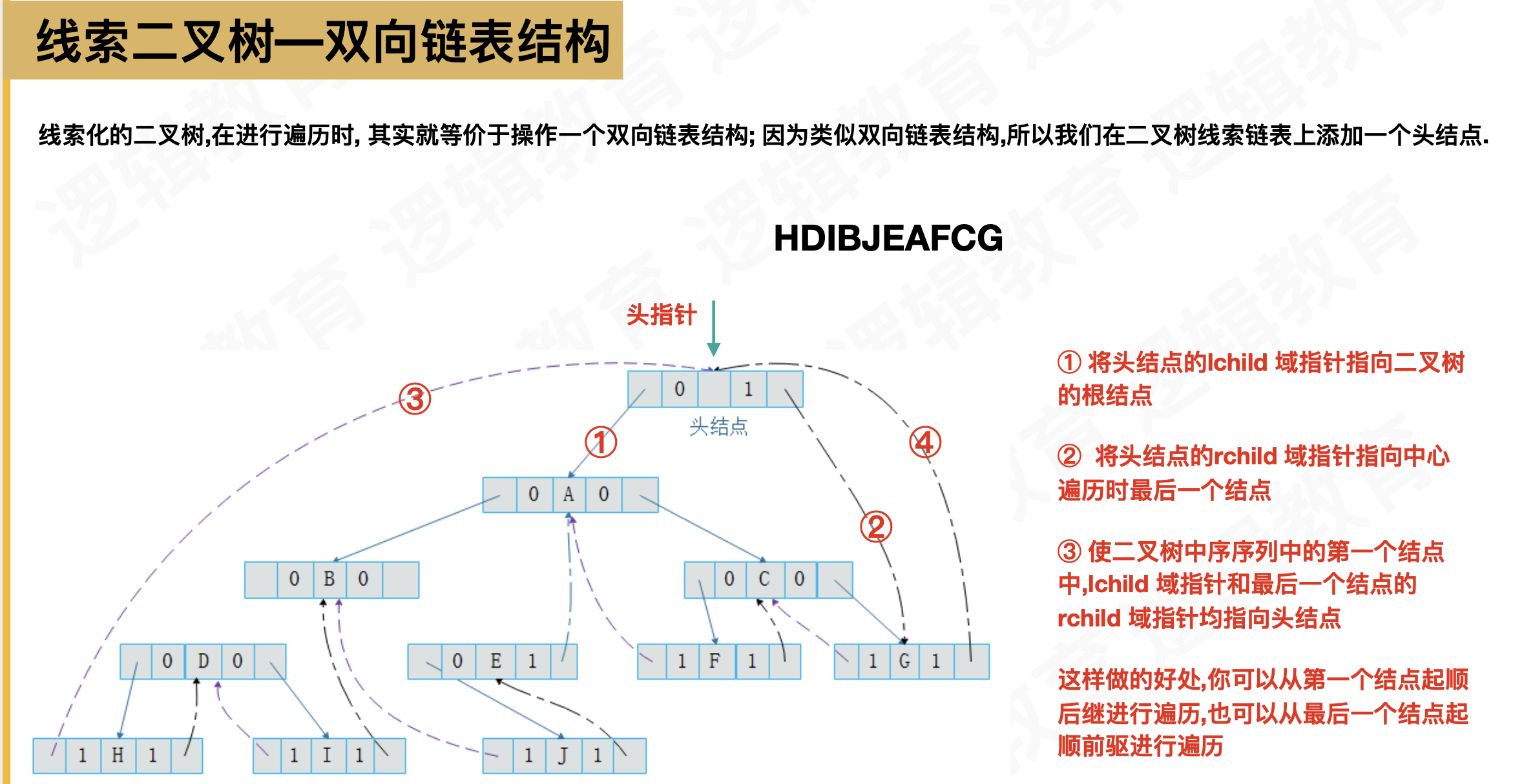
/* 中序遍历二叉树T,并将其中序线索化,Thrt指向头结点 */
Status InOrderThreading(BiThrTree *Thrt , BiThrTree T){

    *Thrt=(BiThrTree)malloc(sizeof(BiThrNode));

    if (! *Thrt) {
        exit(OVERFLOW);
    }

    //建立头结点;
    (*Thrt)->LTag = Link;
    (*Thrt)->RTag = Thread;
    //右指针回指向
    (*Thrt)->rchild = (*Thrt);

    /* 若二叉树空,则左指针回指 */
    if (!T) {
        (*Thrt)->lchild=*Thrt;
    }else{

        (*Thrt)->lchild=T;
        pre=(*Thrt);

        //中序遍历进行中序线索化
        InThreading(T);

        //最后一个结点rchil 孩子
        pre->rchild = *Thrt;
        //最后一个结点线索化
        pre->RTag = Thread;
        (*Thrt)->rchild = pre;

    }
    return OK;
}
/*中序遍历二叉线索树T*/
Status InOrderTraverse_Thr(BiThrTree T){
    BiThrTree p;
    p=T->lchild; /* p指向根结点 */
    while(p!=T)
    { /* 空树或遍历结束时,p==T */
        while(p->LTag==Link)
            p=p->lchild;
        if(!visit(p->data)) /* 访问其左子树为空的结点 */
            return ERROR;
        while(p->RTag==Thread&&p->rchild!=T)
        {
            p=p->rchild;
            visit(p->data); /* 访问后继结点 */
        }
        p=p->rchild;
    }

    return OK;
}
哈夫曼编码
[哈夫曼编码的思想]baijiahao.baidu.com/s?id=166472…
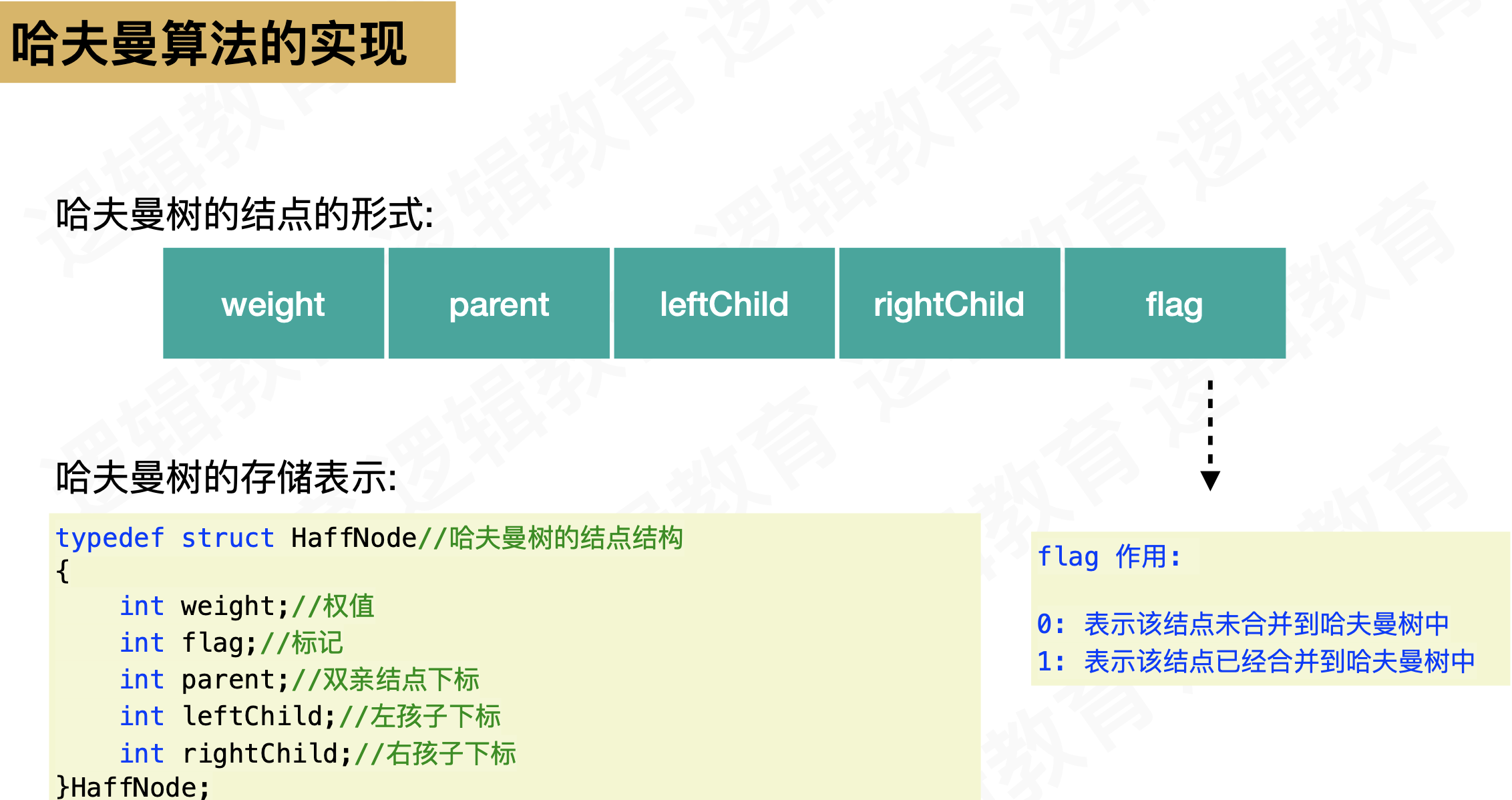
定义数据结构
const int MaxValue = 10000;//初始设定的权值最大值
const int MaxBit = 4;//初始设定的最大编码位数
const int MaxN = 10;//初始设定的最大结点个数

typedef struct HaffNode{
    int weight;
    int flag;
    int parent;
    int leftChild;
    int rightChild;
}HaffNode;

typedef struct Code//存放哈夫曼编码的数据元素结构
{
    int bit[MaxBit];//数组
    int start;  //编码的起始下标
    int weight;//字符的权值
}Code;
构建哈夫曼树
//1.
//根据权重值,构建哈夫曼树;
//{2,4,5,7}
//n = 4;
void Haffman(int weight[],int n,HaffNode *haffTree){

    int j,m1,m2,x1,x2;

    //1.哈夫曼树初始化
    //n个叶子结点. 2n-1
    for(int i = 0; i < 2*n-1;i++){

        if(i<n)
            haffTree[i].weight = weight[i];
        else
            haffTree[i].weight = 0;

        haffTree[i].parent = 0;
        haffTree[i].flag = 0;
        haffTree[i].leftChild = -1;
        haffTree[i].rightChild = -1;
    }


    //2.构造哈夫曼树haffTree的n-1个非叶结点
    for (int i = 0; i< n - 1; i++){
         m1 = m2 = MaxValue;
         x1 = x2 = 0;
        //2,4,5,7
        for (j = 0; j< n + i; j++)//循环找出所有权重中,最小的二个值--morgan
        {
            if (haffTree[j].weight < m1 && haffTree[j].flag == 0)
            {
                m2 = m1;
                x2 = x1;
                m1 = haffTree[j].weight;
                x1 = j;
            } else if(haffTree[j].weight<m2 && haffTree[j].flag == 0)
            {
                m2 = haffTree[j].weight;
                x2 = j;
            }
        }

        //3.将找出的两棵权值最小的子树合并为一棵子树
        haffTree[x1].parent = n + i;
        haffTree[x2].parent = n + i;
        //将2个结点的flag 标记为1,表示已经加入到哈夫曼树中
        haffTree[x1].flag = 1;
        haffTree[x2].flag = 1;
        //修改n+i结点的权值
        haffTree[n + i].weight = haffTree[x1].weight + haffTree[x2].weight;
        //修改n+i的左右孩子的值
        haffTree[n + i].leftChild = x1;
        haffTree[n + i].rightChild = x2;
    }

}
哈夫曼编码
/*
 9.2 哈夫曼编码
 由n个结点的哈夫曼树haffTree构造哈夫曼编码haffCode
 //{2,4,5,7}
 */
void HaffmanCode(HaffNode haffTree[], int n, Code haffCode[])
{
    //1.创建一个结点cd
    Code *cd = (Code * )malloc(sizeof(Code));
    int child, parent;
    //2.求n个叶结点的哈夫曼编码
    for (int i = 0; i<n; i++)
    {
        //从0开始计数
        cd->start = 0;
        //取得编码对应权值的字符
        cd->weight = haffTree[i].weight;
        //当叶子结点i 为孩子结点.
        child = i;
        //找到child 的双亲结点;
        parent = haffTree[child].parent;
        //由叶结点向上直到根结点
        while (parent != 0)
        {
            if (haffTree[parent].leftChild == child)
                cd->bit[cd->start] = 0;//左孩子结点编码0
            else
                cd->bit[cd->start] = 1;//右孩子结点编码1
            //编码自增
            cd->start++;
            //当前双亲结点成为孩子结点
            child = parent;
            //找到双亲结点
            parent = haffTree[child].parent;
        }

         int temp = 0;

        for (int j = cd->start - 1; j >= 0; j--){
            temp = cd->start-j-1;
            haffCode[i].bit[temp] = cd->bit[j];
        }

        //把cd中的数据赋值到haffCode[i]中.
        //保存好haffCode 的起始位以及权值;
        haffCode[i].start = cd->start;
        //保存编码对应的权值
        haffCode[i].weight = cd->weight;
    }
}