

互斥量 mutex
互斥量mutex也叫做互斥锁,在Linux中,锁是通过mutex来实现的
mutex相关函数
- pthread_mutex_init函数
- pthread_mutex_destroy函数
- pthread_mutex_lock函数
- pthread_mutex_trylock函数//非阻塞式的,如果无法获取锁,直接返回
- pthread_mutex_unlock函数
以上5个函数的返回值都是:成功返回0, 失败返回错误号。
pthread_mutex_init函数
int pthread_mutex_init(pthread_mutex_t *restrict mutex, const pthread_mutexattr_t *restrict attr);
restrict关键字:只用于限制指针,告诉编译器,所有修改该指针指向内存中内容的操作,只能通过本指针完成。不能通过除本指针以外的其他变量或指针修改
1、传出参数,调用时应传 &mutex
2、互斥量属性。是一个传入参数,通常传NULL,选用默认属性(线程间共享)
pthread_mutex_destroy函数
销毁一个互斥锁
int pthread_mutex_destroy(pthread_mutex_t *mutex);
pthread_mutex_lock函数
加锁
int pthread_mutex_lock(pthread_mutex_t *mutex);
pthread_mutex_unlock函数
解锁
int pthread_mutex_unlock(pthread_mutex_t *mutex);
pthread_mutex_trylock函数
尝试加锁
int pthread_mutex_trylock(pthread_mutex_t *mutex);
lock与unlock
lock尝试加锁,如果加锁不成功,线程阻塞,阻塞到持有该互斥量的其他线程解锁为止。
unlock主动解锁函数,同时将阻塞在该锁上的所有线程全部唤醒,至于哪个线程先被唤醒,取决于优先级、调度。默认:先阻塞、先唤醒。
trylock 与lock
lock加锁失败会阻塞,等待锁释放。
trylock加锁失败直接返回错误号(如:EBUSY),不阻塞。
查看下面程序中的问题
#include <stdio.h>
#include <pthread.h>
#include <unistd.h>

void *tfn(void *arg)
{
    srand(time(NULL));
    while (1) {

        printf("hello ");
        sleep(rand() % 3);	/*模拟长时间操作共享资源,导致cpu易主,产生与时间有关的错误*/
        printf("world\n");
        sleep(rand() % 3);
    }
    return NULL;
}
int main(void)
{
    pthread_t tid;
    srand(time(NULL));
    pthread_create(&tid, NULL, tfn, NULL);
    while (1) {
        printf("HELLO ");
        sleep(rand() % 3);
        printf("WORLD\n");
        sleep(rand() % 3);
    }
    pthread_join(tid, NULL);
    return 0;
}
注意这段程序的共享资源是标准输出,也就是stdout
修改:使用mutex互斥锁进行同步
#include <stdio.h>
#include <string.h>
#include <pthread.h>
#include <stdlib.h>
#include <unistd.h>

pthread_mutex_t mutex;

void err_thread(int ret, char *str)
{
    if (ret != 0) {
        fprintf(stderr, "%s:%s\n", str, strerror(ret));
        pthread_exit(NULL);
    }
}

void *tfn(void *arg)
{
    srand(time(NULL));

    while (1) {

        pthread_mutex_lock(&mutex);
        printf("hello ");
        sleep(rand() % 3);	/*模拟长时间操作共享资源,导致cpu易主,产生与时间有关的错误*/
        printf("world\n");
        pthread_mutex_unlock(&mutex);

        sleep(rand() % 3);

    }

    return NULL;
}

int main(void)
{
    int flag = 5;
    pthread_t tid;
    srand(time(NULL));

    pthread_mutex_init(&mutex, NULL);
    pthread_create(&tid, NULL, tfn, NULL);
    while (flag--) {

        pthread_mutex_lock(&mutex);

        printf("HELLO ");
        sleep(rand() % 3);
        printf("WORLD\n");
        pthread_mutex_unlock(&mutex);

        sleep(rand() % 3);

    }
    pthread_cancel(tid);                //  将子线程杀死,子线程中自带取消点
    pthread_join(tid, NULL);

    pthread_mutex_destroy(&mutex);

    return 0;                           //main中的return可以将整个进程退出
}


/*线程之间共享资源stdout*/
1.定义全局互斥量,初始化init(&m, NULL)互斥量,添加对应的destroy
2.两个线程while中,两次printf前后,分别加lock和unlock
3.将unlock挪至第二个sleep后,发现交替现象很难出现。
线程在操作完共享资源后本应该立即解锁,但修改后,线程抱着锁睡眠。睡醒解锁后又立即加锁,这两个库函数本身不会阻塞。
所以在这两行代码之间失去cpu的概率很小。因此,另外一个线程很难得到加锁的机会。
4.main 中加flag = 5 将flg在while中--  这时,主线程输出5次后试图销毁锁,但子线程未将锁释放,无法完成。
main 中加pthread_cancel()将子线程取消。
读写锁
与互斥量类似,但读写锁允许更高的并行性。其特性为:写独占,读共享。
- 1.读写锁是“写模式加锁”时, 解锁前,所有对该锁加锁的线程都会被阻塞。
- 2.读写锁是“读模式加锁”时, 如果线程以读模式对其加锁会成功;如果线程以写模式加锁会阻塞。
- 3.读写锁是“读模式加锁”时, 既有试图以写模式加锁的线程,也有试图以读模式加锁的线程。那么读写锁会阻塞随后的读模式锁请求。优先满足写模式锁。读锁、写锁并行阻塞,写锁优先级高
主要函数:
pthread_rwlock_init函数
pthread_rwlock_destroy函数
pthread_rwlock_rdlock函数
pthread_rwlock_wrlock函数
pthread_rwlock_tryrdlock函数
pthread_rwlock_trywrlock函数
pthread_rwlock_unlock函数

pthread_rwlock_t类型	用于定义一个读写锁变量。
pthread_rwlock_t rwlock;
pthread_rwlock_init函数
初始化一把读写锁
int pthread_rwlock_init(pthread_rwlock_t *restrict rwlock, const pthread_rwlockattr_t *restrict attr);
attr表示读写锁属性,通常使用默认属性,传NULL即可。
pthread_rwlock_destroy函数
销毁一把读写锁
int pthread_rwlock_destroy(pthread_rwlock_t *rwlock);
pthread_rwlock_rdlock函数
以读方式请求读写锁。(常简称为:请求读锁)
int pthread_rwlock_rdlock(pthread_rwlock_t *rwlock);
pthread_rwlock_unlock函数
解锁
int pthread_rwlock_unlock(pthread_rwlock_t *rwlock);
pthread_rwlock_tryrdlock函数
非阻塞以读方式请求读写锁(非阻塞请求读锁)
int pthread_rwlock_tryrdlock(pthread_rwlock_t *rwlock);
pthread_rwlock_trywrlock函数
非阻塞以写方式请求读写锁(非阻塞请求写锁)
int pthread_rwlock_trywrlock(pthread_rwlock_t *rwlock);
示例代码:
/* 3个线程不定时 "写" 全局资源,5个线程不定时 "读" 同一全局资源 */

#include <stdio.h>
#include <unistd.h>
#include <pthread.h>

int counter;                          //全局资源
pthread_rwlock_t rwlock;

void *th_write(void *arg)
{
    int t;
    int i = (int)arg;

    while (1) {
        t = counter;
        usleep(1000);

        pthread_rwlock_wrlock(&rwlock);
        printf("=======write %d: %lu: counter=%d ++counter=%d\n", i, pthread_self(), t, ++counter);
        pthread_rwlock_unlock(&rwlock);

        usleep(5000);
    }
    return NULL;
}

void *th_read(void *arg)
{
    int i = (int)arg;

    while (1) {
        pthread_rwlock_rdlock(&rwlock);
        printf("----------------------------read %d: %lu: %d\n", i, pthread_self(), counter);
        pthread_rwlock_unlock(&rwlock);

        usleep(900);
    }
    return NULL;
}

int main(void)
{
    int i;
    pthread_t tid[8];

    pthread_rwlock_init(&rwlock, NULL);

    for (i = 0; i < 3; i++)
        pthread_create(&tid[i], NULL, th_write, (void *)i);

    for (i = 0; i < 5; i++)
        pthread_create(&tid[i+3], NULL, th_read, (void *)i);

    for (i = 0; i < 8; i++)
        pthread_join(tid[i], NULL);

    pthread_rwlock_destroy(&rwlock);            //释放读写琐

    return 0;
}
条件变量Condition的作用
生产者消费者模型
pthread_cond_init函数
pthread_cond_destroy函数
pthread_cond_wait函数
pthread_cond_timedwait函数
pthread_cond_signal函数
pthread_cond_broadcast函数

pthread_cond_t类型	用于定义条件变量
pthread_cond_t cond;
pthread_cond_init函数
初始化一个条件变量
int pthread_cond_init(pthread_cond_t *restrict cond, const pthread_condattr_t *restrict attr);
attr表条件变量属性,通常为默认值,传NULL即可
pthread_cond_destroy函数
销毁一个条件变量
int pthread_cond_destroy(pthread_cond_t *cond);
pthread_cond_wait函数
阻塞等待一个条件变量
int pthread_cond_wait(pthread_cond_t *restrict cond, pthread_mutex_t *restrict mutex);
- 1.阻塞等待条件变量cond(参1)
- 2.释放已掌握的互斥锁(解锁互斥量)相当于pthread_mutex_unlock(&mutex); 前面两步为一个原子操作。
- 3.当被唤醒,pthread_cond_wait函数返回时,解除阻塞并重新申请获取互斥锁pthread_mutex_lock(&mutex);
pthread_cond_timedwait函数
限时等待一个条件变量
int pthread_cond_timedwait(pthread_cond_t *restrict cond, pthread_mutex_t *restrict mutex, const struct timespec *restrict abstime);
参3:	参看man sem_timedwait函数,查看struct timespec结构体。
		struct timespec {
			time_t tv_sec;		/* seconds */ 秒
			long   tv_nsec;	/* nanosecondes*/ 纳秒
		}
形参abstime:绝对时间。
如:time(NULL)返回的就是绝对时间。而alarm(1)是相对时间,相对当前时间定时1秒钟。
			struct timespec t = {1, 0};
			pthread_cond_timedwait (&cond, &mutex, &t); 只能定时到 1970年1月1日 00:00:01秒(早已经过去)
		正确用法:
			time_t cur = time(NULL); 获取当前时间。
struct timespec t;	定义timespec 结构体变量t
			t.tv_sec = cur+1; 定时1秒
pthread_cond_timedwait (&cond, &mutex, &t); 传参				参APUE.11.6线程同步条件变量小节
		在讲解setitimer函数时我们还提到另外一种时间类型:
        struct timeval {
             time_t      tv_sec;  /* seconds */ 秒
             suseconds_t tv_usec; 	/* microseconds */ 微秒
        };
pthread_cond_signal函数
唤醒至少一个阻塞在条件变量上的线程
int pthread_cond_signal(pthread_cond_t *cond);
pthread_cond_broadcast函数
唤醒全部阻塞在条件变量上的线程
int pthread_cond_broadcast(pthread_cond_t *cond);
示例代码:
/*借助条件变量模拟 生产者-消费者 问题*/
#include <stdlib.h>
#include <unistd.h>
#include <pthread.h>
#include <stdio.h>

/*链表作为公享数据,需被互斥量保护*/
struct msg {
    struct msg *next;
    int num;
};

struct msg *head;
struct msg *mp;

/* 静态初始化 一个条件变量 和 一个互斥量*/
pthread_cond_t has_product = PTHREAD_COND_INITIALIZER;
pthread_mutex_t lock = PTHREAD_MUTEX_INITIALIZER;

void *consumer(void *p)
{
    for (;;) {
        pthread_mutex_lock(&lock);
        while (head == NULL) {           //头指针为空,说明没有节点    可以为if吗?不能,防止有多个消费者
            pthread_cond_wait(&has_product, &lock);
        }
        mp = head;
        head = mp->next;    //模拟消费掉一个产品
        pthread_mutex_unlock(&lock);

        printf("-Consume ---%d\n", mp->num);
        free(mp);
        mp = NULL;
        sleep(rand() % 5);
    }
}

void *producer(void *p)
{
    for (;;) {
        mp = malloc(sizeof(struct msg));
        mp->num = rand() % 1000 + 1;        //模拟生产一个产品
        printf("-Produce ---%d\n", mp->num);

        pthread_mutex_lock(&lock);
        mp->next = head;
        head = mp;
        pthread_mutex_unlock(&lock);

        pthread_cond_signal(&has_product);  //将等待在该条件变量上的一个线程唤醒
        sleep(rand() % 5);
    }
}

int main(int argc, char *argv[])
{
    pthread_t pid, cid;
    srand(time(NULL));

    pthread_create(&pid, NULL, producer, NULL);
    pthread_create(&cid, NULL, consumer, NULL);

    pthread_join(pid, NULL);
    pthread_join(cid, NULL);

    return 0;
}
条件变量的优势
相较于mutex而言,条件变量可以减少竞争。
如直接使用mutex,除了生产者、消费者之间要竞争互斥量以外,消费者之间也需要竞争互斥量,但如果汇聚(链表)中没有数据,消费者之间竞争互斥锁是无意义的。有了条件变量机制以后,只有生产者完成生产,才会引起消费者之间的竞争。提高了程序效率
信号量
进化版的互斥锁(1 --> N)
由于互斥锁的粒度比较大,如果我们希望在多个线程间对某一对象的部分数据进行共享,使用互斥锁是没有办法实现的,只能将整个数据对象锁住。这样虽然达到了多线程操作共享数据时保证数据正确性的目的,却无形中导致线程的并发性下降。线程从并行执行,变成了串行执行。与直接使用单线程无异。
信号量,是相对折中的一种处理方式,既能保证同步,数据不混乱,又能提高线程并发。
主要应用函数:
sem_init函数
sem_destroy函数
sem_wait函数
sem_trywait函数
sem_timedwait函数
sem_post函数
以上6 个函数的返回值都是:成功返回0, 失败返回-1,同时设置errno。(注意,它们没有pthread前缀)
sem_t类型,本质仍是结构体。但应用期间可简单看作为整数,忽略实现细节(类似于使用文件描述符)。 sem_t sem; 规定信号量sem不能 < 0。头文件 <semaphore.h>
信号量基本操作:
sem_wait:	1. 信号量大于0,则信号量--		(类比pthread_mutex_lock)
	  |			2. 信号量等于0,造成线程阻塞
	对应
	  |
	sem_post:	将信号量++,同时唤醒阻塞在信号量上的线程	(类比pthread_mutex_unlock)
但,由于sem_t的实现对用户隐藏,所以所谓的++、--操作只能通过函数来实现,而不能直接++、--符号。
信号量的初值,决定了占用信号量的线程的个数。
sem_init函数
初始化一个信号量
	int sem_init(sem_t *sem, int pshared, unsigned int value);
	参1:sem信号量
参2:pshared取0用于线程间;取非0(一般为1)用于进程间
参3:value指定信号量初值
sem_destroy函数
销毁一个信号量
	int sem_destroy(sem_t *sem);
sem_wait函数
给信号量加锁 --
	int sem_wait(sem_t *sem);
sem_post函数
给信号量解锁 ++
	 int sem_post(sem_t *sem);
sem_trywait函数
尝试对信号量加锁 --	(与sem_wait的区别类比lock和trylock)
	 int sem_trywait(sem_t *sem);
sem_timedwait函数
限时尝试对信号量加锁 --
	int sem_timedwait(sem_t *sem, const struct timespec *abs_timeout);
	参2:abs_timeout采用的是绝对时间。
	定时1秒:
		time_t cur = time(NULL); 获取当前时间。
struct timespec t;	定义timespec 结构体变量t
		t.tv_sec = cur+1; 定时1秒
		t.tv_nsec = t.tv_sec +100;
sem_timedwait(&sem, &t); 传参
生产者消费者信号量模型
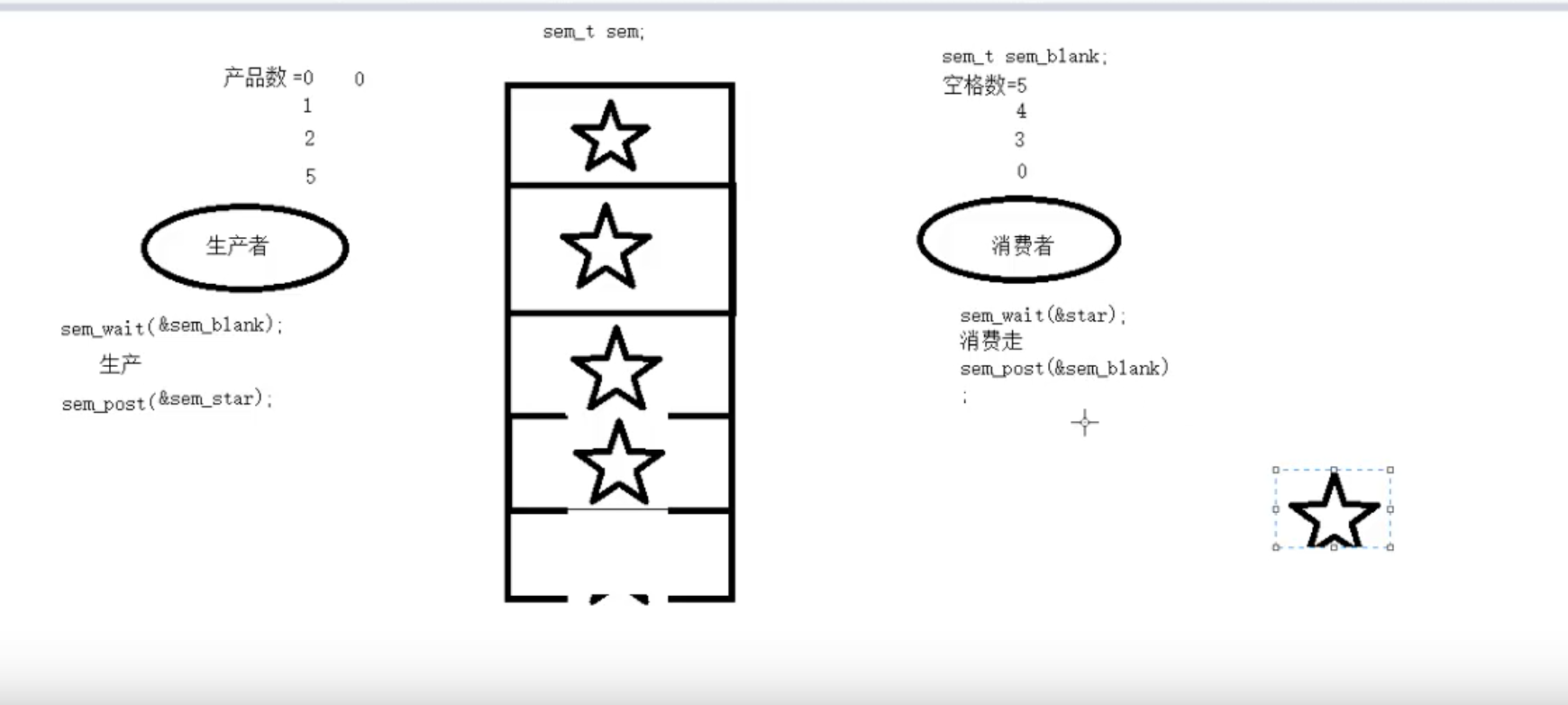
/*信号量实现 生产者 消费者问题*/

#include <stdlib.h>
#include <unistd.h>
#include <pthread.h>
#include <stdio.h>
#include <semaphore.h>

#define NUM 5

int queue[NUM];                                     //全局数组实现环形队列
sem_t blank_number, product_number;                 //空格子信号量, 产品信号量

void *producer(void *arg)
{
    int i = 0;

    while (1) {
        sem_wait(&blank_number);                    //生产者将空格子数--,为0则阻塞等待
        queue[i] = rand() % 1000 + 1;               //生产一个产品
        printf("----Produce---%d\n", queue[i]);
        sem_post(&product_number);                  //将产品数++

        i = (i+1) % NUM;                            //借助下标实现环形
        sleep(rand()%3);
    }
}

void *consumer(void *arg)
{
    int i = 0;

    while (1) {
        sem_wait(&product_number);                  //消费者将产品数--,为0则阻塞等待
        printf("-Consume---%d\n", queue[i]);
        queue[i] = 0;                               //消费一个产品
        sem_post(&blank_number);                    //消费掉以后,将空格子数++

        i = (i+1) % NUM;
        sleep(rand()%3);
    }
}

int main(int argc, char *argv[])
{
    pthread_t pid, cid;

    sem_init(&blank_number, 0, NUM);                //初始化空格子信号量为5
    sem_init(&product_number, 0, 0);                //产品数为0

    pthread_create(&pid, NULL, producer, NULL);
    pthread_create(&cid, NULL, consumer, NULL);

    pthread_join(pid, NULL);
    pthread_join(cid, NULL);

    sem_destroy(&blank_number);
    sem_destroy(&product_number);

    return 0;
}
进程间同步
互斥量mutex
进程间也可以使用互斥锁,来达到同步的目的。但应在pthread_mutex_init初始化之前,修改其属性为进程间共享。mutex的属性修改函数主要有以下几个。
主要应用函数:
	pthread_mutexattr_t mattr 类型:		用于定义mutex锁的【属性】
	pthread_mutexattr_init函数:			初始化一个mutex属性对象
		int pthread_mutexattr_init(pthread_mutexattr_t *attr);
	pthread_mutexattr_destroy函数:		销毁mutex属性对象 (而非销毁锁)
		int pthread_mutexattr_destroy(pthread_mutexattr_t *attr);
	pthread_mutexattr_setpshared函数:	修改mutex属性。
		int pthread_mutexattr_setpshared(pthread_mutexattr_t *attr, int pshared);
		参2:pshared取值:
			线程锁:PTHREAD_PROCESS_PRIVATE (mutex的默认属性即为线程锁,进程间私有)
			进程锁:PTHREAD_PROCESS_SHARED
示例代码
#include <stdio.h>
#include <unistd.h>
#include <fcntl.h>
#include <stdlib.h>
#include <string.h>
#include <pthread.h>
#include <sys/mman.h>
#include <sys/wait.h>

struct mt {
    int num;
    pthread_mutex_t mutex;
    pthread_mutexattr_t mutexattr;
};

int main(void)
{
    int i;
    struct mt *mm;
    pid_t pid;
/*
    int fd = open("mt_test", O_CREAT | O_RDWR, 0777);
    ftruncate(fd, sizeof(*mm));
    mm = mmap(NULL, sizeof(*mm), PROT_READ|PROT_WRITE, MAP_SHARED, fd, 0);
    close(fd);
    unlink("mt_test");
*/
    mm = mmap(NULL, sizeof(*mm), PROT_READ|PROT_WRITE, MAP_SHARED|MAP_ANON, -1, 0);
    memset(mm, 0, sizeof(*mm));

    pthread_mutexattr_init(&mm->mutexattr);                                  //初始化mutex属性对象
    pthread_mutexattr_setpshared(&mm->mutexattr, PTHREAD_PROCESS_SHARED);    //修改属性为进程间共享

    pthread_mutex_init(&mm->mutex, &mm->mutexattr);                          //初始化一把mutex琐

    pid = fork();
    if (pid == 0) {
        for (i = 0; i < 10; i++) {
            pthread_mutex_lock(&mm->mutex);
            (mm->num)++;
            pthread_mutex_unlock(&mm->mutex);
            printf("-child----------num++   %d\n", mm->num);
        }
    } else if (pid > 0) {
        for ( i = 0; i < 10; i++) {
        //    sleep(1);
            pthread_mutex_lock(&mm->mutex);
            mm->num += 2;
            pthread_mutex_unlock(&mm->mutex);
            printf("-------parent---num+=2  %d\n", mm->num);
        }
        wait(NULL);
    }

    pthread_mutexattr_destroy(&mm->mutexattr);          //销毁mutex属性对象
    pthread_mutex_destroy(&mm->mutex);                  //销毁mutex
    munmap(mm,sizeof(*mm));                             //释放映射区

    return 0;
}
文件锁
借助 fcntl函数来实现锁机制。 操作文件的进程没有获得锁时,可以打开,但无法执行read、write操作。
fcntl函数: 获取、设置文件访问控制属性。
int fcntl(int fd, int cmd, ... /* arg */ );
F_SETLK (struct flock *) 设置文件锁(trylock)
F_SETLKW (struct flock *) 设置文件锁(lock)W --> wait
F_GETLK (struct flock *) 获取文件锁
struct flock {
              ...
              short l_type;    	锁的类型:F_RDLCK 、F_WRLCK 、F_UNLCK
              short l_whence;  	偏移位置:SEEK_SET、SEEK_CUR、SEEK_END
              off_t l_start;   		起始偏移:1000
              off_t l_len;     		长度:0表示整个文件加锁
              pid_t l_pid;     	持有该锁的进程ID:(F_GETLK only)
              ...
         };
进程间文件锁示例
#include <stdio.h>
#include <sys/types.h>
#include <sys/stat.h>
#include <fcntl.h>
#include <unistd.h>
#include <stdlib.h>

void sys_err(char *str)
{
    perror(str);
    exit(1);
}

int main(int argc, char *argv[])
{
    int fd;
    struct flock f_lock;

    if (argc < 2) {
        printf("./a.out filename\n");
        exit(1);
    }

    if ((fd = open(argv[1], O_RDWR)) < 0)
        sys_err("open");

    f_lock.l_type = F_WRLCK;        /*选用写琐*/
//    f_lock.l_type = F_RDLCK;      /*选用读琐*/

    f_lock.l_whence = SEEK_SET;
    f_lock.l_start = 0;
    f_lock.l_len = 0;               /* 0表示整个文件加锁 */

    fcntl(fd, F_SETLKW, &f_lock);
    printf("get flock\n");

    sleep(10);

    f_lock.l_type = F_UNLCK;
    fcntl(fd, F_SETLKW, &f_lock);
    printf("un flock\n");

    close(fd);

    return 0;
}
多线程间共享文件描述符,而给文件加锁,是通过修改文件描述符所指向的文件结构体中的成员变量来实现的。因此,多线程中无法使用文件锁。
