

在Object-C中,方法调用后会被缓存起来,在下一次调用的时候就会去缓存中拿取,方法缓存在cache_t中,-号方法存在类中,+号方法以实例方法的形式存在元类中。
一、cache_t内部结构
// 类的结构
struct objc_class : objc_object {
    // Class ISA;     //8
    Class superclass; //8
    cache_t cache;    //16
    class_data_bits_t bits;
    ...
}
// cache_t结构
struct cache_t {
    struct bucket_t *_buckets; //8
    mask_t _mask;              //4
    mask_t _occupied;          //4
...
};

typedef uint32_t mask_t;
这是cache_t的源码。
struct bucket_t {
private:
    // IMP-first is better for arm64e ptrauth and no worse for arm64.
    // IMP-first 对 arm64e 的效果更好,对 arm64 不会有坏的影响。
    // SEL-first is better for armv7* and i386 and x86_64.
    // SEL-first 适用于 armv7 * 和 i386 和 x86_64
#if __arm64__
    MethodCacheIMP _imp; //MethodCacheIMP 为对应的函数的内存地址
    cache_key_t _key;    //cache_key_t    为方法的SEL,也就是方法名
#else
    cache_key_t _key;
    MethodCacheIMP _imp;
#endif

public:
    inline cache_key_t key() const { return _key; }
    inline IMP imp() const { return (IMP)_imp; }
    inline void setKey(cache_key_t newKey) { _key = newKey; }
    inline void setImp(IMP newImp) { _imp = newImp; }

    void set(cache_key_t newKey, IMP newImp);
};
_buckets是一个bucket_t结构体的数组,bucket_t里面存放_imp和_key。_mask的大小等于总大小-1。_occupied表示的是已经存取的方法的个数。- 这里有一个注意点,就是
IMP-first和SEL-first,上面源码已说明。
二、方法缓存
方法在调用的时候,先去缓存中查找,如果缓存中已经存在了该方法,则直接返回,否则就会把方法缓存取来。
static void cache_fill_nolock(Class cls, SEL sel, IMP imp, id receiver)
{
    cacheUpdateLock.assertLocked();

    // Never cache before +initialize is done
    if (!cls->isInitialized()) return;

    // Make sure the entry wasn't added to the cache by some other thread
    // before we grabbed the cacheUpdateLock.
    if (cache_getImp(cls, sel)) return;

    cache_t *cache = getCache(cls);//拿到类中的cache
    cache_key_t key = getKey(sel);//将sel转换为key

    // Use the cache as-is if it is less than 3/4 full
    mask_t newOccupied = cache->occupied() + 1;
    mask_t capacity = cache->capacity();
   //判断cache是否初始化
    if (cache->isConstantEmptyCache()) {
        // Cache is read-only. Replace it.
        //没有缓存过内容,重新开辟空间,最少4字节
        cache->reallocate(capacity, capacity ?: INIT_CACHE_SIZE);
    }
    else if (newOccupied <= capacity / 4 * 3) {
        // Cache is less than 3/4 full. Use it as-is.
    }
    else {
        // Cache is too full. Expand it.
        cache->expand();//cache扩容
    }

    // Scan for the first unused slot and insert there.
    // There is guaranteed to be an empty slot because the
    // minimum size is 4 and we resized at 3/4 full.
    bucket_t *bucket = cache->find(key, receiver);//根据key查找
    if (bucket->key() == 0) cache->incrementOccupied();
    bucket->set(key, imp);//添加方法到缓存
}

 enum {
    INIT_CACHE_SIZE_LOG2 = 2,
    INIT_CACHE_SIZE      = (1 << INIT_CACHE_SIZE_LOG2)
};
//可知 INIT_CACHE_SIZE 初始值为 4
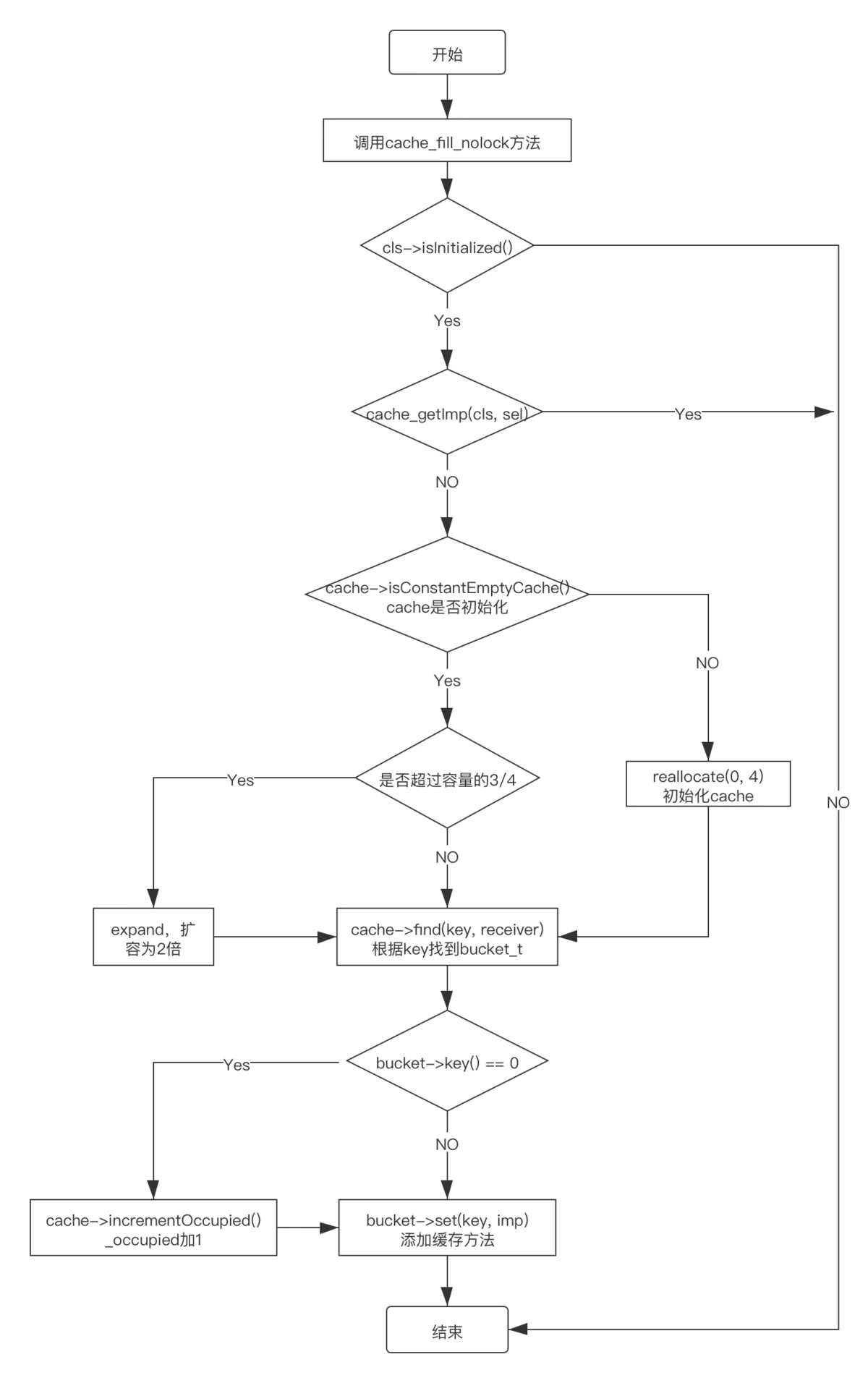
if (!cls->isInitialized()) return;类没有初始化,直接returnif (cache_getImp(cls, sel)) return;找到缓存,则直接返回cache_t *cache = getCache(cls);和cache_key_t key = getKey(sel);分别为获取到类的cache_t对象和根据方法名获取到cache_key_t对象mask_t newOccupied = cache->occupied() + 1;和mask_t capacity = cache->capacity();分别为cache对象的Occupied和mask对象在原基础上+1if (cache->isConstantEmptyCache())缓存为空,需要执行cache->reallocate(capacity, capacity ?: INIT_CACHE_SIZE);方法进行申请内存else if (newOccupied <= capacity / 4 * 3)没有超出哈希表3/4容量时,跳过直接进行下面缓存的操作- 如果超出哈希表3/4容量时,需要执行
cache->expand();进行哈希表扩容 bucket_t *bucket = cache->find(key, receiver);根据key进行方法存储cache->incrementOccupied()Occupied++bucket->set(key, imp);写入哈希表
三 、cache的初始化
void cache_t::reallocate(mask_t oldCapacity, mask_t newCapacity)
{
   bool freeOld = canBeFreed();
   bucket_t *oldBuckets = buckets();//获取现有的buckets
   bucket_t *newBuckets = allocateBuckets(newCapacity);//开辟一个新的buckets
   // Cache's old contents are not propagated.
   // This is thought to save cache memory at the cost of extra cache fills.
   // fixme re-measure this
   assert(newCapacity > 0);
   assert((uintptr_t)(mask_t)(newCapacity-1) == newCapacity-1);
   //重新设置buckets和mask
   setBucketsAndMask(newBuckets, newCapacity - 1);
  //回收旧的buckets
   if (freeOld) {
       cache_collect_free(oldBuckets, oldCapacity);
       cache_collect(false);
   }
}
在cache尚未初始化的时候会调用reallocate方法进行初始化,分配一个大小为4的数组
四、expand扩容
缓存的方法数量超过了当前容量的四分之三时,进行扩容,扩容为当前容量的2倍。
void cache_t::expand()
{
    cacheUpdateLock.assertLocked();
    // 拿到当前的容量
    uint32_t oldCapacity = capacity();
    // 扩容当前容量的2倍
    uint32_t newCapacity = oldCapacity ? oldCapacity*2 : INIT_CACHE_SIZE;

    if ((uint32_t)(mask_t)newCapacity != newCapacity) {
        // mask overflow - can't grow further
        // fixme this wastes one bit of mask
        newCapacity = oldCapacity;
    }
   //重新开辟内存
    reallocate(oldCapacity, newCapacity);
}
五、 _buckets查找
bucket_t * cache_t::find(cache_key_t k, id receiver)
{
     assert(k != 0);

    bucket_t *b = buckets();
    mask_t m = mask();
    // 通过cache_hash函数【begin  = k & m】计算出key值 k 对应的 index值 begin,用来记录查询起始索引
    mask_t begin = cache_hash(k, m);
    // begin 赋值给 i,用于切换索引
    mask_t i = begin;
    do {
        if (b[i].key() == 0  ||  b[i].key() == k) {
            //用这个i从散列表取值,如果取出来的bucket_t的 key = k,则查询成功,返回该bucket_t,
            //如果key = 0,说明在索引i的位置上还没有缓存过方法,同样需要返回该bucket_t,用于中止缓存查询。
            return &b[I];
        }
    } while ((i = cache_next(i, m)) != begin);
    // hack
    Class cls = (Class)((uintptr_t)this - offsetof(objc_class, cache));
    cache_t::bad_cache(receiver, (SEL)k, cls);
}
cache_next方法其实就是i= i-1,回到do循环里面,相当于查找数据的上一个元素。当i=0的时候,i指向的是数组的首元素位置,重新将mask赋值给i,使其指向散列表最后一个元素,重新开始反向遍历数组。
#if __arm__  ||  __x86_64__  ||  __i386__
// objc_msgSend has few registers available.
// Cache scan increments and wraps at special end-marking bucket.
#define CACHE_END_MARKER 1
static inline mask_t cache_next(mask_t i, mask_t mask) {
    return (i+1) & mask;
}

#elif __arm64__
// objc_msgSend has lots of registers available.
// Cache scan decrements. No end marker needed.
#define CACHE_END_MARKER 0
static inline mask_t cache_next(mask_t i, mask_t mask) {
    return i ? i-1 : mask;
六、setBucketsAndMask() 设置buckets和mask
//重新设置buckets和mask
setBucketsAndMask(newBuckets, newCapacity - 1);

void cache_t::setBucketsAndMask(struct bucket_t *newBuckets, mask_t newMask)
{
    // objc_msgSend uses mask and buckets with no locks.
    // It is safe for objc_msgSend to see new buckets but old mask.
    // (It will get a cache miss but not overrun the buckets' bounds).
    // It is unsafe for objc_msgSend to see old buckets and new mask.
    // Therefore we write new buckets, wait a lot, then write new mask.
    // objc_msgSend reads mask first, then buckets.

    // ensure other threads see buckets contents before buckets pointer
    mega_barrier();//添加线程安全,确保其他线程查看到新的存储单元

    _buckets = newBuckets;

    // ensure other threads see new buckets before new mask
    mega_barrier();//添加线程安全,确保其他线程设置新的mask之后,查看新的存储单元
    // _mask为总容量-1
    _mask = newMask;
    _occupied = 0;//清空旧的缓存,已占用容量为0
}
七、cache流程
八、总结
Class中的Cache主要是为了在消息发送的过程中,进行方法的缓存,加快调用效率,使用了动态扩容的技术,当容量达到总容量的3/4时,开始2倍扩容,扩容时会完全抹除旧的buckets,并且创建新的buckets代替,之后把最近一次临界的imp和key缓存进来,经典的LRU算法。
