

DataStream Transformations Window
window算子在flink中是非常重要的,要理解window算子首先要明白window的相关机制和原理。本文将从实战的角度讲解api的使用,详细的原理机制建议先阅读官方文档Windows。下面以Tumbling Windows为例讲解一些常见用法。下面基于ProcessingTime的样例都适用于EventTime。
基于ProcessingTime的基本用法
Window Join
定义
| Transformation | Description |
|---|---|
| DataStream,DataStream → DataStream | Join two data streams on a given key and a common window. |
说明
将两个window的数据进行join
样例
代码
public class WindowJoinDemo {
    public static void main(String[] args) throws Exception {
        final StreamExecutionEnvironment env = StreamExecutionEnvironment.createLocalEnvironment();
        env.setParallelism(1);
        DataStream<Tuple2<String, Integer>> orangeStream = env.addSource(new DataSource());
        DataStream<Tuple2<String, Integer>> greenStream = env.addSource(new DataSource());
        DataStream<Tuple3<String, Integer, Integer>> joinedStream = runWindowJoin(orangeStream, greenStream, 5);
        joinedStream.print("join");
        env.execute("Windowed Join Demo");
    }

    public static DataStream<Tuple3<String, Integer, Integer>> runWindowJoin(
            DataStream<Tuple2<String, Integer>> grades,
            DataStream<Tuple2<String, Integer>> salaries,
            long windowSize) {

        return grades.join(salaries)
                .where(new NameKeySelector())
                .equalTo(new NameKeySelector())
                .window(TumblingProcessingTimeWindows.of(Time.seconds(windowSize)))
                .apply(new JoinFunction<Tuple2<String, Integer>, Tuple2<String, Integer>, Tuple3<String, Integer, Integer>>() {

                    @Override
                    public Tuple3<String, Integer, Integer> join(
                            Tuple2<String, Integer> first,
                            Tuple2<String, Integer> second) {
                        return new Tuple3<String, Integer, Integer>(first.f0, first.f1, second.f1);
                    }
                });
    }

    private static class NameKeySelector implements KeySelector<Tuple2<String, Integer>, String> {
        @Override
        public String getKey(Tuple2<String, Integer> value) {
            return value.f0;
        }
    }

    private static class DataSource extends RichParallelSourceFunction<Tuple2<String, Integer>> {
        private volatile boolean running = true;

        @Override
        public void run(SourceContext<Tuple2<String, Integer>> ctx) throws Exception {
            int bound = 50;
            String[] keys = new String[]{"foo", "bar", "baz"};

            final long numElements = RandomUtils.nextLong(10, 20);
            int i = 0;
            while (running && i < numElements) {
                Thread.sleep(RandomUtils.nextLong(1, 5) * 1000L);
                Tuple2 data = new Tuple2<>(keys[RandomUtils.nextInt(0, 3)], RandomUtils.nextInt(0, bound));
                ctx.collect(data);
                System.out.println(Thread.currentThread().getId() + "-sand data:" + data);
                i++;
            }
        }

        @Override
        public void cancel() {
            running = false;
        }
    }
}
输出结果
59-sand data:(bar,49)
58-sand data:(bar,44)
58-sand data:(foo,2)
59-sand data:(baz,34)
58-sand data:(baz,2)
59-sand data:(baz,29)
join> (baz,34,2)
join> (baz,29,2)
说明
两条流里面的数据类型都是Tuple2,随机生成一些数据,窗口大小设置为5秒,根据两个流数据中的key进行join
Window CoGroup
定义
| Transformation | Description |
|---|---|
| DataStream,DataStream → DataStream | Cogroups two data streams on a given key and a common window. |
说明
coGroup方法的是用与上面join方法类似,不同的地方在于coGroup方法可以拿到两个窗口的所有数据,所以可以实现更多的场景,例如join就相当于coGroup的特例,也就是两个窗口的数据集根据key取交集。
样例
代码
public class WindowCoGroupDemo {
    public static void main(String[] args) throws Exception {
        final StreamExecutionEnvironment env = StreamExecutionEnvironment.createLocalEnvironment();
        env.setParallelism(1);

        DataStream<Tuple2<String, Integer>> orangeStream = env.addSource(new DataSource());
        DataStream<Tuple2<String, Integer>> greenStream = env.addSource(new DataSource());

        DataStream<Tuple3<String, Integer, Integer>> joinedStream = runWindowCoGroup(orangeStream, greenStream, 10);

        joinedStream.print();

        env.execute("Windowed CoGroup Demo");
    }

    public static DataStream<Tuple3<String, Integer, Integer>> runWindowCoGroup(
            DataStream<Tuple2<String, Integer>> orangeStream,
            DataStream<Tuple2<String, Integer>> greenStream,
            long windowSize) {

        return orangeStream.coGroup(greenStream)
                .where(new NameKeySelector())
                .equalTo(new NameKeySelector())
                .window(TumblingProcessingTimeWindows.of(Time.seconds(windowSize)))
                .apply(new Join());
    }

    private static class Join implements CoGroupFunction<Tuple2<String, Integer>, Tuple2<String, Integer>, Tuple3<String, Integer, Integer>>{

        @Override
        public void coGroup(Iterable<Tuple2<String, Integer>> first, Iterable<Tuple2<String, Integer>> second, Collector<Tuple3<String, Integer, Integer>> out) throws Exception {
            first.forEach(x -> {
                second.forEach(y -> {
                    if (x.f0.equals(y.f0)){
                        out.collect(new Tuple3<>(x.f0, x.f1, y.f1));
                    }
                });
            });
        }
    }

    private static class NameKeySelector implements KeySelector<Tuple2<String, Integer>, String> {
        @Override
        public String getKey(Tuple2<String, Integer> value) {
            return value.f0;
        }
    }

    private static class DataSource extends RichParallelSourceFunction<Tuple2<String, Integer>> {
        private volatile boolean running = true;

        @Override
        public void run(SourceContext<Tuple2<String, Integer>> ctx) throws Exception {
            int bound = 50;
            String[] keys = new String[]{"foo", "bar", "baz"};

            final long numElements = RandomUtils.nextLong(10, 20);
            int i = 0;
            while (running && i < numElements) {
                Thread.sleep(RandomUtils.nextLong(1, 5) * 1000L);
                Tuple2 data = new Tuple2<>(keys[RandomUtils.nextInt(0, 3)], RandomUtils.nextInt(0, bound));
                ctx.collect(data);
                System.out.println(Thread.currentThread().getId() + "-sand data:" + data);
                i++;
            }
        }

        @Override
        public void cancel() {
            running = false;
        }
    }
}
输出结果
59-sand data:(baz,4)
59-sand data:(foo,48)
57-sand data:(foo,34)
57-sand data:(foo,40)
59-sand data:(baz,24)
59-sand data:(bar,1)
57-sand data:(bar,22)
57-sand data:(bar,41)
(bar,1,22)
(bar,1,41)
(foo,48,34)
(foo,48,40)
说明
样例中对两个窗口的数据进行了类似join的计算
基于EventTime的基本用法
EventTime&Watermark
样例
代码
public class EventTimeWindowDemo {
    public static void main(String[] args) throws Exception {
        final StreamExecutionEnvironment env = StreamExecutionEnvironment.createLocalEnvironment();
        env.setParallelism(1);
        env.setStreamTimeCharacteristic(TimeCharacteristic.EventTime);

        DataStream<Tuple3<String, Integer, Long>> orangeStream = env.addSource(new DataSource("orangeStream"))
                .assignTimestampsAndWatermarks(new BoundedOutOfOrdernessGenerator());

        orangeStream.keyBy(0)
                .window(TumblingEventTimeWindows.of(Time.seconds(30)))
                .apply(new WindowFunction<Tuple3<String, Integer, Long>, Object, Tuple, TimeWindow>() {
                    @Override
                    public void apply(Tuple tuple, TimeWindow window, Iterable<Tuple3<String, Integer, Long>> input, Collector<Object> out) throws Exception {
                        System.out.println(window.toString());
                        out.collect(input);
                    }
                }).name("EventTimeWindow").print("out");

        env.execute("EventTime Demo");
    }

    private static class DataSource extends RichParallelSourceFunction<Tuple3<String, Integer, Long>> {

        private volatile boolean running = true;
        private volatile String name;

        public DataSource(String name) {
            this.name = name;
        }

        @Override
        public void run(SourceContext<Tuple3<String, Integer, Long>> ctx) throws Exception {
            Random random = new Random();
            int bound = 100;
            final long numElements = 10;
            int i = 0;

            while (running && i < numElements) {
                Thread.sleep(1500);
                Tuple3 data = new Tuple3<>("foo", random.nextInt(bound), getRandomInt(i*10, 60+i*10));
                ctx.collect(data);
                System.out.println(Thread.currentThread().getId() + "-" + this.name + "-sand data:" + data);
                i++;
            }
            Thread.sleep(5000);
        }

        @Override
        public void cancel() {
            running = false;
        }

        private long getRandomInt(int min, int max){
            return 1573441860000L + 1000* RandomUtils.nextInt(min, max);
        }
    }

    private static class BoundedOutOfOrdernessGenerator implements AssignerWithPeriodicWatermarks<Tuple3<String, Integer, Long>> {
        private final long maxOutOfOrderness = 10000;
        private long currentMaxTimestamp;

        @Override
        public long extractTimestamp(Tuple3<String, Integer, Long> row, long previousElementTimestamp) {
            long timestamp = row.f2;
            currentMaxTimestamp = Math.max(timestamp, currentMaxTimestamp);
            System.out.println(Thread.currentThread().getId() + "-" + row + ",time="+stampToDate(row.f2.toString()) + ",watermark=" + stampToDate(String.valueOf(currentMaxTimestamp - maxOutOfOrderness)));
            return timestamp;
        }

        @Override
        public Watermark getCurrentWatermark() {
            return new Watermark(currentMaxTimestamp - maxOutOfOrderness);
        }

        private static String stampToDate(String s) {
            String res;
            SimpleDateFormat simpleDateFormat = new SimpleDateFormat("yyyy-MM-dd HH:mm:ss");
            long lt = new Long(s);
            Date date = new Date(lt);
            res = simpleDateFormat.format(date);
            return res;
        }
    }
}
输出结果
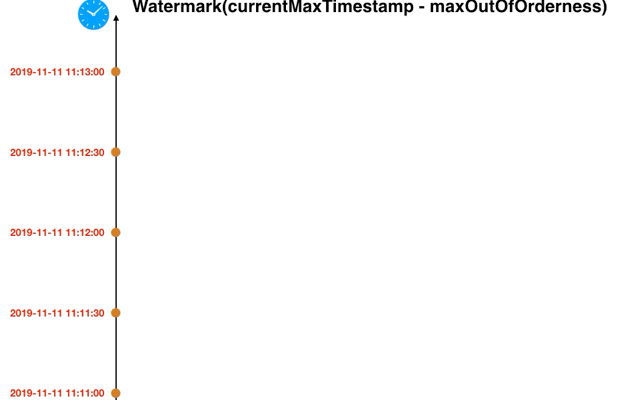
说明
- 时间窗口设置为30s
- watermark的计算公式为当前最大时间戳减去10s,也就是最大可容忍延迟10s的数据
- 默认采用的是
EventTimeTrigger,下面是触发窗口计算的公式,其中window.maxTimestamp()返回的是窗口结束时间-1毫秒
	@Override
	public TriggerResult onElement(Object element, long timestamp, TimeWindow window, TriggerContext ctx) throws Exception {
		if (window.maxTimestamp() <= ctx.getCurrentWatermark()) {
			// if the watermark is already past the window fire immediately
			return TriggerResult.FIRE;
		} else {
			ctx.registerEventTimeTimer(window.maxTimestamp());
			return TriggerResult.CONTINUE;
		}
	}
Interval Join
定义
| Transformation | Description |
|---|---|
| KeyedStream,KeyedStream → DataStream | Join two elements e1 and e2 of two keyed streams with a common key over a given time interval, so that e1.timestamp + lowerBound <= e2.timestamp <= e1.timestamp + upperBound |
说明
-
这个算子只支持EventTime
-
下图为这个算子的基本原理,watermark是对单个流中数据允许迟到多久进行控制的一个机制,而两个流进行join,就会涉及到两条流中的窗口是否同步的问题,这样就要考虑流和流之间的窗口存在延迟的情况,也就是
between要指定的时间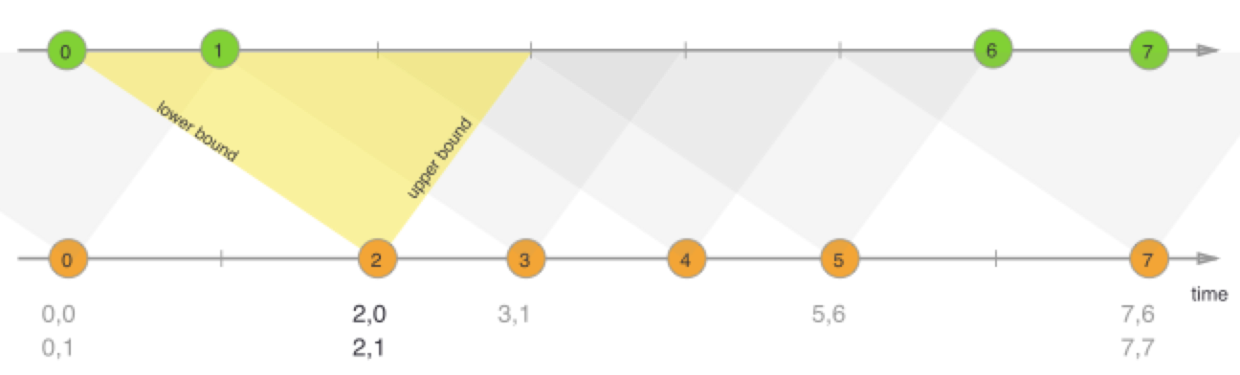
-
上面介绍的Window Join算子(如下图)是基于两个相同时间窗口内所有数据的inner join;而Interval Join是以每个元素为视角,一条流中的元素去另一条流中查找key相同的元素,并且两个元素的时间戳要满足
a.timestamp + lowerBound <= b.timestamp <= a.timestamp + upperBound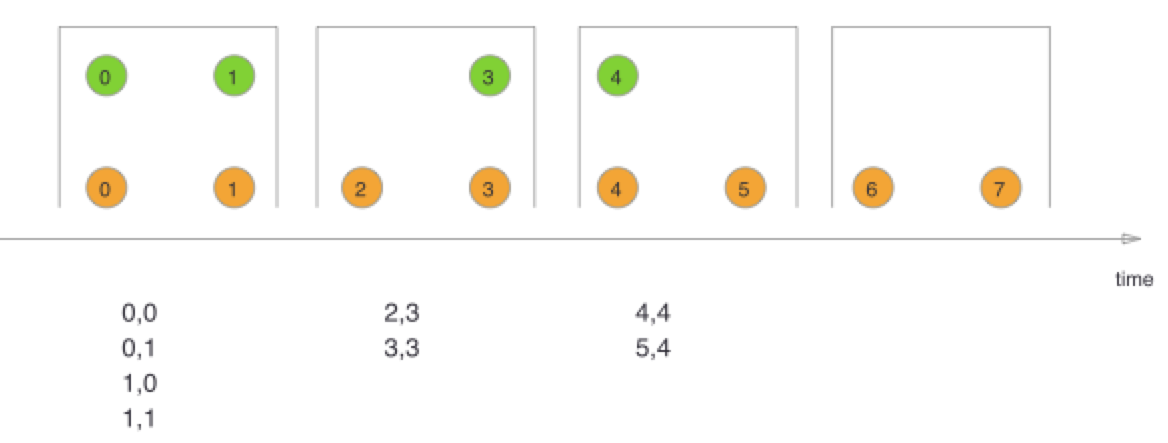
样例
代码
public class IntervalJoinDemo {
    public static void main(String[] args) throws Exception {
        final StreamExecutionEnvironment env = StreamExecutionEnvironment.createLocalEnvironment();
        env.setParallelism(1);
        //Time-bounded stream joins are only supported in event time
        env.setStreamTimeCharacteristic(TimeCharacteristic.EventTime);

        DataStream<Tuple3<String, Integer, Long>> orangeStream = env.addSource(new DataSource("orangeStream")).assignTimestampsAndWatermarks(new BoundedOutOfOrdernessGenerator());
        DataStream<Tuple3<String, Integer, Long>> greenStream = env.addSource(new DataSource("greenStream")).assignTimestampsAndWatermarks(new BoundedOutOfOrdernessGenerator());

        orangeStream
                .keyBy(0)
                .intervalJoin(greenStream.keyBy(0))
                .between(Time.seconds(-5), Time.seconds(5))
                .process(new ProcessJoinFunction<Tuple3<String, Integer, Long>, Tuple3<String, Integer, Long>, Object>() {
                    @Override
                    public void processElement(Tuple3<String, Integer, Long> left, Tuple3<String, Integer, Long> right, Context ctx, Collector<Object> out) throws Exception {
                        out.collect(new Tuple5<>(left.f0, left.f1, left.f2, right.f1, right.f2));
                    }
                }).name("intervalJoin").print("xxxxxx");

        env.execute("Interval Join Demo");
    }

    private static class DataSource extends RichParallelSourceFunction<Tuple3<String, Integer, Long>> {

        private volatile boolean running = true;
        private volatile String name;

        public DataSource(String name) {
            this.name = name;
        }

        @Override
        public void run(SourceContext<Tuple3<String, Integer, Long>> ctx) throws Exception {
            Random random = new Random();
            int bound = 100;
            Tuple3[] data = new Tuple3[]{
                    new Tuple3<>("foo", random.nextInt(bound), getRandomInt(50, 70)), new Tuple3<>("foo", random.nextInt(bound),  getRandomInt(40, 60))};
            final long numElements = data.length;
            int i = 0;
            while (running && i < numElements) {
                Thread.sleep(RandomUtils.nextLong(1, 5) * 1000L);
                ctx.collect(data[i]);
                System.out.println(Thread.currentThread().getId() + "-" + this.name + "-sand data:" + data[i]);
                i++;
            }
        }

        @Override
        public void cancel() {
            running = false;
        }

        private long getRandomInt(int min, int max){
            return 1573441870000L + 1000*(new Random().nextInt(max-min+1)+min);
        }
    }

    private static class BoundedOutOfOrdernessGenerator implements AssignerWithPeriodicWatermarks<Tuple3<String, Integer, Long>> {

        private final long maxOutOfOrderness = 10000;

        private long currentMaxTimestamp;

        @Override
        public long extractTimestamp(Tuple3<String, Integer, Long> row, long previousElementTimestamp) {
            System.out.println(Thread.currentThread().getId() + "-" + row + ",time="+stampToDate(row.f2.toString()));
            long timestamp = row.f2;
            currentMaxTimestamp = Math.max(timestamp, currentMaxTimestamp);
            System.out.println(Thread.currentThread().getId() + "-watermark:" + stampToDate(String.valueOf(currentMaxTimestamp - maxOutOfOrderness)));
            return timestamp;
        }

        @Override
        public Watermark getCurrentWatermark() {
            return new Watermark(currentMaxTimestamp - maxOutOfOrderness);
        }

        private static String stampToDate(String s) {
            String res;
            SimpleDateFormat simpleDateFormat = new SimpleDateFormat("yyyy-MM-dd HH:mm:ss");
            long lt = new Long(s);
            Date date = new Date(lt);
            res = simpleDateFormat.format(date);
            return res;
        }
    }
}
