文章将告诉我们,整个JS社区为何要马上采用 ES6模块 ,以及这样做的重要性。
当前发展情况
为了弄明白为什么全部迁移到 ES6模块 如此重要,我们首先需要描述一下当前的实际状况。在过去5年,JavaScript 的发展如此迅猛,以至于大多数的开发者都没有意识到现在有 5 种方式可以来创建 JavaScript 脚本和应用!
原始的 IIFE () : 这是最古老也是最简单的使 JS 模块化的方法了。看下面这个例子就是用
IIFE来实现JS 块的:
    const myModule = (function (...deps){
       // JavaScript chunk
       return {hello : () => console.log(‘hello from myModule’)};
    })(dependencies);
对这段代码不应该感到惊奇,它只是一种把变量或者方法包裹起来的普遍模式,也是适合在JS本地使用的唯一方法。它也存在一个问题,就是不能我们需要的依赖。
AMD (异步模块依赖) : Require.js 很受欢迎,它可以给模块注入依赖。另一个优点就是允许动态加载 JS 块。
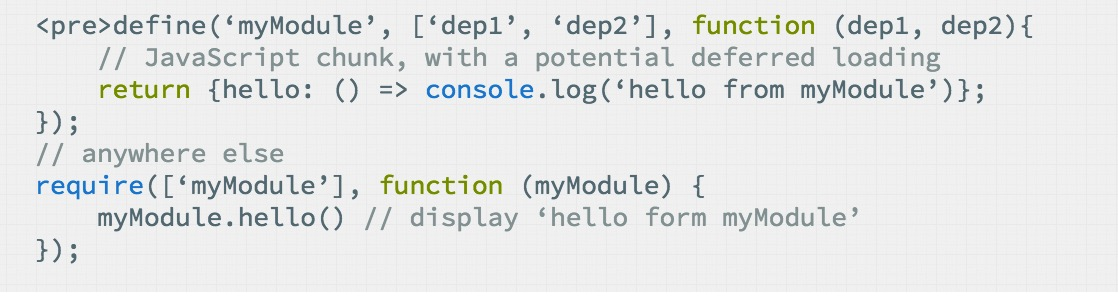
效率高,但是有点冗长,并且不能在 Node.js 本地运行。
CommonJs : Node.js 平台的默认格式. 通常用法类似这样:
    // file1.js
    modules.export = {
        hello : () => console.log(‘hello from myModule’)
    }

    // file2;
    const myModule = require('./file1.js');
    myModule.hello();
感觉这种方式更酷吧,它可以定义变量的作用域,还可以定义模块之间的依赖。但这是专为 Node 设计的,这种方式并不能在浏览器运行,也不能异步加载模块。但是,你可以在前端app使用它,借助 Browserify 或者其他工具来转换,让它可以在浏览器运行。
UMD (通用模块依赖) : 到这里,我们发现还没有一种既可以同时兼容浏览器和 Node 服务器的解决方案。AMD 适合浏览器,CommonJS 适合 Node.
UMD 就来尝试解决这个问题。它通过把 AMD 和 CommonJS 结合在一个模式下,使之在各种需求下都是可集成的,代码大概这样:
    (function (global, factory) {
        typeof exports === 'object' && typeof module !== 'undefined' ? factory() :
        typeof define === 'function' && define.amd ? define(factory) :
    (factory());
    }(this, function () {
        // JavaScript chunk
        return {
           hello : () => console.log(‘hello from myModule’)
        }
    });
如你所见,该模式根据内容来判断选择 AMD 还是 CommonJS. 这种模式对于打包 多环境 的库,如 lodash 或者 moment.js 是十分适合的。
因此,为何要加一个新模块类型 ?
首先,这些解决方案没有一个是由TC39团队定义的标准。ECMA6 现在已经被大量的开发者所使用,那为何不选择该版本JS定义的标准(ES6模块)呢?
这个标准提供了一个更加灵活有力的解决方式。我推荐你看这篇文章, 了解 ES6模块的全部属性,因为这篇文章,我把重点放在了ES6模块这个性质上。它能够更加精确地定义模块间哪些需要被 exposed/imported 。一起看看下面的代码:
// file1.js
const f1 = ()=> console.log(‘f1’);
const f2 = ()=> console.log(‘f2’);
const f3 = ()=> console.log(‘f3’);
export {f1, f2, f3};

// file2.js
import {f1, f2} from “./file1”;
f1(); // display ‘f1’
f2(); // display ‘f2’
We see above, that we can import easily just what we want with a static notation. In contrario of the others solutions, like CommonJS where we can call dynamically what we want. If we take the same example in CommonJS with a little difference.
从这里我们可以看出,我们只需要静态地声明我们想要 import 的内容就可以。与其它模式不同,像 CommonJS 我们可以动态加载需要的文件。如果我们在 CommonJS 里面使用这个例子,就会有点不同:
// file1.js
const f1 = ()=> console.log(‘f1’);
const f2 = ()=> console.log(‘f2’);
const f3 = ()=> console.log(‘f3’);
modules.exports = {f1,f2,f3};

// file2.js
const file1 = require(‘./file1’);
file1.f1(); // display ‘f1’
file1.f2(); // display ‘f2’
file1[process.ENV.funcName]();
很明显,最后一行是无法呈现成真正的代码的,但它表明了一些值是无法控制的,所以无法在静态分析中预知。这里,我们实质上是可以调用 f3的,因为用 CommonJs (AMD、IIFE 或者 UMD) 我们都是无法限制 import 的内容的。
所以?了解代码的静态分析是使用什么是不是也很重要呢?
答案是肯定的!
因为有了这个控制,开发者工具可以检测到一些 bug。 而且如果你要使用 WebPack 2 或者 Rollup.js 将会更有趣,结合 Tree Shaking, 你编译的文件将会更小。Tree Shaking 的功能就是把不用用到的代码移除掉。
这就是 tree shaking 的一个例子 :
原文件
//-------------
// main.js
import {cube} from './maths.js';
console.log( cube( 5 ) ); // 125

//-------------
// maths.js
export function square ( x ) {
   return x * x;
}

// This function gets included
export function cube ( x ) {
   return x * x * x;
}
输出文件
function cube ( x ) {
   return x * x * x;
}

console.log( cube( 5 ) ); // 125
Mathieu Breton CTO chez JS-Republic