3.5 Boolean Expressions
1. Exam Points
- Logical operators
NOT, AND, and OR.
- For AND, true and true evaluates to true, otherwise false.
- For OR, false and false evaluates to false, otherwise true.
- For AND, if the first condition is false, no need to evaluate the second condition.
- For OR, if the first condition is true, no need to evaluate the second condition.
- Relational operators:
=, ≠, >, <, ≥, and ≤
Equivalent expressions:
- NOT (input1 OR input2) is equivalent to (NOT input1) AND (NOT input2)
- NOT (input1 AND input2) is equivalent to (NOT input1) OR (NOT input2)
- Work on
logic gates: AND gate and OR gate.
2. Knowledge Points
(1) Boolean Expressions
- The way statements are sequenced and combined in a program determines the computed result.
- Programs incorporate iteration and selection constructs to represent repetition and make decisions to handle varied input values.
- A
Boolean value is either true or false.
- Example:
- 4 > 3 evaluates to true
- 15 MOD 2 = 0 evaluates to false
- An expression that evaluates to a Boolean value is a
Boolean expression.
- Example:
- 10 > 2 is a Boolean expression
- 10 > 2 AND 3 > 4 is a Boolean expression
- 10 + 2 is not a Boolean expression
(2) Relational Operators
Relational operators are used in Boolean expressions.
=, ≠, >, <, ≥, and ≤- Example:
- a = b
- a ≠ b
- a > b
- a < b
- a ≥ b
- a ≤ b
(3) Logical Operators
Logical operators NOT, AND, and OR, which are also used in Boolean expressions.
AND : evaluates to true if both conditions are true, otherwise it evaluates to false
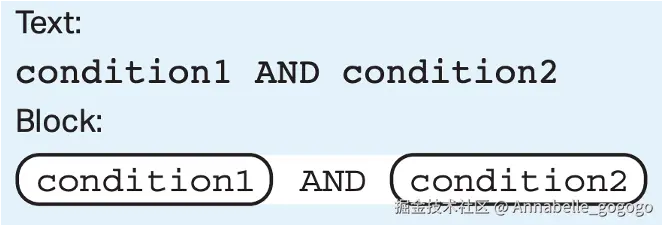
OR : evaluates to false if both conditions are false, otherwise it evaluates to true
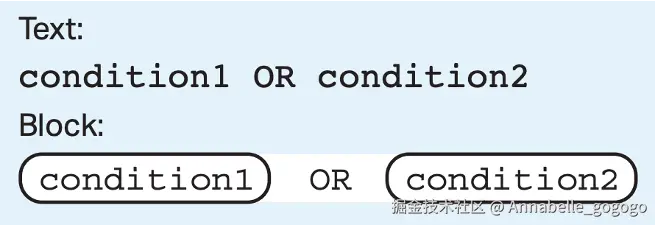
NOT : evaluates to true if condition is false, otherwise it evaluates to false
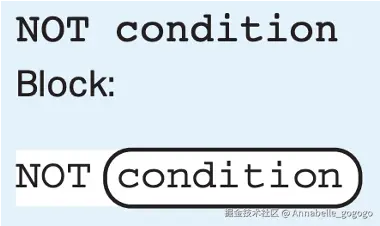
- Examples:
- (4 > 3) AND (4 < 6)
- (4 > 3) AND (5 MOD 2 = 0)
- (4 < 3) OR (4 < 6)
- (5 MOD 2 = 0) OR (5 MOD 3 = 1)
- NOT (4 > 3)
- NOT (a > b)
Equivalent expressions:
NOT (input1 OR input2) is equivalent to (NOT input1) AND (NOT input2)NOT (input1 AND input2) is equivalent to (NOT input1) OR (NOT input2)
3. Exercises



