智能体的未来:AGI路径上的关键技术突破
🌟 Hello,我是摘星!🌈 在彩虹般绚烂的技术栈中,我是那个永不停歇的色彩收集者。
🦋 每一个优化都是我培育的花朵,每一个特性都是我放飞的蝴蝶。
🔬 每一次代码审查都是我的显微镜观察,每一次重构都是我的化学实验。
🎵 在编程的交响乐中,我既是指挥家也是演奏者。让我们一起,在技术的音乐厅里,奏响属于程序员的华美乐章。
摘要
作为一名长期关注人工智能发展的技术博主摘星,我深刻感受到当前AI领域正处于一个前所未有的变革时期。从ChatGPT的横空出世到各类智能体(Intelligent Agents)的蓬勃发展,我们正站在通用人工智能(AGI, Artificial General Intelligence)的门槛上。在过去的几年里,我见证了AI技术从单一任务的专用系统向多模态、多任务的智能体系统演进,这种演进不仅仅是技术层面的突破,更是对人工智能本质理解的深化。智能体作为AGI实现的重要载体,其发展轨迹清晰地勾勒出了通向AGI的技术路径。当前的技术局限性主要体现在推理能力的不足、知识整合的困难、以及缺乏真正的自主学习能力等方面,但随着大语言模型(LLM)技术的成熟、多模态融合技术的发展、以及强化学习与符号推理的结合,我们正逐步克服这些障碍。从技术投资的角度来看,智能体技术栈的各个层面都蕴含着巨大的商业机会,从底层的计算基础设施到上层的应用场景,每一个环节都可能诞生下一个独角兽企业。本文将深入分析当前智能体技术的发展现状、技术瓶颈、以及通向AGI的可能路径,为技术从业者和投资者提供前瞻性的洞察。1. 当前技术局限性分析
1.1 推理能力的局限性
当前智能体系统在复杂推理任务上仍存在显著局限。虽然大语言模型在文本生成和简单推理方面表现出色,但在需要多步骤逻辑推理、因果关系分析和抽象概念理解方面仍有不足。# 当前智能体推理能力评估示例
class ReasoningEvaluator:
def __init__(self):
self.test_cases = {
'logical_reasoning': [],
'causal_inference': [],
'abstract_thinking': []
}
def evaluate_reasoning_capability(self, agent, task_type):
"""
评估智能体的推理能力
Args:
agent: 智能体实例
task_type: 任务类型(逻辑推理、因果推理、抽象思维)
"""
results = []
for test_case in self.test_cases[task_type]:
response = agent.process(test_case['input'])
accuracy = self.calculate_accuracy(response, test_case['expected'])
results.append({
'case_id': test_case['id'],
'accuracy': accuracy,
'response_time': test_case['time']
})
return self.aggregate_results(results)
def calculate_accuracy(self, response, expected):
# 计算推理准确性的复杂逻辑
return min(1.0, len(set(response) & set(expected)) / len(expected))
图1 当前AI推理局限性分析图
1.2 知识整合与迁移困难
现有智能体在跨域知识整合和迁移学习方面面临挑战。不同领域的知识往往以孤立的方式存储和处理,缺乏有效的知识融合机制。| 知识整合维度 | 当前能力水平 | 主要挑战 | 改进方向 |
|---|---|---|---|
| 跨模态知识融合 | 中等 | 模态间语义对齐困难 | 统一表示学习 |
| 领域知识迁移 | 较低 | 领域特异性过强 | 元学习方法 |
| 常识知识整合 | 中等 | 隐式知识显式化困难 | 知识图谱增强 |
| 时序知识更新 | 较低 | 知识遗忘与冲突 | 持续学习机制 |
1.3 自主学习能力不足
当前智能体主要依赖大规模预训练数据,缺乏真正的自主学习和适应能力。在面对新环境或新任务时,往往需要大量的标注数据和重新训练。# 自主学习能力评估框架
class AutonomousLearningAssessment:
def __init__(self):
self.learning_metrics = {
'adaptation_speed': 0,
'sample_efficiency': 0,
'knowledge_retention': 0,
'transfer_capability': 0
}
def assess_learning_capability(self, agent, new_environment):
"""
评估智能体的自主学习能力
"""
# 测试适应速度
adaptation_time = self.measure_adaptation_time(agent, new_environment)
# 测试样本效率
sample_efficiency = self.measure_sample_efficiency(agent, new_environment)
# 测试知识保持
retention_score = self.measure_knowledge_retention(agent)
# 测试迁移能力
transfer_score = self.measure_transfer_capability(agent)
return {
'adaptation_speed': 1.0 / adaptation_time,
'sample_efficiency': sample_efficiency,
'knowledge_retention': retention_score,
'transfer_capability': transfer_score
}
"真正的智能不在于记住多少知识,而在于能够快速学习和适应新环境的能力。" —— 人工智能研究先驱
2. 通用人工智能的技术路径
2.1 技术路径概览
通向AGI的技术路径并非单一,而是多条路径的融合。主要包括符号主义路径、连接主义路径、以及混合路径。图2 AGI技术路径分类图
2.2 关键技术突破点
2.2.1 大语言模型的扩展与优化
大语言模型(LLM)作为当前最有前景的AGI技术路径,其发展重点在于模型规模扩展、训练效率提升和推理能力增强。# LLM优化策略实现
class LLMOptimizer:
def __init__(self, model_config):
self.config = model_config
self.optimization_strategies = [
'parameter_efficient_tuning',
'knowledge_distillation',
'mixture_of_experts',
'retrieval_augmented_generation'
]
def optimize_model(self, base_model, optimization_type):
"""
根据不同策略优化LLM模型
"""
if optimization_type == 'parameter_efficient_tuning':
return self.apply_peft(base_model)
elif optimization_type == 'knowledge_distillation':
return self.apply_distillation(base_model)
elif optimization_type == 'mixture_of_experts':
return self.apply_moe(base_model)
elif optimization_type == 'retrieval_augmented_generation':
return self.apply_rag(base_model)
def apply_peft(self, model):
"""
应用参数高效微调技术
"""
# LoRA、Adapter等技术实现
pass
def apply_rag(self, model):
"""
应用检索增强生成技术
"""
# 外部知识库检索与生成结合
pass
2.2.2 多模态融合技术
多模态融合是实现AGI的关键技术之一,需要将视觉、听觉、文本等不同模态的信息进行有效整合。| 模态类型 | 技术成熟度 | 主要挑战 | 应用场景 |
|---|---|---|---|
| 视觉-文本 | 高 | 细粒度理解 | 图像描述、VQA |
| 音频-文本 | 中 | 情感理解 | 语音助手、音频分析 |
| 视频-文本 | 中 | 时序建模 | 视频理解、动作识别 |
| 三模态融合 | 低 | 对齐复杂性 | 具身智能、虚拟助手 |
2.3 认知架构设计
认知架构(Cognitive Architecture)为AGI提供了整体框架,整合感知、记忆、推理、学习等认知功能。# 认知架构基础框架
class CognitiveArchitecture:
def __init__(self):
self.perception_module = PerceptionModule()
self.memory_system = MemorySystem()
self.reasoning_engine = ReasoningEngine()
self.learning_module = LearningModule()
self.action_planner = ActionPlanner()
def cognitive_cycle(self, input_data):
"""
认知循环:感知-记忆-推理-学习-行动
"""
# 感知阶段
perceived_info = self.perception_module.process(input_data)
# 记忆检索
relevant_memory = self.memory_system.retrieve(perceived_info)
# 推理决策
reasoning_result = self.reasoning_engine.reason(
perceived_info, relevant_memory
)
# 学习更新
self.learning_module.update(
perceived_info, reasoning_result
)
# 行动规划
action_plan = self.action_planner.plan(reasoning_result)
return action_plan
图3 认知架构循环流程图
3. 智能体在AGI中的角色
3.1 智能体作为AGI的实现载体
智能体(Intelligent Agents)不仅是AGI技术的重要组成部分,更是AGI能力的具体体现形式。通过智能体,抽象的AGI概念得以具体化和实用化。# AGI智能体架构设计
class AGIAgent:
def __init__(self):
self.core_capabilities = {
'reasoning': ReasoningCapability(),
'learning': LearningCapability(),
'perception': PerceptionCapability(),
'communication': CommunicationCapability(),
'planning': PlanningCapability()
}
self.knowledge_base = UnifiedKnowledgeBase()
self.goal_system = GoalManagementSystem()
def process_task(self, task):
"""
处理复杂任务的通用流程
"""
# 任务理解与分解
subtasks = self.decompose_task(task)
# 能力调度与协调
execution_plan = self.coordinate_capabilities(subtasks)
# 执行与监控
results = self.execute_with_monitoring(execution_plan)
# 结果整合与学习
final_result = self.integrate_and_learn(results, task)
return final_result
def coordinate_capabilities(self, subtasks):
"""
协调不同能力模块完成子任务
"""
plan = []
for subtask in subtasks:
required_capabilities = self.analyze_required_capabilities(subtask)
capability_sequence = self.optimize_capability_sequence(
required_capabilities
)
plan.append({
'subtask': subtask,
'capabilities': capability_sequence
})
return plan
3.2 智能体的层次化组织
在AGI系统中,智能体往往以层次化的方式组织,形成从简单到复杂的能力层次。| 智能体层次 | 主要功能 | 技术特点 | 应用示例 |
|---|---|---|---|
| 基础感知智能体 | 数据处理、模式识别 | 专用神经网络 | 图像识别、语音识别 |
| 任务执行智能体 | 特定任务完成 | 强化学习、规划算法 | 游戏AI、机器人控制 |
| 认知推理智能体 | 复杂推理、知识整合 | 符号推理、知识图谱 | 专家系统、问答系统 |
| 通用智能体 | 跨域任务、自主学习 | 多模态融合、元学习 | 通用助手、AGI原型 |
3.3 多智能体协作机制
AGI的实现可能需要多个专门化智能体的协作,通过分工合作实现超越单一智能体的能力。图4 多智能体协作架构图
# 多智能体协作框架
class MultiAgentSystem:
    def __init__(self):
        self.agents = {
            'coordinator': CoordinatorAgent(),
            'perception': PerceptionAgent(),
            'reasoning': ReasoningAgent(),
            'learning': LearningAgent(),
            'execution': ExecutionAgent()
        }
        self.communication_protocol = CommunicationProtocol()
        self.task_scheduler = TaskScheduler()

    def solve_complex_problem(self, problem):
        """
        通过多智能体协作解决复杂问题
        """
        # 问题分析与任务分配
        task_allocation = self.agents['coordinator'].analyze_and_allocate(problem)

        # 并行处理与信息交换
        partial_results = {}
        for agent_id, subtask in task_allocation.items():
            agent = self.agents[agent_id]
            result = agent.process(subtask)
            partial_results[agent_id] = result

            # 信息共享
            self.communication_protocol.broadcast(agent_id, result)

        # 结果整合与优化
        final_solution = self.agents['coordinator'].integrate_results(
            partial_results, problem
        )

        return final_solution
4. 技术发展趋势与投资机会
4.1 技术发展趋势分析
4.1.1 计算范式的演进
从云计算到边缘计算,再到端云协同,计算范式的演进为AGI的部署提供了新的可能性。图5 AGI计算范式演进时间线
4.1.2 模型架构创新
Transformer架构的成功催生了更多创新架构的探索,包括状态空间模型、混合专家模型等。# 新型模型架构探索
class NextGenArchitecture:
def __init__(self, config):
self.config = config
self.architecture_types = [
'state_space_models',
'mixture_of_experts',
'retrieval_augmented',
'neuro_symbolic_hybrid'
]
def build_hybrid_architecture(self):
"""
构建混合架构模型
"""
components = {
'transformer_backbone': self.build_transformer_layer(),
'state_space_layer': self.build_state_space_layer(),
'expert_routing': self.build_expert_routing(),
'symbolic_reasoning': self.build_symbolic_layer()
}
return HybridModel(components)
def build_state_space_layer(self):
"""
构建状态空间模型层
用于处理长序列和时序依赖
"""
return StateSpaceLayer(
state_dim=self.config.state_dim,
input_dim=self.config.input_dim,
output_dim=self.config.output_dim
)
4.2 投资机会分析
4.2.1 基础设施层投资机会
| 投资领域 | 市场规模预测 | 增长率 | 关键技术 | 代表公司 | | --- | --- | --- | --- | --- | | AI芯片 | 1000亿美元(2030) | 25% | 专用AI处理器 | NVIDIA、AMD、Intel | | 云计算平台 | 800亿美元(2030) | 20% | 分布式训练、推理优化 | AWS、Azure、GCP | | 数据基础设施 | 300亿美元(2030) | 30% | 数据湖、实时处理 | Snowflake、Databricks | | 网络基础设施 | 200亿美元(2030) | 15% | 5G/6G、边缘计算 | 华为、爱立信、思科 |4.2.2 应用层投资机会
智能体技术在各个垂直领域的应用蕴含着巨大的商业价值。# 投资机会评估模型
class InvestmentOpportunityAnalyzer:
def __init__(self):
self.evaluation_criteria = {
'market_size': 0.3,
'technical_feasibility': 0.25,
'competitive_landscape': 0.2,
'regulatory_risk': 0.15,
'time_to_market': 0.1
}
def evaluate_opportunity(self, sector_data):
"""
评估特定领域的投资机会
"""
scores = {}
for criterion, weight in self.evaluation_criteria.items():
score = self.calculate_criterion_score(sector_data, criterion)
scores[criterion] = score * weight
total_score = sum(scores.values())
risk_level = self.assess_risk_level(sector_data)
return {
'total_score': total_score,
'detailed_scores': scores,
'risk_level': risk_level,
'recommendation': self.generate_recommendation(total_score, risk_level)
}
def calculate_criterion_score(self, data, criterion):
"""
计算单项评估标准得分
"""
# 根据不同标准计算得分的具体逻辑
if criterion == 'market_size':
return min(10, data['market_size_billion'] / 10)
elif criterion == 'technical_feasibility':
return data['technical_readiness_level']
# 其他标准的计算逻辑...
return 5.0 # 默认中等分数
4.2.3 新兴技术投资热点
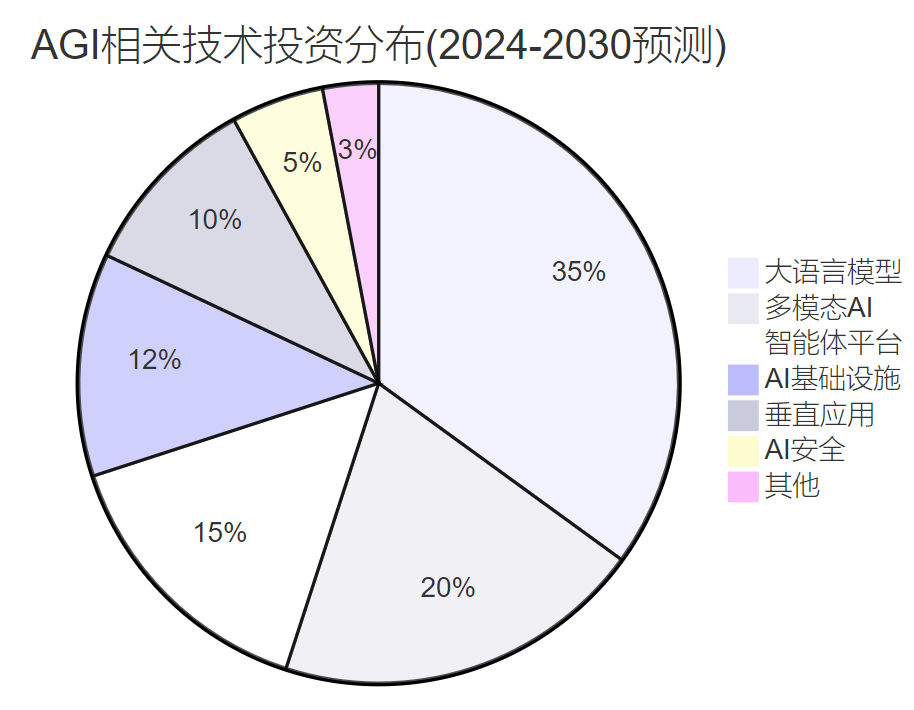图6 AGI相关技术投资分布预测图
4.3 技术商业化路径
4.3.1 B2B市场机会
企业级智能体解决方案是当前最具商业价值的应用方向。# 企业级智能体解决方案架构
class EnterpriseAgentSolution:
def __init__(self, industry_type):
self.industry = industry_type
self.solution_components = self.design_solution_stack()
def design_solution_stack(self):
"""
设计企业级解决方案技术栈
"""
base_stack = {
'data_layer': 'Enterprise Data Lake',
'model_layer': 'Fine-tuned LLM',
'agent_layer': 'Domain-specific Agents',
'interface_layer': 'API Gateway',
'security_layer': 'Enterprise Security'
}
# 根据行业特点定制化
if self.industry == 'finance':
base_stack['compliance_layer'] = 'Financial Compliance'
base_stack['risk_management'] = 'Risk Assessment Engine'
elif self.industry == 'healthcare':
base_stack['privacy_layer'] = 'HIPAA Compliance'
base_stack['clinical_decision'] = 'Clinical Decision Support'
return base_stack
def estimate_roi(self, deployment_scale):
"""
估算投资回报率
"""
implementation_cost = self.calculate_implementation_cost(deployment_scale)
annual_savings = self.estimate_annual_savings(deployment_scale)
roi_years = implementation_cost / annual_savings
return {
'implementation_cost': implementation_cost,
'annual_savings': annual_savings,
'payback_period': roi_years,
'five_year_roi': (annual_savings * 5 - implementation_cost) / implementation_cost
}
"投资AGI不是投资未来,而是投资正在发生的现在。关键在于识别哪些技术已经足够成熟,可以创造实际价值。" —— 知名AI投资人
5. 技术挑战与解决方案
5.1 技术标准化挑战
AGI技术的快速发展带来了标准化的迫切需求,包括模型接口标准、数据格式标准、评估标准等。| 标准化领域 | 当前状态 | 主要挑战 | 解决方案 |
|---|---|---|---|
| 模型接口 | 分散化 | 兼容性差 | 统一API标准 |
| 数据格式 | 多样化 | 互操作性低 | 通用数据模式 |
| 评估指标 | 不统一 | 比较困难 | 标准化基准测试 |
| 安全规范 | 初步阶段 | 风险控制难 | 安全认证体系 |
5.2 伦理与安全挑战
AGI的发展必须考虑伦理和安全问题,确保技术发展符合人类价值观和社会利益。# AI安全与伦理评估框架
class AIEthicsEvaluator:
def __init__(self):
self.evaluation_dimensions = {
'fairness': FairnessEvaluator(),
'transparency': TransparencyEvaluator(),
'accountability': AccountabilityEvaluator(),
'privacy': PrivacyEvaluator(),
'safety': SafetyEvaluator()
}
def comprehensive_evaluation(self, ai_system):
"""
对AI系统进行全面的伦理评估
"""
evaluation_results = {}
for dimension, evaluator in self.evaluation_dimensions.items():
score = evaluator.evaluate(ai_system)
recommendations = evaluator.get_recommendations(score)
evaluation_results[dimension] = {
'score': score,
'level': self.get_compliance_level(score),
'recommendations': recommendations
}
overall_score = self.calculate_overall_score(evaluation_results)
return {
'overall_score': overall_score,
'dimension_scores': evaluation_results,
'compliance_status': self.determine_compliance_status(overall_score)
}
def get_compliance_level(self, score):
"""
根据得分确定合规等级
"""
if score >= 0.9:
return 'Excellent'
elif score >= 0.7:
return 'Good'
elif score >= 0.5:
return 'Acceptable'
else:
return 'Needs Improvement'
5.3 可持续发展挑战
AGI技术的大规模部署面临能耗和环境影响的挑战,需要发展绿色AI技术。图7 绿色AGI技术发展路径图
6. 未来展望与发展路线图
6.1 技术发展时间线
基于当前技术发展趋势和研究进展,我们可以预测AGI技术的发展时间线。# AGI发展里程碑预测模型
class AGIDevelopmentPredictor:
def __init__(self):
self.milestones = {
'2024-2025': {
'multimodal_agents': 0.8,
'domain_specific_agi': 0.6,
'reasoning_capability': 0.7
},
'2026-2027': {
'general_problem_solving': 0.7,
'autonomous_learning': 0.6,
'human_level_reasoning': 0.5
},
'2028-2030': {
'full_agi_prototype': 0.4,
'commercial_agi_deployment': 0.3,
'superintelligence_emergence': 0.1
}
}
def predict_milestone_probability(self, timeframe, milestone):
"""
预测特定时间段内达成里程碑的概率
"""
if timeframe in self.milestones:
return self.milestones[timeframe].get(milestone, 0.0)
return 0.0
def generate_development_roadmap(self):
"""
生成AGI发展路线图
"""
roadmap = {}
for timeframe, milestones in self.milestones.items():
high_probability_milestones = [
milestone for milestone, prob in milestones.items()
if prob >= 0.6
]
roadmap[timeframe] = high_probability_milestones
return roadmap
6.2 产业生态发展预测
AGI技术将催生全新的产业生态,包括技术提供商、应用开发商、服务集成商等多个层次。| 生态角色 | 主要职能 | 核心竞争力 | 发展前景 |
|---|---|---|---|
| 基础模型提供商 | 大模型研发与训练 | 算法创新、计算资源 | 寡头竞争格局 |
| 智能体平台商 | 开发工具与平台 | 易用性、生态建设 | 快速增长期 |
| 垂直解决方案商 | 行业应用开发 | 领域专业知识 | 百花齐放 |
| 基础设施服务商 | 计算、存储、网络 | 规模效应、可靠性 | 稳定增长 |
6.3 社会影响与变革
AGI的普及将对社会各个层面产生深远影响,需要提前做好准备和规划。图8 AGI社会影响思维导图
7. 实践建议与行动指南
7.1 技术从业者建议
对于技术从业者,建议关注以下几个方面的能力建设:# 技术能力发展规划
class TechSkillDevelopmentPlan:
def __init__(self):
self.skill_categories = {
'core_ai_skills': [
'machine_learning_fundamentals',
'deep_learning_architectures',
'natural_language_processing',
'computer_vision',
'reinforcement_learning'
],
'agi_specific_skills': [
'multimodal_learning',
'reasoning_systems',
'knowledge_representation',
'cognitive_architectures',
'agent_based_systems'
],
'engineering_skills': [
'distributed_systems',
'model_optimization',
'mlops_practices',
'system_design',
'performance_tuning'
],
'domain_knowledge': [
'ethics_and_safety',
'business_understanding',
'interdisciplinary_knowledge',
'research_methodology'
]
}
def create_learning_path(self, current_level, target_role):
"""
创建个性化学习路径
"""
learning_path = []
if target_role == 'agi_researcher':
priority_skills = (
self.skill_categories['core_ai_skills'] +
self.skill_categories['agi_specific_skills']
)
elif target_role == 'agi_engineer':
priority_skills = (
self.skill_categories['core_ai_skills'] +
self.skill_categories['engineering_skills']
)
elif target_role == 'agi_product_manager':
priority_skills = (
self.skill_categories['domain_knowledge'] +
self.skill_categories['core_ai_skills'][:3] # 前3个核心技能
)
for skill in priority_skills:
learning_path.append({
'skill': skill,
'estimated_time': self.estimate_learning_time(skill, current_level),
'resources': self.get_learning_resources(skill),
'assessment_method': self.get_assessment_method(skill)
})
return learning_path
7.2 企业战略建议
企业在AGI时代需要制定前瞻性的战略规划:- 技术投资策略:平衡短期应用和长期研发投入
- 人才培养计划:建立AGI相关的人才梯队
- 业务模式创新:探索AI驱动的新商业模式
- 风险管理体系:建立AI治理和风险控制机制
7.3 投资者行动指南
对于投资者,建议采用分层投资策略:# 投资组合优化模型
class AGIInvestmentPortfolio:
def __init__(self, risk_tolerance, investment_horizon):
self.risk_tolerance = risk_tolerance
self.investment_horizon = investment_horizon
self.asset_categories = {
'infrastructure': {'risk': 'low', 'return': 'medium', 'liquidity': 'high'},
'platform': {'risk': 'medium', 'return': 'high', 'liquidity': 'medium'},
'application': {'risk': 'high', 'return': 'very_high', 'liquidity': 'low'},
'research': {'risk': 'very_high', 'return': 'uncertain', 'liquidity': 'very_low'}
}
def optimize_portfolio(self, total_investment):
"""
优化投资组合配置
"""
if self.risk_tolerance == 'conservative':
allocation = {
'infrastructure': 0.6,
'platform': 0.3,
'application': 0.1,
'research': 0.0
}
elif self.risk_tolerance == 'moderate':
allocation = {
'infrastructure': 0.4,
'platform': 0.4,
'application': 0.15,
'research': 0.05
}
elif self.risk_tolerance == 'aggressive':
allocation = {
'infrastructure': 0.2,
'platform': 0.3,
'application': 0.4,
'research': 0.1
}
portfolio = {}
for category, percentage in allocation.items():
portfolio[category] = {
'amount': total_investment * percentage,
'percentage': percentage,
'expected_return': self.calculate_expected_return(category),
'risk_level': self.asset_categories[category]['risk']
}
return portfolio
"在AGI的浪潮中,最重要的不是预测未来,而是为各种可能的未来做好准备。" —— 技术战略专家
结论
作为技术博主摘星,通过深入分析智能体在AGI发展路径中的关键作用,我深刻认识到我们正处于人工智能发展的关键转折点。当前技术的局限性虽然明显,包括推理能力不足、知识整合困难、自主学习能力有限等问题,但这些挑战正在通过多种技术路径得到逐步解决。通用人工智能的实现路径呈现出多元化特征,从传统的符号主义到现代的连接主义,再到融合两者优势的混合路径,每一条道路都在为AGI的最终实现贡献力量。智能体作为AGI的重要载体和实现形式,不仅承载着技术突破的希望,更是连接理论研究与实际应用的重要桥梁。从投资角度来看,AGI相关技术栈的各个层面都蕴含着巨大的商业机会,从基础设施到应用层面,从硬件到软件,每个环节都可能诞生颠覆性的创新。然而,技术发展的同时也带来了标准化、伦理安全、可持续发展等挑战,这些问题的解决需要全社会的共同努力。展望未来,AGI技术的发展将经历从专用智能体到通用智能体的演进过程,预计在2025-2030年间将出现重要的技术突破和商业化应用。对于技术从业者而言,需要持续学习和适应新技术发展;对于企业来说,需要制定前瞻性的AI战略;对于投资者而言,需要采用分层投资策略来平衡风险和收益。最终,AGI的成功实现将不仅仅是技术的胜利,更是人类智慧与机器智能协同发展的里程碑,它将重新定义工作、学习、创造的方式,推动人类社会进入一个全新的智能时代。参考资料
1. [OpenAI GPT-4 Technical Report](https://arxiv.org/abs/2303.08774) 2. [Google DeepMind Gemini: A Family of Highly Capable Multimodal Models](https://arxiv.org/abs/2312.11805) 3. [Microsoft AutoGen: Enabling Next-Gen LLM Applications](https://github.com/microsoft/autogen) 4. [Anthropic Constitutional AI: Harmlessness from AI Feedback](https://arxiv.org/abs/2212.08073) 5. [Stanford HAI AI Index Report 2024](https://aiindex.stanford.edu/report/) 6. [MIT Technology Review: The State of AI in 2024](https://www.technologyreview.com/2024/01/03/1086046/whats-next-for-ai-in-2024/) 7. [Nature: Artificial General Intelligence - A Gentle Introduction](https://www.nature.com/articles/s42256-023-00718-2) 8. [IEEE Spectrum: The Road to AGI](https://spectrum.ieee.org/artificial-general-intelligence)🌈 我是摘星!如果这篇文章在你的技术成长路上留下了印记:
👁️ 【关注】与我一起探索技术的无限可能,见证每一次突破
👍 【点赞】为优质技术内容点亮明灯,传递知识的力量
🔖 【收藏】将精华内容珍藏,随时回顾技术要点
💬 【评论】分享你的独特见解,让思维碰撞出智慧火花
🗳️ 【投票】用你的选择为技术社区贡献一份力量
技术路漫漫,让我们携手前行,在代码的世界里摘取属于程序员的那片星辰大海!