写译 — 优先级调度算法的那些事儿
- Author : Cyan_RA9
- 和大家分享英语写译,包括计算机英文教材,计算机基础,中英文诗词,英文名著,日常对话等,每一篇文章 我都会分别给出“原文内容”,“第一版翻译” 和 “第二版翻译”,以及“生词整理”共四部分。
- 写译 — 优先级调度算法的那些事儿
【原文内容】
- 优先级调度算法(PSA, Priority Scheduling Algorithm):
- 工作原理:可以适用于作业调度、进程调度;作业(进程)的优先级由外界赋予,系统只需要根据外界赋予的优先级来进行调度即可;根据是否可以抢占,优先级调度算法可以分为“非抢占式优先级调度算法” 和 “抢占式优先级调度算法”;根据在调度程序运行过程中优先级是否可以动态变化,优先级调度算法又可分为“静态优先级” 和 “动态优先级”。对于静态优先级,是指各个进程的优先级在调度程序运行之初就已经确定好,整个运行期间不会改变;对于动态优先级,是指在调度程序运行的过程中,各个进程的优先级是动态变化的。
- 适用情景:适合实时系统或需要区分任务优先级的场景。
- 优点:灵活,可根据任务重要性调整优先级。
- 缺点:低优先级进程可能“饥饿”;动态调整优先级会增加开销。
【第一版翻译:(润色前,手译)】
- PSA(Priority Scheduling Algorithm):
- FUNCTIONAL PRINCIPLES : It is applicable to both job scheduling and process scheduling; The priority of the job(Process) is attributed by outside, and the system just needs to schedule processes according to their priorities attributed by outside; PSA can be divided into "non-preemptive PSA" and "preemptive PSA" depending on whether or not it is preemptive; And PSA can be also divided into "Static priorities" and "Dynamic priorities" depending on whether or not the priorities can change dynamically during the scheduling program's execution. AS for Static PSA, referred to a scenario where every single process's priority is predetermined at the beginning of function of scheduling program and constant during the whole execution; As to Dynamic PSA, referred to a situation where every single process's priority is dynamically variable during the execution of the scheduling program.
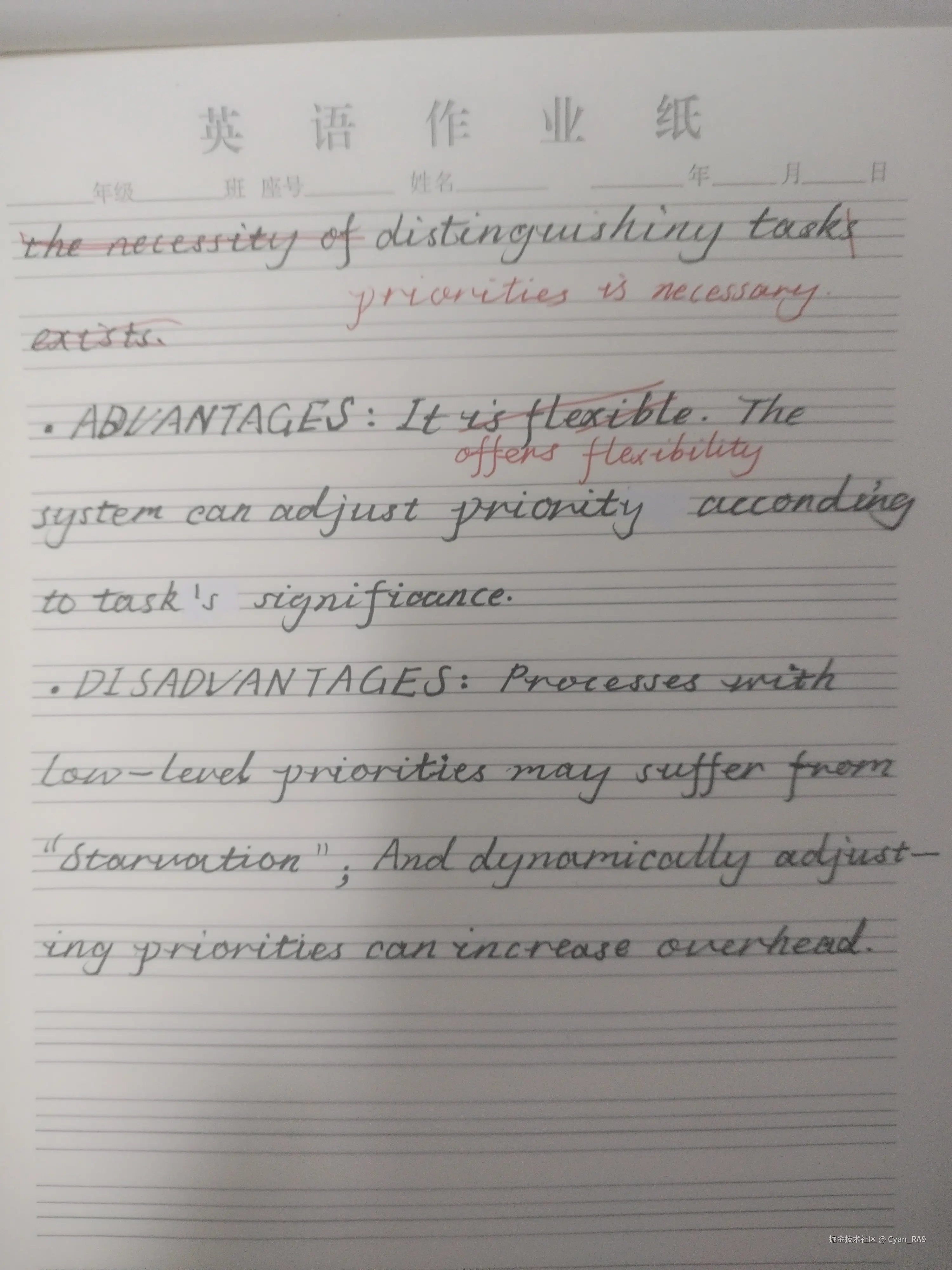
- APPLICABLE SCENARIOS : It is applicable to Real-Time Systems or other scenes where the necessity of distinguishing tasks exists.
- ADVANTAGES : It is flexible. The system can adjust priority according to task's significance.
- DISADVANTAGES : Processes with low-level priorities may suffer from "starvation"; And dynamically adjusting priorities can increase overhead.
【第二版翻译:(润色后,雅思水准)】
- Priority Scheduling Algorithm(PSA)
- FUNCTIONAL PRINCIPLES : This algorithm is applicable to both job scheduling and process scheduling; The priority of a job(or process) is assigned externally, and the system merely needs to schedule processes according to these externally assigned priorities; PSA can be categorized into "non-preemptive PSA" and "preemptive PSA" depending on whether preemption is allowed; Furthermore, PSA can also be classified into "Static priorities" and "Dynamic priorities" based on whether priorities can change dynamically during the scheduling program's execution. AS for Static PSA, it refers to a scenario where every single process's priority is predetermined at the beginning of the scheduling program's execution and remains constant throughout its entire run; As to Dynamic PSA, it refers to a situation where every single process's priority dynamically changes during the scheduling program's execution.
- APPLICABLE SCENARIOS : It is applicable to Real-Time Systems or other contexts where distinguishing task priorities is necessary.
- ADVANTAGES : It offers flexibility. The system can adjust priority according to task's significance.
- DISADVANTAGES : Processes with low-level priorities may suffer from "starvation"; And dynamically adjusting priorities can increase overhead.
【生词整理】
- assign : v.分配,指派,指定,布置
- assigned : adj.指定的,赋值的;v.assigned的过去式和过去分词
- be assigned externally:phrase.由外界赋予
- externally assigned priorities :phrase.外界赋予的优先级
- categorize:v.将...分类,把...加以归类
- preemption:n.先买,先占,先买权,抢占
- whether preemption is allowed:phrase.是否可以抢占
- furthermore:adv.此外,而且,再者
- classify:v.分类,归类
- classified:adj.机密的,分类的;v.classify的过去式和过去分词
- predetermined:adj.预先决定的,提前确定的;v.predetermine的过去式和过去分词
- Real-Time Systems:n.实时系统
- experience starvation:phrase.“饥饿”
- overhead:phrase.n.天花板,企业费用,日常开支,开销;adj&adv.在头上的(地),在空中的(地)
【写译手稿】