GaussDB-Stream方式的Hint
功能描述
指明stream使用的方法,可以为broadcast和redistribute,或者直接指定生成gather计划。
语法格式
| ``` [no] broadcast|redistribute|local_roundrobin( [@queryblock] table_list) gather( [@queryblock] REL|JOIN|ALL)
| -------------------------------------------------------------------------------------------------------------------- |
#### 参数说明
- @queryblock请参见[指定Hint所处的查询块Queryblock](https://doc.hcs.huawei.com/db/zh-cn/gaussdbqlh/24.1.30/devg-dist/gaussdb-12-0272.html#ZH-CN_TOPIC_0000001911585745)章节,可省略,表示在当前查询块生效。
- broadcast、redistribute和local_roundrobin表示数据分布方法。
- no表示hint的stream方式不使用。
- table_list为进行stream操作的单表或多表join结果集,请参见[参数说明](https://doc.hcs.huawei.com/db/zh-cn/gaussdbqlh/24.1.30/devg-dist/gaussdb-12-0275.html#ZH-CN_TOPIC_0000001865746472__zh-cn_topic_0000001656059552_section35948678143011)。
<!---->
- gather
[]()[]()gather hint可以指定三种计划生成方式:
- REL:只生成基于基表的gather路径,然后再在CN上执行剩余计划。
- JOIN:尽可能生成基于join的gather路径,在能下推的join子计划上面(join下面不包含重分布节点)添加gather路径,剩余计划在CN上执行。对于需要重分布节点的join计划则无法生成基于join的gather路径,会回退生成基于基表的gather路径。

在指定hint(JOIN)后,对于分布表和复制表做连接的情况会导致无法生成hint(JOIN)期望的计划,因为优化器已经寻找更优的计划进行替代。
- ALL:基于最优方式选择Gather Rel或Gather Join路径。
#### 示例
对[示例](https://doc.hcs.huawei.com/db/zh-cn/gaussdbqlh/24.1.30/devg-dist/gaussdb-12-0271.html#ZH-CN_TOPIC_0000001911666285__zh-cn_topic_0000001656058848_section671421102912)中原语句使用如下hint:
| ```
explain select /*+ no redistribute(store_sales store_returns item store) leading(((store_sales store_returns item store) customer)) */ i_product_name product_name ...
``` |
| ------------------------------------------------------------------------------------------------------------------------------------------------------------------------------- |
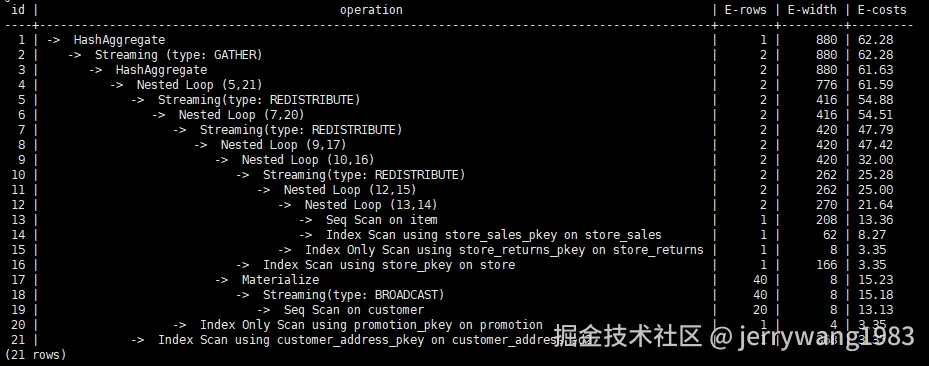
原计划中,(store_sales store_returns item store)和customer做join时,前者做了重分布,此hint表示禁止前者混合表做重分布,但仍然保持join顺序,则生成计划如下所示:
对语句进行Gather Hint指定:
1. 生成基表Gather计划 /* +GATHER(REL)*/。
```
gaussdb=# explain select /*+ GATHER(REL)*/* from t1, t2, t3 where t1.c2 = t2.c2 and t2.c2 = t3.c2;
id | operation | E-rows | E-width | E-costs
----+---------------------------------------+--------+---------+---------
1 | -> Hash Join (2,8) | 20 | 36 | 44.10
2 | -> Hash Join (3,5) | 20 | 24 | 29.22
3 | -> Streaming (type: GATHER) | 20 | 12 | 14.35
4 | -> Seq Scan on t1 | 20 | 12 | 13.13
5 | -> Hash | 20 | 12 | 14.35
6 | -> Streaming (type: GATHER) | 20 | 12 | 14.35
7 | -> Seq Scan on t2 | 20 | 12 | 13.13
8 | -> Hash | 20 | 12 | 14.35
9 | -> Streaming (type: GATHER) | 20 | 12 | 14.35
10 | -> Seq Scan on t3 | 20 | 12 | 13.13
(10 rows)
Predicate Information (identified by plan id)
-----------------------------------------------
1 --Hash Join (2,8)
Hash Cond: (t1.c2 = t3.c2)
2 --Hash Join (3,5)
Hash Cond: (t1.c2 = t2.c2)
(4 rows)
```
1. 生成可下推计划的Join Gather计划 /*+ GATHER(REL)*/。
```
gaussdb=# explain select /*+ GATHER(JOIN)*/* from t1, t2, t3 where t1.c1 = t2.c1 and t2.c2 = t3.c2;
id | operation | E-rows | E-width | E-costs
----+------------------------------------+--------+---------+---------
1 | -> Hash Join (2,7) | 20 | 36 | 42.37
2 | -> Streaming (type: GATHER) | 20 | 24 | 27.49
3 | -> Hash Join (4,5) | 20 | 24 | 26.56
4 | -> Seq Scan on t1 | 20 | 12 | 13.13
5 | -> Hash | 21 | 12 | 13.13
6 | -> Seq Scan on t2 | 20 | 12 | 13.13
7 | -> Hash | 20 | 12 | 14.35
8 | -> Streaming (type: GATHER) | 20 | 12 | 14.35
9 | -> Seq Scan on t3 | 20 | 12 | 13.13
(9 rows)
Predicate Information (identified by plan id)
-----------------------------------------------
1 --Hash Join (2,7)
Hash Cond: (t2.c2 = t3.c2)
3 --Hash Join (4,5)
Hash Cond: (t1.c1 = t2.c1)
(4 rows)
```
1. 生成最优方式的Gather计划 /*+ GATHER(ALL)*/。
[]()[]()会基于最优方式及规则选择GATHER(REL)或者GATHER(JOIN)路径。
```
gaussdb=# explain select /*+ GATHER(ALL)*/* from t1, t2, t3 where t1.c1 = t2.c1 and t2.c2 = t3.c2;
id | operation | E-rows | E-width | E-costs
----+------------------------------------+--------+---------+---------
1 | -> Hash Join (2,7) | 20 | 36 | 42.37
2 | -> Streaming (type: GATHER) | 20 | 24 | 27.49
3 | -> Hash Join (4,5) | 20 | 24 | 26.56
4 | -> Seq Scan on t1 | 20 | 12 | 13.13
5 | -> Hash | 21 | 12 | 13.13
6 | -> Seq Scan on t2 | 20 | 12 | 13.13
7 | -> Hash | 20 | 12 | 14.35
8 | -> Streaming (type: GATHER) | 20 | 12 | 14.35
9 | -> Seq Scan on t3 | 20 | 12 | 13.13
(9 rows)
Predicate Information (identified by plan id)
-----------------------------------------------
1 --Hash Join (2,7)
Hash Cond: (t2.c2 = t3.c2)
3 --Hash Join (4,5)
Hash Cond: (t1.c1 = t2.c1)
(4 rows)
```
local_ronndrobin hint使用:
```
SET enable_fast_query_shipping=off; --关闭FQS优化
SET query_dop=4; --设置并行度
gaussdb=# EXPLAIN(costs off) SELECT /*+ local_roundrobin(t2) scandop(t2 1) scandop(t1 4)*/* FROM t1, t2 WHERE t1.c1 = t2.c1;
id | operation
----+------------------------------------------------------------
1 | -> Streaming (type: GATHER)
2 | -> Streaming(type: LOCAL GATHER dop: 1/4)
3 | -> Nested Loop (4,6)
4 | -> Streaming(type: LOCAL BROADCAST dop: 4/4)
5 | -> Seq Scan on t1
6 | -> Materialize
7 | -> Streaming(type: LOCAL ROUNDROBIN dop: 4/1)
8 | -> Seq Scan on t2
(8 rows)
Predicate Information (identified by plan id)
-----------------------------------------------
3 --Nested Loop (4,6)
Join Filter: (t1.c1 = t2.c1)
(2 rows)
```
可以看到成功选择了local_ronndrobin的数据分布方式,但是使用约束较多(并行度设置,关闭FQS优化)一般不建议使用。

local_roundrobin hint只有在表扫描并行度为1的时候才会生效,建议和[scandop hint](https://doc.hcs.huawei.com/db/zh-cn/gaussdbqlh/24.1.30/devg-dist/gaussdb-12-0295.html#ZH-CN_TOPIC_0000001865585608)一起使用。
更多详情请参考GaussDB 文档中心:<https://doc.hcs.huawei.com/db/zh-cn/gaussdbqlh/24.1.30/productdesc/qlh_03_0001.html>