一、字符串字符类型排序问题
题目
给定一个字符串,其中仅包含,大小写字母,数字和问号。要求对该字符串内部字符排序,满足以下要求:
- 问号的占用的位置不变
- 数字占用的位置不变,数字之间由大到小排序
- 字母占用的位置不变,字母之间按字典序排序
具体请配合样例理解
样例
输入:
12A?zc
输出:
21A?cz
输入:
1Ad?z?t24
输出:
4Ad?t?z21
输入:
???123??zxy?
输出:
???321??xyz?
解题思路:
问题理解
我们需要对给定的字符串进行排序,但有以下特殊要求:
- 问号的位置保持不变。
- 数字的位置保持不变,但数字之间按从大到小排序。
- 字母的位置保持不变,但字母之间按字典序排序。
数据结构选择
- 问号的位置:我们可以通过遍历字符串,记录问号的位置。
- 数字和字母的排序:我们可以分别提取出数字和字母,进行排序,然后再放回原位置。
算法步骤
- 记录问号的位置:遍历字符串,记录问号的位置。
- 提取数字和字母:遍历字符串,提取出所有的数字和字母。
- 排序:对提取出的数字按从大到小排序,对提取出的字母按字典序排序。
- 重组字符串:根据记录的问号位置和排序后的数字、字母,重组字符串。
最终代码:
#include <iostream>
#include <string>
#include <vector>
#include <algorithm>
using namespace std;

string solution(string inp) {
    // 记录问号的位置
    vector<int> questionMarks;
    for (int i = 0; i < inp.size(); ++i) {
        if (inp[i] == '?') {
            questionMarks.push_back(i);
        }
    }

    // 提取数字和字母
    vector<char> digits;
    vector<char> letters;
    for (char c : inp) {
        if (isdigit(c)) {
            digits.push_back(c);
        } else if (isalpha(c)) {
            letters.push_back(c);
        }
    }

    // 排序
    sort(digits.begin(), digits.end(), greater<char>());
    sort(letters.begin(), letters.end());

    // 重组字符串
    string result = inp;
    int digitIndex = 0;
    int letterIndex = 0;
    for (int i = 0; i < result.size(); ++i) {
        if (result[i] == '?') continue;
        if (isdigit(result[i])) {
            result[i] = digits[digitIndex++];
        } else if (isalpha(result[i])) {
            result[i] = letters[letterIndex++];
        }
    }

    return result;
}

int main() {
    // Add your test cases here

    cout << (solution("12A?zc") == "21A?cz") << endl;
    cout << (solution("1Ad?z?t24") == "4Ad?t?z21") << endl;
    cout << (solution("???123??zxy?") == "???321??xyz?") << endl;

    return 0;
}
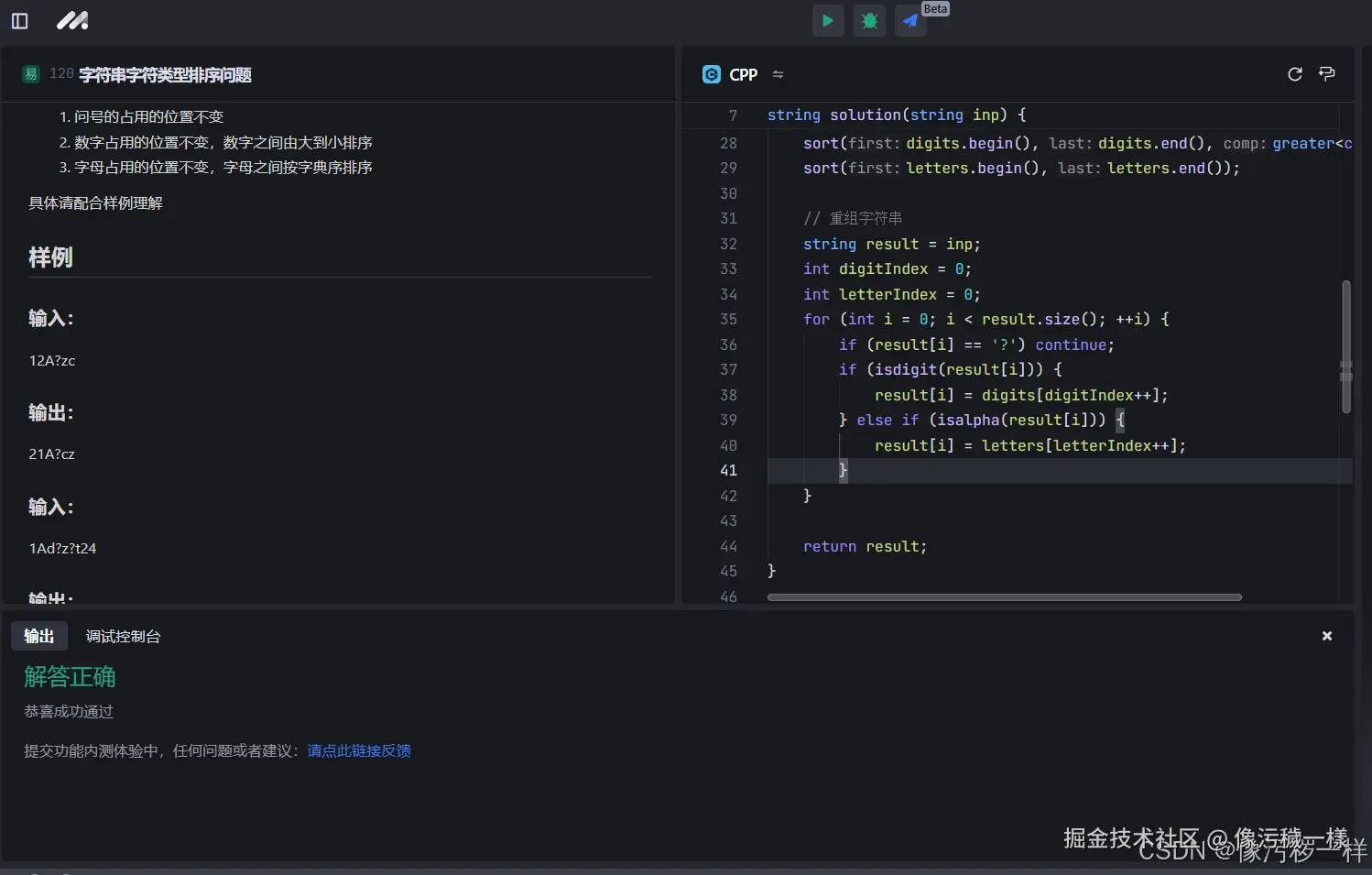
运行结果:
 编辑
编辑
二、小C点菜问题
问题描述
小C来到了一家餐馆,准备点一些菜。
已知该餐馆有 nn 道菜,第 ii 道菜的售价为 wiwi。
小C准备点一些价格相同的菜,但小C不会点单价超过 mm 的菜。
小C想知道,自己最多可以点多少道菜?
测试样例
样例1:
输入:
m = 6, w = [2, 3, 3, 6, 6, 6, 9, 9, 23]
输出:3
样例2:
输入:
m = 4, w = [1, 2, 4, 4, 4]
解题思路:
问题理解
小C想要点一些价格相同的菜,并且这些菜的价格不能超过给定的上限 m。我们需要找出在满足这个条件下,小C最多可以点多少道菜。
数据结构选择
我们可以使用一个数组来存储每道菜的价格。为了快速统计每种价格的菜的数量,我们可以使用一个哈希表(在C++中可以使用 std::unordered_map)来记录每种价格的菜的数量。
算法步骤
- 遍历价格数组:统计每种价格的菜的数量,并将结果存储在哈希表中。
- 筛选价格:遍历哈希表,只考虑价格不超过
m的菜。 - 找出最大数量:在筛选后的价格中,找出数量最多的那个,即为小C最多可以点的菜的数量。
最终代码:
#include <bits/stdc++.h>

using namespace std;

long solution(int m, const std::vector<int> w) {
    // 1. 统计每种价格的菜的数量
    std::unordered_map<int, int> priceCount;
    for (int price : w) {
        if (price <= m) {
            priceCount[price]++;
        }
    }

    // 2. 找出数量最多的菜
    int maxCount = 0;
    for (const auto& pair : priceCount) {
        if (pair.second > maxCount) {
            maxCount = pair.second;
        }
    }

    return maxCount;
}
int main() {
    std::cout << (solution(6, {2, 3, 3, 6, 6, 6, 9, 9, 23}) == 3) << std::endl;
    std::cout << (solution(4, {1, 2, 4, 4, 4}) == 3) << std::endl;
    std::cout << (solution(5, {5, 5, 5, 5, 6, 7, 8}) == 4) << std::endl;
    return 0;
}
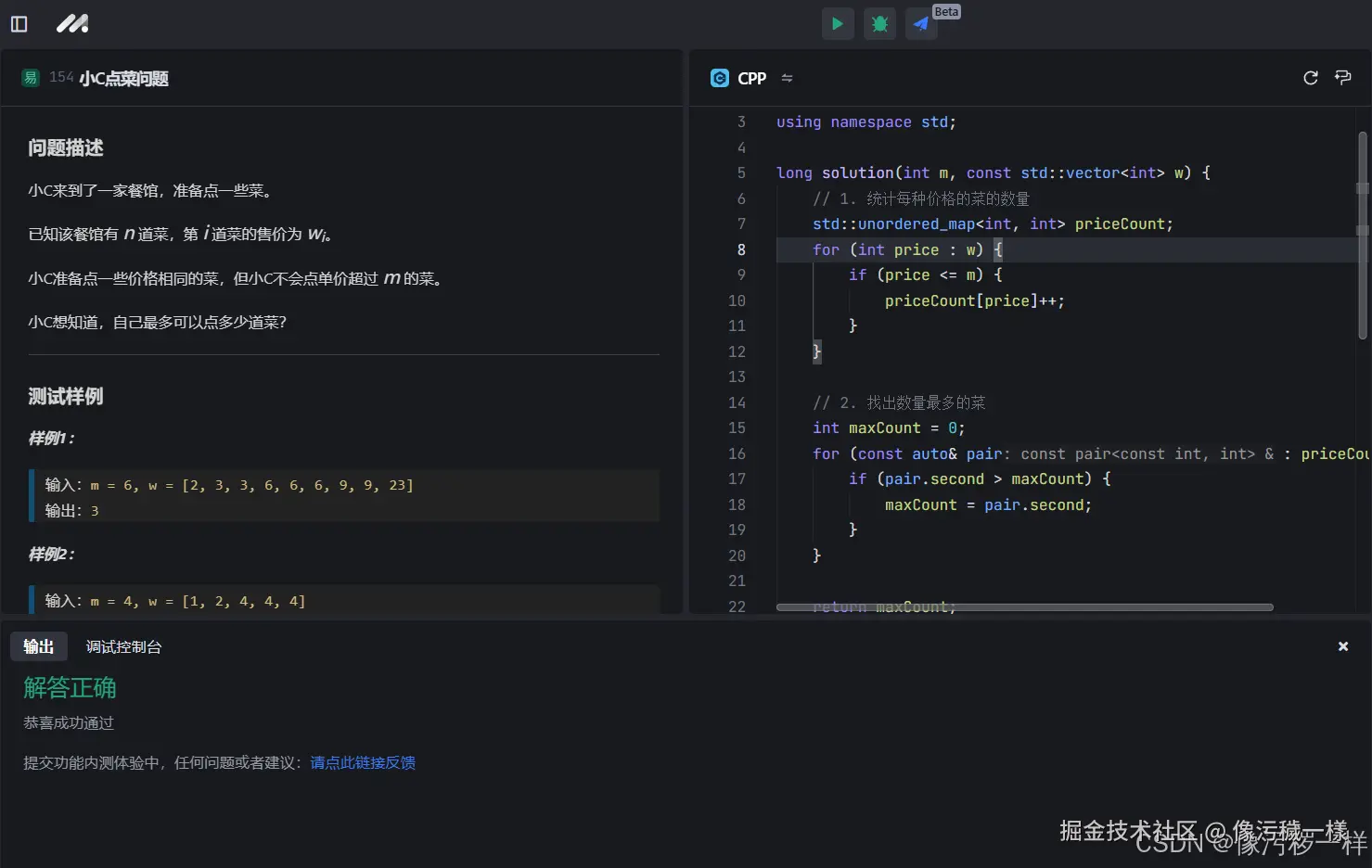
运行结果: