ERQ:32位转5位仅掉些许精度,来看看两段式后训练量化 | ICML 2024

50 阅读6分钟

后训练量化(PTQ)在视觉TransformerViTs)领域引起了广泛关注,因为它在模型压缩方面表现出了高效率。然而,现有的方法通常忽视了量化权重和激活之间复杂的相互依赖关系,导致了相当大的量化误差。论文提出了一种名为ERQ的两步PTQ方法,精心设计用于顺序降低激活和权重量化带来的量化误差。ERQ首先引入了激活量化误差减小(Aqer),将激活量化误差的最小化策略性地表述为一个岭回归问题,并通过使用全精度更新权重来解决。随后,ERQ引入了权重量化误差减小(Wqer),采用迭代的方法来减轻由权重量化引起的量化误差。在每次迭代中,采用经验推导出的有效代理来细化量化权重的舍入方向,并结合岭回归求解器以减少权重量化误差。实验结果证明了该方法的有效性。值得注意的是,ERQW3A4 ViT-S的准确性上超越了最先进的GPTQ,提升幅度达22.36%

来源:晓飞的算法工程笔记 公众号,转载请注明出处

论文: ERQ: Error Reduction for Post-Training Quantization of Vision Transformers

Introduction


视觉TransformerViTs)显著挑战了卷积神经网络(CNNs),成为计算机视觉领域的新范式。ViTs利用多头自注意力(MHSA)机制来捕捉图像块之间的长距离关系,在各种视觉任务中展现出令人印象深刻的进展。

然而,强大的能力伴随着相当的复杂性。ViTs固有的架构复杂性导致了高计算需求和可观的内存要求,这在资源受限的环境中部署时带来了挑战。为了缓解这一困境,模型量化吸引了业界和学术界的持续关注。量化通过实现权重和激活的低位表示来减少模型复杂性,为高效部署提供了一条有前景的途径。最近,研究人员逐渐关注于视觉Transformer的后训练量化(PTQ),该方法旨在利用一个小型校准数据集和较低的成本对模型进行量化。

为了适应ViTs独特的结构,已经许多研究探索了各种后训练量化(PTQ)方法。例如,为了处理长尾post-Softmax激活,有研究提出了 log2/log2log2/log \sqrt{2} 量化器和twin uniform量化器。为了管理高度变化的激活,有研究采用了重参数化技术和power-of-two因子。此外,有研究采用进化搜索方法来确定不稳定的缩放因子。然而,现有的方法通常忽视了权重和激活量化之间复杂的相互依赖关系,这在权重-激活量化时导致了相当大的量化误差。
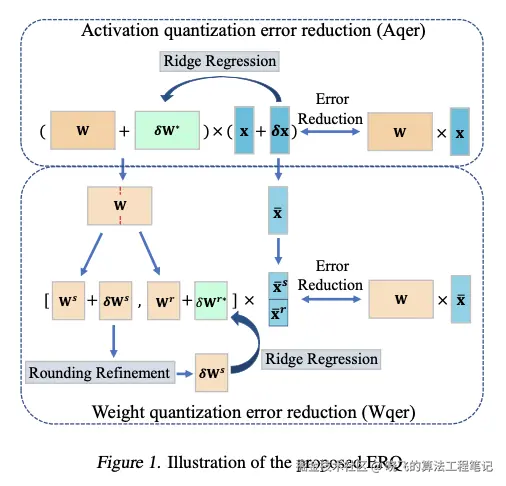
论文提出一种为ViTs量身定制的两步后训练量化方法ERQ,旨在顺序减小由量化激活和权重引起的量化误差。如图1所示,ERQ由两个步骤组成,即激活量化误差减少(Aqer)和权重量化误差减少(Wqer)。Aqer将激活量化引起的量化误差公式化为一个岭回归问题,该问题可以通过权重更新以闭式解的方式解决。随后,引入Wqer以迭代的量化和修正方式减小由权重量化引起的量化误差。特别地,在每次迭代中,量化全精度权重的前半部分,并通过先执行四舍五入细化,后再次解决岭回归问题来减小产生的量化误差。前者推导出输出误差的有效代理,用于细化量化权重的四舍五入方向,以降低量化误差。后者则通过更新剩余的全精度权重进一步减小量化误差。这样的过程持续进行,直到所有权重被准确量化。

ERQ在对各种ViTs变体(ViTDeiTSwin)及任务(图像分类、目标检测和实例分割)进行的广泛实验中证明了其有效性。值得注意的是,在图像分类任务中,ERQW3A4 ViT-S上比GPTQ的性能提高了22.36%

Method


相互纠缠的 δx\delta{\mathbf{x}}δW\delta\mathbf{W} 使得找到公式 4 的最优解变得具有挑战性。为使问题变得可处理,将公式 4放宽为两个顺序的子问题,通过分别最小化来自量化激活和权重的误差。如图1所示,首先进行激活量化误差减少 (Aqer),然后进行权重量化误差减少 (Wqer)。

Activation Quantization Error Reduction

为减轻由激活量化引起的误差,引入激活量化误差减少 (Aqer),将误差减轻问题形式化为岭回归问题。具体来说,将权重保留为全精度,仅考虑由激活量化误差 δx\delta{\mathbf{x}} 引起的均方误差 (MSE):

LMSE=E[WxW(x+δx)22].\labeleq:objact\begin{align} \mathcal{L}^{\text{MSE}} = \mathbb{E} \left[ \| \mathbf{W}\mathbf{x} - \mathbf{W}(\mathbf{x}+\delta{\mathbf{x}})\|_2^2 \right]. \label{eq:obj-act} \end{align}

为了最小化公式 5,将其形式化为岭回归问题,其中通过将权重 W\mathbf{W} 与调整项 δW\delta\mathbf{W}^* 相加来完成最小化:

E[Wx(W+δW)(x+δx)22]+λ1δW22=E[δW(x+δx)Wδx22]+λ1δW22=E[δWxˉ+Wδx22]+λ1δW22.\labeleq:objact1\begin{equation} \begin{aligned} &\mathbb{E} \left[ \| \mathbf{W}\mathbf{x} - (\mathbf{W} + \delta\mathbf{W}^*)(\mathbf{x}+\delta{\mathbf{x}})\|_2^2 \right] + \lambda_1 \| \delta\mathbf{W}^* \|_2^2 \\ & = \mathbb{E} \left[\| - \delta\mathbf{W}^*(\mathbf{x}+\delta{\mathbf{x}}) - \mathbf{W}\delta{\mathbf{x}} \|_2^2\right] + \lambda_1 \| \delta\mathbf{W}^* \|_2^2 \\ & = \mathbb{E} \left[ \| \delta\mathbf{W}^*\bar{\mathbf{x}} + \mathbf{W}\delta{\mathbf{x}} \|_2^2 \right] + \lambda_1 \| \delta\mathbf{W}^* \|_2^2. \label{eq:obj-act1} \end{aligned} \end{equation}

这里, δW\delta\mathbf{W}^* 表示通过岭回归计算出的调整项, xˉ=x+δx\bar{\mathbf{x}}=\mathbf{x}+\delta\mathbf{x} 是量化输入, λ1δW22\lambda_1\| \delta\mathbf{W}^* \|_2^2 作为正则化项, λ1\lambda_1 是控制正则化强度的超参数。公式6构成了岭回归问题。为了最小化它,首先计算其相对于 δW\delta\mathbf{W}^* 的梯度:

δWE[δWxˉ+Wδx22]+λ1δW22=E[2(δWxˉ+Wδx)xˉT]+2λ1δW.\labeleq:objact2\begin{equation} \begin{aligned} \frac{\partial}{\partial \delta\mathbf{W}^*} & \mathbb{E}\left[ \| \delta\mathbf{W}^*\bar{\mathbf{x}} + \mathbf{W}\delta{\mathbf{x}} \|_2^2 \right] + \lambda_1 \| \delta\mathbf{W}^* \|_2^2 \\ & = \mathbb{E} \left[ 2 (\delta\mathbf{W}^*\bar{\mathbf{x}} + \mathbf{W}\delta{\mathbf{x}})\bar{\mathbf{x}}^T \right] + 2\lambda_1 \delta\mathbf{W}^*. \label{eq:obj-act2} \end{aligned} \end{equation}

然后,通过将公式 7设置为零来求解 δW\delta\mathbf{W}^*

E[2(δWxˉ+Wδx)xˉT]+2λ1δW=0δW=WE[δxxˉT](E[xˉxˉT]+λ1I)1.\begin{equation} \begin{aligned} & \mathbb{E}\left[ 2 (\delta\mathbf{W}^*\bar{\mathbf{x}} + \mathbf{W}\delta{\mathbf{x}})\bar{\mathbf{x}}^T \right] + 2\lambda_1 \delta\mathbf{W}^* = 0 \\ & \Rightarrow \delta\mathbf{W}^* = -\mathbf{W} \mathbb{E} \left[\delta{\mathbf{x}}\bar{\mathbf{x}}^T\right](\mathbb{E} \left[\bar{\mathbf{x}}\bar{\mathbf{x}}^T \right] + \lambda_1 \mathbf{I})^{-1}. \end{aligned} \end{equation}

正则化项 λ1I\lambda_1 \mathbf{I} 确保 E[xˉxˉT]+λ1I\mathbb{E} \left[\bar{\mathbf{x}}\bar{\mathbf{x}}^T \right] + \lambda_1 \mathbf{I} 的逆始终存在,这对计算稳定性至关重要。此外,它抑制了异常值,从而减轻了过拟合,提高了模型的泛化能力。抑制异常值对于随后的权重量化也至关重要,因为它限制了权重的范围。这种限制防止量化点分布在未覆盖的区域,从而增强了量化的表达能力。

在实践中,给定校准数据集,使用 1NnNδxnxˉnT\frac{1}{N}\sum_n^N \delta{\mathbf{x}}_n\bar{\mathbf{x}}_n^T1NnNxˉnxˉnT\frac{1}{N}\sum_n^N \bar{\mathbf{x}}_n\bar{\mathbf{x}}_n^T 分别估计 E[δxxˉT]\mathbb{E}\left[\delta{\mathbf{x}}\bar{\mathbf{x}}^T\right]E[xˉxˉT]\mathbb{E}\left[\bar{\mathbf{x}}\bar{\mathbf{x}}^T \right] 。这里, N=B×T>>DinsN = B\times T >> D_{in}^s ,其中 BB 是校准数据集的大小, TT 是一张图像的标记数量。请注意, δx\delta{\mathbf{x}}xˉ\bar{\mathbf{x}} 是在给定输入和量化参数的情况下确定的。在得到 δW\delta\mathbf{W}^* 后,通过 W=W+δW\mathbf{W} = \mathbf{W} + \delta\mathbf{W}^* 将其合并到网络的权重中。通过这样做,所提出的Aqer明确减轻了从量化激活到权重的量化误差。

Weight Quantization Error Reduction

在进行Aqer后需执行权重量化,提出权重量化误差减少(Wqer)来减轻由此产生的量化误差。在这里,目标被定义为:

LMSE=E[Wxˉ(W+δW)xˉ22]=iDoutLiMSE=iDoutE[Wi,:xˉ(Wi,:+δWi,:)xˉ22].\labeleq:objweight0\begin{equation} \begin{aligned} \mathcal{L}^{\text{MSE}} & = \mathbb{E} \left[\| \mathbf{W}\bar{\mathbf{x}} - (\mathbf{W}+\delta\mathbf{W})\bar{\mathbf{x}}\|_2^2 \right] = \sum_i^{D_{out}} \mathcal{L}^{\text{MSE}}_i \\ & = \sum_i^{D_{out}} \mathbb{E} \left[\| \mathbf{W}_{i,:}\bar{\mathbf{x}} - (\mathbf{W}_{i,:}+\delta\mathbf{W}_{i,:})\bar{\mathbf{x}}\|_2^2 \right]. \label{eq:obj-weight0} \end{aligned} \end{equation}

注意,在进行Aqer后,激活值被量化。公式9表明输出通道之间的最小化是独立进行的。因此,分别分析每个 LiMSE\mathcal{L}^{\text{MSE}}_i 的最小化。同时对整个全精度权重进行量化会导致无法恢复的量化误差。因此,采用迭代的量化和修正方法,逐步减少由权重量化引起的量化误差。

在每次迭代中,首先对未量化权重的前半部分进行量化,然后减轻由此产生的量化误差。具体来说,从当前的全精度权重 Wi,:\mathbf{W}_{i,:} 和相应的 xˉ\bar{\mathbf{x}} 开始。然后,将 W\mathbf{W} 划分为两个部分:前半部分 Wi,:sR1×Dins\mathbf{W}^s_{i,:} \in \mathbb{R}^{ 1\times D_{in}^s} 用于量化,而剩余部分 Wi,:rR1×Dinr\mathbf{W}^r_{i,:} \in \mathbb{R}^{1 \times D_{in}^r} 保持全精度。对应地,从 xˉ\bar{\mathbf{x}} 中派生出 xˉsRDins\bar{\mathbf{x}}^s \in \mathbb{R}^{D_{in}^s}xˉrRDinr\bar{\mathbf{x}}^r \in \mathbb{R}^{D_{in}^r} ,其中 xˉs\bar{\mathbf{x}}^sxˉr\bar{\mathbf{x}}^r 分别包含与 Wi,:s\mathbf{W}^s_{i,:}Wi,:r\mathbf{W}^r_{i,:} 对应的 xˉ\bar{\mathbf{x}} 的行。量化后的 Wi,:s\mathbf{W}^s_{i,:} 的量化误差记为 δWi,:s=Wˉi,:sWi,:s\delta\mathbf{W}^s_{i,:} = \bar{\mathbf{W}}^s_{i,:} - \mathbf{W}^s_{i,:} ,由此产生的均方误差(MSE)为:

LiMSE=E[[Wi,:s,Wi,:r][xˉs,xˉr][Wi,:s+δWi,:s,Wi,:r][xˉs,xˉr]22]=E[δWi,:sxˉs22].\labeleq:objweightdivide\begin{equation} \begin{split} \mathcal{L}^{\text{MSE}}_i & = \mathbb{E} \big[ \| [ \mathbf{W}^s_{i,:},\mathbf{W}^r_{i,:} ] [ \bar{\mathbf{x}}^s, \bar{\mathbf{x}}^r ] \\ & \quad\quad\quad - [ \mathbf{W}^s_{i,:}+\delta\mathbf{W}^s_{i,:},\mathbf{W}^r_{i,:} ] [ \bar{\mathbf{x}}^s, \bar{\mathbf{x}}^r ] \|_2^2 \big] \\ & = \mathbb{E} \left[ \| \delta\mathbf{W}^s_{i,:}\bar{\mathbf{x}}^s \|_2^2 \right]. \end{split} \label{eq:obj-weight-divide} \end{equation}

在这里, Wi,:=[Wi,:s,Wi,:r]\mathbf{W}_{i,:} = [ \mathbf{W}^s_{i,:},\mathbf{W}^r_{i,:} ]xˉ=[xˉs,xˉr]\bar{\mathbf{x}} = [ \bar{\mathbf{x}}^s, \bar{\mathbf{x}}^r ] 。为了减轻公式10,首先引入四舍五入优化(Rounding Refinement),在该过程中会细化量化权重的四舍五入方向。比如调整 δWi,:s\delta\mathbf{W}^s_{i,:} ,以减少 E[δWi,:sxˉs22]\mathbb{E} \left[ \| \delta\mathbf{W}^s_{i,:}\bar{\mathbf{x}}^s \|_2^2 \right] 本身。然后,在四舍五入优化之后,给定 E[δWi,:sxˉs22]\mathbb{E} \left[ \| \delta\mathbf{W}^s_{i,:}\bar{\mathbf{x}}^s \|_2^2 \right] ,构建一个岭回归(Ridge Regression)问题,通过调整 Wi,:r\mathbf{W}^r_{i, :} 来进一步减轻该误差。

Rounding Refinement

最初,目标是调整量化权重的四舍五入方向,以最小化 E[δWi,:sxˉs22]\mathbb{E} \left[ \| \delta\mathbf{W}^s_{i,:}\bar{\mathbf{x}}^s \|_2^2 \right] 。具体来说,对于 Wi,:s\mathbf{W}^s_{i,:} 中的第 jj 个值,记作 Wi,js\mathbf{W}^s_{i,j} ,量化过程涉及向下取整或向上取整。因此, Wi,:s\mathbf{W}^s_{i,:} 的量化误差,记作 δWi,js\delta\mathbf{W}^s_{i,j} ,可以表示为 δWsi,j\delta\mathbf{W}^{s\downarrow}{i, j}δWsi,j\delta\mathbf{W}^{s\uparrow}{i, j} 。这里, δWi,js=Wi,jsQun(Wi,js,b)>0\delta\mathbf{W}^{s\downarrow}_{i, j} = \mathbf{W}^s_{i,j} - \text{Q}_{un\downarrow}(\mathbf{W}^s_{i,j}, b) > 0 表示采用向下取整策略所产生的误差, δWi,js=Wi,jsQun(Wi,js,b)<0\delta\mathbf{W}^{s\uparrow}_{i, j} = \mathbf{W}^s_{i,j} - \text{Q}_{un\uparrow}(\mathbf{W}^s_{i,j}, b) < 0 表示采用向上取整策略所产生的误差,其中 /\downarrow/\uparrow 表示在公式1中将 \left\lfloor \cdot \right\rceil 替换为 \left\lfloor \cdot \right\rfloor / \left\lceil \cdot \right\rceil

选择 δWi,:s\delta\mathbf{W}^s_{i,:} 是一个NP难题,其解可以通过混合整数二次规划(MIPQ)进行搜索。然而, E[δWi,:sxˉs22]\mathbb{E} \left[ \| \delta\mathbf{W}^s_{i,:}\bar{\mathbf{x}}^s \|_2^2 \right] 的高计算复杂度使得在合理时间内找到解决方案成为一项挑战。如表1所示,使用 E[δWi,:sxˉs22]\mathbb{E} \left[ \| \delta\mathbf{W}^s_{i,:}\bar{\mathbf{x}}^s \|_2^2 \right] 作为MIPQ的目标消耗了约130小时的巨大时间成本。

  • Efficient Proxy

因此,目标是找到 E[δWi,:sxˉs22]\mathbb{E} \left[ \| \delta\mathbf{W}^s_{i,:}\bar{\mathbf{x}}^s \|_2^2 \right] 的一个高效代理。首先,将 E[δWi,:sxˉs22]\mathbb{E} \left[ \| \delta\mathbf{W}^s_{i,:}\bar{\mathbf{x}}^s \|_2^2 \right] 重写为:

E[δWi,:sxˉs22]=Δ(E[δWi,:sxˉs])2+Var[δWi,:sxˉs].\labeleq:objweight1\begin{equation} \begin{aligned} \mathbb{E} \left[ \| \delta\mathbf{W}^s_{i,:}\bar{\mathbf{x}}^s \|_2^2 \right] & \overset{\Delta}{=} (\mathbb{E} \left[ \delta\mathbf{W}^s_{i,:}\bar{\mathbf{x}}^s \right])^2 + \text{Var} \left[ \delta\mathbf{W}^s_{i,:}\bar{\mathbf{x}}^s \right]. \label{eq:obj-weight1} \end{aligned} \end{equation}

这里, Δ\Delta 表示利用 E[Z2]=(E[Z])2+Var[Z]\mathbb{E}\left[ Z^2 \right] = (\mathbb{E}\left[ Z \right])^2 + \text{Var}\left[ Z \right]

根据中心极限定理,神经网络中的大量乘法和加法运算使得激活值通常呈现出高斯分布,这也是许多以前量化领域研究的基本假设。同时,图2展示了全精度和量化激活的通道分布。可以看出,量化激活仍然表现出近似的高斯分布。

因此,论文认为 xˉs\bar{\mathbf{x}}^s 的通道分布仍然可以通过高斯分布进行捕捉,并用 DinsD_{in}^s 维的高斯分布 N(μs,Σs)\mathcal{N}(\boldsymbol{\mu}^s, \boldsymbol{\Sigma}^s)xˉs\bar{\mathbf{x}}^s 进行建模,其中 DinsD_{in}^sxˉs\bar{\mathbf{x}}^s 的维度, μsRDins,ΣsRDins×Dins\boldsymbol{\mu}^s \in \mathbb{R}^{D_{in}^s}, \boldsymbol{\Sigma}^s \in \mathbb{R}^{D_{in}^s \times D_{in}^s} 。然后,公式11变为:

E[δWi,:sxˉs]2+Var[δWi,:sxˉs]=δWi,:sμsμsT(δWi,:s)T+δWi,:Σs(δWi,:s)T=δWi,:s(μsμsT+Σs)(δWi,:s)T.\labeleq:objweight3\begin{equation} \begin{aligned} & \mathbb{E} \left[ \delta\mathbf{W}^s_{i,:}\bar{\mathbf{x}}^s \right]^2 + \text{Var} \left[ \delta\mathbf{W}^s_{i,:}\bar{\mathbf{x}}^s \right] \\ & \quad = \delta\mathbf{W}^s_{i,:}\boldsymbol{\mu}^s\boldsymbol{\mu}^{sT}(\delta\mathbf{W}^s_{i,:})^T + \delta\mathbf{W}_{i,:}\boldsymbol{\Sigma}^s(\delta\mathbf{W}^s_{i,:})^T \\ & \quad = \delta\mathbf{W}^s_{i,:}(\boldsymbol{\mu}^s\boldsymbol{\mu}^{sT} + \boldsymbol{\Sigma}^s)(\delta\mathbf{W}^s_{i,:})^T. \label{eq:obj-weight3} \end{aligned} \end{equation}

这里,公式12是得到的 E[δWi,:sxˉs22]\mathbb{E} \left[ \| \delta\mathbf{W}^s_{i,:}\bar{\mathbf{x}}^s \|_2^2 \right] 的代理。在实践中,使用给定的校准数据集来估计经验值 μ^s\hat{\boldsymbol{\mu}}^sΣ^s\hat{\boldsymbol{\Sigma}}^s 。请注意,对于所有输出通道, μ^s\hat{\boldsymbol{\mu}}^sΣ^s\hat{\boldsymbol{\Sigma}}^s 是共享的,只需进行一次计算。

3展示了代理与 E[δWi,:sxˉs22]\mathbb{E} \left[ \| \delta\mathbf{W}^s_{i,:}\bar{\mathbf{x}}^s \|_2^2 \right] 之间的关系。可以看出,所提出的代理与真实值成比例,证明了其可信度。

使用代理的计算复杂度为 O((Dins)2)O((D_{in}^s)^2) ,而 E[δWi,:sxˉs22]\mathbb{E} \left[ \| \delta\mathbf{W}^s_{i,:}\bar{\mathbf{x}}^s \|_2^2 \right] 的复杂度为 O(NDins)O(ND_{in}^s) ,其中 N>>DinsN >> D_{in}^s 。因此,该代理可以作为一个低成本的目标,用于求解 δWi,:s\delta\mathbf{W}^s_{i,:} 。如表1所示,将方程12作为MIPQ的目标将时间成本从约130小时降低到约10小时。然而,由于当前开源的MIPQ实现仅支持CPU,无法充分利用GPU的能力,这样的成本仍然是适度的。接下来将介绍Rounding Refinement,一种支持GPU的方法,利用代理的梯度更快地调整 δWi,:s\delta\mathbf{W}^s_{i,:}

  • Rounding Refinement

首先,使用最接近取整策略初始化 δWi,js\delta\mathbf{W}^s_{i,j} 。此时, δWi,js\delta\mathbf{W}^s_{i,j} 要么等于 δWi,js\delta\mathbf{W}^{s\downarrow}_{i, j} ,要么等于 δWi,js\delta\mathbf{W}^{s\uparrow}_{i, j} 。然后,目标是确定一个索引集合 S\mathcal{S} ,该集合包含需要修改的元素的索引集合,其取整方向被颠倒:

δWi,js={δWi,jsifδWi,js=δWi,jsδWi,jsotherwise.,jS.\labeleq:objweight6\begin{equation} \begin{aligned} \delta\mathbf{W}_{i, j}^s = \begin{cases} \delta\mathbf{W}^{s\downarrow}_{i, j} & \text{if} \,\, \delta\mathbf{W}_{i, j}^s = \delta\mathbf{W}^{s\uparrow}_{i, j} \\ \delta\mathbf{W}^{s\uparrow}_{i, j} & \text{otherwise.} \end{cases} , j \in \mathcal{S}. \label{eq:obj-weight6} \end{aligned} \end{equation}

为了确定 S\mathcal{S} ,首先对代理(公式12)相对于 δWi,:s\delta\mathbf{W}^s_{i,:} 求导。

GδWi,:s=δWi,:sδWi,:s(μsμsT+Σs)(δWi,:s)T=2δWi,:s(μsμsT+Σs).\labeleq:objweight4\begin{equation} \begin{aligned} \boldsymbol{G}_{\delta\mathbf{W}^s_{i,:}} & = \frac{\partial}{\partial \delta\mathbf{W}^s_{i,:}} \delta\mathbf{W}^s_{i,:}(\boldsymbol{\mu}^s\boldsymbol{\mu}^{sT} + \boldsymbol{\Sigma}^s)(\delta\mathbf{W}^s_{i,:})^T \\ & = 2 \delta\mathbf{W}^s_{i,:}(\boldsymbol{\mu}^s\boldsymbol{\mu}^{sT} + \boldsymbol{\Sigma}^s) . \label{eq:obj-weight4} \end{aligned} \end{equation}

只选择梯度符号相同的元素,因为这才是允许颠倒的唯一方式。例如,当 δWi,js=δWi,js\delta\mathbf{W}_{i, j}^s = \delta\mathbf{W}^{s\downarrow}_{i, j} 时,仅当 GδWi,js\boldsymbol{G}_{\delta\mathbf{W}_{i, j}^s}δWi,js\delta\mathbf{W}_{i, j}^s 具有相同的符号时,才能将其替换为 δWi,js\delta\mathbf{W}^{s\uparrow}_{i, j} 。因此,索引集合 S\mathcal{S} 定义为:

S=topk_index(M),M=GδWi,:s1(GδWi,:sδWi,:s)RDins.\labeleq:objweight5\begin{equation} \begin{aligned} & \mathcal{S} = \mathrm{topk\_index}(\mathcal{M}), \\ & \mathcal{M} = \lvert \boldsymbol{G}_{\delta\mathbf{W}_{i, :}^s} \odot \mathbb{1}(\boldsymbol{G}_{\delta\mathbf{W}_{i, :}^s} \odot \delta\mathbf{W}_{i, :}^s ) \rvert \in \mathbb{R}^{D_{in}^s}. \label{eq:obj-weight5} \end{aligned} \end{equation}

这里, topk_index\mathrm{topk\_index} 返回前 k\mathrm{k} 个元素的索引, 1()\mathbb{1}(\cdot) 对于非负输入返回1,对负输入返回0\lvert \cdot \rvert 返回输入的绝对值。

在获得 S\mathcal{S} 后,通过公式13进行颠倒。上述过程会迭代,直到调整后的 δWi,:s\delta\mathbf{W}^s_{i, :} 引发更大的代理值或达到最大迭代次数。在获得 δWi,:s\delta\mathbf{W}^s_{i, :} 后,量化可以通过 Wˉi,:s=Wi,:s+δWi,:s\bar{\mathbf{W}}^s_{i, :} = \mathbf{W}^s_{i, :}+\delta\mathbf{W}^s_{i, :} 完成。然后,将 Wˉi,:s\bar{\mathbf{W}}^s_{i, :} 添加到量化权重集合中。Rounding Refinement的整体过程在算法1的第7行到第18行中给出。如表1所示,Rounding Refinement通过 150×150\times 的成本显著减少了时间开销,从10小时减少到4分钟,同时可接受的准确性损失。

  • Ridge Regression

Rounding Refinement之后,建议用 δWi,:r\delta\mathbf{W}^{r*}_{i, :} 调整 Wi,:r\mathbf{W}^r_{i, :} ,以进一步抵消 E[δWi,:sxˉs22]\mathbb{E} \left[ \| \delta\mathbf{W}^s_{i,:}\bar{\mathbf{x}}^s \|_2^2 \right] ,从而得到以下目标:

E[δWi,:sxˉs+δWi,:rxˉr22]+λ2δWi,:r22,\labeleq:objweight7\begin{equation} \begin{split} \mathbb{E} \big[ \|\delta\mathbf{W}^s_{i, :}\bar{\mathbf{x}}^s + \delta\mathbf{W}^{r*}_{i, :}\bar{\mathbf{x}}^r \|_2^2 \big] + \lambda_2\| \delta\mathbf{W}^{r*}_{i, :} \|_2^2, \end{split} \label{eq:obj-weight7} \end{equation}

其中, λ2\lambda_2 是一个超参数,用于控制正则化项 λ2δWi,:r22\lambda_2\| \delta\mathbf{W}^{r*}_{i, :} \|_2^2 的强度。公式16的最小化形成了岭回归问题,解决方案定义为:

δWi,:r=δWi,:sE[xˉsxˉrT](E[xˉrxˉrT]+λ2I)1.\labeleq:objsteptwosolution\begin{equation} \begin{split} \delta\mathbf{W}^{r*}_{i, :} = - \delta\mathbf{W}^s_{i, :}\mathbb{E} \left[ \bar{\mathbf{x}}^s\bar{\mathbf{x}}^{rT} \right](\mathbb{E} \left[ \bar{\mathbf{x}}^r \bar{\mathbf{x}}^{rT} \right] + \lambda_2 \mathbf{I})^{-1}. \end{split} \label{eq:obj-steptwosolution} \end{equation}

在实践中,通过使用 1NnNxˉnrxˉnsT\frac{1}{N}\sum_n^N \bar{\mathbf{x}}_n^r\bar{\mathbf{x}}_n^{sT}1NnNxˉnrxˉnrT\frac{1}{N}\sum_n^N \bar{\mathbf{x}}_n^r\bar{\mathbf{x}}_n^{rT} 来估计 E[xˉrxˉsT]\mathbb{E}\left[\bar{\mathbf{x}}^r \bar{\mathbf{x}}^{sT}\right]E[xˉrxˉrT]\mathbb{E}\left[\bar{\mathbf{x}}^r \bar{\mathbf{x}}^{rT} \right] 。随后, Wi,:r=Wi,:r+δWi,:r\mathbf{W}^r_{i, :} = \mathbf{W}^r_{i, :}+\delta\mathbf{W}^{r*}_{i, :} 以减小误差。目前, Wi,:r\mathbf{W}^r_{i, :} 仍然保持为全精度,并将在下一次迭代中处理。该过程持续进行,直到所有权重被准确量化。所提出的Rounding RefinementRidge Regression共同形成了Wqer,其整体过程在算法1中给出。在实践中,对多个输出通道并行执行Wqer

Experiments


如果本文对你有帮助,麻烦点个赞或在看呗~
更多内容请关注 微信公众号【晓飞的算法工程笔记】

work-life balance.