2.定时器的回调函数内不应执行耗时操作,否则可能因占用过长的时间,导致其他定时器无法正常超时;
3.由于定时器的回调函数是在 MultiTimerYield 内执行的,需要注意栈空间的使用不能过大,否则可能会导致栈溢出。
Examples
见example目录下的测试代码,main.c为普通平台测试demo,test_linux.c为linux平台的测试demo。
#include <stdio.h>
#include <sys/time.h>
#include <time.h>
#include "MultiTimer.h"
MultiTimer timer1;
MultiTimer timer2;
MultiTimer timer3;
uint64\_t PlatformTicksGetFunc(void)
{
struct timespec current_time;
clock\_gettime(CLOCK_MONOTONIC, ¤t_time);
return (uint64\_t)((current_time.tv_sec \* 1000) + (current_time.tv_nsec / 1000000));
}
void exampleTimer1Callback(MultiTimer\* timer, void \*userData)
{
printf("exampleTimer1Callback-> %s.\r\n", (char\*)userData);
MultiTimerStart(timer, 1000, exampleTimer1Callback, userData);
}
void exampleTimer2Callback(MultiTimer\* timer, void \*userData)
{
printf("exampleTimer2Callback-> %s.\r\n", (char\*)userData);
}
void exampleTimer3Callback(MultiTimer\* timer, void \*userData)
{
printf("exampleTimer3Callback-> %s.\r\n", (char\*)userData);
MultiTimerStart(timer, 4567, exampleTimer3Callback, userData);
}
int main(int argc, char \*argv[])
{
MultiTimerInstall(PlatformTicksGetFunc);
MultiTimerStart(&timer1, 1000, exampleTimer1Callback, "1000ms CYCLE timer");
MultiTimerStart(&timer2, 5000, exampleTimer2Callback, "5000ms ONCE timer");
MultiTimerStart(&timer3, 3456, exampleTimer3Callback, "3456ms delay start, 4567ms CYCLE timer");
while (1) {
MultiTimerYield();
}
}
源码解析
先看源码:
MultiTimer.h
/\*
 \* Copyright (c) 2021 0x1abin
 \*
 \* Permission is hereby granted, free of charge, to any person obtaining a copy
 \* of this software and associated documentation files (the "Software"), to
 \* deal in the Software without restriction, including without limitation the
 \* rights to use, copy, modify, merge, publish, distribute, sublicense, and/or
 \* sell copies of the Software, and to permit persons to whom the Software is
 \* furnished to do so, subject to the following conditions:
 \*
 \* The above copyright notice and this permission notice shall be included in
 \* all copies or substantial portions of the Software.
 \*
 \* THE SOFTWARE IS PROVIDED "AS IS", WITHOUT WARRANTY OF ANY KIND, EXPRESS OR
 \* IMPLIED, INCLUDING BUT NOT LIMITED TO THE WARRANTIES OF MERCHANTABILITY,
 \* FITNESS FOR A PARTICULAR PURPOSE AND NONINFRINGEMENT. IN NO EVENT SHALL THE
 \* AUTHORS OR COPYRIGHT HOLDERS BE LIABLE FOR ANY CLAIM, DAMAGES OR OTHER
 \* LIABILITY, WHETHER IN AN ACTION OF CONTRACT, TORT OR OTHERWISE, ARISING
 \* FROM, OUT OF OR IN CONNECTION WITH THE SOFTWARE OR THE USE OR OTHER DEALINGS
 \* IN THE SOFTWARE.
 \*/

#ifndef \_MULTI\_TIMER\_H\_
#define \_MULTI\_TIMER\_H\_

#include <stdint.h>

#ifdef \_\_cplusplus
extern "C" {
#endif

typedef uint64\_t (\*PlatformTicksFunction_t)(void);

typedef struct MultiTimerHandle MultiTimer;

typedef void (\*MultiTimerCallback_t)(MultiTimer\* timer, void\* userData);

struct MultiTimerHandle {
    MultiTimer\* next;
    uint64\_t deadline;
    MultiTimerCallback_t callback;
    void\* userData;
};

/\*\*
 \* @brief Platform ticks function.
 \*
 \* @param ticksFunc ticks function.
 \* @return int 0 on success, -1 on error.
 \*/
int MultiTimerInstall(PlatformTicksFunction_t ticksFunc);

/\*\*
 \* @brief Start the timer work, add the handle into work list.
 \*
 \* @param timer target handle strcut.
 \* @param timing Set the start time.
 \* @param callback deadline callback.
 \* @param userData user data.
 \* @return int 0: success, -1: fail.
 \*/
int MultiTimerStart(MultiTimer\* timer, uint64\_t timing, MultiTimerCallback_t callback, void\* userData);

/\*\*
 \* @brief Stop the timer work, remove the handle off work list.
 \*
 \* @param timer target handle strcut.
 \* @return int 0: success, -1: fail.
 \*/
int MultiTimerStop(MultiTimer\* timer);

/\*\*
 \* @brief Check the timer expried and call callback.
 \*
 \* @return int The next timer expires.
 \*/
int MultiTimerYield(void);

#ifdef \_\_cplusplus
}
#endif

#endif
MultiTimer.c
#include "MultiTimer.h"
#include <stdio.h>

/\* Timer handle list head. \*/
static MultiTimer\* timerList = NULL;

/\* Timer tick \*/
static PlatformTicksFunction_t platformTicksFunction = NULL;

int MultiTimerInstall(PlatformTicksFunction_t ticksFunc)
{
    platformTicksFunction = ticksFunc;
    return 0;
}

int MultiTimerStart(MultiTimer\* timer, uint64\_t timing, MultiTimerCallback_t callback, void\* userData)
{
    if (!timer || !callback ) {
        return -1;
    }
    MultiTimer\*\* nextTimer = &timerList; //因为需要修改timerList,所以我们
    /\* Remove the existing target timer. \*/
    for (; \*nextTimer; nextTimer = &(\*nextTimer)->next) {
        if (timer == \*nextTimer) {
            \*nextTimer = timer->next; /\* remove from list \*/
            break;
        }
    }

    /\* Init timer. \*/
    timer->deadline = platformTicksFunction() + timing;
    timer->callback = callback;
    timer->userData = userData;

    /\* Insert timer. \*/
    for (nextTimer = &timerList;; nextTimer = &(\*nextTimer)->next) {
        if (!\*nextTimer) {
            timer->next = NULL;
            \*nextTimer = timer;
            break;
        }
        if (timer->deadline < (\*nextTimer)->deadline) {
            timer->next = \*nextTimer;
            \*nextTimer = timer;
            break;
        }
    }
    return 0;
}

int MultiTimerStop(MultiTimer\* timer)
{
    MultiTimer\*\* nextTimer = &timerList;
    /\* Find and remove timer. \*/
    for (; \*nextTimer; nextTimer = &(\*nextTimer)->next) {
        MultiTimer\* entry = \*nextTimer;
        if (entry == timer) {
            \*nextTimer = timer->next;
            break;
        }
    }
    return 0;
}

int MultiTimerYield(void)
{
    MultiTimer\* entry = timerList;
    for (; entry; entry = entry->next) {
        /\* Sorted list, just process with the front part. \*/
        if (platformTicksFunction() < entry->deadline) {
            return (int)(entry->deadline - platformTicksFunction());
        }
        /\* remove expired timer from list \*/
        timerList = entry->next;

        /\* call callback \*/
        if (entry->callback) {
            entry->callback(entry, entry->userData);
        }
    }
    return 0;
}
三、SmartTimer
##1.SmartTimer能干什么?##
简单说来,SmartTimer是一个轻量级的基于STM32的定时器调度器,在单片机”裸跑”的情况下,可以很方便的实现异步编程。
它可以应用在对实时性要求没那么高的场合,比如说一个空气检测装置,每200ms收集一次甲醛数据,这个任务显然对实时性要求没那么高,如果时间上相差几毫秒,甚至几十毫秒也没关系,那么使用SmartTimer非常适合;而如果开发一个四轴飞行器,无论是对陀螺仪数据的采集、计算,以及对4个电机的控制,在时间的控制上都需要非常精确。那么这种场合下SmartTimer无法胜任,你需要一个带有抢占优先级机制的实时系统。
不同的场景,选择不同的工具和架构才是最合理的,SmartTimer只能做它力所能及的事情。
虽然SmartTimer是基于STM32开发的,但是它可以很方便的移植到其他的单片机上。
##2. SmartTimer的一般用法##
###2.1 Runlater。###
在单片机编程中,想实现在”xxx毫秒后调用xxx函数”的功能,一般有3种方法:
- 用阻塞的,非精确的方式,就是用for(i=0;i<0xffff;i++);这种循环等待的方式,来非精确的延迟一段时间,然后再顺序执行下面的程序;
- 利用硬件定时器实现异步的精确延时,把XXX函数在定时器中断里执行;
- 同样是利用硬件定时器,但是只在定时器中断里设置标志位,在系统的主While循环中检测这个标志位,当检测到标志置位后,去运行XXX函数。
从理论上来说,以上3种方式中,第3种采用定时器设定标志位的方法最好。因为首先主程序不用阻塞,在等待的时间里,MCU完全可以去做其他的事情,其次在定时器中断里不用占用太多的时间,节约中断资源。但这种方式有个缺点,就是实现起来相对麻烦一些。因为如果你要有N个runlater的需求,那么就得设置N个标志位,还要考虑定时器的分配、设定。在程序主While循环里也会遍布N个查询标志位的if语句。如果N足够多,其实大于5个,就会比较头疼。这样会使主While循环看起来很乱。这样的实现不够简洁、优雅。
SmartTimer首先解决的就是这个问题,它可以优雅地延迟调用某函数。
###2.2 Runloop###
在定时器编程方面还有另一个典型需求,就是“每隔xxx毫秒运行一次XXX函数,一共运行XXX次”。这个实现起来和runlater差不多,就是加一个运行次数的技术标志。我就不再赘述了。还是那句话:
SmartTimer可以优雅的实现Runloop功能。
###2.3 Delay### 并不是说非阻塞就一定比阻塞好,因为在某些场景下,必须得用到阻塞,使单片机停下来等待某个事件。那么SmartTimer也可以提供这个功能。
##3. SmartTimer的高级用法## 所谓的高级用法,并不是说SmartTimer有隐藏模式,能开启黑科技。而是说,如果你能转变思路,举一反三地话,可以利用SmartTimer提供的简单功能实现更加优化、合理的系统结构。
传统的单片机裸跑一般采用状态机模式,就是在主While循环里设定一些标志位或是设定好程序进行的步骤,根据事件的进程来跳转程序。简单的说来,这是一种顺序执行的程序结构。其灵活性和实时性并不高,尤其是当需要处理的业务越来越多,越来越复杂时,状态机会臃肿不堪,一不留神(其实是一定以及肯定)就会深埋bug于其中,调试解决BUG时也会异常痛苦。
如果你能转换一下思路,不再把业务逻辑中各个模块的关系看成基于因果(顺序),而是基于时间,模块间如果需要确定次序可以采用标志位进行同步。那么恭喜你,你已经有了采用实时系统的思想,可以尝试使用RT-thread等操作系统来完成你的项目了。但是,使用操作系统有几个问题,第一是当单片机资源有限的时候,使用操作系统恐怕不太合适;第二是学习操作系统本身有一定的难度,至少你需要花费一定的时间;第三如果你的项目复杂度没有那么高,使用操作系统有点大材小用。
那么,请允许我没羞没臊的说一句,其实利用SmartTimer中的Runloop功能可以简单的实现基于时间的主程序框架。
##4.关于Demo## 与源码一起提供的,还有一个Demo程序。这个Demo比较简单,主要是为了测试SmartTimer的功能。Demo程序基本可以体现Runlater,Runloop,Delay功能。同时也能基本体现基于时间的编程思想(单片机裸跑程序框架)。
##5.SmartTimer的使用## SmartTimer.h中声明的公开函数并不多,总共有8个:
void stim\_init ( void );

void stim\_tick (void);

void stim\_mainloop ( void );

int8\_t stim\_loop ( uint16\_t delayms, void (\*callback)(void), uint16\_t times);

int8\_t stim\_runlater ( uint16\_t delayms, void (\*callback)(void));

void stim\_delay ( uint16\_t delayms);

void stim\_kill\_event(int8\_t id);

void stim\_remove\_event(int8\_t id);
下面我将逐一介绍 ###5.1 必要的前提### SmartTimer能够工作的必要条件是:
- A. 设置Systick的定时中断(也可以是其他的硬件定时器TIMx,我选择的是比较简单的Systick),我默认设置为1ms中断一次,使用者可以根据自己的情况来更改。Systick时钟的设置在stim_init函数中,该函数必须在主程序初始化阶段调用一次。
- B. 在定时器中断函数中调用stim_tick();可以说,这个函数是SmartTimer的引擎,如A步骤所述,默认情况下,每1ms,定时器中断会调用一次stim_tick();
- C. 在主While循环中执行stim_mainloop(),这个函数主要有两个作用,一是执行定时结束后的回调函数;二是回收使用完毕的timer事件的资源。
###5.2 开始使用SmartTimer### 做好以上的搭建工作后,就可以开始使用SmartTimer了。
int8_t stim_runlater ( uint16_t delayms, void (*callback)(void));
该函数接受两个参数,返回定时事件的id。参数delayms传入延迟多长时间,注意这里的单位是根据之前A步骤里,你设置的时间滴答来确定的(默认单位是1ms);第二个参数是回调函数的函数指针,目前只支持没有参数,且无返回值的回调函数,未来会考虑加入带参数和返回值的回调。 举例:
timer\_runlater(100,ledflash); //100豪秒(100\*1ms=100ms)后,执行void ledflash(void)函数
如果在stim_init()中,设置的时钟滴答为10ms执行一次,那么传入同样的参数,意义就会改变:
timer\_runlater(100,ledflash); //1秒(100\*10ms=1000ms=1S)后,执行void ledflash(void)函数
int8_t stim_loop ( uint16_t delayms, void (*callback)(void), uint16_t times);
这个函数的参数意义同runlater差不多,我就不详细说明了。 该函数接收3个参数,delayms为延迟时间,callback为回调函数指针,times是循环次数。 举例(以1ms滴答为例):
timer\_runloop(50,ledflash,5); // 每50ms,执行一次ledflash(),总共执行5次` `timer\_runloop(80,ledflash, TIMER\_LOOP\_FOREVER); // 每80ms,执行一次ledflash(),无限循环。
void timer_delay ( uint16_t delayms); //延迟xx ms
这个函数会阻塞主程序,并延迟一段时间。
void stim_kill_event(int8_t id);
void stim_remove_event(int8_t id);
这两个函数,可以将之前设定的定时事件取消。比如之前用stim_loop无限循环了一个事件,当获取某个指令后,需要取消这个任务,则可以用这两个函数取消事件调度。这两个函数的区别是:
void stim\_kill\_event(int8\_t id); //直接取消事件,忽略未处理完成的调度任务。` `void stim\_remove\_event(int8\_t id);//将已经完成计时的调度任务处理完毕之后,再取消事件
###5.3 注意事项### SmartTimer可接受的Timer event数量是有上限的,这个上限由smarttimer.h中的宏定义
#define TIMEREVENT\_MAX\_SIZE 20
来决定的。默认为20个,你可以根据实际情况增加或减少。但不可多于128个
源码分析
smarttimer.h
/\*
 \* =====================================================================================
 \*
 \* Filename: smarttimer.h
 \*
 \* Description:
 \*
 \* Version: 1.1
 \* Created: 2016/7/14 ÐÇÆÚËÄ ÉÏÎç 10:48:35
 \* Revision: none
 \* Compiler: armcc
 \*
 \* Author: lell
 \* Organization:
 \*
 \* =====================================================================================
 \*/
#ifndef \_\_SMARTTIMER\_H\_\_
#define \_\_SMARTTIMER\_H\_\_
#include "stm32f10x.h"

//#define STIM\_DEBUG


#ifndef NULL
#define NULL ((void \*)0)
#endif

#define CLOSE\_INTERRUPT() \_\_ASM("CPSID I")
#define OPEN\_INTERRUPT() \_\_ASM("CPSIE I")


#define STIM\_EVENT\_MAX\_SIZE 20 /\*max size of timer event number \*/
#define STIM\_LOOP\_FOREVER (uint16\_t)0xffff

#define STIM\_INVALID 0xff

#define STIM\_EVENT\_IDLE 0x00
#define STIM\_EVENT\_ACTIVE 0x01
#define STIM\_EVENT\_RECYCLE 0x02

void stim\_init ( void );
void stim\_tick (void);
void stim\_mainloop ( void );
int8\_t stim\_loop ( uint16\_t delayms, void (\*callback)(void), uint16\_t times);
int8\_t stim\_runlater ( uint16\_t delayms, void (\*callback)(void));
void stim\_delay ( uint16\_t delayms);
void stim\_kill\_event(int8\_t id);
void stim\_remove\_event(int8\_t id);

#ifdef STIM\_DEBUG
uint8\_t stim\_get\_eventnum(void);
void stim\_print\_status(void);
#endif

#endif
smarttimer.c
/\*
\* =====================================================================================
\*
\* Filename: smarttimer.c
\*
\* Description: software timer dispath
\*
\* Version: 1.1
\* Created: 2015/7/14 ÐÇÆÚËÄ ÉÏÎç 10:37:39
\* Revision: none
\* Compiler: armcc
\*
\* Author: lell(elecsunxin@gmail.com)
\* Organization:
\*
\* =====================================================================================
\*/
//#include <stdlib.h>
#include "smarttimer.h"
#ifdef STIM\_DEBUG
#include <stdio.h>
#endif
struct stim\_event{
uint32\_t tick_punch;
uint32\_t interval;
uint32\_t looptimes;
uint8\_t id;
uint8\_t stat;
struct stim\_event \*next;
struct stim\_event \*prev;
};
struct stim\_event\_list{
struct stim\_event \*head;
struct stim\_event \*tail;
uint8\_t count;
};
struct stim\_event\_list\_manager{
struct stim\_event\_list list[2];
uint8\_t cur_index;
};
static struct stim\_event event_pool[STIM_EVENT_MAX_SIZE];
static struct stim\_event\_list\_manager list_manager;
static struct stim\_event\_list recycle_list;
static void (\*callback_list[STIM_EVENT_MAX_SIZE])(void);
static uint8\_t mark_list[STIM_EVENT_MAX_SIZE];
static uint32\_t current_tick;
/\*
\* === FUNCTION ======================================================================
\* Name: init\_linked
\* Description: init a stim\_event\_list linked
\* =====================================================================================
\*/
static void init\_linked ( struct stim\_event\_list \*list )
{
list->head = list->tail = NULL;
list->count = 0;
} /\* ----- end of static function init\_linked ----- \*/
/\*
\* === FUNCTION ======================================================================
\* Name: remove\_node
\* Description: remove a node from a stim\_event\_list linked
\* =====================================================================================
\*/
static void remove\_node ( struct stim\_event \*event, struct stim\_event\_list \*list )
{
if(list->head == event){
list->head = event->next;
if(list->head == NULL){
list->tail = NULL;
}else{
event->next->prev = NULL;
}
}else{
event->prev->next = event->next;
if(event->next == NULL){
list->tail = event->prev;
}else{
event->next->prev = event->prev;
}
}
list->count--;
} /\* ----- end of static function remove\_event ----- \*/
/\*
\* === FUNCTION ======================================================================
\* Name: insert\_node\_prev
\* Description: insert a nodes in stim\_event\_list linked
\* =====================================================================================
\*/
static void insert\_node\_prev ( struct stim\_event \*new_node,struct stim\_event \*node,struct stim\_event\_list \*list )
{
new_node->next = node;
if(node->prev == NULL){
list->head = new_node;
new_node->prev = NULL;
}else{
new_node->prev = node->prev;
node->prev->next = new_node;
}
node->prev = new_node;
list->count++;
} /\* ----- end of static function insert\_node\_prev ----- \*/
/\*
\* === FUNCTION ======================================================================
\* Name: insert\_to\_tail
\* Description: insert a nodes in stim\_event\_list linked
\* =====================================================================================
\*/
static void insert\_to\_tail ( struct stim\_event \*new_node ,struct stim\_event\_list \*list)
{
struct stim\_event \*node = list->tail;
if(list->count == 0){
list->head = new_node;
list->tail = new_node;
new_node->next = NULL;
new_node->prev = NULL;
}else{
node->next = new_node;
new_node->prev = node;
new_node->next = NULL;
list->tail = new_node;
}
list->count++;
} /\* ----- end of static function insert\_event ----- \*/
/\*
\* === FUNCTION ======================================================================
\* Name: malloc\_event
\* Description: get a new event struct from event\_pool
\* return: a pointer of event struct.
\*
\* =====================================================================================
\*/
static struct stim\_event\* malloc\_event (void)
{
uint8\_t i;
for(i = 0; i < STIM_EVENT_MAX_SIZE; i++){
if(event_pool[i].stat == STIM_EVENT_IDLE){
event_pool[i].stat = STIM_EVENT_ACTIVE;
return &event_pool[i];
}
}
return NULL;
} /\* ----- end of static function stim\_malloc\_event ----- \*/
/\*
\* === FUNCTION ======================================================================
\* Name: free\_event
\* Description: release event to event\_pool
\* =====================================================================================
\*/
static void free\_event (struct stim\_event \*event)
{
callback_list[event->id] = NULL;
mark_list[event->id] = STIM_INVALID;
event->stat = STIM_EVENT_IDLE;
event->interval = 0;
event->looptimes = 0;
event->tick_punch = 0;
event->prev = NULL;
event->next = NULL;
} /\* ----- end of static function stim\_free\_event ----- \*/
/\*
\* === FUNCTION ======================================================================
\* Name: insert\_event
\* Description: insert a timer event to a special list
\* =====================================================================================
\*/
static void insert\_event ( struct stim\_event \*event,struct stim\_event\_list \*list )
{
uint8\_t i;
struct stim\_event \*node;
if(list->count == 0){
//insert event to a empty linked
insert\_to\_tail(event,list);
}else{
node = list->head;
for(i = 0; i < list->count; i++){
if(event->tick_punch > node->tick_punch){
node = node->next;
}else{
break;
}
}
if(node == NULL){
//insert event to linked tail
insert\_to\_tail(event,list);
}else{
//insert event to a linked
insert\_node\_prev(event,node,list);
}
}
} /\* ----- end of static function insert\_event ----- \*/
/\*
\* === FUNCTION ======================================================================
\* Name: find\_event
\* Description:
\* =====================================================================================
\*/
static struct stim\_event\* find\_event ( int8\_t id, struct stim\_event\_list \*list )
{
uint8\_t i;
struct stim\_event \*event;
event = list->head;
for(i = 0; i < list->count; i++){
if(event->id == id){
break;
}else{
event = event->next;
}
}
return event;
} /\* ----- end of static function find\_event ----- \*/
/\*
\* === FUNCTION ======================================================================
\* Name: recyle\_event
\* Description: insert an event which stat is STIM\_EVENT\_RECYCLE into recycle linked
\* =====================================================================================
\*/
static void recyle\_event ( struct stim\_event \*event )
{
struct stim\_event\_list \*list = &list_manager.list[list_manager.cur_index];
remove\_node(event,list);
insert\_to\_tail(event,&recycle_list);
} /\* ----- end of static function recyle\_event ----- \*/
/\*
\* === FUNCTION ======================================================================
\* Name: push\_event
\* Description: push a stim\_event to event linked list.
\* =====================================================================================
\*/
static struct stim\_event\* push\_event ( uint32\_t delayms, void (\*callback)(void),uint16\_t times )
{
struct stim\_event \*event;
event = malloc\_event();
event->interval = delayms;
event->looptimes = times;
event->next = NULL;
event->tick_punch = current_tick + delayms;
mark_list[event->id] = 0;
if(callback != NULL){
callback_list[event->id] = callback;
}
if(event->tick_punch < current_tick){
insert\_event(event,&list_manager.list[list_manager.cur_index ^ 0x01]);
}else{
insert\_event(event,&list_manager.list[list_manager.cur_index]);
}
return event;
} /\* ----- end of static function stim\_push\_delay\_event ----- \*/
/\*
\*
\* === FUNCTION ======================================================================
\* Name: stim\_delay
\* Description: wait some milliseconds.It will blocking process until time out.
\* =====================================================================================
\*/
void stim\_delay ( uint16\_t delayms)
{
struct stim\_event \*event;
CLOSE\_INTERRUPT();
event = push\_event(delayms,NULL,1);
OPEN\_INTERRUPT();
while(mark_list[event->id] == 0);
} /\* ----- end of function stim\_delay ----- \*/
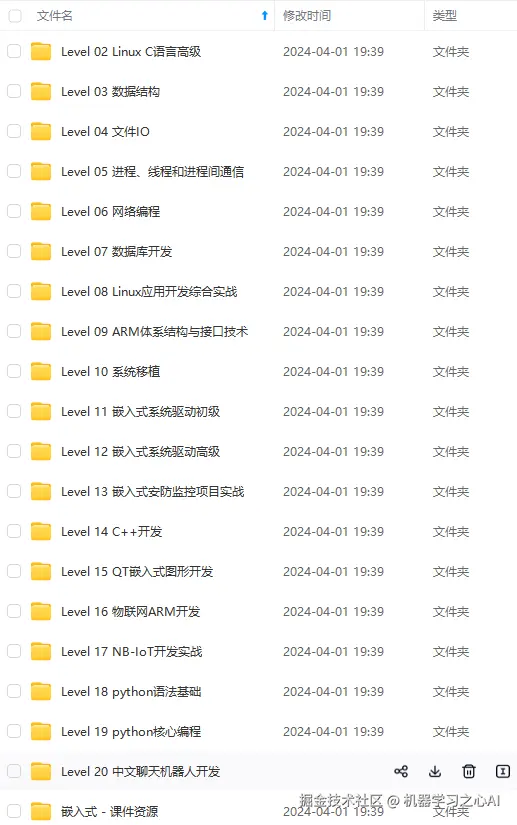

**既有适合小白学习的零基础资料,也有适合3年以上经验的小伙伴深入学习提升的进阶课程,涵盖了95%以上物联网嵌入式知识点,真正体系化!**
**由于文件比较多,这里只是将部分目录截图出来,全套包含大厂面经、学习笔记、源码讲义、实战项目、大纲路线、电子书籍、讲解视频,并且后续会持续更新**
**[如果你需要这些资料,可以戳这里获取](https://gitee.com/vip204888)**