计算机结构
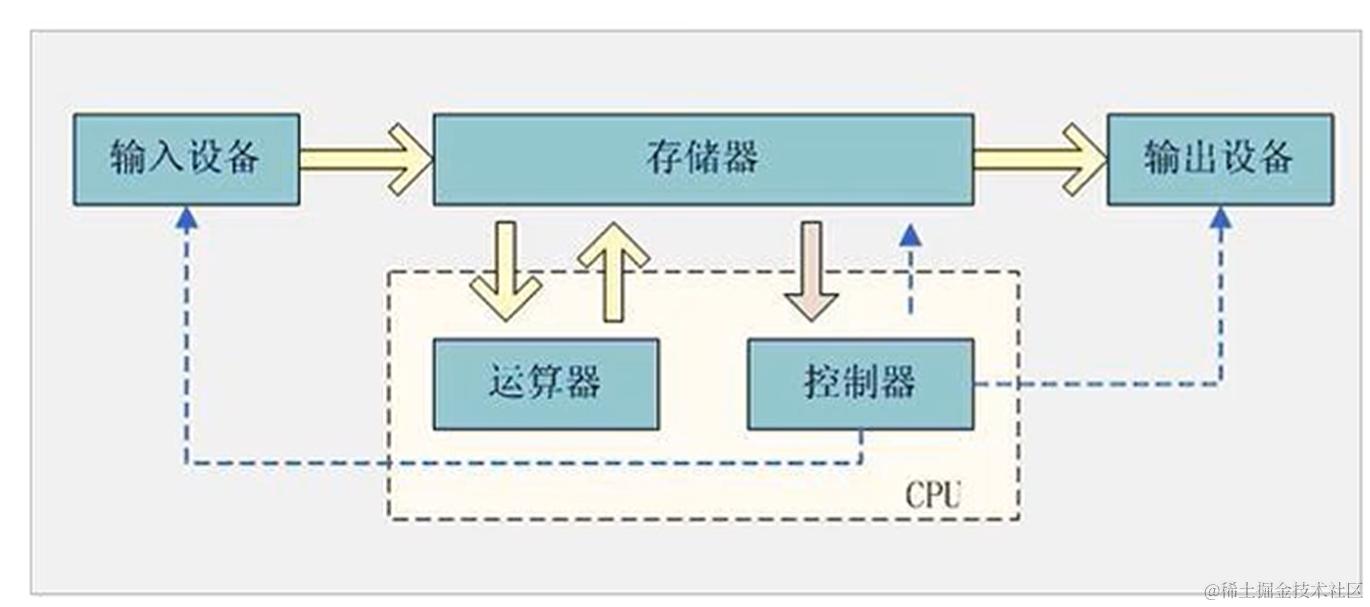
输入设备 -》 存储器 -》 输出设备
-
CPU: 中央处理器
-
内存: 程序都是在内存中运行,内存会保存程序运行时的数据,提供给CPU 使用
-
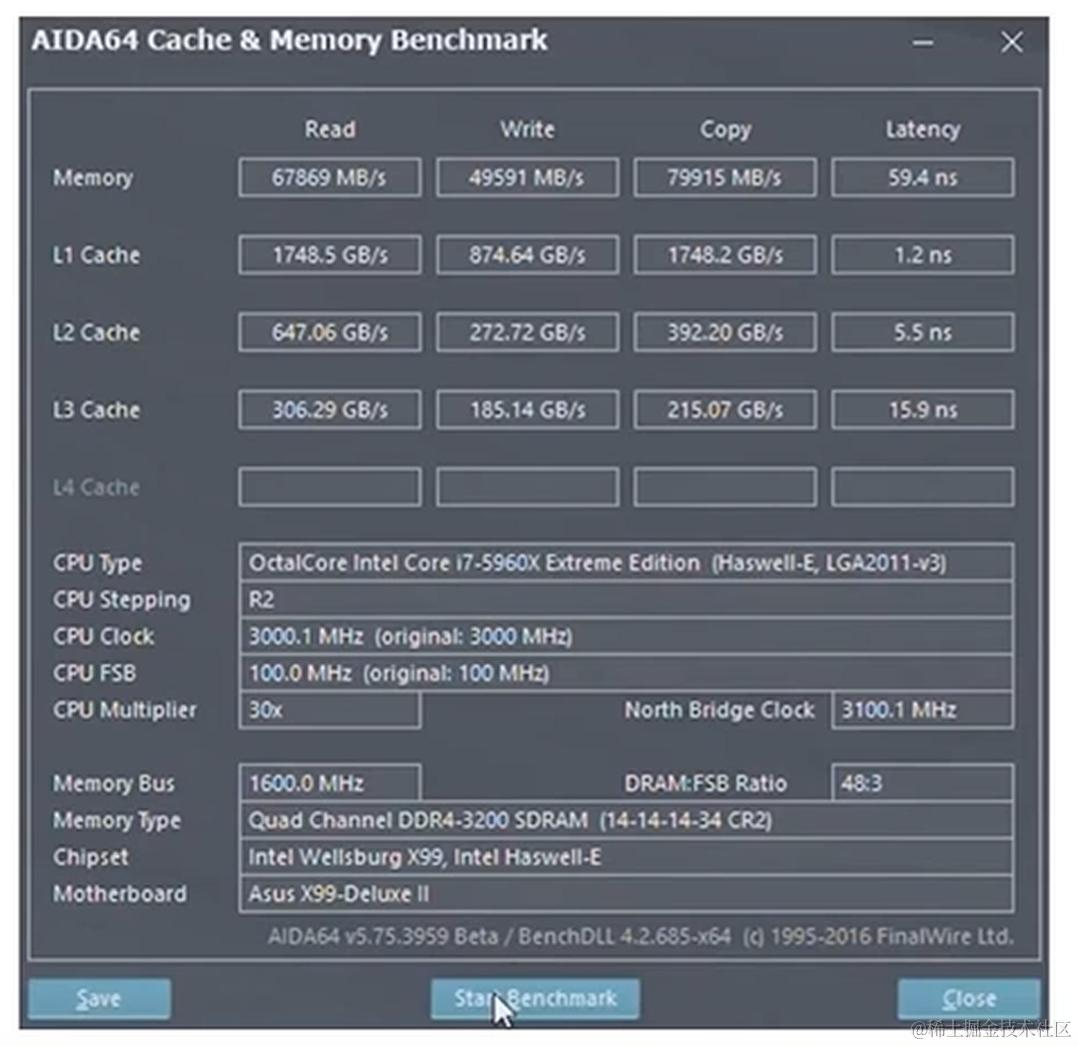
缓存: CPU运行速度和内存访问速度相差比较大,导致 CPU 每次操作内存耗费时间,不能发挥cpu 的性能,于是就设计了 cpu 和内存之间增加缓存的设计;
靠近 cpu 的缓存成为 L1,然后依次是 L2 、 L3 和主内存,cpu 缓存模型如下图:
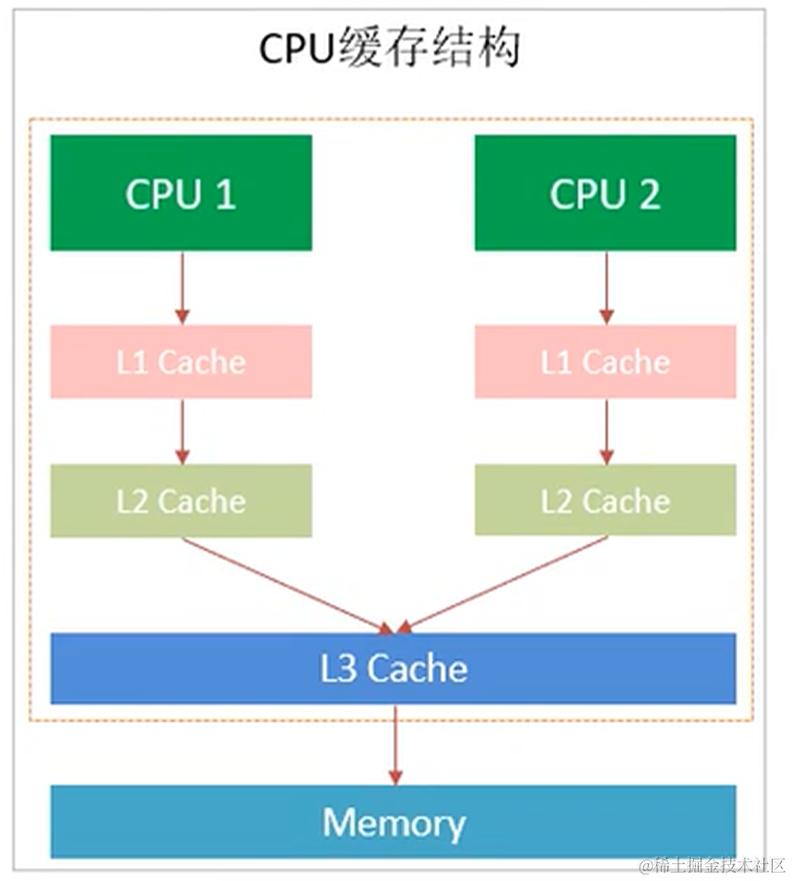
CPU Cache 内置在 CPU 中,分三个级别:L1、L2、L3。
级别越小越接近 CPU 速度也越快 ,同时代表着容量越小,
- L1 容量最小,速度最快,每一个核上都有一个 L1 Cache
- L2 Cache 更大一些,速度要慢一些,一般情况下每个核上都有一个独立 L2 Cache
- L3 Cache 最大,速度最慢, 每一个 CPU 插槽之间共享 L3 Cache
Java Mermory Model
java 内存模型 不是 Java 内存结构
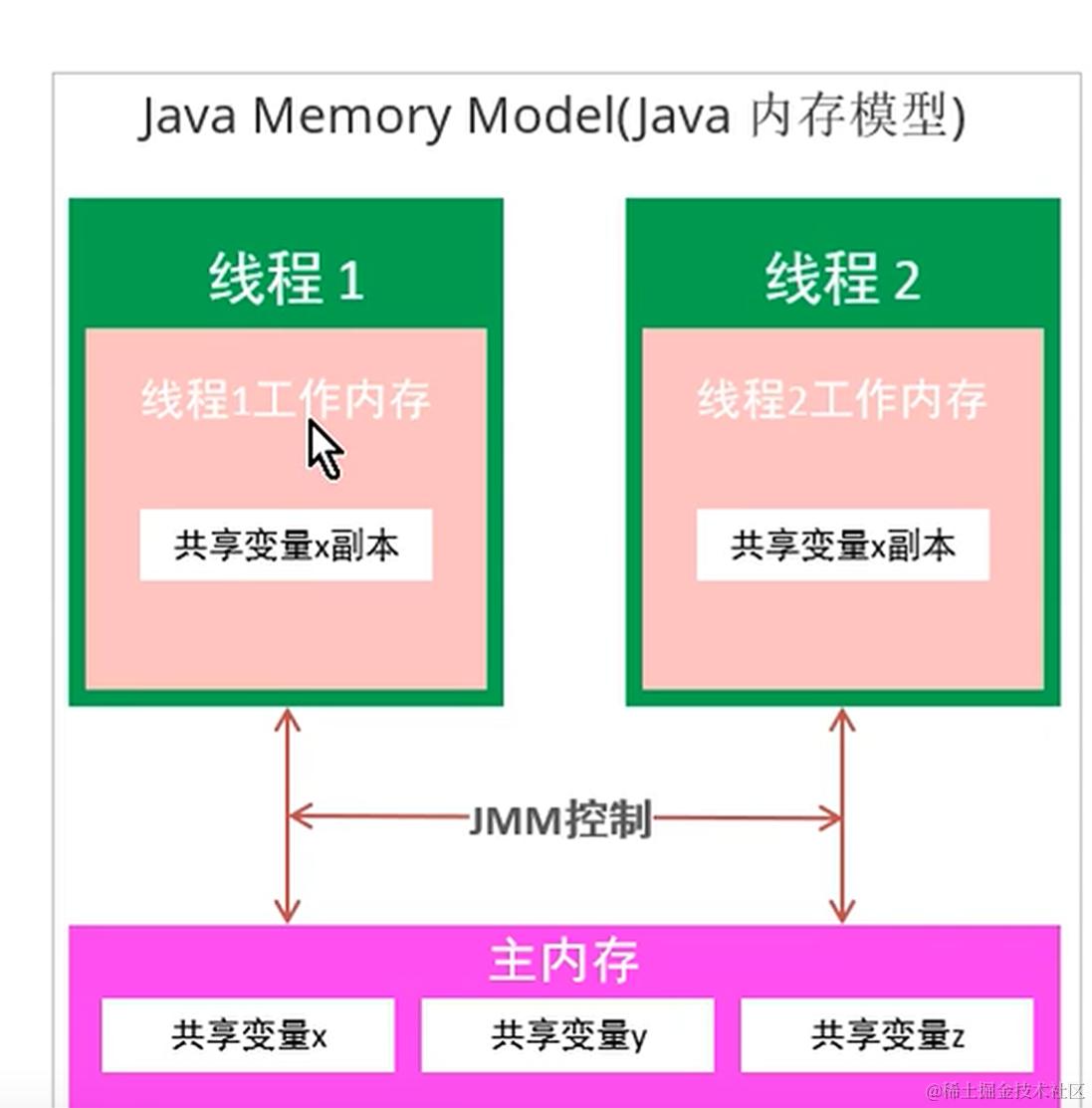
Java 内存模型是 JVM 一套规范,描述 java 程序中各种变量(线程共享变量)的方法问规则,以及在JVM 中变量从内存存取的细节
-
主内存 主内存是所有线程共享的,都能访问的。所有的共享变量都存储于主内存。
-
工作内存 每个线程都有自己的工作内存,工作内存只存储本线程对共享变量的副本。线程对变量的读取操作都是必须在工作内存中完成,而不能直接读取主内存中的变量,不同线程之间也不能直接访问对方的工作内存中的变量
如下图:
volatile 保证有序性和可见性
- volatile 告诉编译器不进行重排序 , 保证有序性
- volatile 告诉当前 JVM 当前线程变量的值是不稳定,需要从共享内存中获取 , 保证可见性
主内存与工作内存交互过程
8种原子操作来完成主内存和共享内存之间的交互;
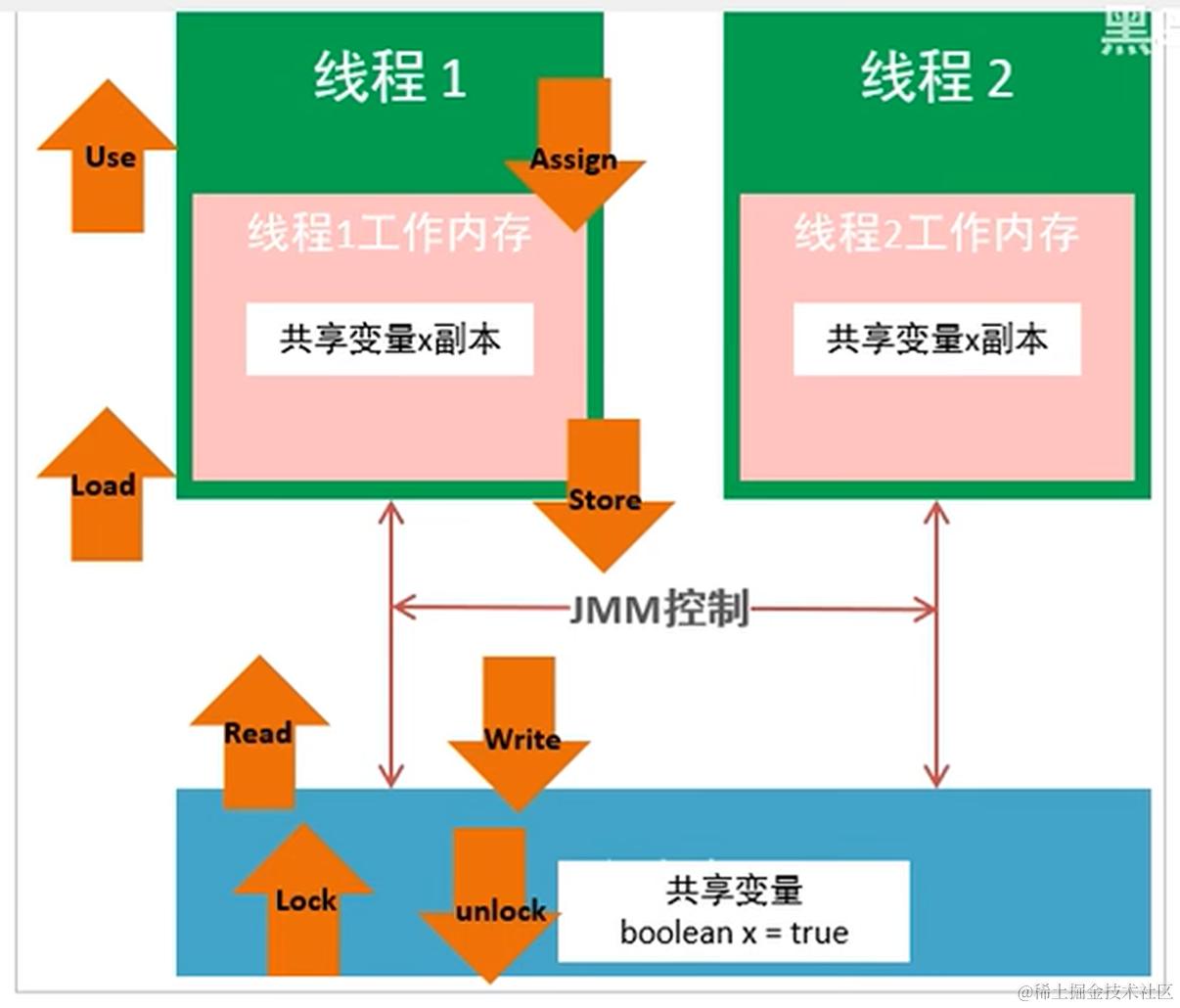
lock -> read -> load -> use -> assign -> store -> write -> unlock
- 如果对一个变量执行 lock 操作,将会清空工作内存中此变量的值,从共享内存重新获取
- 对一个变量执行 unlock 操作之前,必须先把此变量同步到主内存中
synchronized 保证原子性原理
原子性: 在一次或多次操作中,要么所有的操作都执行并且不受其他因素干扰中断,要么所有的操作都不执行。
加锁的互斥性,synchronized 保证同一时间只有一个线程操作,
synchronized 保证可见性
可见性: 共享内存可见性
lock 原子操作会从共享内存刷新工作内存中变量的值
synchronized 保证有序性
重排序: 为了提高程序的执行效率,编译器和 CPU 会对程序中的代码进行重排序, 只能保证单线程最终结果是不变的;
因为编译器和 cpu 的重排序,导致最终的执行顺序不一定是我们代码的顺序;
加锁的互斥性,避免了重排序的造成的有序性问题;
synchronized 可重入锁
同一个线程可以拿到同一个锁多次,锁对象内部有一个计数器(recursions变量)来记录拿到锁的次数, 释放锁时候计数器 -1 。
- 可以避免死锁
- 可以更好的封装代码
synchronized 不可中断
加锁之后,需要加锁的线程对象去释放锁,第二个线程访问时是不可中断的,一直处在等待状态。如果加锁的线程死掉就会出现死锁的现象;
面试题:synchronized 和 ReentrantReadWriteLock
1、synchronized 是关键字,ReentrantReadWriteLock 是一个实现 Lock 的类
2、synchronized 有 jvm 自动加锁和释放锁, Lock 手动释放
3、synchronized 不可中断,Lock 可以中断也可以不中断
4、通过 Lock 可以知道线程有没有拿到锁, 而 synchronized 不能
5、synchronized 能锁住代码快 和方法, Lock 只能锁住代码快
6、Lock 可以读取锁提高多线程读效率
7、synchronized 是非公平锁,ReentrantLock 是控制是否公平
monitor
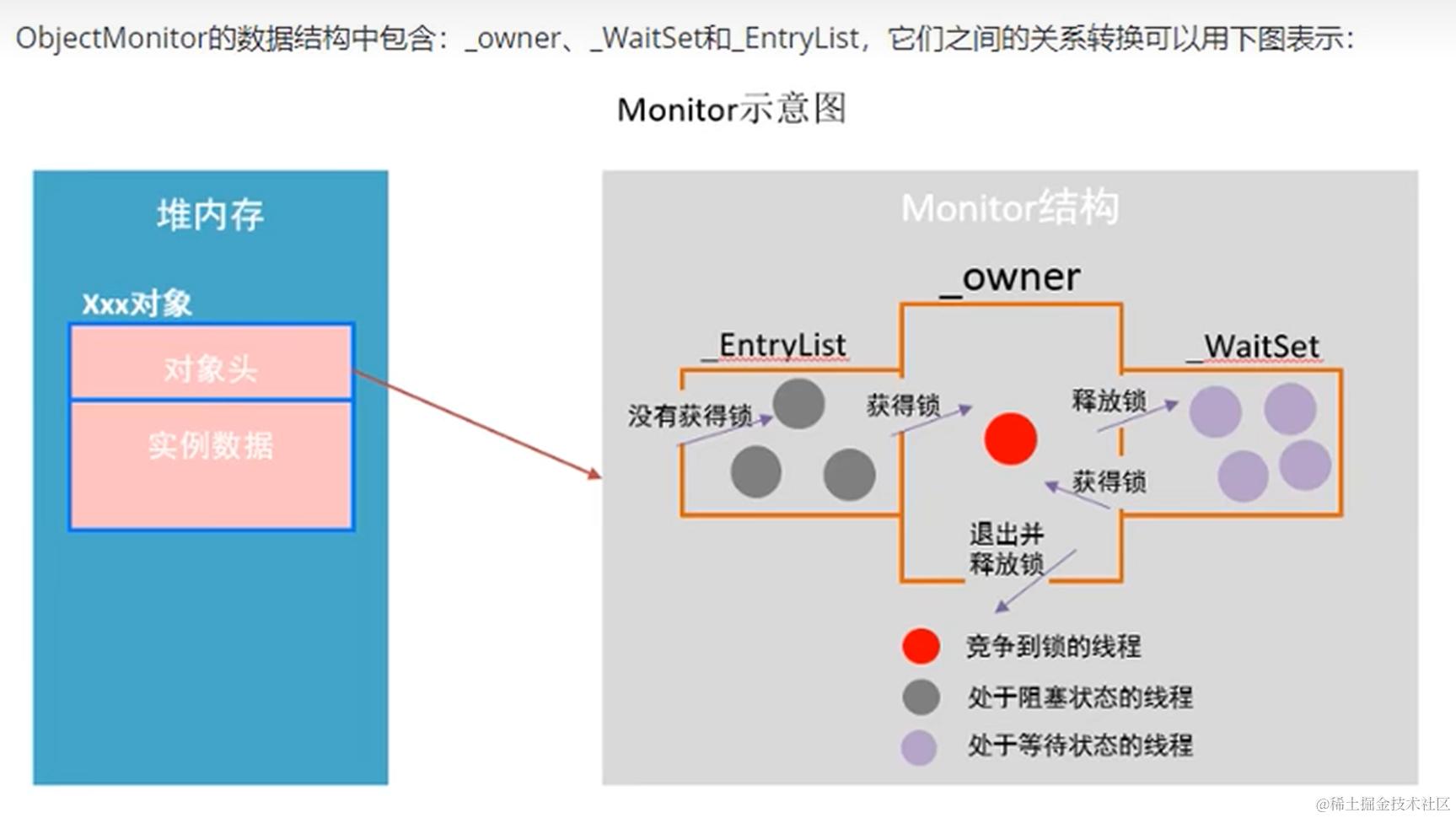
monitor 对象锁结构
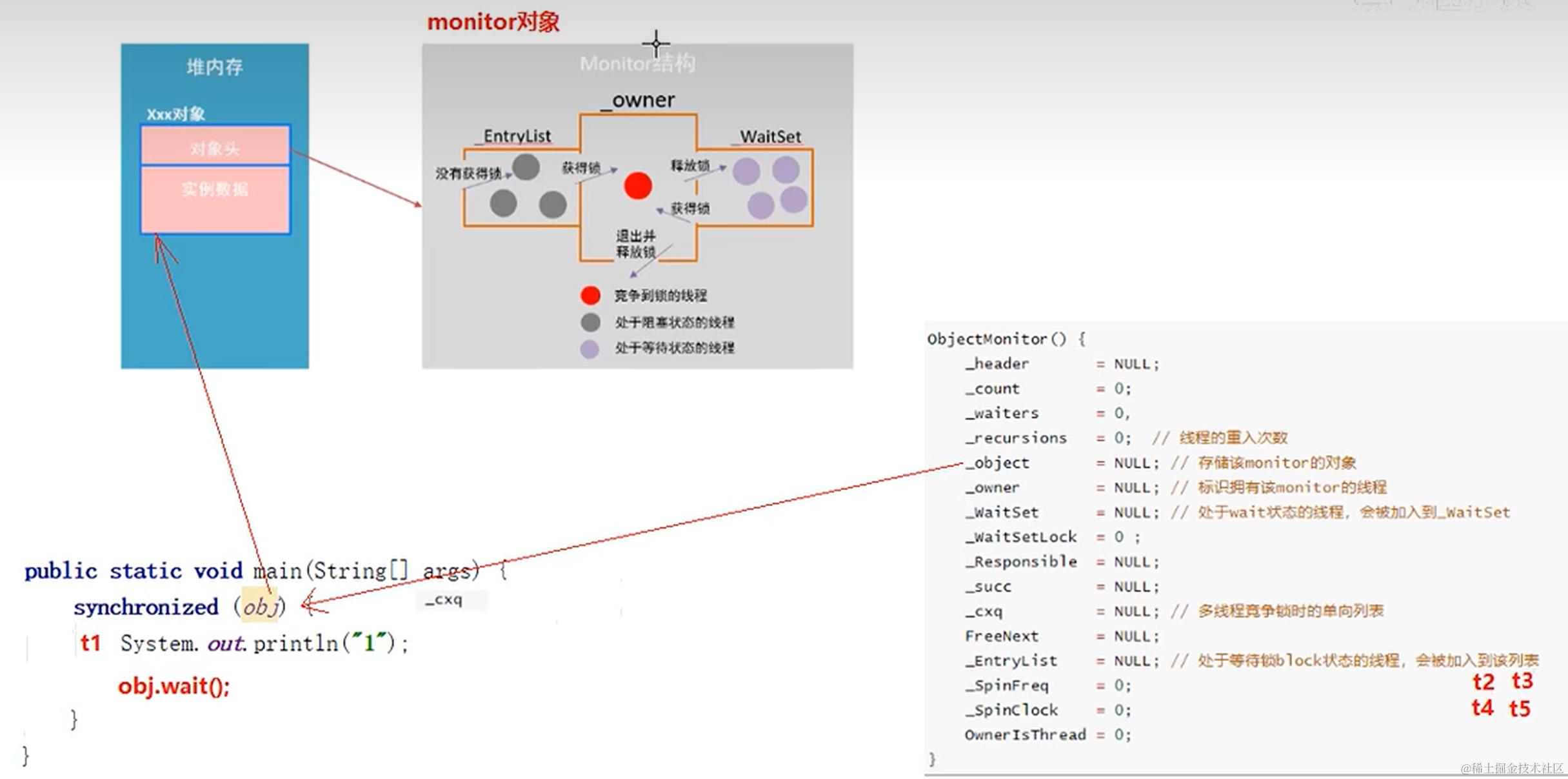
JDK8 JVM 源码
下载流程
openJDK -》 jdk8 -》 下载渠道选hotspot 左边点 zip 下载
monitorenter
每一个对象都会和一个监视器 monitor 关联,监视器被占用时会被锁住,其他线程无法来获取monitor 。
当 JVM 执行某个线程的某个方法内部的 monitorenter 时,它会尝试获取当前对象对应的 monitor 的所有权。过程如下:
- 如 monitor 进入数为0 ,线程可以进入 monitor ,并将monitor 的进入数量为1,当前线程承载 monitor 的所有者 owner。
- 若线程已拥有 monitor 的所有权,运行它重入 monitor,则进入 monitor 计数 recursions +1
- 如其他线程已经占用 monitor 的所有权,那么当前尝试获取monitor 的所有权的线程会被阻塞,直到 monitor 的进入数为0 ,才能重新尝试获取 monitor 的所有权。
synchronized 隐式调用 monitorenter 和 monitorexit ,
-
一个是 owner 所有者
-
一个是 recursions 计数器 重入 计数器++ , 退出 计数器--;
monitor 竞争
- UseBiasedLocking 判断偏向锁
- fast_enter 偏向锁
- slow_enter 重量级锁
\hotspot-87ee5ee27509\src\share\vm\runtime\objectMonitor.cpp
//------------------------------------------------------------------------------------------------------------------------
// Synchronization
//
// The interpreter's synchronization code is factored out so that it can
// be shared by method invocation and synchronized blocks.
//%note synchronization_3

//%note monitor_1
IRT_ENTRY_NO_ASYNC(void, InterpreterRuntime::monitorenter(JavaThread* thread, BasicObjectLock* elem))
#ifdef ASSERT
  thread->last_frame().interpreter_frame_verify_monitor(elem);
#endif
  if (PrintBiasedLockingStatistics) {
    Atomic::inc(BiasedLocking::slow_path_entry_count_addr());
  }
  Handle h_obj(thread, elem->obj());
  assert(Universe::heap()->is_in_reserved_or_null(h_obj()),
         "must be NULL or an object");
  if (UseBiasedLocking) {
    // Retry fast entry if bias is revoked to avoid unnecessary inflation
    ObjectSynchronizer::fast_enter(h_obj, elem->lock(), true, CHECK);
  } else {
    ObjectSynchronizer::slow_enter(h_obj, elem->lock(), CHECK);
  }
  assert(Universe::heap()->is_in_reserved_or_null(elem->obj()),
         "must be NULL or an object");
#ifdef ASSERT
  thread->last_frame().interpreter_frame_verify_monitor(elem);
#endif
IRT_END
slow_enter -> ObjectMonitor::enter
void ATTR ObjectMonitor::enter(TRAPS) {
  // The following code is ordered to check the most common cases first
  // and to reduce RTS->RTO cache line upgrades on SPARC and IA32 processors.
  Thread * const Self = THREAD ;
  void * cur ;

  cur = Atomic::cmpxchg_ptr (Self, &_owner, NULL) ;
  if (cur == NULL) {
     // Either ASSERT _recursions == 0 or explicitly set _recursions = 0.
     assert (_recursions == 0   , "invariant") ;
     assert (_owner      == Self, "invariant") ;
     // CONSIDER: set or assert OwnerIsThread == 1
     return ;
  }

  if (cur == Self) {
     // TODO-FIXME: check for integer overflow!  BUGID 6557169.
     _recursions ++ ;
     return ;
  }

  if (Self->is_lock_owned ((address)cur)) {
    assert (_recursions == 0, "internal state error");
    _recursions = 1 ;
    // Commute owner from a thread-specific on-stack BasicLockObject address to
    // a full-fledged "Thread *".
    _owner = Self ;
    OwnerIsThread = 1 ;
    return ;
  }

  // 省略一些代码

  { // Change java thread status to indicate blocked on monitor enter.
    JavaThreadBlockedOnMonitorEnterState jtbmes(jt, this);

    DTRACE_MONITOR_PROBE(contended__enter, this, object(), jt);
    if (JvmtiExport::should_post_monitor_contended_enter()) {
      JvmtiExport::post_monitor_contended_enter(jt, this);
    }

    OSThreadContendState osts(Self->osthread());
    ThreadBlockInVM tbivm(jt);

    Self->set_current_pending_monitor(this);

    // TODO-FIXME: change the following for(;;) loop to straight-line code.
    for (;;) {
      jt->set_suspend_equivalent();
      // cleared by handle_special_suspend_equivalent_condition()
      // or java_suspend_self()

      EnterI (THREAD) ;

      if (!ExitSuspendEquivalent(jt)) break ;

      //
      // We have acquired the contended monitor, but while we were
      // waiting another thread suspended us. We don't want to enter
      // the monitor while suspended because that would surprise the
      // thread that suspended us.
      //
          _recursions = 0 ;
      _succ = NULL ;
      exit (false, Self) ;

      jt->java_suspend_self();
    }
    Self->set_current_pending_monitor(NULL);
  }

  Atomic::dec_ptr(&_count);
  assert (_count >= 0, "invariant") ;
  Self->_Stalled = 0 ;

  // Must either set _recursions = 0 or ASSERT _recursions == 0.
  assert (_recursions == 0     , "invariant") ;
  assert (_owner == Self       , "invariant") ;
  assert (_succ  != Self       , "invariant") ;
  assert (((oop)(object()))->mark() == markOopDesc::encode(this), "invariant") ;

  // The thread -- now the owner -- is back in vm mode.
  // Report the glorious news via TI,DTrace and jvmstat.
  // The probe effect is non-trivial.  All the reportage occurs
  // while we hold the monitor, increasing the length of the critical
  // section.  Amdahl's parallel speedup law comes vividly into play.
  //
  // Another option might be to aggregate the events (thread local or
  // per-monitor aggregation) and defer reporting until a more opportune
  // time -- such as next time some thread encounters contention but has
  // yet to acquire the lock.  While spinning that thread could
  // spinning we could increment JVMStat counters, etc.

  DTRACE_MONITOR_PROBE(contended__entered, this, object(), jt);
  if (JvmtiExport::should_post_monitor_contended_entered()) {
    JvmtiExport::post_monitor_contended_entered(jt, this);
  }

  if (event.should_commit()) {
    event.set_klass(((oop)this->object())->klass());
    event.set_previousOwner((TYPE_JAVALANGTHREAD)_previous_owner_tid);
    event.set_address((TYPE_ADDRESS)(uintptr_t)(this->object_addr()));
    event.commit();
  }

  if (ObjectMonitor::_sync_ContendedLockAttempts != NULL) {
     ObjectMonitor::_sync_ContendedLockAttempts->inc() ;
  }
}
此处省略锁的自选优化等操作,统一放在后面 synchronized 优化
以上竞争流程
- 通过 CAS 尝试吧 monitor 的 _owner 字段设置为当前线程
- 如果设置之前的 _owner 指向当前线程,说明当前线程再次进入 monitor ,即重入锁, 执行 recursions++,记录重入的次数。
- 如果当前线程是第一次进入该 monitor ,设置 recursions 为 1 ,_owner 为当前线程,该线程成功获取锁并返回
- 如果获取失败,则等待着锁释放
monitor 等待
ObjectMonitor::enterI
void ATTR ObjectMonitor::EnterI (TRAPS) {
    Thread * Self = THREAD ;
    assert (Self->is_Java_thread(), "invariant") ;
    assert (((JavaThread *) Self)->thread_state() == _thread_blocked   , "invariant") ;

    // Try the lock - TATAS
    if (TryLock (Self) > 0) {
        assert (_succ != Self              , "invariant") ;
        assert (_owner == Self             , "invariant") ;
        assert (_Responsible != Self       , "invariant") ;
        return ;
    }

    DeferredInitialize () ;

    // We try one round of spinning *before* enqueueing Self.
    //
    // If the _owner is ready but OFFPROC we could use a YieldTo()
    // operation to donate the remainder of this thread's quantum
    // to the owner.  This has subtle but beneficial affinity
    // effects.

    if (TrySpin (Self) > 0) {
        assert (_owner == Self        , "invariant") ;
        assert (_succ != Self         , "invariant") ;
        assert (_Responsible != Self  , "invariant") ;
        return ;
    }

    // The Spin failed -- Enqueue and park the thread ...
    assert (_succ  != Self            , "invariant") ;
    assert (_owner != Self            , "invariant") ;
    assert (_Responsible != Self      , "invariant") ;

    // Enqueue "Self" on ObjectMonitor's _cxq.
    //
    // Node acts as a proxy for Self.
    // As an aside, if were to ever rewrite the synchronization code mostly
    // in Java, WaitNodes, ObjectMonitors, and Events would become 1st-class
    // Java objects.  This would avoid awkward lifecycle and liveness issues,
    // as well as eliminate a subset of ABA issues.
    // TODO: eliminate ObjectWaiter and enqueue either Threads or Events.
    //

    ObjectWaiter node(Self) ;
    Self->_ParkEvent->reset() ;
    node._prev   = (ObjectWaiter *) 0xBAD ;
    node.TState  = ObjectWaiter::TS_CXQ ;

    // Push "Self" onto the front of the _cxq.
    // Once on cxq/EntryList, Self stays on-queue until it acquires the lock.
    // Note that spinning tends to reduce the rate at which threads
    // enqueue and dequeue on EntryList|cxq.
    ObjectWaiter * nxt ;
    for (;;) {
        node._next = nxt = _cxq ;
        if (Atomic::cmpxchg_ptr (&node, &_cxq, nxt) == nxt) break ;

        // Interference - the CAS failed because _cxq changed.  Just retry.
        // As an optional optimization we retry the lock.
        if (TryLock (Self) > 0) {
            assert (_succ != Self         , "invariant") ;
            assert (_owner == Self        , "invariant") ;
            assert (_Responsible != Self  , "invariant") ;
            return ;
        }
    }

    // Check for cxq|EntryList edge transition to non-null.  This indicates
    // the onset of contention.  While contention persists exiting threads
    // will use a ST:MEMBAR:LD 1-1 exit protocol.  When contention abates exit
    // operations revert to the faster 1-0 mode.  This enter operation may interleave
    // (race) a concurrent 1-0 exit operation, resulting in stranding, so we
    // arrange for one of the contending thread to use a timed park() operations
    // to detect and recover from the race.  (Stranding is form of progress failure
    // where the monitor is unlocked but all the contending threads remain parked).
    // That is, at least one of the contended threads will periodically poll _owner.
    // One of the contending threads will become the designated "Responsible" thread.
    // The Responsible thread uses a timed park instead of a normal indefinite park
    // operation -- it periodically wakes and checks for and recovers from potential
    // strandings admitted by 1-0 exit operations.   We need at most one Responsible
    // thread per-monitor at any given moment.  Only threads on cxq|EntryList may
    // be responsible for a monitor.
    //
    // Currently, one of the contended threads takes on the added role of "Responsible".
    // A viable alternative would be to use a dedicated "stranding checker" thread
    // that periodically iterated over all the threads (or active monitors) and unparked
    // successors where there was risk of stranding.  This would help eliminate the
    // timer scalability issues we see on some platforms as we'd only have one thread
    // -- the checker -- parked on a timer.

    if ((SyncFlags & 16) == 0 && nxt == NULL && _EntryList == NULL) {
        // Try to assume the role of responsible thread for the monitor.
        // CONSIDER:  ST vs CAS vs { if (Responsible==null) Responsible=Self }
        Atomic::cmpxchg_ptr (Self, &_Responsible, NULL) ;
    }

    // The lock have been released while this thread was occupied queueing
    // itself onto _cxq.  To close the race and avoid "stranding" and
    // progress-liveness failure we must resample-retry _owner before parking.
    // Note the Dekker/Lamport duality: ST cxq; MEMBAR; LD Owner.
    // In this case the ST-MEMBAR is accomplished with CAS().
    //
    // TODO: Defer all thread state transitions until park-time.
    // Since state transitions are heavy and inefficient we'd like
    // to defer the state transitions until absolutely necessary,
    // and in doing so avoid some transitions ...

    TEVENT (Inflated enter - Contention) ;
    int nWakeups = 0 ;
    int RecheckInterval = 1 ;

    for (;;) {

        if (TryLock (Self) > 0) break ;
        assert (_owner != Self, "invariant") ;

        if ((SyncFlags & 2) && _Responsible == NULL) {
           Atomic::cmpxchg_ptr (Self, &_Responsible, NULL) ;
        }

        // park self
        if (_Responsible == Self || (SyncFlags & 1)) {
            TEVENT (Inflated enter - park TIMED) ;
            Self->_ParkEvent->park ((jlong) RecheckInterval) ;
            // Increase the RecheckInterval, but clamp the value.
            RecheckInterval *= 8 ;
            if (RecheckInterval > 1000) RecheckInterval = 1000 ;
        } else {
            TEVENT (Inflated enter - park UNTIMED) ;
            Self->_ParkEvent->park() ;
        }

        if (TryLock(Self) > 0) break ;

        // The lock is still contested.
        // Keep a tally of the # of futile wakeups.
        // Note that the counter is not protected by a lock or updated by atomics.
        // That is by design - we trade "lossy" counters which are exposed to
        // races during updates for a lower probe effect.
        TEVENT (Inflated enter - Futile wakeup) ;
        if (ObjectMonitor::_sync_FutileWakeups != NULL) {
           ObjectMonitor::_sync_FutileWakeups->inc() ;
        }
        ++ nWakeups ;

        // Assuming this is not a spurious wakeup we'll normally find _succ == Self.
        // We can defer clearing _succ until after the spin completes
        // TrySpin() must tolerate being called with _succ == Self.
        // Try yet another round of adaptive spinning.
        if ((Knob_SpinAfterFutile & 1) && TrySpin (Self) > 0) break ;

        // We can find that we were unpark()ed and redesignated _succ while
        // we were spinning.  That's harmless.  If we iterate and call park(),
        // park() will consume the event and return immediately and we'll
        // just spin again.  This pattern can repeat, leaving _succ to simply
        // spin on a CPU.  Enable Knob_ResetEvent to clear pending unparks().
        // Alternately, we can sample fired() here, and if set, forgo spinning
        // in the next iteration.

        if ((Knob_ResetEvent & 1) && Self->_ParkEvent->fired()) {
           Self->_ParkEvent->reset() ;
           OrderAccess::fence() ;
        }
        if (_succ == Self) _succ = NULL ;

        // Invariant: after clearing _succ a thread *must* retry _owner before parking.
        OrderAccess::fence() ;
    }

    // Egress :
    // Self has acquired the lock -- Unlink Self from the cxq or EntryList.
    // Normally we'll find Self on the EntryList .
    // From the perspective of the lock owner (this thread), the
    // EntryList is stable and cxq is prepend-only.
    // The head of cxq is volatile but the interior is stable.
    // In addition, Self.TState is stable.

    assert (_owner == Self      , "invariant") ;
    assert (object() != NULL    , "invariant") ;
    // I'd like to write:
    //   guarantee (((oop)(object()))->mark() == markOopDesc::encode(this), "invariant") ;
    // but as we're at a safepoint that's not safe.

    UnlinkAfterAcquire (Self, &node) ;
    if (_succ == Self) _succ = NULL ;

    assert (_succ != Self, "invariant") ;
    if (_Responsible == Self) {
        _Responsible = NULL ;
        OrderAccess::fence(); // Dekker pivot-point

        // We may leave threads on cxq|EntryList without a designated
        // "Responsible" thread.  This is benign.  When this thread subsequently
        // exits the monitor it can "see" such preexisting "old" threads --
        // threads that arrived on the cxq|EntryList before the fence, above --
        // by LDing cxq|EntryList.  Newly arrived threads -- that is, threads
        // that arrive on cxq after the ST:MEMBAR, above -- will set Responsible
        // non-null and elect a new "Responsible" timer thread.
        //
        // This thread executes:
        //    ST Responsible=null; MEMBAR    (in enter epilog - here)
        //    LD cxq|EntryList               (in subsequent exit)
        //
        // Entering threads in the slow/contended path execute:
        //    ST cxq=nonnull; MEMBAR; LD Responsible (in enter prolog)
        //    The (ST cxq; MEMBAR) is accomplished with CAS().
        //
        // The MEMBAR, above, prevents the LD of cxq|EntryList in the subsequent
        // exit operation from floating above the ST Responsible=null.
    }

    // We've acquired ownership with CAS().
    // CAS is serializing -- it has MEMBAR/FENCE-equivalent semantics.
    // But since the CAS() this thread may have also stored into _succ,
    // EntryList, cxq or Responsible.  These meta-data updates must be
    // visible __before this thread subsequently drops the lock.
    // Consider what could occur if we didn't enforce this constraint --
    // STs to monitor meta-data and user-data could reorder with (become
    // visible after) the ST in exit that drops ownership of the lock.
    // Some other thread could then acquire the lock, but observe inconsistent
    // or old monitor meta-data and heap data.  That violates the JMM.
    // To that end, the 1-0 exit() operation must have at least STST|LDST
    // "release" barrier semantics.  Specifically, there must be at least a
    // STST|LDST barrier in exit() before the ST of null into _owner that drops
    // the lock.   The barrier ensures that changes to monitor meta-data and data
    // protected by the lock will be visible before we release the lock, and
    // therefore before some other thread (CPU) has a chance to acquire the lock.
    // See also: http://gee.cs.oswego.edu/dl/jmm/cookbook.html.
    //
    // Critically, any prior STs to _succ or EntryList must be visible before
    // the ST of null into _owner in the *subsequent* (following) corresponding
    // monitorexit.  Recall too, that in 1-0 mode monitorexit does not necessarily
    // execute a serializing instruction.

    if (SyncFlags & 8) {
       OrderAccess::fence() ;
    }
    return ;
}
等待流程:
- 当前线程被封装 ObjectWaiter 对象 node, 状态设置成 ObjectWaiter::TS_CXQ。
- 在for 循环中, 通过 CAS 把 node 节点 push 到 _cxq 列表中,同一时刻可能有多个线程把自己的 node 节点 push 到 _cxq 列表中
- node 节点 push 到 _cxq 列表之后, 通过自选尝试获取锁,如果还没有获取, 则通过 park 将当前线程挂起,等待被唤醒
- 当前线程被唤醒时, 会从挂起的点继续执行,通过 ObjectMonitor::TryLock 尝试获取锁
monitor 释放
ObjectMonitor::exit
void ATTR ObjectMonitor::exit(bool not_suspended, TRAPS) {
   Thread * Self = THREAD ;
   //...省略
   if (_recursions != 0) {
     _recursions--;        // this is simple recursive enter
     TEVENT (Inflated exit - recursive) ;
     return ;
   }

    //...省略
      ObjectWaiter * w = NULL ;
      int QMode = Knob_QMode ;

      if (QMode == 2 && _cxq != NULL) {
          // QMode == 2 : cxq has precedence over EntryList.
          // Try to directly wake a successor from the cxq.
          // If successful, the successor will need to unlink itself from cxq.
          w = _cxq ;
          assert (w != NULL, "invariant") ;
          assert (w->TState == ObjectWaiter::TS_CXQ, "Invariant") ;
          ExitEpilog (Self, w) ;
          return ;
      }

      if (QMode == 3 && _cxq != NULL) {
          // Aggressively drain cxq into EntryList at the first opportunity.
          // This policy ensure that recently-run threads live at the head of EntryList.
          // Drain _cxq into EntryList - bulk transfer.
          // First, detach _cxq.
          // The following loop is tantamount to: w = swap (&cxq, NULL)
          w = _cxq ;
          for (;;) {
             assert (w != NULL, "Invariant") ;
             ObjectWaiter * u = (ObjectWaiter *) Atomic::cmpxchg_ptr (NULL, &_cxq, w) ;
             if (u == w) break ;
             w = u ;
          }
          assert (w != NULL              , "invariant") ;

          ObjectWaiter * q = NULL ;
          ObjectWaiter * p ;
          for (p = w ; p != NULL ; p = p->_next) {
              guarantee (p->TState == ObjectWaiter::TS_CXQ, "Invariant") ;
              p->TState = ObjectWaiter::TS_ENTER ;
              p->_prev = q ;
              q = p ;
          }

          // Append the RATs to the EntryList
          // TODO: organize EntryList as a CDLL so we can locate the tail in constant-time.
          ObjectWaiter * Tail ;
          for (Tail = _EntryList ; Tail != NULL && Tail->_next != NULL ; Tail = Tail->_next) ;
          if (Tail == NULL) {
              _EntryList = w ;
          } else {
              Tail->_next = w ;
              w->_prev = Tail ;
          }

          // Fall thru into code that tries to wake a successor from EntryList
      }

      if (QMode == 4 && _cxq != NULL) {
          // Aggressively drain cxq into EntryList at the first opportunity.
          // This policy ensure that recently-run threads live at the head of EntryList.

          // Drain _cxq into EntryList - bulk transfer.
          // First, detach _cxq.
          // The following loop is tantamount to: w = swap (&cxq, NULL)
          w = _cxq ;
          for (;;) {
             assert (w != NULL, "Invariant") ;
             ObjectWaiter * u = (ObjectWaiter *) Atomic::cmpxchg_ptr (NULL, &_cxq, w) ;
             if (u == w) break ;
             w = u ;
          }
          assert (w != NULL              , "invariant") ;

          ObjectWaiter * q = NULL ;
          ObjectWaiter * p ;
          for (p = w ; p != NULL ; p = p->_next) {
              guarantee (p->TState == ObjectWaiter::TS_CXQ, "Invariant") ;
              p->TState = ObjectWaiter::TS_ENTER ;
              p->_prev = q ;
              q = p ;
          }

          // Prepend the RATs to the EntryList
          if (_EntryList != NULL) {
              q->_next = _EntryList ;
              _EntryList->_prev = q ;
          }
          _EntryList = w ;

          // Fall thru into code that tries to wake a successor from EntryList
      }

      w = _EntryList  ;
      if (w != NULL) {
          // I'd like to write: guarantee (w->_thread != Self).
          // But in practice an exiting thread may find itself on the EntryList.
          // Lets say thread T1 calls O.wait().  Wait() enqueues T1 on O's waitset and
          // then calls exit().  Exit release the lock by setting O._owner to NULL.
          // Lets say T1 then stalls.  T2 acquires O and calls O.notify().  The
          // notify() operation moves T1 from O's waitset to O's EntryList. T2 then
          // release the lock "O".  T2 resumes immediately after the ST of null into
          // _owner, above.  T2 notices that the EntryList is populated, so it
          // reacquires the lock and then finds itself on the EntryList.
          // Given all that, we have to tolerate the circumstance where "w" is
          // associated with Self.
          assert (w->TState == ObjectWaiter::TS_ENTER, "invariant") ;
          ExitEpilog (Self, w) ;
          return ;
      }

      // If we find that both _cxq and EntryList are null then just
      // re-run the exit protocol from the top.
      w = _cxq ;
      if (w == NULL) continue ;

      // Drain _cxq into EntryList - bulk transfer.
      // First, detach _cxq.
      // The following loop is tantamount to: w = swap (&cxq, NULL)
      for (;;) {
          assert (w != NULL, "Invariant") ;
          ObjectWaiter * u = (ObjectWaiter *) Atomic::cmpxchg_ptr (NULL, &_cxq, w) ;
          if (u == w) break ;
          w = u ;
      }
      TEVENT (Inflated exit - drain cxq into EntryList) ;

      assert (w != NULL              , "invariant") ;
      assert (_EntryList  == NULL    , "invariant") ;

      // Convert the LIFO SLL anchored by _cxq into a DLL.
      // The list reorganization step operates in O(LENGTH(w)) time.
      // It's critical that this step operate quickly as
      // "Self" still holds the outer-lock, restricting parallelism
      // and effectively lengthening the critical section.
      // Invariant: s chases t chases u.
      // TODO-FIXME: consider changing EntryList from a DLL to a CDLL so
      // we have faster access to the tail.

      if (QMode == 1) {
         // QMode == 1 : drain cxq to EntryList, reversing order
         // We also reverse the order of the list.
         ObjectWaiter * s = NULL ;
         ObjectWaiter * t = w ;
         ObjectWaiter * u = NULL ;
         while (t != NULL) {
             guarantee (t->TState == ObjectWaiter::TS_CXQ, "invariant") ;
             t->TState = ObjectWaiter::TS_ENTER ;
             u = t->_next ;
             t->_prev = u ;
             t->_next = s ;
             s = t;
             t = u ;
         }
         _EntryList  = s ;
         assert (s != NULL, "invariant") ;
      } else {
         // QMode == 0 or QMode == 2
         _EntryList = w ;
         ObjectWaiter * q = NULL ;
         ObjectWaiter * p ;
         for (p = w ; p != NULL ; p = p->_next) {
             guarantee (p->TState == ObjectWaiter::TS_CXQ, "Invariant") ;
             p->TState = ObjectWaiter::TS_ENTER ;
             p->_prev = q ;
             q = p ;
         }
      }

      // In 1-0 mode we need: ST EntryList; MEMBAR #storestore; ST _owner = NULL
      // The MEMBAR is satisfied by the release_store() operation in ExitEpilog().

      // See if we can abdicate to a spinner instead of waking a thread.
      // A primary goal of the implementation is to reduce the
      // context-switch rate.
      if (_succ != NULL) continue;

      w = _EntryList  ;
      if (w != NULL) {
          guarantee (w->TState == ObjectWaiter::TS_ENTER, "invariant") ;
          ExitEpilog (Self, w) ;
          return ;
      }
   }
}
-
能执行 monitorexit 指令的线程一定是拥有当前对象的 monitor 的所有权的线程
-
先判断是否是重入状态, 如果是重入状态则计数器 _recursions -- 并退出,
-
Knob_QMode控制阻塞唤醒顺序
Knob_QMode 有5个值,分别为0,1,2,3,4,默认策略为0。以下策略都是自旋的,一直会自旋到取到线程为止:
- 0:默认策略。OnDeck取Entry List的首位。如果Entry List为空则先用局部变量w指向cxq,然后将cxq置为null,最后将w改造成新的Entry List,再取Entry List的首位成为OnDeck线程。
- 1:OnDeck取Entry List的首位。如果Entry List为空则将cxq的节点逆向载入Entry List,再取Entry List的首位成为OnDeck线程。
- 2:OnDeck直接取cxq的首位。如果cxq为空则取EntryList的首位。
- 3:将cxq的元素插入Entry List的队尾(cxq的首接Entry List的首),再取Entry List的首位成为OnDeck线程。
- 4:将cxq的元素插入Entry List的队首(cxq的尾接Entry List的首),再取Entry List的首位成为OnDeck线程。
-
执行 monitorexit 时会将 monitor 的进入数 -1 ,当 monitor 进入数减为 0 是,当前线程推出 monitor, 不再拥有 monitor 的所有权,此时其他被这个 monitor 阻塞的线程可以尝试获取这个 monitor 对象的所有权
monitor 是重量级锁
可以看到 ObjectMonitor 的函数调用中会涉及到 Atomic::cmpxchg_ptr, Atomic::inc_ptr 等内核函数,执行同步代码快, 没有竞争到锁的对象会 park 挂起, 竞争到锁的线程会 unpark 唤醒。
这个时候会存在操作系统的用户态和内核态转换, 这种切换会消耗大量的系统资源 ,所有 synchronized 是重量级的操作

系统调用:
- 用户态程序将一些数据存放在寄存器中,或者使用参数创建一个堆栈, 以此表明需要操作系统提供的服务
- 用户态执行系统调用
- CPU 切换到内核态,并跳到位于内存指定位置的指令。
- 系统调用处理器会读取程序放入到内存的数据,并执行程序请求的服务
- 系统调用完成后,操作系统会重置 CPU 为用户态并返回系统调用的结果
没有优化之前