回顾
导读
- AQS 是什么、底层原理(独占模式、共享模式实现)
- AQS 变种 CLH 相比于原始 CLH 的改变
版本及说明
AQS
- AQS 全称是 AbstractQueuedSynchronizer,是 Java 并发包中的一个抽象类,用于构建各种同步器和锁,如 ReentrantLock、CountDownLatch、Semaphore 等。
核心思想
- 基于 CAS 和 变种 CLH 实现对互斥资源的访问;访问互斥资源时,当互斥资源空闲时,通过 CAS 操作将互斥资源置为锁定状态,并将访问线程置为当前线程,当互斥资源被其他线程锁定时,通过变种 CLH 实现的逻辑 FIFO 队列实现对线程的阻塞以及资源释放时的唤醒机制。
结构
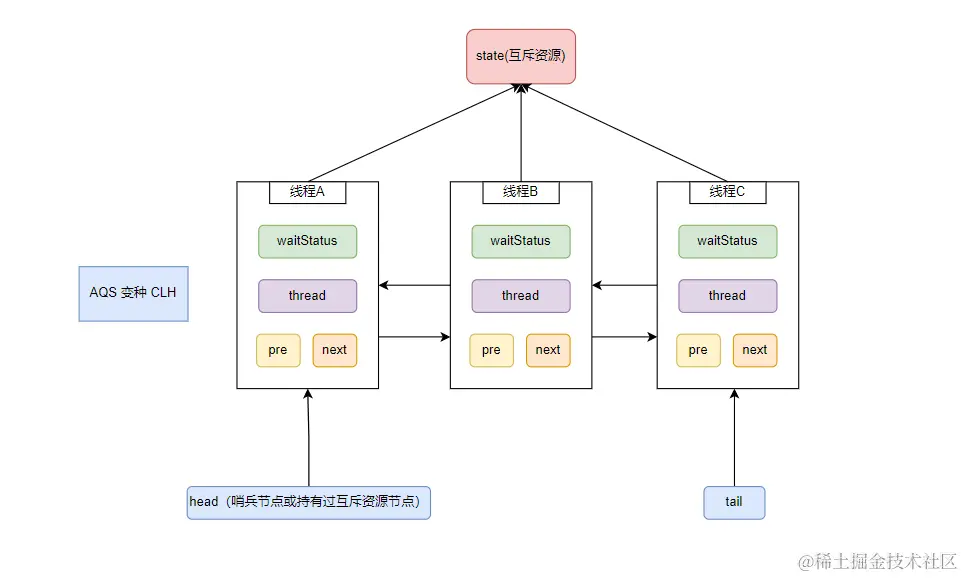
- AQS 使用 int 成员变量 state 表示同步状态,通过内置的 FIFO 等待队列 来完成获取资源线程的排队工作。
public abstract class AbstractQueuedSynchronizer extends AbstractOwnableSynchronizer
implements java.io.Serializable {
private transient volatile Node head;
private transient volatile Node tail;
private volatile int state;
protected final int getState() {
return state;
}
protected final void setState(int newState) {
state = newState;
}
protected final boolean compareAndSetState(int expect, int update) {
return unsafe.compareAndSwapInt(this, stateOffset, expect, update);
}
}
state 状态
| 状态名 | 描述 |
|---|
| SIGNAL(-1) | 表示该节点正常等待 |
| PROPAGATE(-3) | 应将 releaseShared 传播到其他节点 |
| CONDITION(-2) | 该节点位于条件队列,不能用于同步队列节点 |
| CANCELLED(1) | 由于超时、中断或其他原因,该节点被取消 |
| (0) | 节点初始状态 |
Node 节点
static final class Node {
static final Node SHARED = new Node();
static final Node EXCLUSIVE = null;
volatile int waitStatus;
volatile Node prev;
volatile Node next;
volatile Thread thread;
Node nextWaiter;
}
独占模式和共享模式
- AQS 支持两种资源共享方式:Exclusive(独占,只有一个线程能执行,如基于独占模式实现的 ReentrantLock)和 Share(共享,多个线程可同时执行,如基于共享模式实现的 Semaphore/CountDownLatch)。
独占模式
获取锁
public final void acquire(int arg) {
if (!tryAcquire(arg) && acquireQueued(addWaiter(Node.EXCLUSIVE), arg))
selfInterrupt();
}
private Node addWaiter(Node mode) {
Node node = new Node(Thread.currentThread(), mode);
Node pred = tail;
if (pred != null) {
node.prev = pred;
if (compareAndSetTail(pred, node)) {
pred.next = node;
return node;
}
}
enq(node);
return node;
}
private Node enq(final Node node) {
for (; ; ) {
Node t = tail;
if (t == null) {
if (compareAndSetHead(new Node()))
tail = head;
} else {
node.prev = t;
if (compareAndSetTail(t, node)) {
t.next = node;
return t;
}
}
}
}
final boolean acquireQueued(final Node node, int arg) {
boolean failed = true;
try {
boolean interrupted = false;
for (; ; ) {
final Node p = node.predecessor();
if (p == head && tryAcquire(arg)) {
setHead(node);
p.next = null;
failed = false;
return interrupted;
}
if (shouldParkAfterFailedAcquire(p, node) &&
parkAndCheckInterrupt())
interrupted = true;
}
} finally {
if (failed)
cancelAcquire(node);
}
}
private void setHead(Node node) {
head = node;
node.thread = null;
node.prev = null;
}
private static boolean shouldParkAfterFailedAcquire(Node pred, Node node) {
int ws = pred.waitStatus;
if (ws == Node.SIGNAL)
return true;
if (ws > 0) {
do {
node.prev = pred = pred.prev;
} while (pred.waitStatus > 0);
pred.next = node;
} else {
compareAndSetWaitStatus(pred, ws, Node.SIGNAL);
}
return false;
}
private void cancelAcquire(Node node) {
if (node == null)
return;
node.thread = null;
Node pred = node.prev;
while (pred.waitStatus > 0)
node.prev = pred = pred.prev;
Node predNext = pred.next;
node.waitStatus = Node.CANCELLED;
if (node == tail && compareAndSetTail(node, pred)) {
compareAndSetNext(pred, predNext, null);
} else {
int ws;
if (pred != head &&
((ws = pred.waitStatus) == Node.SIGNAL ||
(ws <= 0 && compareAndSetWaitStatus(pred, ws, Node.SIGNAL))) &&
pred.thread != null) {
Node next = node.next;
if (next != null && next.waitStatus <= 0)
compareAndSetNext(pred, predNext, next);
} else {
unparkSuccessor(node);
}
node.next = node;
}
}
释放锁
public final boolean release(int arg) {
if (tryRelease(arg)) {
Node h = head;
if (h != null && h.waitStatus != 0)
unparkSuccessor(h);
return true;
}
return false;
}
private void unparkSuccessor(Node node) {
int ws = node.waitStatus;
if (ws < 0)
compareAndSetWaitStatus(node, ws, 0);
Node s = node.next;
if (s == null || s.waitStatus > 0) {
s = null;
for (Node t = tail; t != null && t != node; t = t.prev)
if (t.waitStatus <= 0)
s = t;
}
if (s != null)
LockSupport.unpark(s.thread);
}
共享模式
获取锁
public final void acquireShared(int arg) {
if (tryAcquireShared(arg) < 0)
doAcquireShared(arg);
}
private void doAcquireShared(int arg) {
final Node node = addWaiter(Node.SHARED);
boolean failed = true;
try {
boolean interrupted = false;
for (;;) {
final Node p = node.predecessor();
if (p == head) {
int r = tryAcquireShared(arg);
if (r >= 0) {
setHeadAndPropagate(node, r);
p.next = null;
if (interrupted)
selfInterrupt();
failed = false;
return;
}
}
if (shouldParkAfterFailedAcquire(p, node) &&
parkAndCheckInterrupt())
interrupted = true;
}
} finally {
if (failed)
cancelAcquire(node);
}
}
private void setHeadAndPropagate(Node node, int propagate) {
Node h = head;
setHead(node);
if (propagate > 0 || h == null || h.waitStatus < 0 ||
(h = head) == null || h.waitStatus < 0) {
Node s = node.next;
if (s == null || s.isShared())
doReleaseShared();
}
}
释放锁
public final boolean releaseShared(int arg) {
if (tryReleaseShared(arg)) {
doReleaseShared();
return true;
}
return false;
}
private void doReleaseShared() {
*/
for (;;) {
Node h = head;
if (h != null && h != tail) {
int ws = h.waitStatus;
if (ws == Node.SIGNAL) {
if (!compareAndSetWaitStatus(h, Node.SIGNAL, 0))
continue;
unparkSuccessor(h);
}
else if (ws == 0 && !compareAndSetWaitStatus(h, 0, Node.PROPAGATE))
continue;
}
if (h == head)
break;
}
}
private void unparkSuccessor(Node node) {
int ws = node.waitStatus;
if (ws < 0)
compareAndSetWaitStatus(node, ws, 0);
Node s = node.next;
if (s == null || s.waitStatus > 0) {
s = null;
for (Node t = tail; t != null && t != node; t = t.prev)
if (t.waitStatus <= 0)
s = t;
}
if (s != null)
LockSupport.unpark(s.thread);
}
模版方法的使用
- AQS 使用了模板方法模式,当实现自定义同步器时需要重写下面几个 AQS 提供的钩子方法:
protected boolean tryAcquire(int)
protected boolean tryRelease(int)
protected int tryAcquireShared(int)
protected boolean tryReleaseShared(int)
protected boolean isHeldExclusively()
AQS 条件队列 Condition
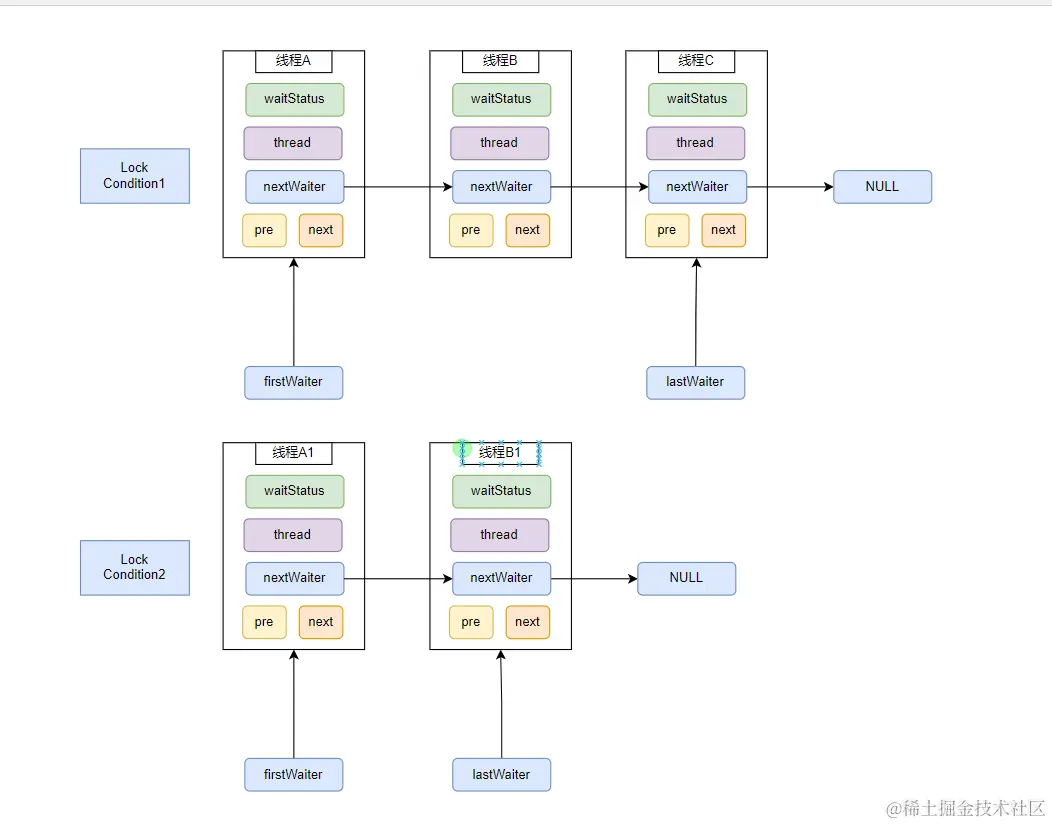
- 在 AQS 的基础上,Java 提供了一个更高级的同步工具 Condition,它允许线程在特定条件下等待和唤醒,以实现更复杂的线程间通信。
- 实现 synchronized 对象锁中的wait、notify、notifyAll, Condition 支持多条件,可以实现更细粒度的控制。
- 仅支持独占锁。
使用示例
public class MainTest {
public static void main(String[] args) {
ReentrantLock lock = new ReentrantLock();
Condition condition = lock.newCondition();
new Thread(() -> {
lock.lock();
System.out.println("线程1获取锁");
System.out.println("线程1条件等待、释放锁");
condition.awaitUninterruptibly();
System.out.println("线程1重新获取锁");
lock.unlock();
System.out.println("线程1释放锁");
}).start();
new Thread(() -> {
lock.lock();
System.out.println("线程2获取锁");
System.out.println("线程唤醒条件队列的的一个锁");
condition.signal();
lock.unlock();
System.out.println("线程2释放锁");
}).start();
}
}
线程1获取锁
线程1条件等待、释放锁
线程2获取锁
线程唤醒条件队列的的一个锁
线程2释放锁
线程1重新获取锁
线程1释放锁
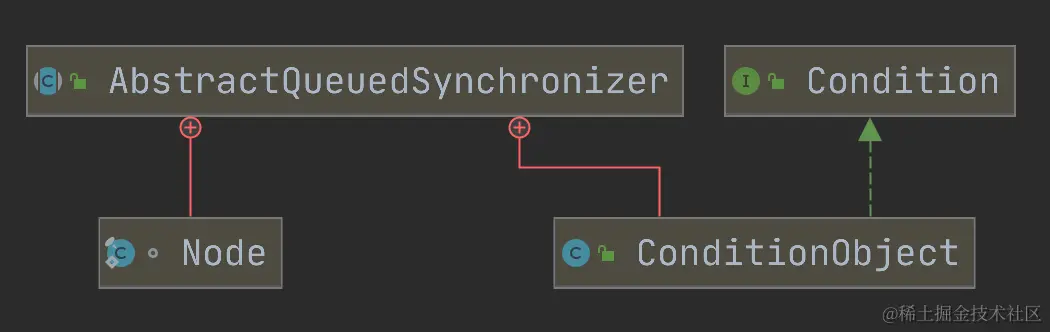
类图
ConditionObject 类结构
- Condition 接口提供了常见的标准方法,ConditionObject 类是具体实现。
public class ConditionObject implements Condition, java.io.Serializable {
private static final long serialVersionUID = 1173984872572414699L;
private transient Node firstWaiter;
private transient Node lastWaiter;
}
Condition 接口提供的方法
void await() throws InterruptedException;
void awaitUninterruptibly();
long awaitNanos(long nanosTimeout) throws InterruptedException;
boolean await(long time, TimeUnit unit) throws InterruptedException;
boolean awaitUntil(Date deadline) throws InterruptedException;
void signal();
void signalAll();
核心方法
- 下面以 await、signal 两个核心方法介绍 Condition 的底层实现。
await()
public final void await() throws InterruptedException {
if (Thread.interrupted()) throw new InterruptedException();
Node node = addConditionWaiter();
int savedState = fullyRelease(node);
int interruptMode = 0;
while (!isOnSyncQueue(node)) {
LockSupport.park(this);
if ((interruptMode = checkInterruptWhileWaiting(node)) != 0)
break;
}
if (acquireQueued(node, savedState) && interruptMode != THROW_IE)
interruptMode = REINTERRUPT;
if (node.nextWaiter != null)
unlinkCancelledWaiters();
if (interruptMode != 0)
reportInterruptAfterWait(interruptMode);
}
private Node addConditionWaiter() {
Node t = lastWaiter;
if (t != null && t.waitStatus != Node.CONDITION) {
unlinkCancelledWaiters();
t = lastWaiter;
}
Node node = new Node(Thread.currentThread(), Node.CONDITION);
if (t == null)
firstWaiter = node;
else
t.nextWaiter = node;
lastWaiter = node;
return node;
}
final int fullyRelease(Node node) {
boolean failed = true;
try {
int savedState = getState();
if (release(savedState)) {
failed = false;
return savedState;
} else {
throw new IllegalMonitorStateException();
}
} finally {
if (failed)
node.waitStatus = Node.CANCELLED;
}
}
public final boolean release(int arg) {
if (tryRelease(arg)) {
Node h = head;
if (h != null && h.waitStatus != 0)
unparkSuccessor(h);
return true;
}
return false;
}
final boolean isOnSyncQueue(Node node) {
if (node.waitStatus == Node.CONDITION || node.prev == null)
return false;
if (node.next != null)
return true;
return findNodeFromTail(node);
}
private boolean findNodeFromTail(Node node) {
Node t = tail;
for (; ; ) {
if (t == node)
return true;
if (t == null)
return false;
t = t.prev;
}
}
signal()
public final void signal() {
if (!isHeldExclusively())
throw new IllegalMonitorStateException();
Node first = firstWaiter;
if (first != null)
doSignal(first);
}
private void doSignal(Node first) {
do {
if ((firstWaiter = first.nextWaiter) == null)
lastWaiter = null;
first.nextWaiter = null;
} while (!transferForSignal(first) &&
(first = firstWaiter) != null);
}
final boolean transferForSignal(Node node) {
if (!compareAndSetWaitStatus(node, Node.CONDITION, 0))
return false;
Node p = enq(node);
int ws = p.waitStatus;
if (ws > 0 || !compareAndSetWaitStatus(p, ws, Node.SIGNAL))
LockSupport.unpark(node.thread);
return true;
}
private Node enq(final Node node) {
for (; ; ) {
Node t = tail;
if (t == null) {
if (compareAndSetHead(new Node()))
tail = head;
} else {
node.prev = t;
if (compareAndSetTail(t, node)) {
t.next = node;
return t;
}
}
}
}
private void doSignalAll(AbstractQueuedSynchronizer.Node first) {
lastWaiter = firstWaiter = null;
do {
AbstractQueuedSynchronizer.Node next = first.nextWaiter;
first.nextWaiter = null;
transferForSignal(first);
first = next;
} while (first != null);
}
补充
AQS 变种 CLH 改进点
- 将 CLH 自旋操作改为线程阻塞操作
- 扩展每个节点的状态、显式的维护前驱节点和后继节点以及出队节点显式设为 null 等辅助 GC 的优化来支持更多功能
参考
预告
- 下一篇文章将介绍基于 AQS 实现的同步器,也就是我们常常使用的 ReentrantLock 、ReentrantReadWriteLock 等等。
- 你的点赞收藏是我更新的最大动力,谢谢。