一、酒驾风险行为分析预测
1.背景描述
本数据集来自2007年青少年风险行为监测系统(YRBSS),该系统是由美国疾病控制和预防中心(CDC)进行的年度调查,旨在监测有健康风险的青少年行为的流行情况。
本数据集的重点是青少年最近(在过去30天内)是否乘坐过醉酒司机的车。

2.数据说明
本数据集包含13387条记录,涉及以下6个变量:
- 是否在过去30天内与饮酒驾驶者一起乘车:1=有;0=没有
- 是否是女性:1=女性;0=男性
- 就读年级:9,10,11,12
- 年龄
- 是否吸烟:1=是;0=否
- 是否拥有驾照:1=有;0=没有
3.数据来源
www.kaggle.com/datasets/ut…
二、数据分析
1.数据读取
import pandas as pd
df=pd.read_csv('data/data225503/Risky_behavior_in_youths.csv',encoding='gbk')
df.head()
.dataframe tbody tr th:only-of-type {
vertical-align: middle;
}
.dataframe tbody tr th {
vertical-align: top;
}
.dataframe thead th {
text-align: right;
}
|
序号 |
是否在过去30天内与饮酒驾驶者一起乘车 |
是否是女性 |
就读年级 |
年龄 |
是否吸烟 |
是否拥有驾照 |
| 0 |
1 |
1 |
1.0 |
10.0 |
15.0 |
1.0 |
0.0 |
| 1 |
2 |
1 |
1.0 |
10.0 |
18.0 |
1.0 |
1.0 |
| 2 |
3 |
1 |
NaN |
NaN |
NaN |
NaN |
NaN |
| 3 |
4 |
0 |
0.0 |
11.0 |
17.0 |
0.0 |
1.0 |
| 4 |
5 |
0 |
0.0 |
11.0 |
17.0 |
0.0 |
1.0 |
2.空值处理
df.isnull().sum()
序号                       0
是否在过去30天内与饮酒驾驶者一起乘车      0
是否是女性                  755
就读年级                    67
年龄                      54
是否吸烟                   388
是否拥有驾照                  54
dtype: int64
df.shape
(13387, 7)
df.isnull().sum()/df.shape[0]
序号                     0.000000
是否在过去30天内与饮酒驾驶者一起乘车    0.000000
是否是女性                  0.056398
就读年级                   0.005005
年龄                     0.004034
是否吸烟                   0.028983
是否拥有驾照                 0.004034
dtype: float64
df.dropna(inplace=True)
df.drop(['序号'], inplace=True, axis=1)
df.shape
(12282, 6)
df.describe()
.dataframe tbody tr th:only-of-type {
vertical-align: middle;
}
.dataframe tbody tr th {
vertical-align: top;
}
.dataframe thead th {
text-align: right;
}
|
是否在过去30天内与饮酒驾驶者一起乘车 |
是否是女性 |
就读年级 |
年龄 |
是否吸烟 |
是否拥有驾照 |
| count |
12282.000000 |
12282.000000 |
12282.000000 |
12282.000000 |
12282.000000 |
12282.000000 |
| mean |
0.313385 |
0.525973 |
10.523449 |
16.152337 |
0.535581 |
0.676193 |
| std |
0.463888 |
0.499345 |
1.114185 |
1.209777 |
0.498753 |
0.467946 |
| min |
0.000000 |
0.000000 |
9.000000 |
14.000000 |
0.000000 |
0.000000 |
| 25% |
0.000000 |
0.000000 |
10.000000 |
15.000000 |
0.000000 |
0.000000 |
| 50% |
0.000000 |
1.000000 |
11.000000 |
16.000000 |
1.000000 |
1.000000 |
| 75% |
1.000000 |
1.000000 |
12.000000 |
17.000000 |
1.000000 |
1.000000 |
| max |
1.000000 |
1.000000 |
12.000000 |
18.000000 |
1.000000 |
1.000000 |
从上表可以看出,
- 经过清洗后,共有12282条数据;
- 在过去30天内与饮酒驾驶者一起乘车占比31.34%;
- 数据中女生人数多于男生,女生人数占比52%;
- 数据中大部分的年级为10、11;
- 年龄均值为16岁;
- 数据中吸烟和有驾照的人为多数,占比分别为53%和67%。
三、数据预处理
1.数据归一化
columns = df.columns
print(columns)
Index(['是否在过去30天内与饮酒驾驶者一起乘车', '是否是女性', '就读年级', '年龄', '是否吸烟', '是否拥有驾照'], dtype='object')
for column in columns[1:]:
    col = df[column]
    col_min = col.min()
    col_max = col.max()
    normalized = (col - col_min) / (col_max - col_min)
    df[column] = normalized
df.head()
.dataframe tbody tr th:only-of-type {
vertical-align: middle;
}
.dataframe tbody tr th {
vertical-align: top;
}
.dataframe thead th {
text-align: right;
}
|
是否在过去30天内与饮酒驾驶者一起乘车 |
是否是女性 |
就读年级 |
年龄 |
是否吸烟 |
是否拥有驾照 |
| 0 |
1 |
1.0 |
0.333333 |
0.25 |
1.0 |
0.0 |
| 1 |
1 |
1.0 |
0.333333 |
1.00 |
1.0 |
1.0 |
| 3 |
0 |
0.0 |
0.666667 |
0.75 |
0.0 |
1.0 |
| 4 |
0 |
0.0 |
0.666667 |
0.75 |
0.0 |
1.0 |
| 5 |
0 |
0.0 |
0.666667 |
0.75 |
1.0 |
1.0 |
2.数据集切分
from sklearn.model_selection import train_test_split
train, test = train_test_split(df, test_size=0.2, random_state=2023)
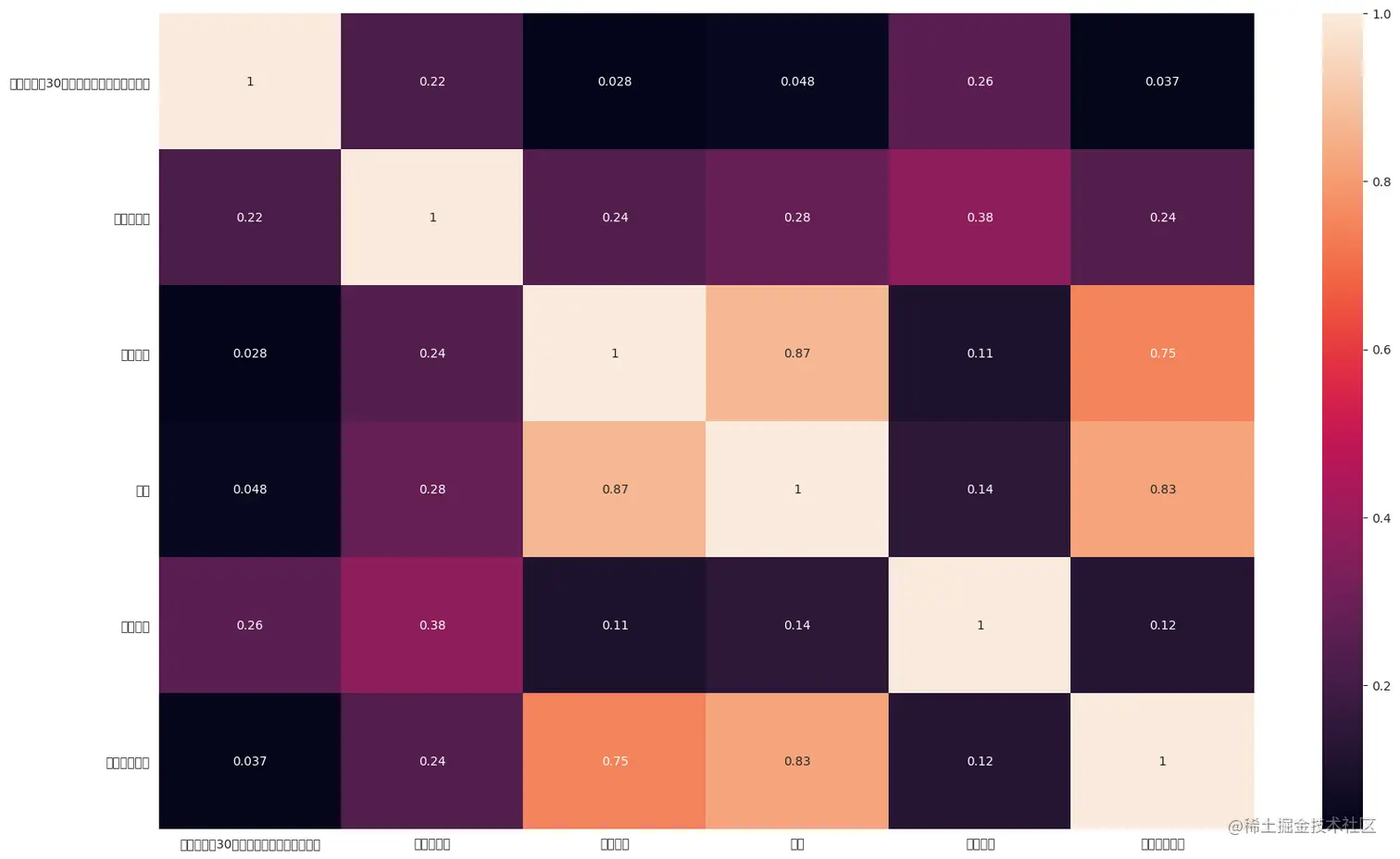
3.协相关
df.corr()
.dataframe tbody tr th:only-of-type {
vertical-align: middle;
}
.dataframe tbody tr th {
vertical-align: top;
}
.dataframe thead th {
text-align: right;
}
|
是否在过去30天内与饮酒驾驶者一起乘车 |
是否是女性 |
就读年级 |
年龄 |
是否吸烟 |
是否拥有驾照 |
| 是否在过去30天内与饮酒驾驶者一起乘车 |
1.000000 |
0.220942 |
0.028239 |
0.048411 |
0.258869 |
0.037261 |
| 是否是女性 |
0.220942 |
1.000000 |
0.240245 |
0.282104 |
0.377348 |
0.238284 |
| 就读年级 |
0.028239 |
0.240245 |
1.000000 |
0.870475 |
0.107223 |
0.748354 |
| 年龄 |
0.048411 |
0.282104 |
0.870475 |
1.000000 |
0.142229 |
0.825015 |
| 是否吸烟 |
0.258869 |
0.377348 |
0.107223 |
0.142229 |
1.000000 |
0.123856 |
| 是否拥有驾照 |
0.037261 |
0.238284 |
0.748354 |
0.825015 |
0.123856 |
1.000000 |
import matplotlib.pyplot as plt
%matplotlib inline
import seaborn as sns
sns.set_style('whitegrid')
plt.figure(figsize=(20,12))
sns.heatmap(df.corr(), annot=True)
四、模型训练
1.网络定义
import paddle
import paddle.nn.functional as F
class Net(paddle.nn.Layer):
def __init__(self):
super(Net, self).__init__()
self.fc = paddle.nn.Linear(in_features=5,out_features=2)
def forward(self, inputs):
pred = self.fc(inputs)
return pred
2.超参设置
net=Net()
epochs = 6
loss_func = paddle.nn.CrossEntropyLoss()
opt = paddle.optimizer.Adam(learning_rate=0.1,parameters=net.parameters())
3.模型训练
for epoch in range(epochs):
all_acc = 0
for i in range(train.shape[0]):
x = paddle.to_tensor([train.iloc[i,1:]])
y = paddle.to_tensor([train.iloc[i,0]])
infer_y = net(x)
loss = loss_func(infer_y,y)
loss.backward()
y=label = paddle.to_tensor([y], dtype="int64")
acc= paddle.metric.accuracy(infer_y, y)
all_acc=all_acc+acc.numpy()
opt.step()
opt.clear_gradients
print("第{}次正确率为:{}".format(epoch+1,all_acc/i))
第1次正确率为:[0.6094259]
第2次正确率为:[0.6070847]
第3次正确率为:[0.5988396]
第4次正确率为:[0.61268324]
第5次正确率为:[0.61115634]
第6次正确率为:[0.5905945]
五、模型评估
1.模型训练
net.eval()
all_acc = 0
for i in range(test.shape[0]):
x = paddle.to_tensor([test.iloc[i,:-1]])
y = paddle.to_tensor([test.iloc[i,-1]])
infer_y = net(x)
y=label = paddle.to_tensor([y], dtype="int64")
loss = loss_func(infer_y, y)
acc = paddle.metric.accuracy(infer_y, y)
all_acc = all_acc+acc.numpy()
print("测试集正确率:{}".format(all_acc/i))
测试集正确率:[0.44177523]
2.预测
import numpy as np
net.eval()
x = paddle.to_tensor([test.iloc[0,1:]])
y = paddle.to_tensor([test.iloc[0,0]])
infer_y = net(x)
y=label = paddle.to_tensor([y], dtype="int64")
loss = loss_func(infer_y, y)
print("test[0] is :\n{}\n y_test[0] is :{}\n predict is {}".format(test.iloc[0,1:] ,test.iloc[0,0], np.argmax(infer_y.numpy()[0])))
test[0] is :
是否是女性     0.00
就读年级      1.00
年龄        0.75
是否吸烟      1.00
是否拥有驾照    1.00
Name: 481, dtype: float64
 y_test[0] is :0
 predict is 0