背景介绍
Message是Android系统中跨线程通信的一个非常重要的手段。在Message中有一种特殊的消息,叫做屏障消息,一旦该消息被插入到消息队列中后,handler将仅仅处理消息队列中的异步消息,同步消息会被阻塞。
使用方法
该特性在Android系统的帧绘制过程中被使用。下面我们来看下该特性的使用方法。postSyncBarrier插入屏障消息,removeSyncBarrier清除屏障消息。两个方法需要同步使用。当插入屏障消息后,消息队列仅仅处理异步消息,同步消息会被阻塞。
frameworks/base/core/java/android/view/ViewRootImpl.java
    void scheduleTraversals() {
        if (!mTraversalScheduled) {
            mTraversalScheduled = true;
            // 插入屏障消息
            mTraversalBarrier = mHandler.getLooper().getQueue().postSyncBarrier();
            mChoreographer.postCallback(
                    Choreographer.CALLBACK_TRAVERSAL, mTraversalRunnable, null);
            if (!mUnbufferedInputDispatch) {
                scheduleConsumeBatchedInput();
            }
            notifyRendererOfFramePending();
            pokeDrawLockIfNeeded();
        }
    }

    void unscheduleTraversals() {
        if (mTraversalScheduled) {
            mTraversalScheduled = false;
            // 移除屏障消息
            mHandler.getLooper().getQueue().removeSyncBarrier(mTraversalBarrier);
            mChoreographer.removeCallbacks(
                    Choreographer.CALLBACK_TRAVERSAL, mTraversalRunnable, null);
        }
    }
源码分析
屏障消息的插入
frameworks/base/core/java/android/os/MessageQueue.java
    /**
     * Posts a synchronization barrier to the Looper's message queue.
     *
     * Message processing occurs as usual until the message queue encounters the
     * synchronization barrier that has been posted.  When the barrier is encountered,
     * later synchronous messages in the queue are stalled (prevented from being executed)
     * until the barrier is released by calling {@link #removeSyncBarrier} and specifying
     * the token that identifies the synchronization barrier.
     *
     * This method is used to immediately postpone execution of all subsequently posted
     * synchronous messages until a condition is met that releases the barrier.
     * Asynchronous messages (see {@link Message#isAsynchronous} are exempt from the barrier
     * and continue to be processed as usual.
     *
     * This call must be always matched by a call to {@link #removeSyncBarrier} with
     * the same token to ensure that the message queue resumes normal operation.
     * Otherwise the application will probably hang!
     *
     * @return A token that uniquely identifies the barrier.  This token must be
     * passed to {@link #removeSyncBarrier} to release the barrier.
     *
     * @hide
     */
    public int postSyncBarrier() {
        return postSyncBarrier(SystemClock.uptimeMillis());
    }

    private int postSyncBarrier(long when) {
        // Enqueue a new sync barrier token.
        // We don't need to wake the queue because the purpose of a barrier is to stall it.
        synchronized (this) {
            final int token = mNextBarrierToken++;
            final Message msg = Message.obtain();
            msg.markInUse();
            msg.when = when;
            msg.arg1 = token;

            Message prev = null;
            Message p = mMessages;
            if (when != 0) {
                // 遍历链表,找到SyncBarrier msg插入的位置
                while (p != null && p.when <= when) {
                    prev = p;
                    p = p.next;
                }
            }
            // 将SyncBarrier msg插入到链表里面
            if (prev != null) { // invariant: p == prev.next
                msg.next = p;
                prev.next = msg;
            } else {
                msg.next = p;
                mMessages = msg;
            }
            return token;
        }
    }

    /**
     * Removes a synchronization barrier.
     *
     * @param token The synchronization barrier token that was returned by
     * {@link #postSyncBarrier}.
     *
     * @throws IllegalStateException if the barrier was not found.
     *
     * @hide
     */
    public void removeSyncBarrier(int token) {
        // Remove a sync barrier token from the queue.
        // If the queue is no longer stalled by a barrier then wake it.
        synchronized (this) {
            Message prev = null;
            Message p = mMessages;
            while (p != null && (p.target != null || p.arg1 != token)) {
                prev = p;
                p = p.next;
            }
            if (p == null) {
                throw new IllegalStateException("The specified message queue synchronization "
                        + " barrier token has not been posted or has already been removed.");
            }
            final boolean needWake;
            if (prev != null) {
                prev.next = p.next;
                needWake = false;
            } else {
                mMessages = p.next;
                needWake = mMessages == null || mMessages.target != null;
            }
            p.recycleUnchecked();

            // If the loop is quitting then it is already awake.
            // We can assume mPtr != 0 when mQuitting is false.
            if (needWake && !mQuitting) {
                nativeWake(mPtr);
            }
        }
    }
消息的取出处理
frameworks/base/core/java/android/os/Looper.java
    /**
     * Run the message queue in this thread. Be sure to call
     * {@link #quit()} to end the loop.
     */
    public static void loop() {
        final Looper me = myLooper();
        if (me == null) {
            throw new RuntimeException("No Looper; Looper.prepare() wasn't called on this thread.");
        }
        final MessageQueue queue = me.mQueue;

        // Make sure the identity of this thread is that of the local process,
        // and keep track of what that identity token actually is.
        Binder.clearCallingIdentity();
        final long ident = Binder.clearCallingIdentity();

        // Allow overriding a threshold with a system prop. e.g.
        // adb shell 'setprop log.looper.1000.main.slow 1 && stop && start'
        final int thresholdOverride =
                SystemProperties.getInt("log.looper."
                        + Process.myUid() + "."
                        + Thread.currentThread().getName()
                        + ".slow", 0);

        final int threshold = SystemProperties.getInt("persist.log.looper."
                                    + Thread.currentThread().getName()
                                    + ".slow", 0);

        boolean slowDeliveryDetected = false;

        for (;;) {
            boolean isBootCompleted = "1".equals(SystemProperties.get("sys.boot_completed"));
            Message msg = queue.next(); // might block
            ......
        }
    }
frameworks/base/core/java/android/os/MessageQueue.java
    Message next() {
        // Return here if the message loop has already quit and been disposed.
        // This can happen if the application tries to restart a looper after quit
        // which is not supported.
        final long ptr = mPtr;
        if (ptr == 0) {
            return null;
        }

        int pendingIdleHandlerCount = -1; // -1 only during first iteration
        int nextPollTimeoutMillis = 0;
        for (;;) {
            if (nextPollTimeoutMillis != 0) {
                Binder.flushPendingCommands();
            }
            // 这里可能会挂在驱动的epoll
            nativePollOnce(ptr, nextPollTimeoutMillis);

            synchronized (this) {
                // Try to retrieve the next message.  Return if found.
                final long now = SystemClock.uptimeMillis();
                Message prevMsg = null;
                Message msg = mMessages;
                if (msg != null && msg.target == null) {
                    // Stalled by a barrier.  Find the next asynchronous message in the queue.
                    do {
                        prevMsg = msg;
                        msg = msg.next;
                    } while (msg != null && !msg.isAsynchronous());
                }
                if (msg != null) {
                    if (now < msg.when) {
                        // Next message is not ready.  Set a timeout to wake up when it is ready.
                        nextPollTimeoutMillis = (int) Math.min(msg.when - now, Integer.MAX_VALUE);
                    } else {
                        // Got a message.
                        mBlocked = false;
                        if (prevMsg != null) {
                            prevMsg.next = msg.next;
                        } else {
                            mMessages = msg.next;
                        }
                        msg.next = null;
                        if (DEBUG) Log.v(TAG, "Returning message: " + msg);
                        msg.markInUse();
                        return msg;
                    }
                } else {
                    // No more messages.
                    nextPollTimeoutMillis = -1;
                }

                // Process the quit message now that all pending messages have been handled.
                if (mQuitting) {
                    dispose();
                    return null;
                }

                // If first time idle, then get the number of idlers to run.
                // Idle handles only run if the queue is empty or if the first message
                // in the queue (possibly a barrier) is due to be handled in the future.
                if (pendingIdleHandlerCount < 0
                        && (mMessages == null || now < mMessages.when)) {
                    pendingIdleHandlerCount = mIdleHandlers.size();
                }
                if (pendingIdleHandlerCount <= 0) {
                    // No idle handlers to run.  Loop and wait some more.
                    mBlocked = true;
                    continue;
                }

                if (mPendingIdleHandlers == null) {
                    mPendingIdleHandlers = new IdleHandler[Math.max(pendingIdleHandlerCount, 4)];
                }
                mPendingIdleHandlers = mIdleHandlers.toArray(mPendingIdleHandlers);
            }

            // Run the idle handlers.
            // We only ever reach this code block during the first iteration.
            for (int i = 0; i < pendingIdleHandlerCount; i++) {
                final IdleHandler idler = mPendingIdleHandlers[i];
                mPendingIdleHandlers[i] = null; // release the reference to the handler

                boolean keep = false;
                try {
                    keep = idler.queueIdle();
                } catch (Throwable t) {
                    Log.wtf(TAG, "IdleHandler threw exception", t);
                }

                if (!keep) {
                    synchronized (this) {
                        mIdleHandlers.remove(idler);
                    }
                }
            }

            // Reset the idle handler count to 0 so we do not run them again.
            pendingIdleHandlerCount = 0;

            // While calling an idle handler, a new message could have been delivered
            // so go back and look again for a pending message without waiting.
            nextPollTimeoutMillis = 0;
        }
    }
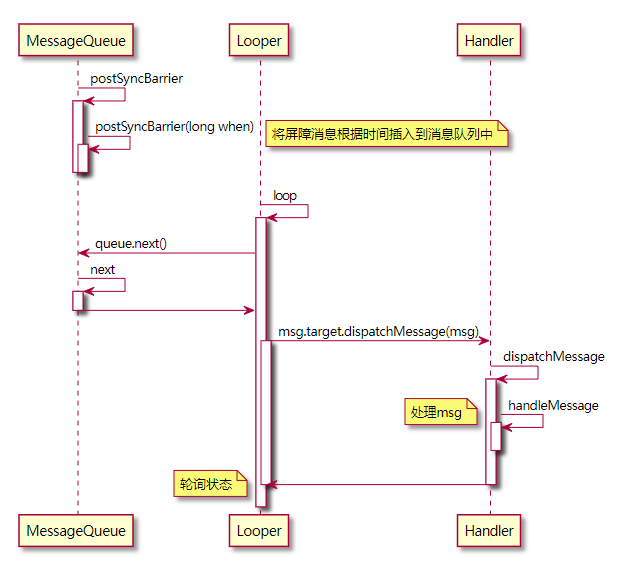
流程图