

Haskell中的类型家族——绝对的指南
类型族是Haskell中最强大的类型级编程特性之一。你可以把它们看作是类型级的函数,但这并没有真正涵盖整个画面。在本文结束时,你将知道它们到底是什么以及如何使用它们。
类型构造器的风格
在Haskell中,一个给定的类型构造器T ,有几个类别可以归属:
data T a b = ... -- data typenewtype T a b = ... -- newtypeclass T a b where ... -- type classtype T a b = ... -- type synonym
TypeFamilies 扩展引入了另外两个类别:
type family T a b where ... -- type familydata family T a b = ... -- data family
类型族被进一步细分为封闭式和开放式,开放式类型族可以是顶层的,也可以是与类相关的:
类型族 | 顶层的 | 关联的 |
开放式 | ✔️ | ✔️ |
关闭 | ✔️ | ❌ |
数据族总是开放的,但也可以是顶层的或关联的:
数据族 | 顶层的 | 关联的 |
开放的 | ✔️ | ✔️ |
关闭 | ❌ | ❌ |
尽管这些类型构造器的种类繁多,一开始可能会让人不知所措,但每种类型都有有效的用例,而且有一些共同的原则支撑着它们。
让我们先谈谈闭合类型族,因为它们与另一个著名的概念:函数相似。
闭合类型族
.png)
由Impure Pics制造。
在术语层面,当我们需要进行计算时,我们会定义函数。例如,这里是列表连接:
append :: forall a. [a] -> [a] -> [a]    -- type signature
append []     ys = ys                    -- clause 1
append (x:xs) ys = x : append xs ys      -- clause 2
在类型层面上,我们使用封闭类型族来定义这种计算:
type Append :: forall a. [a] -> [a] -> [a]  -- kind signature
type family Append xs ys where              -- header
  Append '[]    ys = ys                     -- clause 1
  Append (x:xs) ys = x : Append xs ys       -- clause 2
这里有一个GHCi会话来演示我们如何使用这两种方法:
ghci> append [1, 2, 3] [4, 5, 6]
[1,2,3,4,5,6]
ghci> :kind! Append [1, 2, 3] [4, 5, 6]
Append [1, 2, 3] [4, 5, 6] :: [Nat]
= '[1, 2, 3, 4, 5, 6]
虽然这两个定义之间有惊人的相似性,但也有一些不同:
- 与其他类型构造函数一样,类型族的名称必须以大写字母开头,因此
Append,而不是append。 - 我们不使用类型签名,而是使用独立的类型签名,它必须以
type关键字为前缀(由StandaloneKindSignatures扩展启用)。 - nil构造函数
[]被写成'[],以区别于列表类型构造函数[]。这个怪癖是由于DataKinds的工作方式造成的,与类型族本身没有关系。 - 类型族的子句被分组在类型族的标头下,而术语级函数没有标头。
头部可能是这里最显著的区别,为了理解它的重要性,我们必须首先讨论arity的概念。在这之前,我们先来看看几个封闭类型族的例子,以熟悉其语法。
| 术语级函数 | 闭合类型族 |
|---|---|
not :: Bool -> Bool
not True = False
not False = True
type Not :: Bool -> Bool
type family Not a where
  Not True = False
  Not False = True
fromMaybe :: a -> Maybe a -> a
fromMaybe d Nothing = d
fromMaybe _ (Just x) = x
type FromMaybe :: a -> Maybe a -> a
type family FromMaybe d x where
  FromMaybe d Nothing = d
  FromMaybe _ (Just x) = x
fst :: (a, b) -> a
fst (x, _) = x
type Fst :: (a, b) -> a
type family Fst t where
  Fst '(x, _) = x
练习:使用:kind! 命令将这些类型族应用于GHCi中的各种输入,并将输出结果与你的期望值进行比较。
类型构造函数的arity
类型构造函数的arity是它在使用地点所需要的参数数量。当我们使用高类型的类型时,它就会发挥作用:
type S :: (Type -> Type) -> Type
data S k = MkS (k Bool) (k Integer)
现在,什么构成了S 的有效参数?人们可能会认为,任何类型的构造函数Type -> Type ,都可以用在这里。让我们试一试:
MkS (Just True) Nothing :: S **Maybe**MkS (Left “Hi”) (Right 42) :: S (**Either String**)MkS (Identity False) (Identity 0) :: S **Identity**
所以Maybe,Either String, 和Identity 都能正常工作。但是一个类型的同义词呢?
type Pair :: Type -> Type
type Pair a = (a, a)
从独立的类型签名中,我们看到它有适当的类型Type -> Type 。GHCi也确认了这一点:
ghci> :kind Pair
Pair :: Type -> Type
然而,任何使用S Pair 的尝试都是不成功的:
ghci> MkS (True, False) (0, 1) :: S Pair
<interactive>:6:29: error:
    • The type synonym 'Pair' should have 1 argument,
      but has been given none
由于GHC类型系统的某些设计决定,类型同义词不能被部分应用。在Pair 的情况下,我们说它的arity是1,因为它需要一个参数。Pair Bool,Pair Integer, 和Pair String 都是可以的。另一方面,S Pair 或Functor Pair 则不行。一个类型构造函数的使用在满足其arity要求的情况下被称为饱和的,否则就是不饱和的。
请注意,我们只需要类型构造函数的arity概念,这些构造函数在应用于一个参数时可以还原为其他类型。例如,Pair Bool 不仅等于它自己,也等于(Bool, Bool) :
Pair Bool ~ Pair Bool -- reflexivityPair Bool ~ (Bool, Bool) -- reduction
另一方面,Maybe Bool 只等于它自己:
Maybe Bool ~ Maybe Bool -- reflexivity
因此我们称Maybe 为生成型类型构造函数,而Pair 为非生成型。
非生成类型构造函数有分配给它们的算数,并且必须被饱和使用。生成式类型构造函数不受这种限制,所以我们不对它们应用arity的概念。
类型族的应用也可以还原为其他类型:
Append [1,2] [3,4] ~ Append [1,2] [3,4] -- reflexivityAppend [1,2] [3,4] ~ [1, 2, 3, 4] -- reduction
因此,它们是非生成性的,并且有分配给它们的arity。arity是在定义现场通过考虑类型签名和头来确定的:
type Append :: forall a. [a] -> [a] -> [a]
type family Append xs ys where
在标头中,我们有Append xs ys ,而不是Append xs ,或者干脆是Append 。因此,第一眼看上去,Append 的arity是2。然而,我们还必须考虑到forall-bound变量a 。事实上,即使你写成Append [1,2] [3,4] ,在内部也会变成Append @Nat [1,2] [3,4] 。因此,Append 的 Arity 是 3。
即使我们没有明确写出forall ,这也是正确的:
type Append :: [a] -> [a] -> [a]
type family Append xs ys where
好吧,那么为什么标题很重要呢?难道我们不能通过计算种类签名中的量词来推导出arity吗?嗯,这在大多数情况下是可行的,但这里有一个有趣的反例:
type MaybeIf :: Bool -> Type -> Type
type family MaybeIf b t where
  MaybeIf True  t = Maybe t
  MaybeIf False t = Identity t
这个定义被赋予了2的arity,我们可以通过把它应用于两个参数来使用它:
data PlayerInfo b =
  MkPlayerInfo { name  :: MaybeIf b String,
                 score :: MaybeIf b Integer }
这在使用数据库时可能很有用。当读取一个球员的记录时,我们希望所有的字段都存在,但数据库的更新可能只触及其中的一些字段:
dbReadPlayerInfo :: IO (PlayerInfo False)
dbUpdatePlayerInfo :: PlayerInfo True -> IO ()
在PlayerInfo False ,字段被简单地包裹在Identity中,例如:MkPlayerInfo { name = Identity "Jack", score = Identity 8 } 。在PlayerInfo True 中,字段被包裹在Maybe中,因此可以是Nothing,例如:MkPlayerInfo { name = Nothing, score = Just 10 } 。
然而,MaybeIf 不能被传递给S:
ghci> newtype AuxInfo b = MkAuxInfo (S (MaybeIf b))
<interactive>:33:21: error:
    • The type family 'MaybeIf' should have 2 arguments,
      but has been given 1
    • In the definition of data constructor 'MkAuxInfo'
      In the newtype declaration for 'AuxInfo'
幸运的是,这个问题通过对MaybeIf 的定义做一个小的调整就可以解决了:
type MaybeIf :: Bool -> Type -> Type
type family MaybeIf b where
  MaybeIf True  = Maybe
  MaybeIf False = Identity
请注意种类签名没有变化,但是t 参数被从标题和子句中移除。通过这样的调整,MaybeIf 的arity变成了1,而AuxInfo 的定义也被接受。
练习:确定Not,FromMaybe, 和Fst 的节数。
与GADTs的协同作用
在与GADTs一起工作时,对封闭类型族的需求最常出现。这里有一个异质列表的定义:
type HList :: [Type] -> Type
data HList xs where
  HNil :: HList '[]
  (:&) :: x -> HList xs -> HList (x : xs)
infixr 5 :&
它可以用来表示不同类型的值的序列:
h1 :: HList [Integer, String, Bool]
h1 = 42 :& "Hello" :& True :& HNil

h2 :: HList [Char, Bool]
h2 = 'x' :& False :& HNil
就像对待普通列表一样,我们可以定义一些操作,比如计算长度:
hlength :: HList xs -> Int
hlength HNil = 0
hlength (_ :& xs) = 1 + hlength xs

ghci> hlength h1
3

ghci> hlength h2
2
然而,即使是像连接这样微不足道的事情,我们也需要类型级别的计算:
happend :: HList xs -> HList ys -> HList ??
happened h1 h2 的类型应该是什么?那么,它必须包括第一个列表的元素,然后是第二个列表的元素。这正是Append 类型家族所实现的。
happend :: HList xs -> HList ys -> HList (Append xs ys)
而这正是人们寻求封闭类型族的典型原因:实现对GADT的操作。
评价顺序,或缺乏评价顺序
Haskell是一种懒惰的语言,它的评估策略使我们能够写出如下的代码:
ghci> take 10 (iterate (+5) 0)
[0,5,10,15,20,25,30,35,40,45]
现在让我们在类型层面上尝试一个类似的壮举。首先,我们定义对应于take 和iterate (+5) 的类型族:
type IteratePlus5 :: Nat -> [Nat]
type family IteratePlus5 k where
  IteratePlus5 k = k : IteratePlus5 (k+5)

type Take :: Nat -> [a] -> [a]
type family Take n a where
  Take 0 xs = '[]
  Take n (x : xs) = x : Take (n-1) xs
我们可以看到,Take 是按预期工作的:
ghci> :kind! Take 3 [0, 1, 2, 3, 4, 5]
Take 3 [0, 1, 2, 3, 4, 5] :: [Nat]
= '[0, 1, 2]
另一方面,IteratePlus5 将类型检查器送入一个无限循环:
ghci> :kind! Take 10 (IteratePlus5 0)
^CInterrupted.
很明显,类型族的评估不是懒惰的。事实上,它也不是急切的--规则根本就没有被定义。即使在处理有限数据时,推理作为类型族实现的算法的时间或空间复杂性也是不可能的。#18965是一个GHC问题,为这个问题提供了一个解决方案。同时,这也是一个必须注意的陷阱。
开放式类型族
.png)
由Impure Pics制造。
假设我们想给一些类型分配一个文本标签,可能是为了序列化的目的:
type Label :: Type -> Symbol
type family Label t where
  Label Double = "number"
  Label String = "string"
  Label Bool   = "boolean"
  ...
我们可以使用KnownSymbol 类在术语级别上重新定义标签:
label :: forall t. KnownSymbol (Label t) => String
label = symbolVal (Proxy @(Label t))

ghci> label @Double
"number"
但是如果用户在另一个模块中定义了自己的类型MyType 呢?他们怎么能给它分配一个标签,比如说label @MyType = "mt" ?
对于封闭的类型族,这是不可能的。这就是开放类型族进入画面的地方。要使一个类型族开放,我们必须在其标题中省略where 关键字:
type Label :: Type -> Symbol
type family Label t
实例不再缩进。相反,它们被声明在顶层,可能在不同的模块中,并以type instance 关键字序列为前缀:
type instance Label Double = "number"
type instance Label String = "string"
type instance Label Bool   = "boolean"
现在,用户可以很容易地为自己的类型定义一个Label 的实例:
data MyType = MT
type instance Label MyType = "mt"

ghci> label @MyType
"mt"
在这一点上,人们可能会开始怀疑为什么有人会喜欢封闭的类型族,如果开放的类型族似乎更强大和可扩展。其原因是,可扩展性是有代价的:开放类型族的方程不允许重叠。但是,重叠的方程往往是有用的!
重叠的方程
闭合类型族的子句是有序的,从上到下匹配。这使得我们可以对逻辑联结进行如下定义:
type And :: Bool -> Bool -> Bool
type family And a b where
  And True True = True
  And _    _    = False
如果我们对它们重新排序,And _ _ 方程将匹配所有的输入。但是它排在第二位,所以And True True 子句就有机会匹配。这是封闭式类型族相对于开放式类型族的关键属性:方程可能是重叠的。
开放类型族需要列举所有的可能性,导致组合爆炸:
type And' :: Bool -> Bool -> Bool
type family And' a b

type instance And' True  True  = True
type instance And' True  False = False
type instance And' False True  = False
type instance And' False False = False
兼容的方程
如果说在开放类型族中不允许方程重叠,而在封闭类型族中允许方程重叠,那是过于简单化了。在实践中,规则要更复杂一些。
开放式类型族的实例必须是兼容的。如果以下情况中至少有一个成立,则类型族实例是兼容的:
- 它们的左手边是分开的(也就是说,不重叠)
- 它们的左手边与一个替换统一,在这个替换下,右手边是相等的。
第二个条件使GHC能够接受更多的程序。考虑一下下面的例子:
type family F a
type instance F a    = [a]
type instance F Char = String
虽然左手边明显重叠(a 比Char 更加通用),但最终并无区别。如果用户需要减少F Char ,两个方程的结果都是[Char] 。倾向于数学的读者会认识到这个属性是汇合的。
这里有一个更有趣的例子,有几个类型变量:
type family G a b
type instance G a    Bool = a -> Bool
type instance G Char b    = Char -> b
左手边统一于一个替换a=Char,b=Bool 。右手边在该替换下是相等的:
type instance G Char Bool = Char -> Bool
因此,接受这两个变量是安全的:它们是兼容的。
实例兼容性在封闭类型族中也起作用。考虑FInteger 和FString:
type family FInteger a where
  FInteger Char = Integer
  FInteger a    = [a]

type family FString a where
  FString Char = String
  FString a    = [a]
现在,对于一个未知的x ,GHC能否将FInteger x 减少到[x] ?不能,因为这些方程是从上到下匹配的,GHC首先需要检查x 是否是Char ,在这种情况下,它将减少到Integer 。
另一方面,FString 中的方程是兼容的。因此,如果我们有FString x ,那么x 是否是Char 并不重要,因为两个方程都会被还原为[x] 。
注射性类型族
有些类型族是注入式的:也就是说,我们可以从它们的输出推导出它们的输入。例如,考虑布尔否定法:
type Not :: Bool -> Bool
type family Not x where
  Not True = False
  Not False = True
如果我们知道Not x 是True ,那么我们可以得出结论,x 是False 。默认情况下,编译器不应用这种推理:
s :: forall x. (Not x ~ True, Typeable x) => String
s = show (typeRep @x)

ghci> s
<interactive>:7:1: error:
    • Couldn't match type 'Not x0' with ''True'
        arising from a use of 's'
      The type variable 'x0' is ambiguous
即使编译器可以根据Not x 是True 这一事实将x 实例化为False ,但它没有这样做。当然,我们可以手动操作,GHC会检查我们的操作是否正确:
ghci> s @False
"'False"

ghci> s @True
    <interactive>:12:1: error:
    • Couldn't match type ''False' with ''True'
        arising from a use of 's'
当我们将x 实例化为False ,Not x ~ True 的约束被满足。当我们试图将其实例化为True ,约束不被满足,我们看到一个类型错误。
只有一种有效的方法来实例化x 。如果GHC能自动做到这一点,那不是很好吗?这正是注入式类型族允许我们实现的。按照下面的方法改变Not 的类型族头:
type family Not x = r | r -> x where
首先,我们给Not x 的结果起一个名字,这里我叫它r 。然后,使用功能依赖的语法,我们指定r 决定x 。GHC在需要实例化x 的时候会利用这一信息。
ghci> s
"'False"
这个功能是由TypeFamilyDependencies 扩展启用的。与普通的函数依赖一样,它只被用来指导类型推理,不能用来产生等价物。因此,不幸的是,下面的内容被拒绝了:
not_lemma :: Not x :~: True -> x :~: False
not_lemma Refl = Refl
    -- Could not deduce: x ~ 'False
    -- from the context: 'True ~ Not x
这是一个已知的限制。
关联类型
从代码组织的角度来看,有时将一个开放的类型族与一个类联系起来是有意义的。
考虑一下容器和元素的概念:
type family Elem a
class Container a where
  elements :: a -> [Elem a]

type instance Elem [a] = a
instance Container [a] where
  elements = id

type instance Elem ByteString = Word8
instance Container ByteString where
  elements = ByteString.unpack
我们只会对那些也有容器实例的类型使用Elem,所以把它移到类中会更清楚。这正是关联类型使我们能够做到的:
class Container a where
  type Elem a
  elements :: a -> [Elem a]

instance Container [a] where
  type Elem [a] = a
  elements = id

instance Container ByteString where
  type Elem ByteString = Word8
  elements = ByteString.unpack
关联类型大多等同于开放类型族,喜欢哪种类型往往是一个风格问题。
关联类型的一个优点是它们可以有默认值:
type family Unwrap x where
  Unwrap (f a) = a

class Container a where
  type Elem a
  type Elem x = Unwrap x
  elements :: a -> [Elem a]
这样,我们可以在大多数情况下避免明确定义Elem:
instance Container [a] where
  elements = id

instance Container (Maybe a) where
  elements = maybeToList

instance Container ByteString where
  type Elem ByteString = Word8
  elements = ByteString.unpack
目前的研究表明,关联类型是一种比顶层开放类型族更有前途的抽象机制。参见ICFP 2017--受限类型族。
数据族
数据族可以被认为是类型族,它的实例总是新的、专用的数据类型。
考虑一下下面的例子:
data family Vector a
newtype instance Vector () = VUnit Int
newtype instance Vector Word8 = VBytes ByteArray
data instance Vector (a, b) = VPair !(Vector a) !(Vector b)
一个Vector 是一个元素的序列,但是对于单元类型,我们可以简单地将长度存储为Int ,这比为每个单元值分配内存要有效得多。
注意,我们可以在每个实例的基础上决定在data 和newtype 。
这个例子可以用类型族重写如下:
type family VectorF a

type instance VectorF () = VectorUnit
data VectorUnit = VUnit Int

type instance VectorF Word8 = VectorWord8
data VectorWord8 = VBytes ByteArray

type instance VectorF (a, b) = VectorPair a b
data VectorPair a b = VPair (VectorF a) (VectorF b)
在这个翻译中,每个类型族实例都有一个数据类型。然而,即使抛开模板,这也是一个不完美的翻译。数据族为我们提供了其他东西:它们引入的类型构造函数是生成的,所以我们不必担心它的算术性
例如,下面的代码是有效的:
data Pair1 f x = P1 (f x) (f x)
type VV = Pair1 Vector
另一方面,Pair1 VectorF 会被拒绝,因为这并没有应用于它的参数:
数据族也可以与一个类相关联。
class Vectorizable a where
  data Vector a
  vlength :: Vector a -> Int
就像关联类型和开放类型族一样,这主要是一个代码组织的问题:
非参数化的量化
在术语中,forall 是一个参数化的量化器,这个事实可以用来推理函数。例如,考虑身份函数的类型签名。
id :: forall a. a -> a
它对它的参数只有一件事可以做:未经处理地返回它。例如,它不能在给定一个整数时返回42:
id :: forall a. a -> a
id (x :: Int) = 42      -- Rejected!
id x = x
这不仅对代码的推理很重要,而且对保证类型擦除也很重要。
然而,这些都不适用于类型家族,它们对forall ,有自己的解释:
type F :: forall a. a -> a
type family F a where
  F (a :: Nat) = 42
  F a = a
这段代码被接受,并且没有错误地工作:
ghci> :kind! F 0
F 0 :: Nat
= 42

ghci> :kind! F "Hello"
F "Hello" :: Symbol
= "Hello"
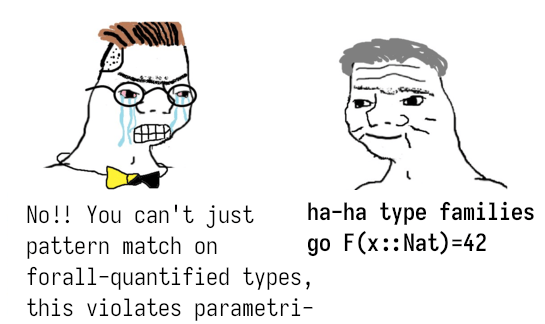
一方面,这阻碍了我们对类型族进行推理的能力。另一方面,这基本上相当于在类型层面上的Π-类型,所以它可以被很好地利用。
非线性模式
在术语级函数中,一个变量不能被绑定超过一次:
dedup (x : x : xs) = dedup (x : xs)   -- Rejected!
dedup (y : xs) = y : dedup xs
dedup [] = []
如果我们想检查两个输入是否相等,我们必须明确地用== 操作符来做:
dedup (x1 : x2 : xs) | x1==x2 = dedup (x1 : xs)
dedup (y : xs) = y : dedup xs
dedup [] = []
另一方面,在类型族实例中,前一种风格也是允许的:
type family Dedup xs where
  Dedup (x : x : xs) = Dedup (x : xs)
  Dedup (y : xs) = y : Dedup xs
  Dedup '[] = '[]
这个特征恰好被称为非线性模式,但不要把它与线性类型混淆,两者没有关系。
总结
类型族是一个强大而广泛使用的(占Hackage软件包的20%)功能。它们在2005年以关联类型同义词的形式被引入,至今仍是一个积极研究的主题,有封闭类型族(2013)、注入类型族(2015)和约束类型族(2017)等创新。
虽然是一个有用的工具,但由于#8095("TypeFamilies painfully slow")和#12088("Type/data family instances in kind checking")等公开问题,使用类型族时必须非常小心。然而,目前正在努力解决这些问题。Serokell的GHC部门致力于改善Haskell的类型级编程设施。
