在线性回归模型中使用梯度下降法
import numpy as np
import matplotlib.pyplot as plt
np.random.seed(666)
x = 2 * np.random.random(size=100)
y = x * 3. + 4. + np.random.normal(size=100)
X = x.reshape(-1, 1)
X[:20]
array([[1.40087424],
       [1.68837329],
       [1.35302867],
       [1.45571611],
       [1.90291591],
       [0.02540639],
       [0.8271754 ],
       [0.09762559],
       [0.19985712],
       [1.01613261],
       [0.40049508],
       [1.48830834],
       [0.38578401],
       [1.4016895 ],
       [0.58645621],
       [1.54895891],
       [0.01021768],
       [0.22571531],
       [0.22190734],
       [0.49533646]])
y[:20]
array([8.91412688, 8.89446981, 8.85921604, 9.04490343, 8.75831915,
       4.01914255, 6.84103696, 4.81582242, 3.68561238, 6.46344854,
       4.61756153, 8.45774339, 3.21438541, 7.98486624, 4.18885101,
       8.46060979, 4.29706975, 4.06803046, 3.58490782, 7.0558176 ])
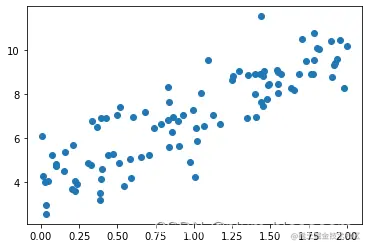
plt.scatter(x, y)
plt.show()
梯度下降法
def J(theta, X_b, y):
    try:
        return np.sum((y - X_b.dot(theta))**2) / len(X_b)
    except:
        return float('inf')
def dJ(theta, X_b, y):
    res = np.empty(len(theta))
    res[0] = np.sum(X_b.dot(theta) - y)
    for i in range(1, len(theta)):
        res[i] = (X_b.dot(theta) - y).dot(X_b[:,i])
    return res * 2 / len(X_b)
def gradient_descent(X_b, y, initial_theta, eta, n_iters = 1e4, epsilon=1e-8):

    theta = initial_theta
    cur_iter = 0

    while cur_iter < n_iters:
        gradient = dJ(theta, X_b, y)
        last_theta = theta
        theta = theta - eta * gradient
        if(abs(J(theta, X_b, y) - J(last_theta, X_b, y)) < epsilon):
            break

        cur_iter += 1

    return theta
X_b = np.hstack([np.ones((len(x), 1)), x.reshape(-1,1)])
initial_theta = np.zeros(X_b.shape[1])
eta = 0.01

theta = gradient_descent(X_b, y, initial_theta, eta)
theta
array([4.02145786, 3.00706277])