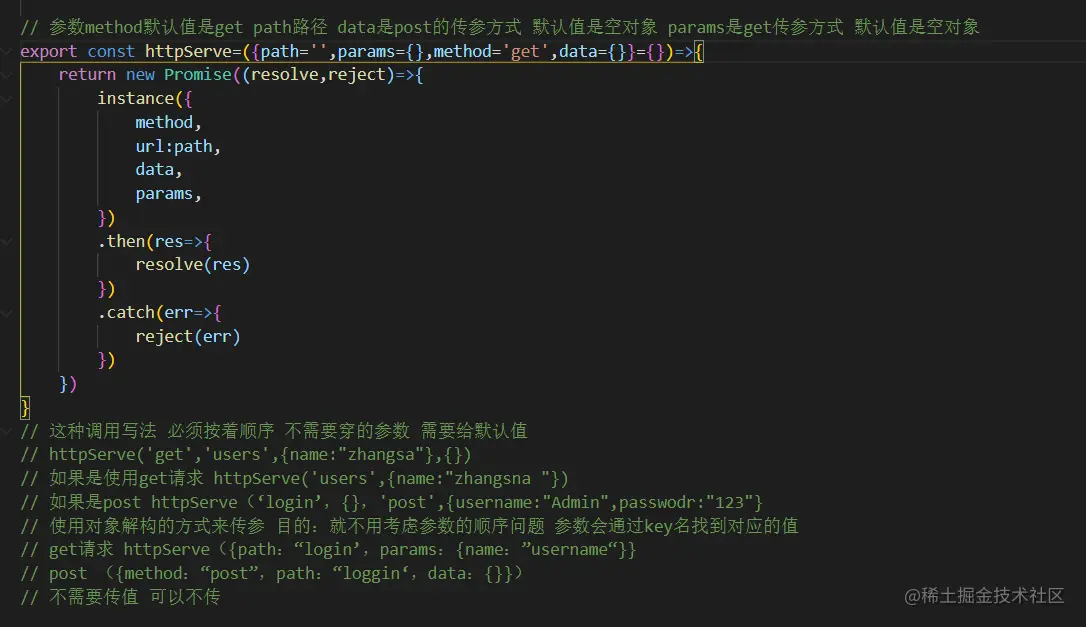
- 使用对象解构的方式来传参 目的:就不用考虑参数的顺序问题 参数会通过key名找到对应的值 不用传的参 直接不写
// 局部axios请求
let instance=axios.create({
    baseURL:"",
    timeout:5000,
})

// 局部的请求拦截器
instance.interceptors.request.use(
    config => {
      // 每次发送请求之前判断是否存在token
      // 如果存在,则统一在http请求的header都加上token,这样后台根据token判断你的登录情况,此处token一般是用户完成登录后储存到localstorage里的
      localStorage.token && (config.headers.Authorization = localStorage.token)
      return config
    },
    error => {
      return Promise.error(error)
    })
    // 局部响应拦截器axios.
instance.interceptors.response.use(response => {
      return response
        }, error => {
            return error
        })

// 参数method默认值是get path路径 data是post的传参方式 默认值是空对象 params是get传参方式 默认值是空对象
export const httpServe=({path='',params={},method='get',data={}}={})=>{
    return new Promise((resolve,reject)=>{
        instance({
            method,
            url:path,
            data,
            params,
        })
        .then(res=>{
            resolve(res)
        })
        .catch(err=>{
            reject(err)
        })
    })
}

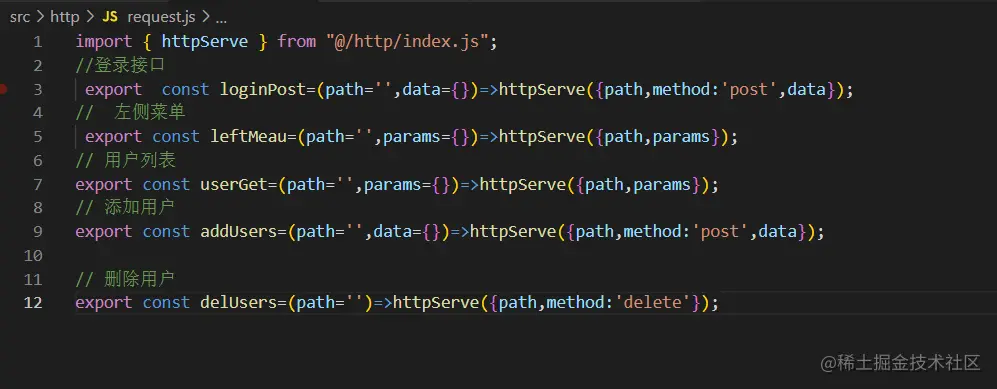
import { httpServe } from "@/http/index.js";
//登录接口
 export  const loginPost=(path='',data={})=>httpServe({path,method:'post',data});
//  左侧菜单
 export const leftMeau=(path='',params={})=>httpServe({path,params});
// 用户列表
export const userGet=(path='',params={})=>httpServe({path,params});
// 添加用户
export const addUsers=(path='',data={})=>httpServe({path,method:'post',data});

// 删除用户
export const delUsers=(path='')=>httpServe({path,method:'delete'});