下面题解中的栈都可以用数组来代替
化栈为队
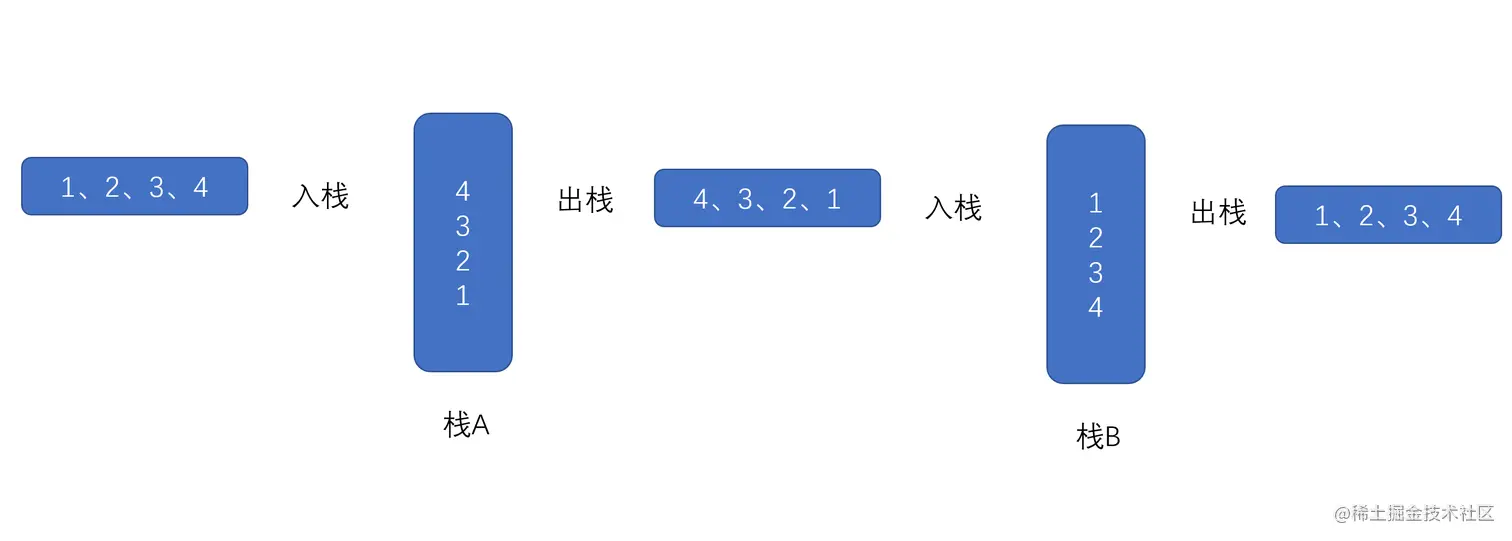
class Stack {
constructor() {
this.arr = [];
}
push(val) {
this.arr.push(val);
}
pop() {
return this.arr.pop();
}
peek() {
return this.arr[this.arr.length - 1];
}
empty() {
return this.arr.length === 0;
}
}
var MyQueue = function() {
this.s1 = new Stack();
this.s2 = new Stack();
};
MyQueue.prototype.push = function(x) {
while(!this.s2.empty()){
this.s1.push(this.s2.pop());
}
this.s1.push(x)
};
MyQueue.prototype.pop = function() {
while(!this.s1.empty()){
this.s2.push(this.s1.pop());
}
return this.s2.pop();
};
MyQueue.prototype.peek = function() {
while(!this.s1.empty()){
this.s2.push(this.s1.pop());
}
return this.s2.peek()
};
MyQueue.prototype.empty = function() {
return this.s1.empty() && this.s2.empty();
};
验证栈序列
 class Stack {
    constructor() {
        this.arr = [];
    }

    push(val) {
        this.arr.push(val);
    }

    pop() {
        return this.arr.pop();
    }

    peek() {
        return this.arr[this.arr.length - 1];
    }

    empty() {
        return this.arr.length === 0;
    }
}
var validateStackSequences = function(pushed, popped) {
    const stack = new Stack();
    for(let i = 0; i < pushed.length; i++) {
        stack.push(pushed[i]);
        while(popped[0] === stack.peek() && !stack.empty()) {
            stack.pop();
            popped.shift();
        }
    }
    if(stack.empty()) return true;
    return false;
};
1249. 移除无效的括号
class Stack {
constructor() {
this.arr = []
}
push(val) {
this.arr.push(val)
}
pop() {
return this.arr.pop()
}
peek() {
return this.arr[this.arr.length - 1]
}
empty() {
return this.arr.length === 0
}
}
var minRemoveToMakeValid = function(s) {
const indexStack = new Stack()
const stack = new Stack()
for(let i = 0
if(s[i] === '(') {
stack.push(s[i])
indexStack.push(i)
continue
}
if( s[i] === ')' && stack.peek() === '(') {
stack.pop()
indexStack.pop()
continue
}
if(s[i] === ')'){
stack.push(s[i])
indexStack.push(i)
}
}
const res = s.split('')
while(!indexStack.empty()) {
const index = indexStack.pop()
res[index] = ''
}
return res.join('')
}
验证二叉树的前序序列化
- 链接 leetcode-cn.com/problems/ve…
- 解题思路
根据题意可以反向推导,从最深的子节点开始,将最深的三个节点入栈,如果先入栈的两个元素是#,并且最后入栈的节点是数值,则说明这个节点是正常的,我们可以把这个节点替换成一个#,放回原来树中,如果前序遍历是合法的最后一定只剩一个#
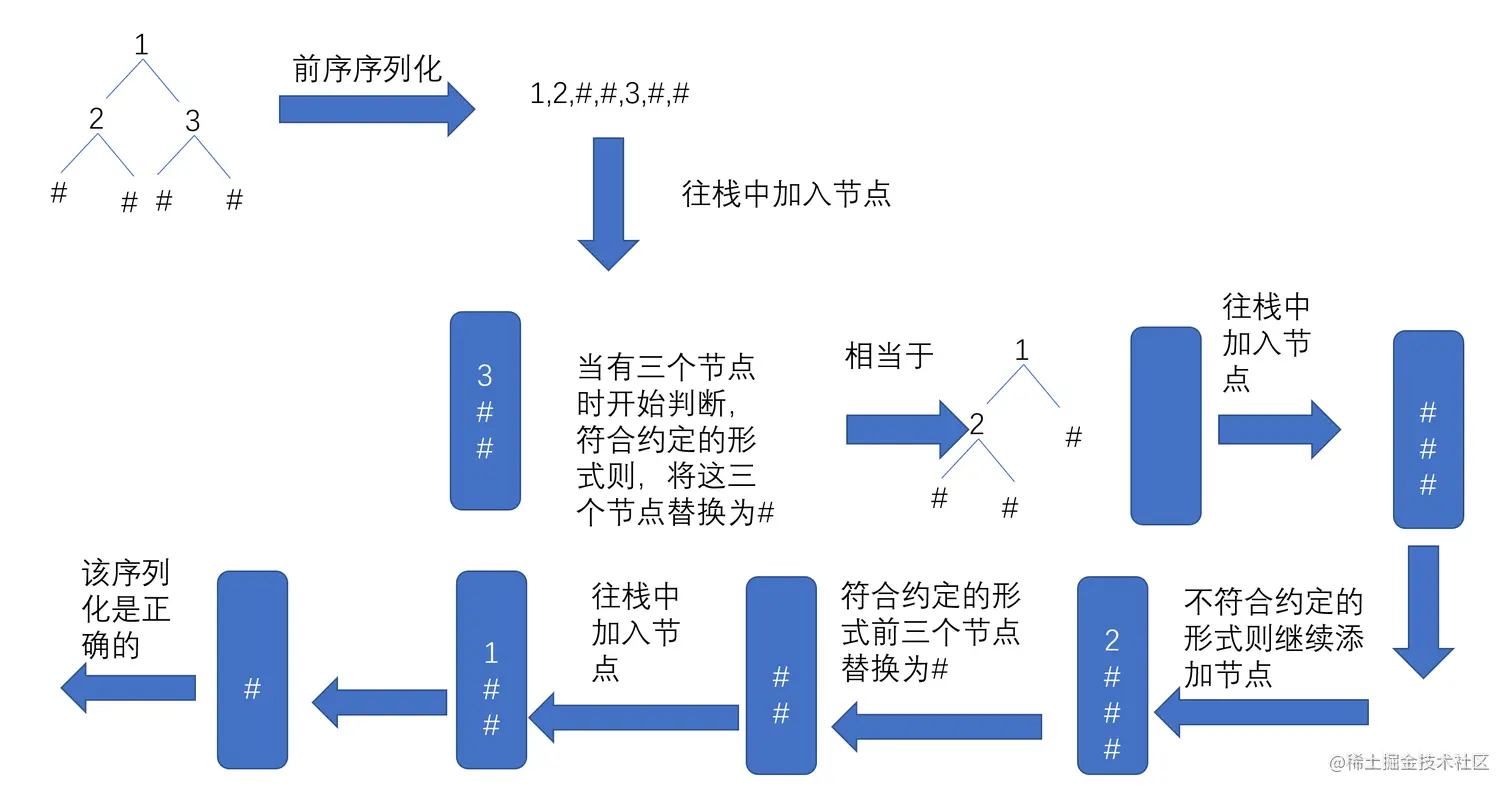
class Stack {
    constructor() {
        this.arr = [];
    }

    push(val) {
        this.arr.push(val);
    }

    pop() {
        return this.arr.pop();
    }

    peek() {
        return this.arr[this.arr.length - 1];
    }

    empty() {
        return this.arr.length === 0;
    }
    size() {
        return this.arr.length;
    }
}
var isValidSerialization = function(preorder) {
    let arr = preorder.split(',');
    const stack = new Stack();
    while(arr.length>0) {
        stack.push(arr.pop());
        if(stack.size() > 2){
            const one = stack.pop();
            const two = stack.pop();
            const three = stack.pop();
            if(one !== two && two === three && three === '#'){
                stack.push('#');
            } else{
                stack.push(three);
                stack.push(two);
                stack.push(one);
            }
        }
    }
    return stack.pop() === '#' && stack.empty();
};
利用栈实现一个计算器
- 思路
通过分治的思想找出式子中优先级最低的运算符,对这个运算符两边的式子分别求值,最后对这两个值进行运算即可。
function calc(s) {
s = s.trim()
let sig = ''
let sigIndex = 0
let sigRank = 999
let rank = 0
if(s[0] === '(' && s[s.length - 1] === ')') {
const a = s.slice(1, s.length - 1)
// 利用栈来检测去除括号之后的式子是否合法
const stack = []
for(let i = 0
if(a[i] === '('){
stack.push(a[i])
}
if(a[i] === ')' && stack[stack.length -1] === '('){
stack.pop()
continue
}
if(a[i] === ')'){
stack.push(a[i])
}
}
// 如果合法则去除括号
if(stack.length === 0){
s = a
}
}
// 找到优先级最低的运算符
for(let i = 0
// 如果有括号,对括号中的运算符优先级加100
if(s[i] === '(') rank +=1
if(s[i] === ')') rank -=1
if(s[i] === '*' || s[i] === '/' || s[i] === '+' || s[i] === '-') {
switch(s[i]) {
case '+':
case '-':
{
let curSigRank = 1 + rank * 100
if(curSigRank < sigRank) {
sigRank = curSigRank
sig = s[i]
sigIndex = i
}
}
break
case '*':
case '/':
{
let curSigRank = 2 + rank * 100
if(curSigRank < sigRank) {
sigRank = curSigRank
sig = s[i]
sigIndex = i
}
}
break
default:
break
}
}
}
if(!sig) return parseInt(s)
const s1 = s.slice(0,sigIndex).trim()
const s2 = s.slice(sigIndex+1).trim()
const num1 = calc(s1)
const num2 = calc(s2)
switch(sig){
case '*':
return num1 * num2
case '/':
return num1 / num2
case '+':
return num1 + num2
case '-':
return num1 - num2
default:
break
}
}



