流程图如下:
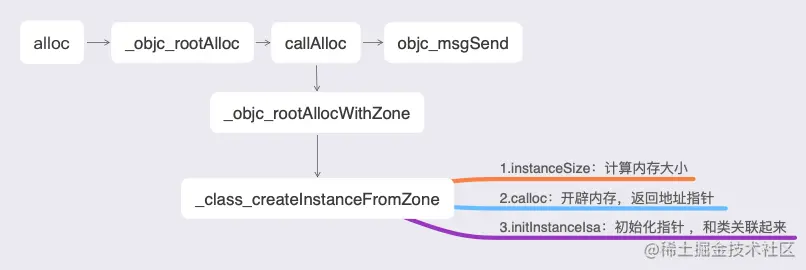
相关源码:
alloc
+ (id)alloc {
    return _objc_rootAlloc(self);
}
_objc_rootAlloc
_objc_rootAlloc(Class cls)
{
return callAlloc(cls, false, true);
}
callAlloc
static ALWAYS_INLINE id
callAlloc(Class cls, bool checkNil, bool allocWithZone=false)
{
#if __OBJC2__
if (slowpath(checkNil && !cls)) return nil;
if (fastpath(!cls->ISA()->hasCustomAWZ())) {
return _objc_rootAllocWithZone(cls, nil);
}
#endif
if (allocWithZone) {
return ((id(*)(id, SEL, struct _NSZone *))objc_msgSend)(cls, @selector(allocWithZone:), nil);
}
return ((id(*)(id, SEL))objc_msgSend)(cls, @selector(alloc));
}
_objc_rootAllocWithZone
_objc_rootAllocWithZone(Class cls, malloc_zone_t *zone __unused)
{
return _class_createInstanceFromZone(cls, 0, nil,
OBJECT_CONSTRUCT_CALL_BADALLOC);
}
_class_createInstanceFromZone
_class_createInstanceFromZone(Class cls, size_t extraBytes, void *zone,
int construct_flags = OBJECT_CONSTRUCT_NONE,
bool cxxConstruct = true,
size_t *outAllocatedSize = nil)
{
ASSERT(cls->isRealized());
bool hasCxxCtor = cxxConstruct && cls->hasCxxCtor();
bool hasCxxDtor = cls->hasCxxDtor();
bool fast = cls->canAllocNonpointer();
size_t size;
size = cls->instanceSize(extraBytes);
if (outAllocatedSize) *outAllocatedSize = size;
id obj;
if (zone) {
obj = (id)malloc_zone_calloc((malloc_zone_t *)zone, 1, size);
} else {
obj = (id)calloc(1, size);
}
if (slowpath(!obj)) {
if (construct_flags & OBJECT_CONSTRUCT_CALL_BADALLOC) {
return _objc_callBadAllocHandler(cls);
}
return nil;
}
if (!zone && fast) {
obj->initInstanceIsa(cls, hasCxxDtor);
} else {
obj->initIsa(cls);
}
if (fastpath(!hasCxxCtor)) {
return obj;
}
construct_flags |= OBJECT_CONSTRUCT_FREE_ONFAILURE;
return object_cxxConstructFromClass(obj, cls, construct_flags);
}