1. 10个最常用的数据结构
- 数组
- 链表
- 栈
- 队列
- 散列表
- 二叉树
- 堆
- 跳表
- 图
- Trie树
2. 10个最常用的算法
- 递归
- 排序
- 二分查找
- 搜索
- 哈希算法
- 贪心算法
- 分治算法
- 回溯算法
- 动态规划
- 字符串匹配算法
3. 数据结构和算法的关系
- 数据结构是数据的组织方式,为算法服务.
- 算法就是针对特定的数据结构执行操作.
4. 常见的时间复杂度
- O(1)
- O(logn)
- O(n)
- O(nlogn)
- O的k次方
- 指数阶 O(2的n次方)
- 阶乘阶 O(n!)
5. 时间复杂度称为渐进时间复杂度,表示算法的执行时间随数据规模的增长关系.
6. 空间复杂度称为渐进空间复杂度,表示算法的存储空间随数据规模的增长关系.
7. 线性表
- 线性表是数据排成像一条线一样的结构.
- 每个线性表上的数据最多只有向前和向后两个方向.
- 数组,链表,队列,栈 都是线性表.
8. 非线性表
- 非线性表中,数据之间不是简单的前后关系
- 二叉树,堆,图 都是非线性表
9. 数组
- 数组是一种线性表数据结构,用一组连续的内存空间,存储一组具有相同类型的数据.
- 连续的内存空间和相同类型的数据
- 优点:让数组可以随机访问/根据下标随机访问数组元素.
- 缺点:数组中添加,删除元素,为了保证内存连续性,需要做大量的数据搬移.
- 数组的查找时间复杂度并不是O(1),即使是排序后的数组,查找某个数据,也需要O(logn)
- 容器/ArrayList和数组比较优点
- ArrayList将很多数组的操作进行封装,便于使用
- ArrayList支持动态扩容
- 动态扩容依然免不了内存中数据搬移,如果能事先确定数据量,创建ArrayList时应先指定数据大小.
- 容器/ArrayList和数组比较缺点
- ArrayList无法存储基本类型,要存储基本类型,会涉及装箱,拆箱有性能损耗
- 数据量已知,且对数据的操作很简单,不涉及ArrayList大部分方法,可以使用数组
- 容器/ArrayList和数组如何选择
- 业务开发,直接使用ArrayList即可,简单.性能低一点几乎无影响
- 底层开发比较网路框架,性能要优化到极致,要使用数组.
10. 链表: 通过指针将一组零散的内存块串联在一起.
- 单链表
Node head = node0;
Node tail = noden;
head.next = node1;
**
tail.next = null;
- 循环链表
Node head = node0;
Node tail = noden;
head.next = node1;
**
tail.next = head;
- 双向链表
Node head = node0;
Node tail = noden;
head.next = node1;
head.pre = null;
**
tail.next = null;
tail.pre = noden-1;
- 双向循环链表
Node head = node0;
Node tail = noden;
head.next = node1;
head.pre = tail;
**
tail.next = head;
tail.pre = noden-1;
11. 数组和链表的比较
- 链表 插入,删除的时间复杂度是O(1),随机访问的时间复杂度是O(n).
- 数组 插入,删除的时间复杂度是O(n),随机访问的时间复杂度是O(1).
- 数组使用内存上的连续空间,对CPU缓存友好,链表中数据在内存上不连续,对CPU缓存不友好.
- 数组缺点是大小固定,声明后就占用完整空间,声明数组过大,会浪费内存,甚至会直接OOM,声明过小后面数组扩容会影响性能.
- 链表天然支持动态扩容.但链表中每个元素都要存储next及pre指针,单个元素占用内存更大.
- 如果数据个数可控,使用数组性能更好.避免存储next及pre指针占用额外空间.
12. 链表的几个问题
1. 单链表实现LRU
public class LRULinkedList<T>{
class Node<T>{
public T data;
public Node next;
public Node(T data, Node next){
super();
this.data = data;
this.next = next;
}
}
private static int DEFAULT_CAPACITY = 6;
private int capacity = DEFAULT_CAPACITY;
private int count = 0;
private Node head = null;
public LRULinkedList(int capacity){
this.capacity = capacity;
}
public boolean isFull(){
return count == capacity;
}
public Node createNode(T data){
Node node = new Node(data, null);
return node;
}
public void access(T data){
if(data == null){
throw new IllegalArgumentException("访问的元素不能为空!");
}
if(head == null){
head = createNode(data);
count++;
return;
}
if(head.data.equals(data)){
return;
}
Node curr = head;
while(curr.next != null && !curr.next.data.equals(data)){
curr = curr.next;
}
if(curr.next != null && curr.next.data.equals(data)){
Node target = curr.next;
curr.next = target.next;
target.next = head;
head = target;
}else{
if(isFull()){
Node c = head;
while(c != null && c.next != null && c.next.next != null) {
c = c.next;
}
c.next = null;
addHead(data);
}else{
addHead(data);
count++;
}
}
}
private void addHead(T data) {
Node target = createNode(data);
target.next = head;
head = target;
}
private void printAll() {
System.out.print("当前数据为: ");
Node curr = head;
while(curr != null) {
System.out.print(" -> " + curr.data);
curr = curr.next;
}
}
public static void main(String[] args) {
LRULinkedList<Integer> list = new LRULinkedList<>(6);
list.access(1);
list.access(3);
list.access(5);
list.access(7);
list.access(9);
list.access(2);
list.access(4);
list.access(6);
list.access(8);
list.access(10);
list.printAll();
Person a = new Person();
a.name = "a";
Person b = new Person();
b.name = "b";
Person c = new Person();
c.name = "c";
a.friend = b;
b.friend = c;
}
public static class Person{
public String name;
public Person friend;
@Override
public String toString() {
return "name:" + name;
}
}
}
2. 上面的例子引出1个认识误区
A.attr = B;
BInstance C = B;
C = null;
- A.attr -> B
- C -> B
- C = null, 仅仅是断开了C这个变量名和 B这个实例的链接,但是B依然被 A.attr 继续链接. B本身不会被置空.
3.1. 使用数组解决
public class JosephusArray {
public static void main(String[] args) {
JosephusArray t = new JosephusArray();
int[] arr = new int[11];
for (int i = 0; i < arr.length; i++) {
arr[i] = i + 1;
}
System.out.println("数组的值:");
Arrays.stream(arr).forEach(System.out::println);
int result = t.findLastItemData(arr, 3);
System.out.println("最终剩余Item的值:" + result);
}
public int findLastItemData(int[] arr, int k) {
if (arr == null || arr.length <= 0) {
return -1;
}
if (arr.length == 1) {
return 0;
}
int length = arr.length;
int count = arr.length;
int index = 0;
int step = 0;
int tagIndex = -1;
while (count > 1) {
while (step < k) {
if (arr[index] != -1) {
step++;
tagIndex = index;
}
if (index == length - 1) {
index = 0;
} else {
index++;
}
}
arr[tagIndex] = -1;
step = 0;
count--;
}
while(arr[index] == -1) {
if (index == length - 1) {
index = 0;
} else {
index++;
}
}
return arr[index];
}
}
数组的值:
1
2
3
4
5
6
7
8
9
10
11
最终剩余Item的值:7
3.2. 使用循环列表解决
public class JosephusLinkedList<T> {
public static class Node<T>{
public T data;
public Node<T> next;
public Node(T data) {
super();
this.data = data;
}
}
private Node<T> head;
private Node<T> tail;
public void add(Node<T> node) {
if(head == null) {
head = tail = node;
head.next = head;
}else {
tail.next = node;
node.next = head;
tail = node;
}
}
public void remove(Node<T> node) {
if(head == null || node == null) {
return;
}
Node curr = head;
while(curr.next != node) {
curr = curr.next;
}
if(head.next == head) {
head.next = null;
head = tail = null;
return;
}
Node next = node.next;
curr.next = next;
if(node == head) {
head = next;
}
node.next = null;
}
public int findLastItemData(int k) {
if(head == null) {
return -1;
}
Node curr = head;
Node pre = null;
int step = 0;
while(head.next != head) {
while(step < k) {
pre = curr;
curr = curr.next;
step++;
}
remove(pre);
step = 0;
}
return (int) head.data;
}
public static void main(String[] args) {
JosephusLinkedList<Integer> t = new JosephusLinkedList<Integer>();
for(int i=1;i<=11;i++) {
t.add(new Node<Integer>(i));
}
int result = t.findLastItemData(5);
System.out.println("最后剩余项的值:" + result);
}
}
最后剩余项的值:8
4. 数组实现LRU
public class LRUBasedArray<T> {
public static int DEFAULT_CAPACITY = 6;
private int capacity = DEFAULT_CAPACITY;
private T[] data;
private int count;
private Map<T, Integer> positionHolder;
public LRUBasedArray(int capacity) {
this.count = 0;
this.capacity = capacity;
this.data = (T[]) new Object[capacity];
this.positionHolder = new HashMap<>(capacity);
}
public void clear() {
positionHolder.clear();
data = (T[]) new Object[capacity];
count = 0;
}
public boolean isFull() {
return count == capacity;
}
public boolean contains(T item) {
return positionHolder.containsKey(item);
}
public void access(T item) {
boolean contains = contains(item);
if(contains) {
int index = positionHolder.get(item);
if(index == 0) {
return;
}else {
transferToRight(index);
setHead(item);
}
}else {
boolean isFull = isFull();
if(isFull) {
removeTail();
transferToRight(capacity - 1);
setHead(item);
}else {
transferToRight(count);
setHead(item);
count++;
}
}
}
public void setHead(T item) {
data[0] = item;
positionHolder.put(item, 0);
}
public void removeTail() {
positionHolder.remove(data[capacity - 1]);
data[capacity - 1] = null;
}
public void transferToRight(int toIndex) {
for(int i = toIndex-1; i >= 0; i--) {
data[i + 1] = data[i];
positionHolder.put(data[i + 1], i+1);
}
}
public void printAll() {
for(int i = 0; i < count; i++) {
System.out.println("item"+i+" : " + data[i]);
}
}
public static void main(String[] args) {
LRUBasedArray<Integer> lruBasedArray = new LRUBasedArray<>(6);
lruBasedArray.access(1);
lruBasedArray.access(2);
lruBasedArray.access(3);
lruBasedArray.access(4);
lruBasedArray.access(5);
lruBasedArray.access(6);
lruBasedArray.access(7);
lruBasedArray.access(3);
lruBasedArray.access(3);
lruBasedArray.access(3);
lruBasedArray.access(8);
lruBasedArray.access(9);
lruBasedArray.access(10);
lruBasedArray.printAll();
}
}
item0 : 10
item1 : 9
item2 : 8
item3 : 3
item4 : 7
item5 : 6
5. 自定义单链表,校验字符是否是回文字符串
public class PalindromeSinglyList<T> {
public class Node<T>{
public T data;
public Node<T> next;
public Node(T data, Node<T> next) {
super();
this.data = data;
this.next = next;
}
@Override
public String toString() {
return "Node [data=" + data + "]";
}
}
public Node<T> head;
public void add(T item) {
if(head == null) {
head = new Node<T>(item, null);
return;
}
Node<T> tail = head;
while(tail.next != null) {
tail = tail.next;
}
tail.next = new Node<T>(item, null);
}
public Node inverseList(Node tail) {
Node curr = head;
Node next = null;
while(curr.next != tail) {
next = curr.next.next;
curr.next.next = head;
head = curr.next;
curr.next = next;
}
tail.next = head;
curr.next = null;
head = tail;
return tail;
}
public boolean compareTwoList(Node leftHead, Node rightHead) {
if(leftHead == null || rightHead == null) {
return false;
}
while(leftHead != null && rightHead != null && leftHead.data.equals(rightHead.data)) {
leftHead = leftHead.next;
rightHead = rightHead.next;
}
return leftHead == null && rightHead == null;
}
private void printNode(Node node) {
while(node != null) {
System.out.println(node);
node = node.next;
}
}
public boolean isPalindrome() {
if(head == null) {
return false;
}
if(head.next == null) {
return true;
}
if(head.next.next == null) {
return head.data.equals(head.next.data);
}
Node slow = head;
Node fast = head;
while(slow.next != null && fast.next != null && fast.next.next != null) {
slow = slow.next;
fast = fast.next.next;
}
Node leftHead,rightHead;
if(fast.next != null) {
rightHead = slow.next;
leftHead = inverseList(slow);
}else {
rightHead = slow;
leftHead = inverseList(slow);
}
System.out.println("左半边列表元素:");
printNode(leftHead);
System.out.println("右半边列表元素:");
printNode(rightHead);
boolean result = compareTwoList(leftHead, rightHead);
System.out.println("是否回文字符串:" + result);
return result;
}
public static void main(String[] args) {
int[] d1 = new int[] {1,2,3,4,3,2,1};
int[] d2 = new int[] {1,2,3,2,1};
int[] d3 = new int[] {1,2,2,1};
int[] d4 = new int[] {1,0,1,0};
PalindromeSinglyList list1 = new PalindromeSinglyList();
for(int item:d1) {
list1.add(item);
}
PalindromeSinglyList list2 = new PalindromeSinglyList();
for(int item:d2) {
list2.add(item);
}
PalindromeSinglyList list3 = new PalindromeSinglyList();
for(int item:d3) {
list3.add(item);
}
PalindromeSinglyList list4 = new PalindromeSinglyList();
for(int item:d4) {
list4.add(item);
}
list1.isPalindrome();
System.out.println("===============");
list2.isPalindrome();
System.out.println("===============");
list3.isPalindrome();
System.out.println("===============");
list4.isPalindrome();
}
}
左半边列表元素:
Node [data=4]
Node [data=3]
Node [data=2]
Node [data=1]
右半边列表元素:
Node [data=4]
Node [data=3]
Node [data=2]
Node [data=1]
是否回文字符串:true
===============
左半边列表元素:
Node [data=3]
Node [data=2]
Node [data=1]
右半边列表元素:
Node [data=3]
Node [data=2]
Node [data=1]
是否回文字符串:true
===============
左半边列表元素:
Node [data=2]
Node [data=1]
右半边列表元素:
Node [data=2]
Node [data=1]
是否回文字符串:true
===============
左半边列表元素:
Node [data=0]
Node [data=1]
右半边列表元素:
Node [data=1]
Node [data=0]
是否回文字符串:false
6. 单链表反转
public class LinkedListTest {
public class Node<T>{
public T data;
public Node<T> next;
public Node(T data){
this.data = data;
}
}
public Node reverse(Node list) {
if(list == null) {
throw new IllegalArgumentException("链表头结点不能为空!");
}
if(list.next == null) {
return list;
}
Node curr = list;
Node next = null;
while(curr.next != null) {
next = curr.next.next;
curr.next.next = list;
list = curr.next;
curr.next = next;
}
return list;
}
private void testReverse() {
Node list = new Node<Integer>(3);
Node n1 = new Node<Integer>(2);
Node n2 = new Node<Integer>(4);
Node n3 = new Node<Integer>(6);
Node n4 = new Node<Integer>(8);
list.next = n1;
n1.next = n2;
n2.next = n3;
n3.next = n4;
Node result = reverse(list);
while(result != null) {
System.out.println("当前值:" + result.data);
result = result.next;
}
}
public static void main(String[] args) {
LinkedListTest t = new LinkedListTest();
t.testReverse();
}
}
当前值:8
当前值:6
当前值:4
当前值:2
当前值:3
- 单链表中环的检测
public boolean checkCircle(Node list) {
if (list == null || list.next == null || list.next.next == null) {
return false;
}
Node slow = list;
Node fast = list;
while(slow.next != null && fast.next != null && fast.next.next != null) {
slow = slow.next;
fast = fast.next.next;
if(slow == fast) {
return true;
}
}
return false;
}
private void testCheckCircle() {
Node list = new Node<Integer>(3);
Node n1 = new Node<Integer>(2);
Node n2 = new Node<Integer>(4);
Node n3 = new Node<Integer>(6);
Node n4 = new Node<Integer>(8);
list.next = n1;
n1.next = n2;
n2.next = n3;
n3.next = n1;
boolean result = checkCircle(list);
System.out.println("当前单链表有环:" + result);
}
public static void main(String[] args) {
LinkedListTest t = new LinkedListTest();
t.testCheckCircle();
}
当前单链表有环:true
7. 两个有序单链表的合并
public Node mergeTwoSortedList(Node l1, Node l2) {
if(l1 == null || l2 == null) {
throw new IllegalArgumentException("参数不能为空!");
}
Node soldier = new Node(null);
Node curr = soldier;
while(l1 != null && l2 != null) {
if(l1.data.hashCode() < l2.data.hashCode()) {
curr.next = l1;
l1 = l1.next;
}else {
curr.next = l2;
l2 = l2.next;
}
curr = curr.next;
}
if(l1 != null) {
curr.next = l1;
}
if(l2 != null) {
curr.next = l2;
}
return soldier.next;
}
public void testMergeTwoSortedList() {
Node<Integer> l1 = new Node<Integer>(1);
Node<Integer> l11 = new Node<Integer>(3);
Node<Integer> l12 = new Node<Integer>(9);
Node<Integer> l13 = new Node<Integer>(19);
l1.next = l11;
l11.next = l12;
l12.next = l13;
Node<Integer> l2 = new Node<Integer>(2);
Node<Integer> l21 = new Node<Integer>(4);
Node<Integer> l22 = new Node<Integer>(6);
Node<Integer> l23 = new Node<Integer>(12);
l2.next = l21;
l21.next = l22;
l22.next = l23;
Node result = mergeTwoSortedList(l1, l2);
while (result != null) {
System.out.println("当前项值:" + result.data);
result = result.next;
}
}
public static void main(String[] args) {
LinkedListTest t = new LinkedListTest();
t.testMergeTwoSortedList();
}
当前项值:1
当前项值:2
当前项值:3
当前项值:4
当前项值:6
当前项值:9
当前项值:12
当前项值:19
8. 删除单链表倒数第K个结点
public Node deleteLastK(Node list, int k) {
if(list == null || k < 1) {
throw new IllegalArgumentException("参数有误!");
}
Node fast = list;
int count = 0;
while(fast.next != null && count < k - 1) {
fast = fast.next;
count++;
}
if(count < k - 1) {
throw new IllegalArgumentException("列表长度不够!");
}
if(fast.next == null) {
Node curr = list;
list = list.next;
curr.next = null;
return curr;
}
Node slow = list;
fast = fast.next;
while(slow.next != null && fast.next != null) {
slow = slow.next;
fast = fast.next;
}
Node next = slow.next.next;
slow.next.next = null;
slow.next = next;
return list;
}
public void testDeleteLastK() {
Node list = new Node<Integer>(3);
Node n1 = new Node<Integer>(2);
Node n2 = new Node<Integer>(4);
Node n3 = new Node<Integer>(6);
Node n4 = new Node<Integer>(8);
Node n5 = new Node<Integer>(10);
Node n6 = new Node<Integer>(12);
list.next = n1;
n1.next = n2;
n2.next = n3;
n3.next = n4;
n4.next = n5;
n5.next = n6;
Node result = deleteLastK(list,4);
while(result != null) {
System.out.println("当前项值:" + result.data);
result = result.next;
}
}
public static void main(String[] args) {
LinkedListTest t = new LinkedListTest();
t.testDeleteLastK();
}
当前项值:3
当前项值:2
当前项值:4
当前项值:8
当前项值:10
当前项值:12
9. 求单链表的中间节点
public Node findMiddleNode(Node list) {
if(list == null) {
throw new IllegalArgumentException("参数不能为空!");
}
if(list.next == null || list.next.next == null) {
return list;
}
Node slow = list;
Node fast = list;
while(slow.next != null && fast.next != null && fast.next.next != null) {
slow = slow.next;
fast = fast.next.next;
}
return slow;
}
public void testFindMiddleNode() {
Node list = new Node<Integer>(3);
Node n1 = new Node<Integer>(2);
Node n2 = new Node<Integer>(4);
Node n3 = new Node<Integer>(6);
Node n4 = new Node<Integer>(8);
Node n5 = new Node<Integer>(10);
Node n6 = new Node<Integer>(12);
list.next = n1;
n1.next = n2;
n2.next = n3;
n3.next = n4;
n4.next = n5;
n5.next = n6;
Node middle = findMiddleNode(list);
System.out.println("中间节点的值:" + middle.data);
}
public static void main(String[] args) {
LinkedListTest t = new LinkedListTest();
t.testFindMiddleNode();
}
中间节点的值:6
13. 栈 : 一种操作受限的线性表结构,仅支持单方向的入栈及出栈.
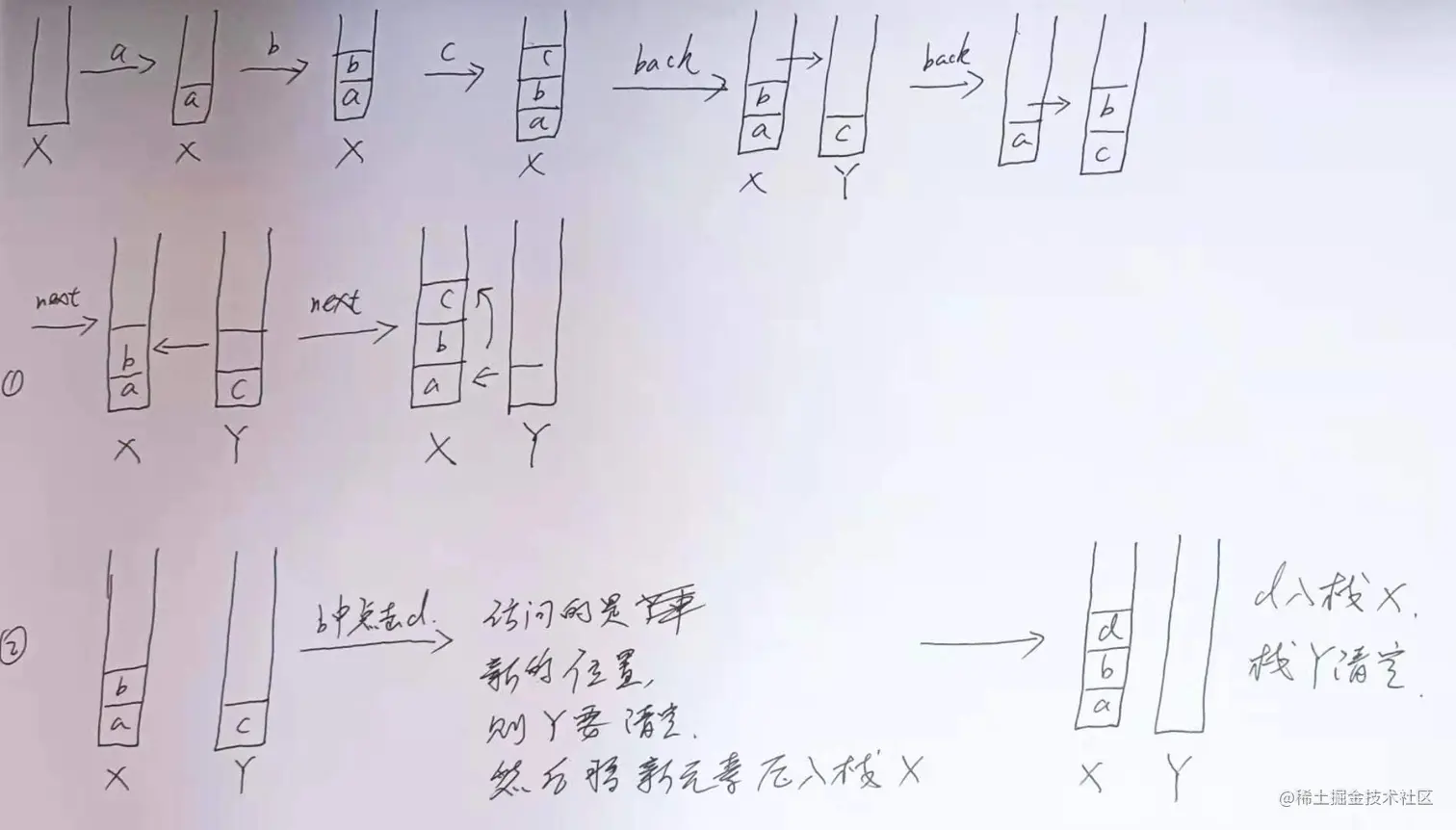
1. 用2个栈来实现浏览器的前进及回退
2. 使用链表实现栈
public class StackBasedOnLinkedList {
public class Node {
public int data;
public Node next;
public Node(int data, Node next) {
super();
this.data = data;
this.next = next;
}
public int getData() {
return data;
}
}
private Node top;
public void push(int data) {
Node node = new Node(data, null);
if (top == null) {
top = node;
} else {
node.next = top;
top = node;
}
}
public int pop() {
if(top == null) {
return -1;
}
int value = top.data;
top = top.next;
return value;
}
public void printAll() {
while(top!=null) {
System.out.println("当前值:" + top.data);
top = top.next;
}
}
public static void main(String[] args) {
StackBasedOnLinkedList t = new StackBasedOnLinkedList();
t.push(1);
t.push(2);
t.push(3);
t.push(4);
t.push(5);
t.printAll();
}
}
当前值:5
当前值:4
当前值:3
当前值:2
当前值:1
3.使用2个栈来实现浏览器的 打开,前进,后退 功能
public class SimpleBrowser {
public class Node {
public String data;
public Node next;
public Node(String data, Node next) {
super();
this.data = data;
this.next = next;
}
public String getData() {
return data;
}
}
public class StackBasedOnLinkedList {
public Node top;
public void push(Node node) {
if (top == null) {
top = node;
} else {
node.next = top;
top = node;
}
}
public String pop() {
if (top == null) {
return "当前栈为空!";
}
String result = top.data;
top = top.next;
return result;
}
public void clear() {
while (top != null) {
pop();
}
}
public boolean hasElements() {
return top != null;
}
public void printAll() {
Node curr = top;
while(curr != null) {
System.out.println("当下元素值:" + curr.data);
curr = curr.next;
}
}
}
public String currentPage;
public StackBasedOnLinkedList backStack;
public StackBasedOnLinkedList forwardStack;
public SimpleBrowser() {
this.backStack = new StackBasedOnLinkedList();
this.forwardStack = new StackBasedOnLinkedList();
}
public boolean canGoBack() {
return this.backStack.hasElements();
}
public boolean canGoForward() {
return this.forwardStack.hasElements();
}
public String goBack() {
if (canGoBack()) {
String url = this.backStack.pop();
this.forwardStack.push(new Node(url, null));
this.currentPage = this.backStack.top == null ? null : this.backStack.top.data;
return url;
}
return null;
}
public String goForward() {
if (canGoForward()) {
String url = this.forwardStack.pop();
this.backStack.push(new Node(url, null));
this.currentPage = url;
return url;
}
return null;
}
public String open(String url) {
this.forwardStack.clear();
this.backStack.push(new Node(url, null));
this.currentPage = url;
return url;
}
public static void main(String[] args) {
SimpleBrowser t = new SimpleBrowser();
t.open("url1");
t.open("url2");
t.open("url3");
t.open("url4");
t.open("url5");
t.open("url6");
t.open("url7");
t.open("url8");
t.goBack();
t.goBack();
t.goBack();
t.goBack();
System.out.println("当前页面:" + t.currentPage);
t.goBack();
t.goForward();
t.goForward();
System.out.println("当前页面:" + t.currentPage);
t.open("urlX");
System.out.println("当前页面:" + t.currentPage);
}
}
当前页面:url4
当前页面:url5
当前页面:urlX
14. 队列: 一种操作受限的线性表,先进先出,就是典型的队列.
1. 入队: 向队列尾部添加1个元素
2. 出队: 从队列头部取1个元素
3. 构建以数组为基础的队列
public class QueueBasedOnArray {
public String[] items;
public int head, tail;
public int size;
public QueueBasedOnArray(int capacity) {
this.size = capacity;
this.items = new String[size];
head = tail = 0;
}
public boolean isEmpty() {
return head == tail;
}
public boolean isFull() {
return tail == size;
}
public boolean enqueue(String item) {
if (isFull()) {
return false;
}
items[tail] = item;
tail++;
return true;
}
public String dequeue() {
if(isEmpty()) {
return null;
}
String result = items[head];
head++;
return result;
}
public void printAll() {
if (isEmpty()) {
return;
}
System.out.println("队列所有元素:");
for (int i = head; i < tail; i++) {
System.out.println("当下元素值:" + items[i]);
}
}
public static void main(String[] args) {
QueueBasedOnArray t = new QueueBasedOnArray(6);
t.enqueue("1");
t.enqueue("2");
t.enqueue("3");
t.enqueue("4");
t.enqueue("5");
t.enqueue("6");
t.enqueue("7");
t.printAll();
t.dequeue();
t.dequeue();
t.dequeue();
t.dequeue();
t.enqueue("X");
t.printAll();
}
}
队列所有元素:
当下元素值:1
当下元素值:2
当下元素值:3
当下元素值:4
当下元素值:5
当下元素值:6
队列所有元素:
当下元素值:5
当下元素值:6
4. 构建以数组为基础的队列,只要数组有剩余空间,就可以继续添加元素
public class DynamicQueueBasedOnArray {
public String[] items;
public int head, tail;
public int size;
public DynamicQueueBasedOnArray(int capacity) {
size = capacity;
items = new String[size];
head = tail = 0;
}
public boolean isEmpty() {
return head == tail;
}
public String dequeue() {
if (isEmpty()) {
return null;
}
String result = items[head];
head++;
return result;
}
public boolean enqueue(String item) {
if (tail == size) {
if (head == 0) {
return false;
} else {
for (int i = head; i < tail; i++) {
items[i - head] = items[i];
}
tail = tail - head;
head = 0;
}
}
items[tail] = item;
tail++;
return true;
}
public void printAll() {
if (isEmpty()) {
return;
}
System.out.println("当下队列所有元素:");
for (int i = head; i < tail; i++) {
System.out.println("当下元素值:" + items[i]);
}
}
public static void main(String[] args) {
DynamicQueueBasedOnArray t = new DynamicQueueBasedOnArray(6);
t.enqueue("1");
t.enqueue("2");
t.enqueue("3");
t.enqueue("4");
t.enqueue("5");
t.enqueue("6");
t.enqueue("7");
t.enqueue("8");
t.printAll();
t.dequeue();
t.dequeue();
t.dequeue();
t.dequeue();
t.enqueue("X");
t.printAll();
}
}
当下队列所有元素:
当下元素值:1
当下元素值:2
当下元素值:3
当下元素值:4
当下元素值:5
当下元素值:6
当下队列所有元素:
当下元素值:5
当下元素值:6
当下元素值:X
5. 构建以链表为基础的队列,无界队列
public class QueueBasedOnLinkedList {
public class Node{
public String data;
public Node next;
public Node(String data, Node next) {
this.data = data;
this.next = next;
}
public Node(String data) {
this.data = data;
}
}
public Node head;
public Node tail;
public void enqueue(String data) {
if(head == null) {
head = tail = new Node(data);
}else {
tail.next = new Node(data);
tail = tail.next;
}
}
public String dequeue() {
if(head == null) {
return null;
}
String data = head.data;
head = head.next;
if(head == null) {
tail = null;
}
return data;
}
public void printAll() {
Node curr = head;
System.out.println("当下队列所有元素:");
while(curr != null) {
System.out.println("当下元素值:" + curr.data);
curr = curr.next;
}
}
public static void main(String[] args) {
QueueBasedOnLinkedList t = new QueueBasedOnLinkedList();
t.enqueue("1");
t.enqueue("2");
t.enqueue("3");
t.enqueue("4");
t.dequeue();
t.printAll();
}
}
当下队列所有元素:
当下元素值:2
当下元素值:3
当下元素值:4
6. 构建以数组为基础的循环队列
- tail指向的是一个当下还未存储元素的索引. 这样便于判断队列是否为空. tail指向的是'下一个',这样当 head==tail, 就说明队列是空的.
- 如果tail指向的是队列中最后一个元素,要判断队列是否为空,就要判断head位置或tail位置的元素是否是空. 为了保证是空,就要在每次出队时候将对应位置的数组元素置空,然后才能'head+1'.
1和2比较可见,tail指向'下一个'可以简化代码.
- 在以数组为基础构建的循环队列里,一定存在1个位置是要被浪费的.
- 因为tail指向'下一个',是当前没有存储元素的位置.
- 而循环队列是环形的,这个位置只能是环上的一个索引值.
- 不像数组构建的非循环对列,tail最大可以是n, 而n并不在数组索引值的范围.
public class CircleQueueBasedOnArray {
public String[] items;
public int head, tail;
public int size;
public CircleQueueBasedOnArray(int capacity) {
head = tail = 0;
size = capacity;
items = new String[size];
}
public boolean isEmpty() {
return head == tail;
}
public boolean isFull() {
return (tail + 1) % size == head;
}
public boolean enqueue(String item) {
if (isFull()) {
return false;
}
items[tail] = item;
tail = (tail + 1) % size;
return true;
}
public String dequeue() {
if (isEmpty()) {
return null;
}
String result = items[head];
head = (head + 1) % size;
return result;
}
public void printAll() {
if (isEmpty()) {
return;
}
System.out.println("当前队列所有元素:");
for (int i = head; i != tail; i = (i + 1) % size) {
System.out.println("当下元素值:" + items[i]);
}
}
public static void main(String[] args) {
CircleQueueBasedOnArray t = new CircleQueueBasedOnArray(6);
t.enqueue("1");
t.enqueue("2");
t.enqueue("3");
t.enqueue("4");
t.enqueue("5");
t.enqueue("6");
t.printAll();
t.dequeue();
t.dequeue();
t.dequeue();
t.printAll();
t.enqueue("11");
t.enqueue("12");
t.enqueue("13");
t.enqueue("14");
t.enqueue("15");
t.printAll();
}
}
当前队列所有元素:
当下元素值:1
当下元素值:2
当下元素值:3
当下元素值:4
当下元素值:5
当前队列所有元素:
当下元素值:4
当下元素值:5
当前队列所有元素:
当下元素值:4
当下元素值:5
当下元素值:11
当下元素值:12
当下元素值:13
15. 递归
1. 可以用递归解决的问题需满足的条件
- 1个问题的解可以分解为几个子问题的解.
- 原问题和子问题,除了数据规模不同,求解方法完全一致.
- 问题分解为子问题,不能无限分解,要有终止条件,即存在递归终止条件.
2. 递归的缺点
- 递归层级太深,会导致堆栈溢出.
- 以JVM为例,每个线程栈的深度是有限的,如果递归数量过大,不断将栈帧压入函数调用栈,超过限制就触发Stack Overfllow
- 递归可能存在重复计算问题
- 比如f(n) = f(n-1) + f(n-2), f(n-1) = f(n-2) + f(n-3) ,f(n-2)就被重复计算了2遍
- 为例避免重复计算,应该将之前指定参数的结果用散列表存下来
- 每一次调用递归,都会创建1个栈帧压栈,栈帧中包含临时变量,多次调用会增加算法的空间复杂度.
- 相对于while循环,我们可以声明1个变量,在while循环中反复使用,空间复杂度低
- 递归是'同步'的,需等待之前的调用结果,如果调用次数过大,会积累至很高的时间成本.
3. 几个递归问题
3.1. n阶楼梯,每次可以上1阶或者上2阶,一共有多少种走法?
private Map<Integer,Integer> results = new HashMap<Integer,Integer>();
public int goStairs(int n){
    if(n <= 1){
        return 1;
    }
    if(n == 2){
        return 2;
    }
    if(results.containsKey(n)){
        return results.get(n);
    }
    return goStairs(n - 1) + goStairs(n - 2);
}
16. 如何评价1个排序算法: 从 排序算法的执行效率, 排序算法的空间复杂度, 排序算法的稳定性 3个方面来衡量.
1. 排序算法的执行效率
- 最好情况,最坏情况,平均情况时间复杂度.
- 要排序的数据有的接近有序,有的完全无序.有序度的不同影响排序的执行时间,需要知道算法在不同有序度的数据下的性能表现.
- 时间复杂度的系数,常数,低阶.
- 时间复杂度反应的是n很大时执行时间的增长趋势,表示时会忽略系数,常数,低阶.
- 但实际排序场景,可能只会遇到1000以内这样很小的数据规模.所以对于同一阶时间复杂度的不同算法,其系数,常数,低阶都要考虑进来.
- 比较次数和交换(移动)次数.
- 基于比较的排序算法,一定会涉及元素间的比较及位置交换(或移动).所以要将比较及交换(或移动)次数也考虑进去.
2. 排序算法的内存消耗
- 和其他算法一样,其内存消耗使用空间复杂度来衡量.
- 原地排序:特指空间复杂度是O(1)的排序算法.
3. 排序算法的稳定性
- 稳定性是指: 若待排序的序列中存在值相等的元素,经过排序之后,值相等元素之间原有的先后顺序保持不变.
- 排序后,值相等元素之间原始顺序不变,称为 稳定的排序算法.
- 排序后,值相等元素之间原始顺序改变,称为 不稳定的排序算法.
- 比如一组数据,要按照attr1属性从大到小排序,attr1属性值相等时,按照attr2属性值从小到大排序.
- 首先按照attr2属性值从小到大排序
- 再利用稳定排序算法,按照attr1从大到小排序.
17. 冒泡排序
1. 冒泡排序只会操作相邻的2个数据.
2. 若相邻的2个元素大小关系不满足要求,则互换.
3. 1次冒泡会让至少1个元素移动到移动到正确位置,重复n次,就完成了n个数据的排序.
public class BubbleSort {
public void bubbleSort(int[] arr) {
if (arr == null || arr.length <= 1) {
return;
}
int length = arr.length;
boolean moved = false;
int temp;
for (int i = 0; i < length; i++) {
moved = false;
for (int j = 0; j < length - 1 - i; j++) {
if (arr[j] > arr[j + 1]) {
temp = arr[j];
arr[j] = arr[j + 1];
arr[j + 1] = temp;
moved = true;
}
}
if (!moved) {
System.out.println("冒泡次数:" + (i + 1));
break;
}
}
}
public static void main(String[] args) {
BubbleSort t = new BubbleSort();
int[] arr = { 12, 54, 32, 8, 6, 3, 111, 45 };
t.bubbleSort(arr);
Arrays.stream(arr).forEach(System.out::println);
}
}
冒泡次数:6
3
6
8
12
32
45
54
111
4. 冒泡排序的时间复杂度,空间复杂度,稳定性
- 最好情况时间复杂度: O(n)
- 所有元素都是有序的.
- 冒泡一次并发现无元素交换就终止排序.
- 最坏情况时间复杂度: O(n^2)
- 平均情况时间复杂度: O(n^2)
- 有序度: 原始数组中排序正确的元素对个数
- 满有序度: 原始数组是完全有序的,其有序度称为满有序度
- 逆序度: 原始数组中排序错误的元素对个数
- 逆序度 = 满有序度 - 有序度
- 逆序度是原始数组需要执行元素交换的次数
- 满有序度 = n*(n-1)/2, 逆序度平均就是 满有序度/2 = n*(n-1)/4
- 比较交换次数肯定大于交换次数,且最坏时间复杂度就是O(n^2).所以冒泡排序的平均情况时间复杂度就是O(n^2)
- 空间复杂度是O(1), 属于稳定排序.
18. 插入排序
1. 插入排序将数组整体分为已排序区间和未排序区间.初始已排序区间只有1个元素,就是数组的第一个元素.
2. 每次取未排序区间头上的元素,在已排序区间中找到合适的位置将其插入,并保证已排序区间一直有序.
3. 重复整个过程,直至未排序区间元素为空.
public class InsertSort {
    public void insertSort(int[] a) {
        if (a == null || a.length <= 1) {
            return;
        }
        int value;
        int j;
        for (int i = 1; i < a.length; i++) {
            value = a[i];
            j = i - 1;
            for (; i >= 0; j--) {
                if(a[j] > value) {
                    a[j + 1] = a[j];
                }else {
                    break;
                }
            }
            a[j + 1] = value;
        }
    }

    public static void main(String[] args) {
        InsertSort t = new InsertSort();
        int[] a = {1,2,31,32,19,18,17,16,61,58,54};
        t.insertSort(a);
        System.out.println("运行结果:\n");
        Arrays.stream(a).forEach(System.out::println);
    }
}

运行结果:

1
2
16
17
18
19
31
32
54
58
61
4. 插入排序最好情况时间复杂度是O(n),最坏情况时间复杂度是O(n^2),平均情况时间复杂度是O(n^2). 空间复杂度是O(1),属于稳定排序.
19. 选择排序
1. 选择排序类似插入排序,也将整个数组分为 已排序区间 和 未排序区间.
2. 每次从未排序区间中找到最小元素,放到 已排序区间末尾.
public class SelectSort {
    public void selectSort(int[] a) {
        if (a == null || a.length <= 1) {
            return;
        }
        int minIndex;
        int temp;
        for (int i = 0; i < a.length - 1; i++) {
            minIndex = i;
            for (int j = i + 1; j < a.length; j++) {
                if (a[j] < a[minIndex]) {
                    minIndex = j;
                }
            }
            temp = a[i];
            a[i] = a[minIndex];
            a[minIndex] = temp;
        }
    }

    public static void main(String[] args) {
        SelectSort t = new SelectSort();
        int[] a = { 3, 5, 7, 2, 4, 6, 89, 40 };
        t.selectSort(a);
        System.out.println("选择排序后数组:");
        Arrays.stream(a).forEach(System.out::println);
    }
}

选择排序后数组:
2
3
4
5
6
7
40
89
3. 选择排序的最好,最坏,平均时间复杂度都是O(n^2),因为每次都要完整比较,没有中途退出的机会.
4. 选择排序的空间复杂度是O(1).
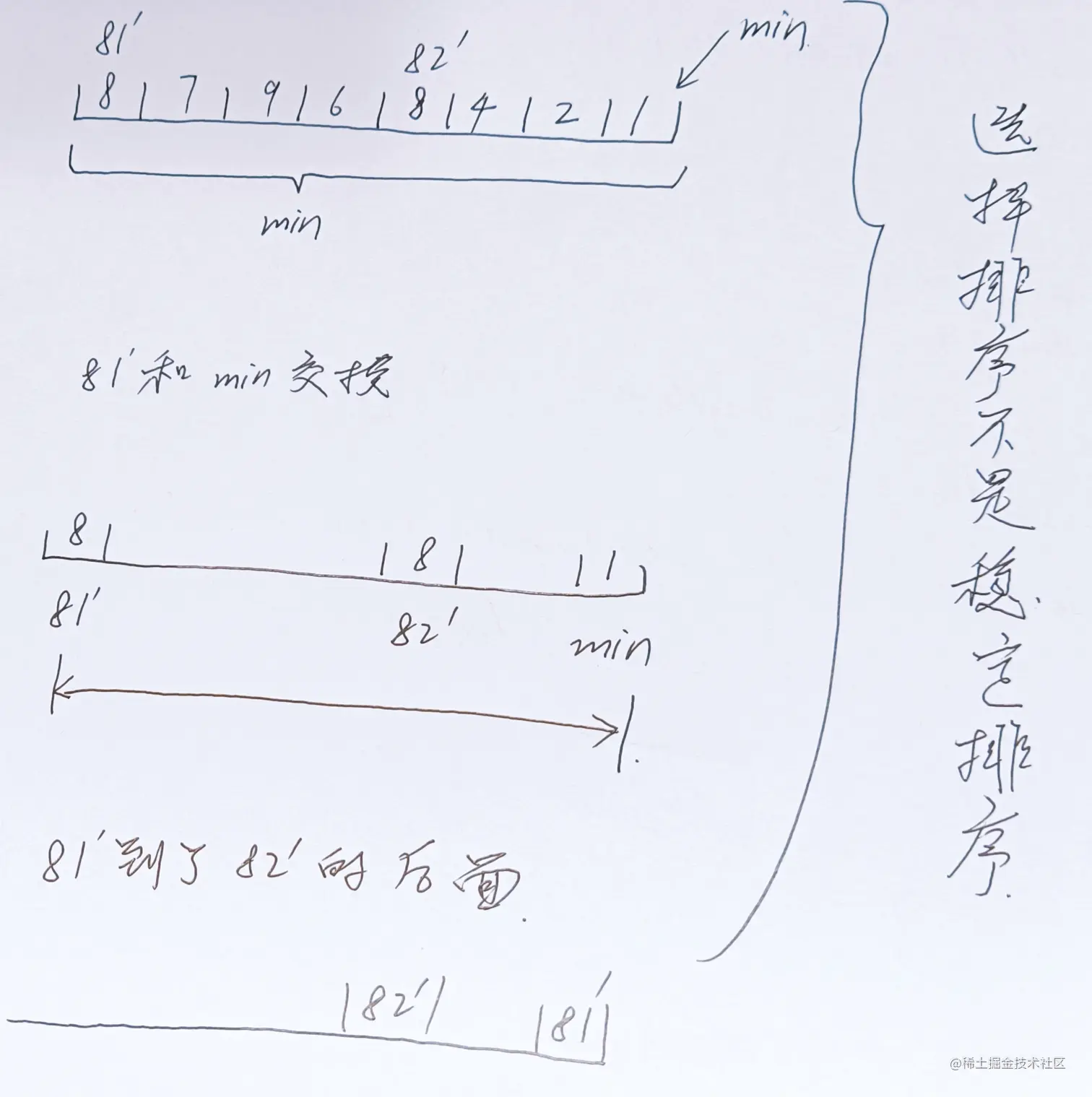
5. 选择排序不是稳定排序,因为min元素要和已排序区间的末尾元素进行交换,有几率导致顺序被打乱. 上图:
20. 冒泡排序和插入排序的时间复杂度相同,都是O(n^2).为什么插入排序使用更普遍
1. 两者虽然时间复杂度相同都是O(n^2),但是元素交换操作,插入排序比冒泡排序要简单,代码行数更低,所以插入排序性能更好.
2. 两者元素交换比较
if(a[j] > a[j + 1]){
temp = a[j];
a[j] = a[j + 1];
a[j + 1] = temp;
moved = true;
}
if(a[j] > value){
a[j + 1] = a[j];
}else{
break;
}
21. 归并排序
1. 将原始数组分为2部分,2部分排序完成后,将2部分合并
2. 每一部分可以继续分为2部分,递归执行
3. 伪代码
public void sort(int[] arr) {
    splitSort(arr, 0, arr.length - 1);
}
public int[] splitSort(int[] arr, int startIndex, int endIndex) {
    if (startIndex >= endIndex) {
        return new int[] { arr[startIndex] };
    }
    int midIndex = (startIndex + endIndex) / 2;
    int[] a1 = splitSort(arr, startIndex, midIndex);
    int[] a2 = splitSort(arr, midIndex + 1, endIndex);
    int[] result = merge(a1, a2);
    return result;
}
public int[] merge(int[] a1, int[] a2) {
    int[] result = new int[a1.length + a2.length];
    int i1 = 0;
    int i2 = 0;
    for (int i = 0; i < result.length; i++) {
        if (a1[i1] > a2[i2]) {
            result[i] = a2[i2];
            i2++;
        } else {
            result[i] = a1[i1];
            i1++;
        }
    }
    return result;
}
4. 归并排序的时间复杂度是O(nlogn),很稳定
5. 归并排序的空间复杂度是O(n),因为合并数组数组需要创建新的数组,所以不是原地排序.
6. 归并排序属于稳定排序.比如a1和a2中有相同值的元素,按照约定将a1的元素先加到合并后的数组中.
22. 快速排序
1. 快速排序,是每次取数组中的一个元素作为分区值,数组中元素值,小于该值的放到其左边,大于该值的放到其右边.
2. 然后对其左边 及 右边 再分别进行排序,递归执行.
3. 伪代码
public void sort(int[] arr){
    quickSort(arr, 0, arr.length - 1);
}
public void quickSort(int[] arr, int startIndex, int endIndex){
    if(arr == null || startIndex >= endIndex){
        return;
    }
    int pivot = partition(arr, startIndex, endIndex);
    quickSort(arr, startIndex, pivot - 1);
    quickSort(arr, pivot + 1, endIndex);
}
public int partition(int[] arr, int startIndex, int endIndex){
    int value = arr[endIndex];
    int pivot = endIndex;
    for(int i = startIndex; i<endIndex - 1; i++){
        if(a[i] < value){
            if(pivot == endIndex){
                if(i != startIndex){
                    swap(i, startIndex);
                }
                pivot = startIndex;
            }else{
                swap(pivot+1, i);
                pivot++;
            }
        }
    }
    if(pivot != endIndex){
        pivot = pivot + 1;
        swap(endIndex, pivot);
    }
    return pivot;
}
4. 快速排序的时间复杂度是O(nlogn),最差时间复杂度是O(n^2).
5. 快速排序是原地排序,因为不涉及创建新的数组,直接对数组元素进行排序.
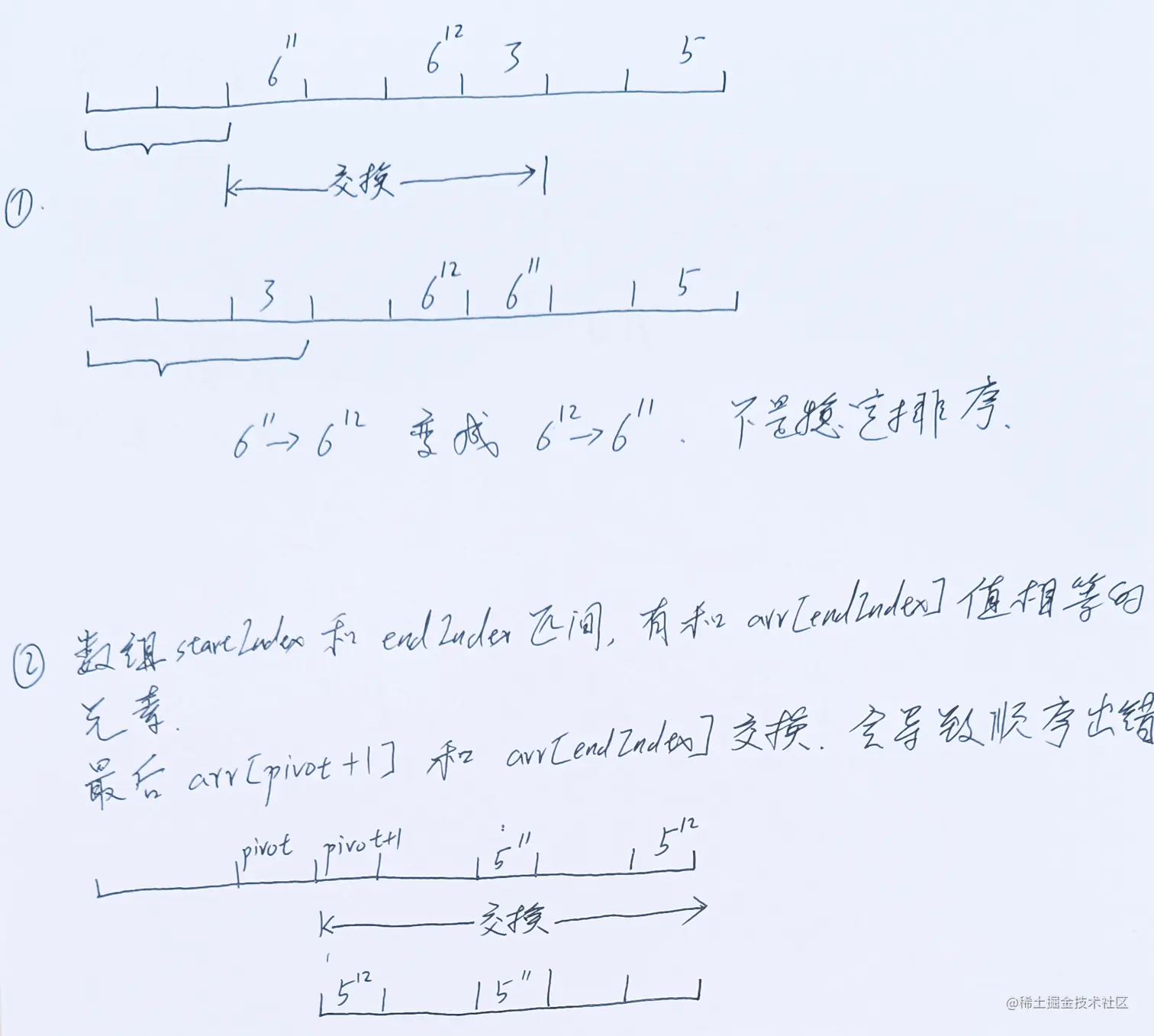
6. 款速排序不是稳定排序,设计到数组元素的交换.有2种情况会导致相同值的元素顺序改变.