You are given two non-empty linked lists representing two non-negative integers. The digits are stored in reverse order, and each of their nodes contains a single digit. Add the two numbers and return the sum as a linked list.
You may assume the two numbers do not contain any leading zero, except the number 0 itself.
Example 1:
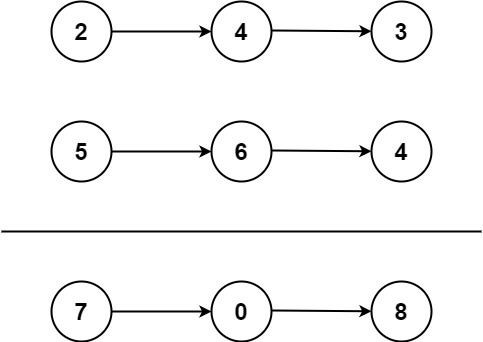
Input: l1 = [2,4,3], l2 = [5,6,4]
Output: [7,0,8]
Explanation: 342 + 465 = 807.
Example 2:
Input: l1 = [0], l2 = [0]
Output: [0]
Example 3:
Input: l1 = [9,9,9,9,9,9,9], l2 = [9,9,9,9]
Output: [8,9,9,9,0,0,0,1]
Constraints:
- The number of nodes in each linked list is in the range
[1, 100]. 0 <= Node.val <= 9- It is guaranteed that the list represents a number that does not have leading zeros.
/**
 * Definition for singly-linked list.
 * public class ListNode {
 *     int val;
 *     ListNode next;
 *     ListNode() {}
 *     ListNode(int val) { this.val = val; }
 *     ListNode(int val, ListNode next) { this.val = val; this.next = next; }
 * }
 */
class Solution {
    public ListNode addTwoNumbers(ListNode l1, ListNode l2) {
        if(l1==null) return l2;
        if(l2==null) return l1;
        ListNode p=new ListNode();
        ListNode head=p;
        int carry=0;
        while(l1!=null || l2!=null){
            int v1=0,v2=0;
            if(l1!=null){
                v1=l1.val;
                l1=l1.next;
            }
            if(l2!=null){
                v2=l2.val;
                l2=l2.next;
            }
            int sum=carry+v1+v2;
            int val=sum%10;
            carry=sum/10;
            ListNode tmp=new ListNode(val);
            p.next=tmp;
            p=p.next;

        }
        if(carry>0){
            ListNode tmp=new ListNode(carry);
            p.next=tmp;
            p=p.next;
        }
        p.next=null;
        return head.next;

    }
}
67. Add Binary
Given two binary strings, return their sum (also a binary string).
The input strings are both non-empty and contains only characters 1 or 0.
Example 1:
Input: a = "11", b = "1"
Output: "100"
Example 2:
Input: a = "1010", b = "1011"
Output: "10101"
Constraints:
-
Each string consists only of
'0'or'1'characters. -
1 <= a.length, b.length <= 10^4 -
Each string is either
"0"or doesn't contain any leading zero.class Solution { public String addBinary(String a, String b) { int l1=a.length()-1,l2=b.length()-1; StringBuilder sb=new StringBuilder(); int carry=0; while(l1>=0 || l2>=0){ int v1=0,v2=0; if(l1>=0){ v1=a.charAt(l1)-'0'; l1--; }
        if(l2>=0){
           v2=b.charAt(l2)-'0';
            l2--;
        }
        int val=(carry+v1+v2)%2;
        carry=(carry+v1+v2)/2;
        sb.insert(0,val);

    }
    if(carry>0){
        sb.insert(0,carry);
    }
    return sb.toString();

}
}
415. Add Strings
Given two non-negative integers num1 and num2 represented as string, return the sum of num1 and num2.
Note:
-
The length of both
num1andnum2is < 5100. -
Both
num1andnum2contains only digits0-9. -
Both
num1andnum2does not contain any leading zero. -
You must not use any built-in BigInteger library or convert the inputs to integer directly.
class Solution { public String addStrings(String num1, String num2) { if(num1==null ||num1.length()==0) return num2; if(num2==null ||num2.length()==0) return num1; int l1=num1.length()-1;int l2=num2.length()-1; int carry=0; StringBuilder sb=new StringBuilder(); while(l1>=0 || l2>=0){ int v1=0, v2=0; if(l1>=0) { v1=num1.charAt(l1)-'0'; l1--; } if(l2>=0){ v2=num2.charAt(l2)-'0'; l2--; } int val=(v1+v2+carry)%10; carry=(v1+v2+carry)/10; sb.insert(0,val);
    }
    if(carry>0){
        sb.insert(0,carry);
    }
   return sb.toString();

}
}
445. Add Two Numbers II
You are given two non-empty linked lists representing two non-negative integers. The most significant digit comes first and each of their nodes contain a single digit. Add the two numbers and return it as a linked list.
You may assume the two numbers do not contain any leading zero, except the number 0 itself.
Follow up:
What if you cannot modify the input lists? In other words, reversing the lists is not allowed.
Example:
Input: (7 -> 2 -> 4 -> 3) + (5 -> 6 -> 4)
Output: 7 -> 8 -> 0 -> 7

class Solution {
    public ListNode addTwoNumbers(ListNode l1, ListNode l2) {
         //reverse
        l1=reverseNode(l1);
        l2=reverseNode(l2);
        ListNode head=new ListNode();
        int carry=0;
        while(l1!=null || l2!=null){
            int v1=0,v2=0;
            if(l1!=null){
                v1=l1.val;
                l1=l1.next;
            }
            if(l2!=null){
                v2=l2.val;
                l2=l2.next;
            }
            int sum=(carry+v1+v2)%10;
            carry=(carry+v1+v2)/10;
            ListNode tmp=new ListNode(sum);
            tmp.next=head.next;
            head.next=tmp;

        }
        if(carry>0){
            ListNode tmp=new ListNode(carry);
            tmp.next=head.next;
            head.next=tmp;

        }

        return head.next;

    }

    ListNode reverseNode(ListNode head){
        if(head==null || head.next==null){
            return head;
        }
        ListNode p1=head;
        ListNode p2=head.next;
        p1.next=null;
        while(p2!=null){
            ListNode tmp=p2.next;
            p2.next=p1;
            p1=p2;
            p2=tmp;
        }
        return p1;

    }
}