Position Based Dynamics

421 阅读1分钟

介绍

基于位置求解。

方法

约束(Constraint)

对于NN个粒子,MM个约束:

C1(x)=0...CM(x)=0C_1(\mathbf{x})=0 \\ ... \\ C_M(\mathbf{x})=0

其中,x=[x1T,...,xNT]T\mathbf{x}=[\mathbf{x}^\mathsf{T}_1,...,\mathbf{x}^\mathsf{T}_N]^\mathsf{T}

非线性高斯—桑德尔求解(The Non-Linear Gauss-Seidel Solver)

单独地求解每个约束C(x)C(\mathbf{x})。在一次迭代中,顶点位置的修正立即应用到下一个约束的求解。 给定x\mathbf{x},求解Δx\Delta \mathbf{x},使得C(x+Δx)=0C(\mathbf{x}+\Delta \mathbf{x})=0。 作线性近似:

C(x+Δx)C(x)+C(x)TΔx=0C(\mathbf{x}+\Delta \mathbf{x})\approx C(\mathbf{x}) + \nabla C(\mathbf{x})^{\mathsf{T}} \Delta \mathbf{x} = 0

由动量守恒定律可知Δx\Delta \mathbf{x}的方向为C\nabla C的方向,引入拉格朗日乘数子λ\lambda

Δx=λM1C(x)\Delta \mathbf{x} = \lambda \mathbf{M}^{-1}\nabla C(\mathbf{x})

其中,M=diag(m1,m2,...,mN)\mathbf{M}=diag(m_1, m_2, ..., m_N)

解得

λ=C(x)ΔC(x)TM1ΔC(x)=C(x)imi1xiC(x)2\lambda = -\frac{C(\mathbf{x})}{\Delta C(\mathbf{x})^\mathsf{T}\mathbf{M}^{-1}\Delta C(\mathbf{x})} = -\frac{C(\mathbf{x})}{\sum_im_i^{-1}\|\nabla_{\mathbf{x}_i} C(\mathbf{x})\|^2}

对于粒子ii

Δxi=λmi1xiC(x)\Delta \mathbf{x}_i=\lambda m^{-1}_{i} \nabla_{\mathbf{x}_i}C(\mathbf{x})

指定约束

Stretching

距离约束:

C(x1,x2)=x1x2dC(\mathbf{x}_1,\mathbf{x}_2)=\|\mathbf{x}_1-\mathbf{x}_2\| - d

梯度:

C(x)=[x1C(x)x2C(x)]=[x1x2x1x2x1x2x1x2]\nabla C(\mathbf{x}) = \left[\begin{matrix} \nabla_{\mathbf{x}_1}C(\mathbf{x}) \\ \nabla_{\mathbf{x}_2}C(\mathbf{x}) \end{matrix}\right] = \left[\begin{matrix}\frac{\mathbf{x}_1-\mathbf{x}_2}{\|\mathbf{x}_1-\mathbf{x}_2\|} \\ -\frac{\mathbf{x}_1-\mathbf{x}_2}{\|\mathbf{x}_1-\mathbf{x}_2\|}\end{matrix}\right]

拉格朗日乘数子:

λ=x1x2dm11+m21\lambda = -\frac{\|\mathbf{x}_1-\mathbf{x}_2\| - d}{m_1^{-1}+m_2^{-1}}

位置修正

Δx1=m11m11+m21(x1x2d)x1x2x1x2Δx2=m21m11+m21(x1x2d)x1x2x1x2\begin{aligned} \Delta \mathbf{x}_1 &= \frac{-m_1^{-1}}{m_1^{-1}+m_2^{-1}}(\|\mathbf{x}_1-\mathbf{x}_2\| - d)\frac{\mathbf{x}_1-\mathbf{x}_2}{\|\mathbf{x}_1-\mathbf{x}_2\|} \\ \Delta \mathbf{x}_2 &= \frac{m_2^{-1}}{m_1^{-1}+m_2^{-1}}(\|\mathbf{x}_1-\mathbf{x}_2\| - d)\frac{\mathbf{x}_1-\mathbf{x}_2}{\|\mathbf{x}_1-\mathbf{x}_2\|} \end{aligned}

算法

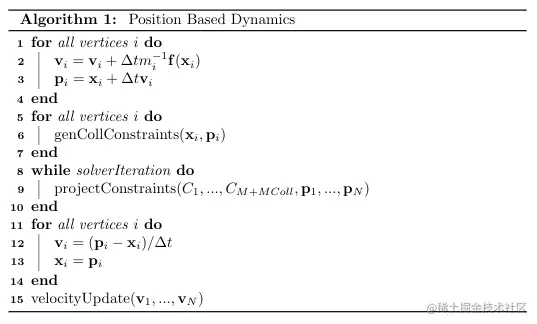
  • 第6行:为了连续碰撞检测,需要当前位置和预测位置。
  • 第15行:根据摩擦力系数和恢复力系数调整速度。

实现

void Stretching::solveConstraint()
{
    RigidBody &rb0 = mPBD.mRigiBodies[mBodyIndexes[0]];
    RigidBody &rb1 = mPBD.mRigiBodies[mBodyIndexes[1]];

    Vector3f x0x1 = rb0.mBaryCenter - rb1.mBaryCenter;
    float x0x1N = x0x1.norm();
    float lambda = -(x0x1N - distance) / (rb0.mInvMass + rb1.mInvMass);

    Vector3f deltaX0 = rb0.mInvMass * lambda / x0x1N * x0x1;
    Vector3f deltaX1 = -rb1.mInvMass * lambda / x0x1N * x0x1;

    rb0.mVelocity += deltaX0 / mPBD.dt;
    rb1.mVelocity += deltaX1 / mPBD.dt;
    rb0.mBaryCenter += deltaX0;
    rb1.mBaryCenter += deltaX1;
}

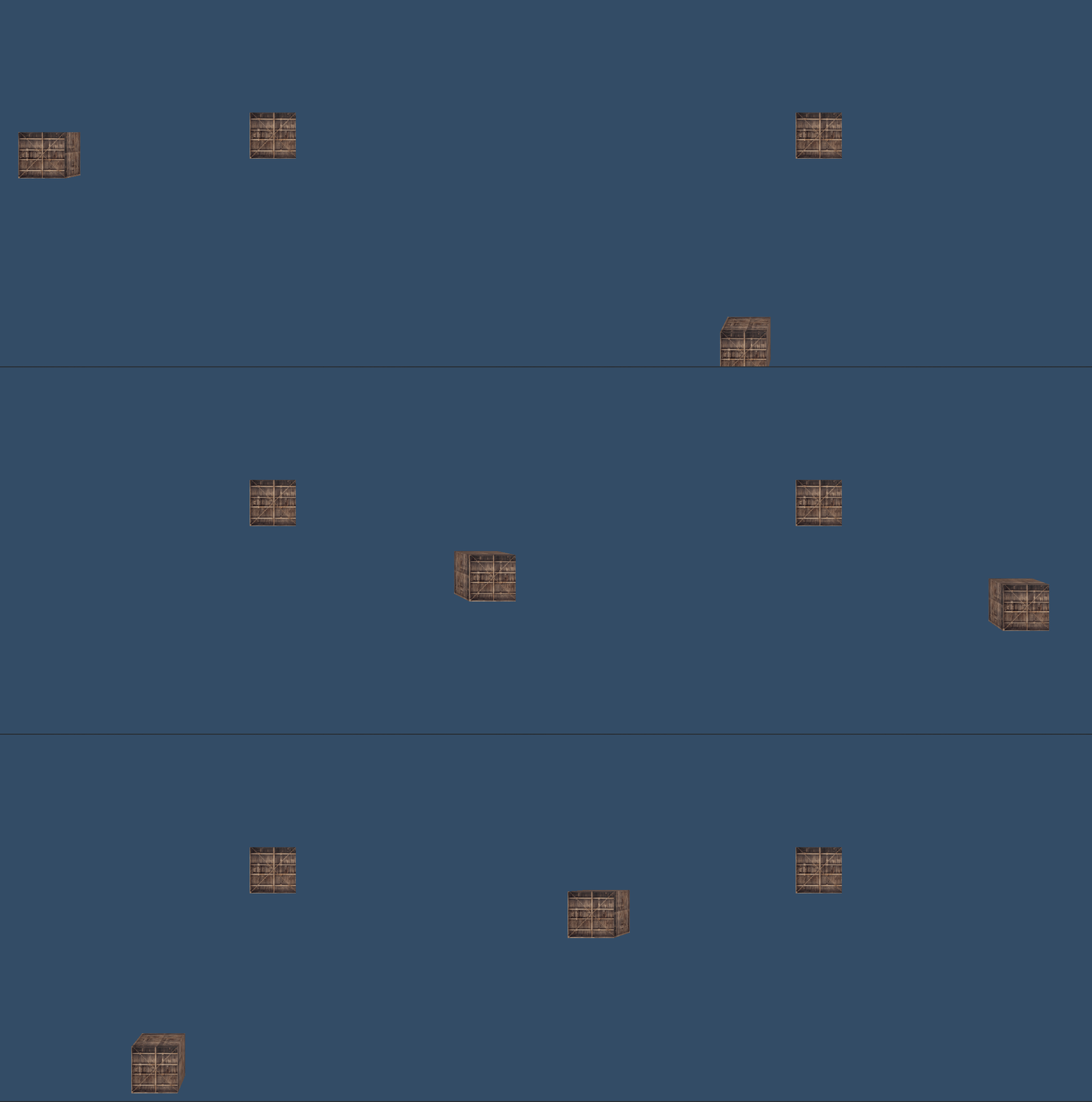
演示
参考

  1. M. Zwicker and C. Soler, Position-Based Simulation Methods in Computer Graphics, 2015, The Eurographics Association, 10.2312/egt.20151045