1.题目: 实现函数fn,让其具有如下功能
let res = fn(1,2)(3);
console.log(res);
function fn(x, y) {
return function (z) {
return x + y + z;
}
}
let res = fn(1, 2)(3);
console.log(res);
function fn() {
let outerArg = Array.from(arguments);
return function () {
let innerArg = Array.from(arguments);
outerArg = outerArg.concat(innerArg);
return eval(outerArg.join('+'));
}
}
let res = fn(1, 2)(3);
console.log(res);
let fn = (x, y) => (z) => x + y + z;
let res = fn(1, 2)(3);
console.log(res);
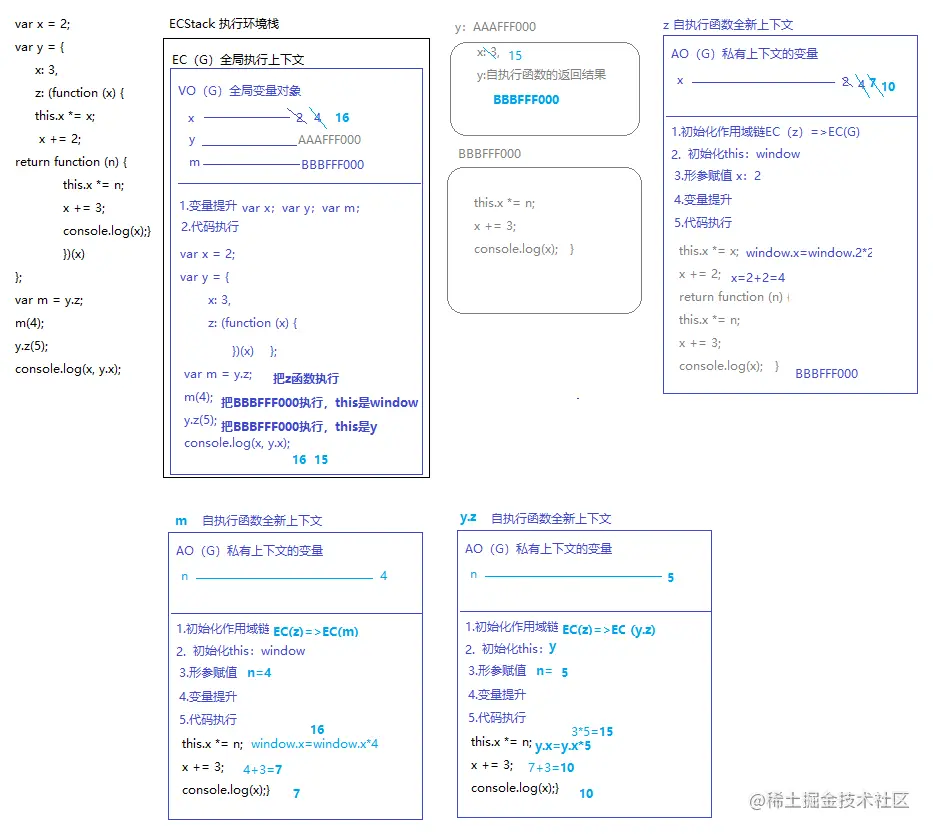
2.this计算题
var x = 2
var y = {
x: 3,
z: (function (x) {
this.x *= x
x += 2
return function (n) {
this.x *= n
x += 3
console.log(x)
}
})(x)
}
var m = y.z
m(4)
y.z(5)
console.log(x, y.x)
3.原型练习题
function Fn(n, m) {
n = n || 0
m = m || 0
this.x = n
this.y = m
this.getX = function () {
console.log(this.x)
}
return n + m
}
Fn.prototype.sum = function () {
console.log(this.x + this.y)
}
Fn.prototype = {
getX: function () {
this.x += 1
console.log(this.x)
},
getY: function () {
this.y -= 1
console.log(this.y)
}
}
let f1 = new Fn(10, 20)
let f2 = new Fn
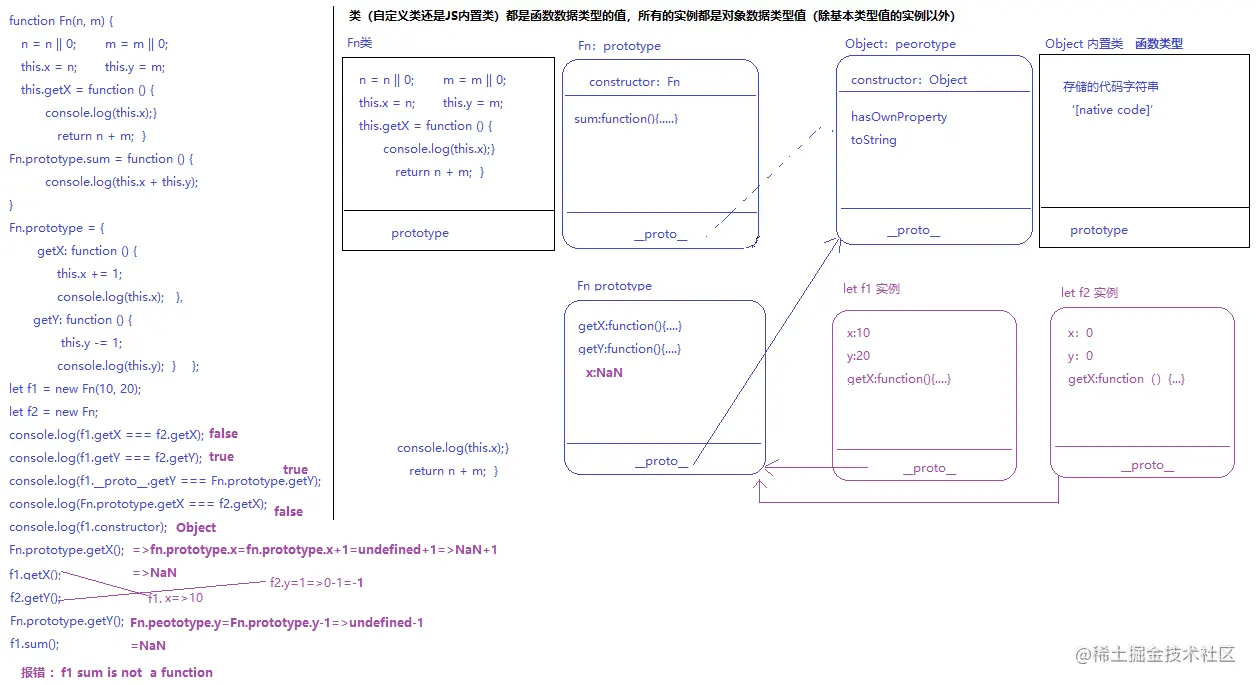
console.log(f1.getX === f2.getX)
console.log(f1.getY === f2.getY)
// 都是找原型上的方法(值得注意的是:在IE浏览器中是不允许我们直接操作 __proto__)
console.log(f1.__proto__.getY === Fn.prototype.getY)
console.log(Fn.prototype.getX === f2.getX)
console.log(f1.constructor)
f1.getX()
// 执行的是私有的getX;方法中的this:f1;console.log(this.x) => f1.x => 10
Fn.prototype.getX()
// 执行的是公有的getX;方法中的this:Fn.prototype;
// this.x += 1 Fn.prototype.x=Fn.prototype.x+1=undefined+1=NaN
// console.log(this.x)
f2.getY()
// 执行的是公有的getY;方法中的this:f2;
// this.y -= 1
// console.log(this.y)
Fn.prototype.getY()
// 执行的是公有的getY;方法中的this:Fn.prototype;
// this.y -= 1
// console.log(this.y)
f1.sum()
// f1.sum => undefined
// undefined() :报错,f1.sum is not a function
//忽略:上面代码的原型优化 Fn.prototype.sum = function () {
console.log(this.x + this.y)
}
let obj = {
// constructor: Fn,
getX: function () {
this.x += 1
console.log(this.x)
},
getY: function () {
this.y -= 1
console.log(this.y)
}
}
// Object.assign(obj1,obj2)把两个对象进行合并,合并过程中,有冲突的属性以obj2为主,
剩余的不冲突的都合并在一起,返回一个合并后的新对象
Fn.prototype = Object.assign(Fn.prototype, obj)
4.原型链计算题
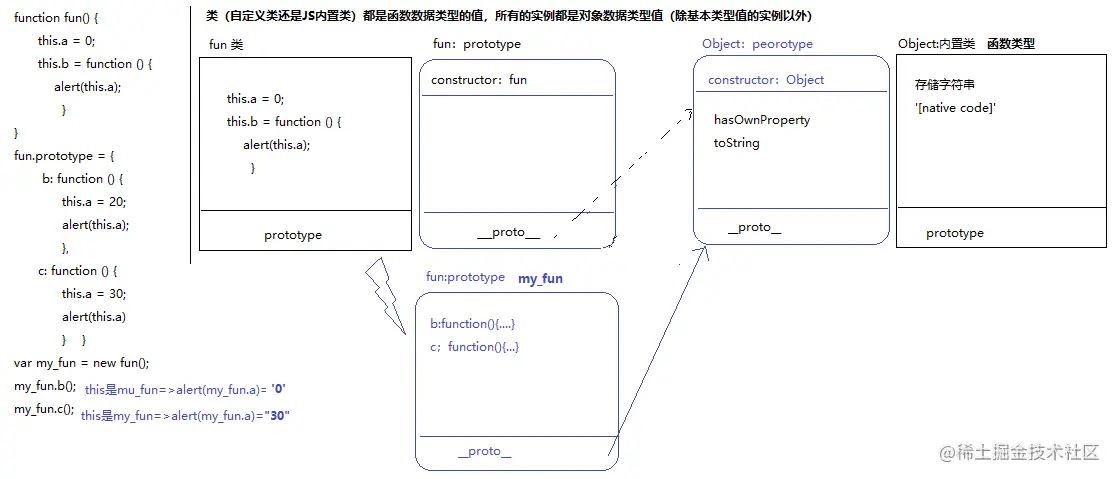
function fun() {
this.a = 0;
this.b = function () {
alert(this.a);
}
}
fun.prototype = {
b: function () {
this.a = 20;
alert(this.a);
},
c: function () {
this.a = 30;
alert(this.a)
}
}
var my_fun = new fun();
my_fun.b();
my_fun.c();
5.原型链计算题
function C1(name) {
// name = undefined
if (name) { //=>if(undefined)
// 条件不成立,也就不执行这句话(没有给实例设置私有的属性NAME)
this.name = name
}
}
function C2(name) {
// name = undefined
this.name = name
}
function C3(name) {
// name = undefined
this.name = name || 'join'
}
C1.prototype.name = 'Tom'
C2.prototype.name = 'Tom'
C3.prototype.name = 'Tom'
alert((new C1().name) + (new C2().name) + (new C3().name))
// new C1().name 创建C1类的一个实例,调取实例上的NAME =>"Tom"
// new C2().name =>"undefined"
// new C3().name =>'join'
// =>"Tomundefinedjoin"
6.原型链计算题
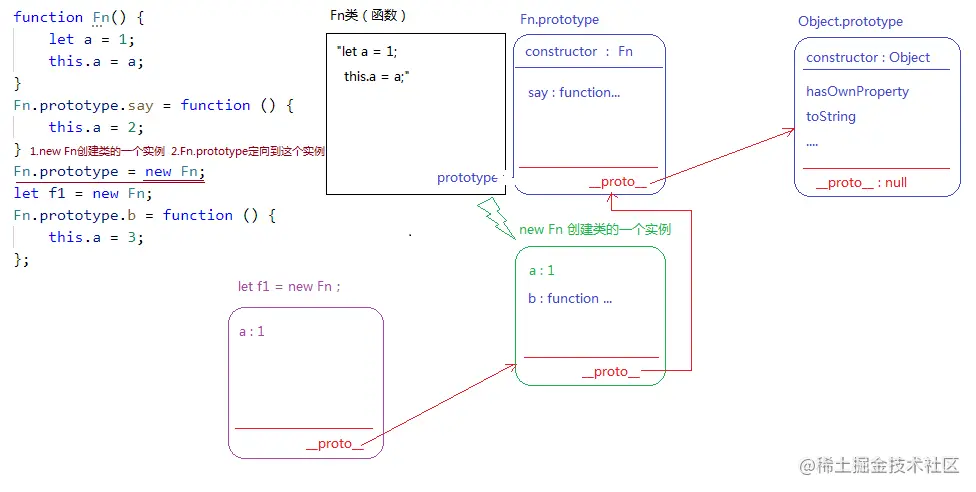
function Fn() {
let a = 1;
this.a = a;
}
Fn.prototype.say = function () {
this.a = 2;
}
Fn.prototype = new Fn;
let f1 = new Fn;
Fn.prototype.b = function () {
this.a = 3;
};
console.log(f1.a);
console.log(f1.prototype);
console.log(f1.b);
console.log(f1.hasOwnProperty('b'));
console.log('b' in f1);
console.log(f1.constructor == Fn);
7.原型链计算题
function Person() {
this.name = 'Hello';
}
Person.prototype.getName = function () {
console.log(this.name);
console.log(this.age);
};
Person.prototype.age = 5000;
var per1 = new Person;
per1.getName();
per1.age = 9;
per1.getName();
console.log(per1.age);
var per2 = new Person;
console.log(per2.age);
8.编写程序实现如下效果
let n = 10;
let m = n.plus(10).minus(5);
console.log(m);
Number.prototype.plus = function plus(n) {
return this + n;
};
Number.prototype.minus = function minus(n) {
return this - n;
};
let n = 10;
let m = n.plus(10).minus(5);
console.log(m);
9.编写程序实现如下效果
let ary = [12,23,12,13,13,12,23,14,8];
ary.unique().sort((a,b)=>a-b);
Array.prototype.unique = function unique() {
return Array.from(new Set(this));
};
let ary = [12, 23, 12, 13, 13, 12, 23, 14, 8];
ary = ary.unique().sort((a, b) => a - b);
console.log(ary);
10. 一个url后面好多key:value,如localhost?key=val&key2=val2&key3=val3,封装一个函数 getParam(‘key’) 通过key获得相应等号后面的值
let url="locallhost?key1=val1&key2=val2&key3=val3"
console.log(url.getParam("key3"))
//=>'val3'
String.prototype.getParams = function getParams(attr) {
// 1.获取字符串中问号后面传参的值,以对象键值对的方式进行存储
let askIndex = this.indexOf('?'),
polIndex = this.indexOf('#'),
askText = '',
obj = {}
if (askIndex > -1) {
polIndex === -1 ? polIndex = this.length : null
askText = this.substring(askIndex + 1, polIndex)
}
askText = askText.split('&')
askText.forEach(item => {
item = item.split('=')
obj[item[0]] = item[1]
})
// console.log(obj)
// 2.根据传递的属性名到对象中找到对应的属性值(如果没有这个属性,不让其返回UNDEFINED,而是让其返回空字符串)
return obj[attr] || ""
}
let url = "locallhost?key1=val1&key2=val2&key3=val3"
console.log(url.getParams("aaa"))
11.下面代码a在什么值情况下会输出1
var a = ?
if (a == 1 && a == 2 && a == 3) {
console.log(1)
}
/* 解决方案一
* ==和===的区别?
* 1\. ==进行比较的时候,两边数据类型不一致,
//则先转换为相同的数据类型,然后再进行比较
* 2\. 除了 对象==字符串 是把对象转换为字符串,其余的都是转换为数字
//(其中比较特殊的是对象,对象转换为数字,首先要把他转换为字符串 => toString 方法)
*/
var a = {
n: 0,
toString: function () {
// a.toString() : this=>a
return ++this.n
}
}
if (a == 1 && a == 2 && a == 3) {
console.log('OK')
}
//2\. 让每一次toString的时候都执行shift,
//删除数组中的第一项,每一次删除返回的结果就是删除的这一项
var a = [1, 2, 3]
a.toString = a.shift
if (a == 1 && a == 2 && a == 3) {
console.log('OK')
}
/*
* 3.解决方案二
* Object.defineProperty:监听某个对象的某个属性,可以在获取或者设置属性的值的时候,做一些自己要做的事情(Vue框架MVVM实现的原理就是基于这个完成的) =>同样原理的还可以使用Proxy代理处理
*
* 全局上下文中变量不带VAR相当于给全局window设置一个属性
*/
var i = 0
Object.defineProperty(window, 'a', {
get() {
// 只要获取a的值,就一定会触发get方法执行
return ++i
}
})
if (a === 1 && a === 2 && a === 3) {
console.log('OK')
}
/* console.log(obj.toString())
let obj = {
n: 0,
toString: function () {
return 'OK'
}
}
console.log(obj.toString())
*/
12.下面代码的输出结果?为什么?
let obj = {
2: 3,
3: 4,
length: 2,
push: Array.prototype.push
}
obj.push(1)
obj.push(2)
console.log(obj)
let obj = {
n: 0
}
// obj.push调取的是私有的属性方法 => Array.prototype.push
// obj.push(1) 相当于让Array原型上的push方法执行
Array.prototype.push = function push(n) {
// 给数组THIS(操作的这个实例)末尾追加新的值
this[this.length] = n
// 1.不仅新增内容到了末尾
// 2.而且让数组的长度LENGTH累加1
return this.length
}
arr.push(100)
let obj = {
2: 3,
3: 4,
length: 2,
push: Array.prototype.push
}
obj.push(1)
/*
* n=1 this:obj
* obj[obj.length]=1 => obj[2]=1 => {2:1,3:4...}
* length累加1 => {2:1,3:4,length:3...}
*/
obj.push(2)
/*
* n=2 this:obj
* this[this.length]=n => obj[obj.length]=2 => obj[3]=2 => {2:1,3:2,length:3...}
* length++ => {2:1,3:2,length:4...}
*/
console.log(obj)