[博客迁移][论文笔记] Towards Logical Specification of Statistical Machine Learning

337 阅读1分钟

from Towards Logical Specification of Statistical Machine Learning


Content

  • Preliminaries

    前导知识,没怎么看懂,不过好像不影响后面

  • Techniques for Conditional Indistinguishability

    • Counterfactual Epistemic Operators

      介绍了两个操作符,主要为形式化公平这个属性做准备

    • Conditional Indistinguishability via Counterfactual Knowledge

      如何用上文描述的两个操作符去表示'Conditional Indistinguishability'

  • Formal Model for Statistical Classification

    • Statistical Classification Problems

      给出了一些定义:

      • C: D \rightarrow L, L be a finite set of class labels, D be the finite set of input data (called feature vectors) that we want to classify.
      • f: D \times L \rightarrow R: be a scoring function that gives a score f(v, ℓ) of predicting the class of an input datum (feature vector) v as a label ℓ.
      • H(v) = l: to represent that a label ℓ maximizes f(v, ℓ).
    • Modeling the Behaviours of Classifiers

      给出了两个公式

      \begin{array}{ll}{s |= \psi(x, y)} & {\text { iff } C\left(\sigma_{s}(x)\right)=\sigma_{s}(y)} \\ {s |= h(x, y)} & {\text { iff } H\left(\sigma_{s}(x)\right)=\sigma_{s}(y)}\end{array}

      ψ(x, y) to represent that C classifies a given input x as a class y.

      h(x, y) to represent that y is the actual class of an input x.

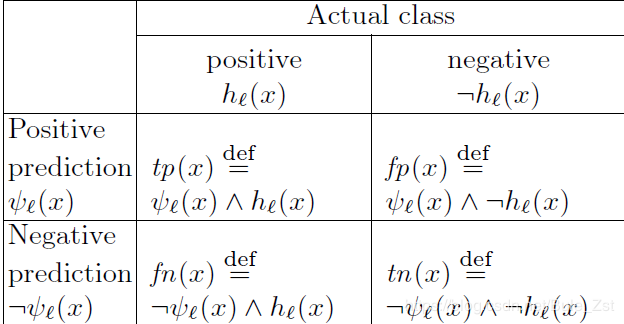
  • Formalizing the Classification Performance

    • 形式化 correctness

    • 1566126879180

    • true positive: s |= \psi_{\ell}(x) \wedge h_{\ell}(x).

    • the precision being within an interval I is given by:

      \operatorname{Pr}\left[v \stackrel{\$}{\leftarrow} \sigma_{w_{\mathrm{real}}}(x) : H(v)=\ell | C(v)=\ell\right] \in I​ or \operatorname{Pr}\left[s \stackrel{\$}{\leftarrow} w_{\mathrm{real}} : s|=h_{\ell}(x) \ | \ s |= \psi_{\ell}(x)\right] \in I​.

    • \text {Precisione}_{\ell, I}(x) \stackrel{\text { def }}{=} \psi_{\ell}(x) \supset \mathbb{P}_{I} h_{\ell}(x) and \text { precision }=\frac{t p}{t p+f p}.

    • \operatorname{Recall}_{\ell, I}(x) \stackrel{\text { def }}{=} h_{\ell}(x) \supset \mathbb{P}_{I} \psi_{\ell}(x)​ and \text {recall}=\frac{t p}{t p+f n}​.

    • \begin{array}{l}{\text{Accuracy}_{\ell, I}(x) \stackrel{\text { def }}{=}}  {\mathbb{P}_{I}(\operatorname{tp}(x) \vee \operatorname{tn}(x))}\end{array}​ and \frac{T P+T N}{T P+T N+F P+F N}​.

  • Formalizing the Robustness of Classifiers

    • Probabilistic Robustness against Targeted Attacks
      • 定义:When a robustness attack aims at misclassifying an input as a specific target label, then it is called a targeted attack.
      • \mathrm{K}_{\varepsilon}^{D} \varphi represents that the classifier C is confident that ϕ is true as far as it classifies the test data that are perturbed by a level ε of noise.
      • D defined by D\left(\sigma_{w}(x) \| \sigma_{w^{\prime}}(x)\right)=\max _{v, v^{\prime}}\left\|v-v^{\prime}\right\|_{p}​ where v and v′ range over the datasets supp(σw(x)) and supp(σw′ (x)) respectively.
      • 以下是给出的公式:
      • h_{\text {panda }}(x) \supset K_{\varepsilon}^{D} \mathbb{P}_{0} \psi_{\text {gibon }}(x), which represents that a panda’s photo x will not be recognized as a gibbon at all after the photo is perturbed by noise.
      • \text { Target Robust}_{panda, \delta}(x, \text { gibbon }) \stackrel{\text { def }}{=} K_{\varepsilon}^{D}\left(h_{\text {panda }}(x) \supset \mathbb{P}_{[0, \delta]} \psi_{\text {gibbon }}(x)\right).
    • Probabilistic Robustness against Non-Targeted Attacks
      • \text { TotalRobust}_{\ell, I}(x) \stackrel{\text { def }}{=} K_{\varepsilon}^{D}\left(h_{\ell}(x) \supset \mathbb{P}_{I} \psi_{\ell}(x)\right)=K_{\varepsilon}^{D} \operatorname{Recall}_{\ell, I}(x).
      • 结论:
      • \text { TotalRobust}_{panda,I}(x) \text { implies TargetRobust }_{\text {panda }, \delta}(x, \text { gibbon }).
      • robustness can be regarded as recall in the presence of perturbed noise.
  • Formalizing the Fairness of Classifiers

    • 符号定义
      • s |= \eta_{G}(x) \text { iff } \sigma_{s}(x) \in G.
      • w|=\xi_{d} \text { iff } \sigma_{w}(x)=d.
    • Group Fairness (Statistical Parity)
      • 定义:the property that the output distributions of the classifier are identical for different groups.
      • \mathcal{R}_{\varepsilon} \stackrel{\text { def }}{=}\left\{\left(w, w^{\prime}\right) \in \mathcal{W} \times \mathcal{W} | D\left(\sigma_{w}(y) \| \sigma_{w^{\prime}}(y)\right) \leq \varepsilon\right\}.
      • \mathfrak{M}, w=\overline{\mathrm{P}_{\varepsilon}} \varphi \text { iff there exists a } w^{\prime} \text { s.t. }\left(w, w^{\prime}\right) \notin \mathcal{R}_{\varepsilon} \text { and } \mathfrak{M}, w^{\prime} |= \varphi.
      • \text { GrpFair }(x, y) \stackrel{\text { def }}{=}\left(\eta_{G_{0}}(x) \wedge \psi(x, y)\right) \supset \neg \overline{\operatorname{P}_\varepsilon ^{\mathrm{tv}}} \mathbb{P}_{1}\left(\xi_{d} \wedge \eta_{G_{1}}(x) \wedge \psi(x, y)\right).
    • Individual Fairness (as Lipschitz Property)
      • the property that the classifier outputs similar labels given similar inputs.
      • \mathcal{R}_{\varepsilon}^{r, D} \stackrel{\text { def }}{=}\left\{\left(w, w^{\prime}\right) \in \mathcal{W} \times \mathcal{W} | \begin{array}{c}{v \in \operatorname{supp}\left(\sigma_{w}(x)\right), v^{\prime} \in \operatorname{supp}\left(\sigma_{w^{\prime}}(x)\right)} \\ {D\left(\sigma_{w}(y) \| \sigma_{w^{\prime}}(y)\right) \leq \varepsilon \cdot r\left(v, v^{\prime}\right)}\end{array}\right\}.
      • \operatorname{lndFair}(x, y) \stackrel{\text { def }}{=} \psi(x, y) \supset \neg \overline{\mathrm{P}_{\varepsilon}^{r, D}} \mathbb{P}_{1}\left(\xi_{d} \wedge \psi(x, y)\right).
    • Equal Opportunity
      • the property that the recall (true positive rate) is the same for all the groups.
      • \mathrm{EqOpp}(x) \stackrel{\text { def }}{=}\left(\eta_{G}(x) \wedge \psi(x, y)\right) \supset \neg\overline{\mathrm{P}_{0}^{\mathrm{tv}}} \mathbb{P}_{1}\left(\xi_{d} \wedge \neg \eta_{G}(x) \wedge \psi(x, y)\right).

Reference

统计学(statistical machine learning)

数学符号,|=,左边一个竖线,右边一个等号是什么符号

total variation 总变差