

BeanFactoryPostProcessor 的子类
你的赞与交流是我最大的动力,期待与你一起共同进步!
在Spring 中提供了扩展点来供程序员扩展实现定制化的功能。在Spring中,容器初始化的时候,同样也用到了相应的扩展点,来完成容器的初始化。这篇文章中将通过源码来分析,Spring扩展的实现原理,与使用技巧。以及在Spring中对某一些类的特殊处理。好了,闲言少叙,在下先上图为敬!从下图开始晕车之旅。。。
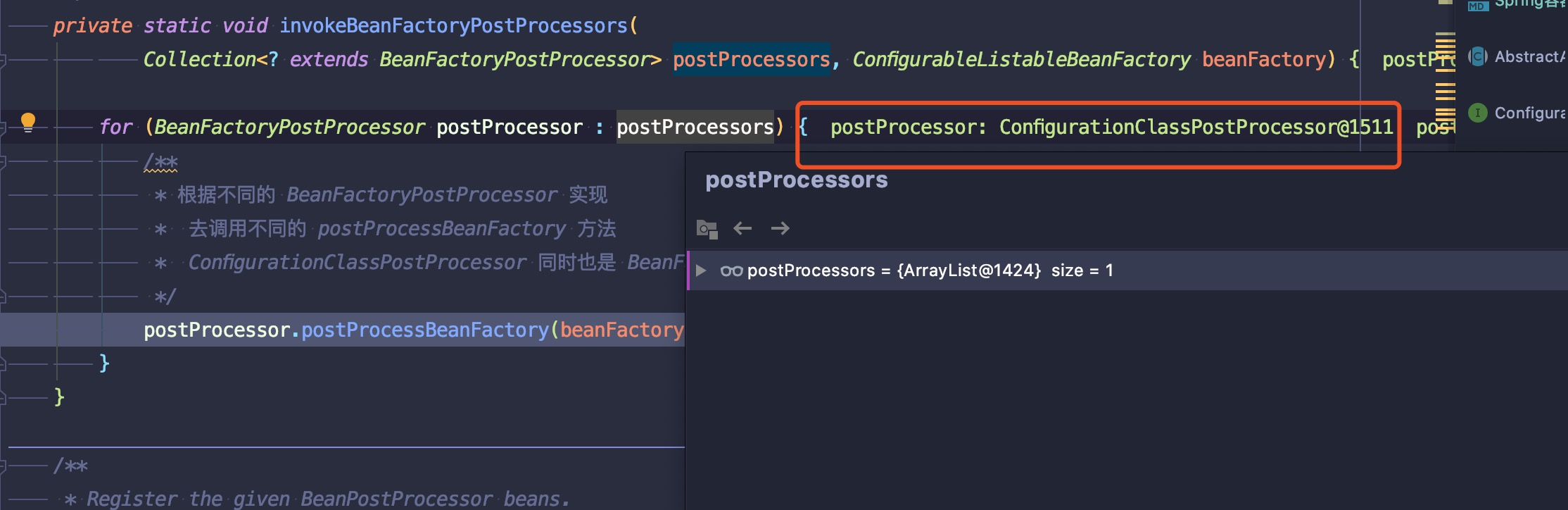
断点调试图一:
private static void invokeBeanFactoryPostProcessors(
        Collection<? extends BeanFactoryPostProcessor> postProcessors, ConfigurableListableBeanFactory beanFactory) {

    for (BeanFactoryPostProcessor postProcessor : postProcessors) {
        /**
         * 根据不同的 BeanFactoryPostProcessor 实现
         *  去调用不同的 postProcessBeanFactory 方法
         *  ConfigurationClassPostProcessor 同时也是 BeanFactoryPostProcessor 的子类
         */
        postProcessor.postProcessBeanFactory(beanFactory);
    }
}
在看具体的postProcessor.postProcessBeanFactory(beanFactory);代码之前,我们先看一下在Spring中这里对应的BeanFactoryPostProcessor的子类实现,如下图:
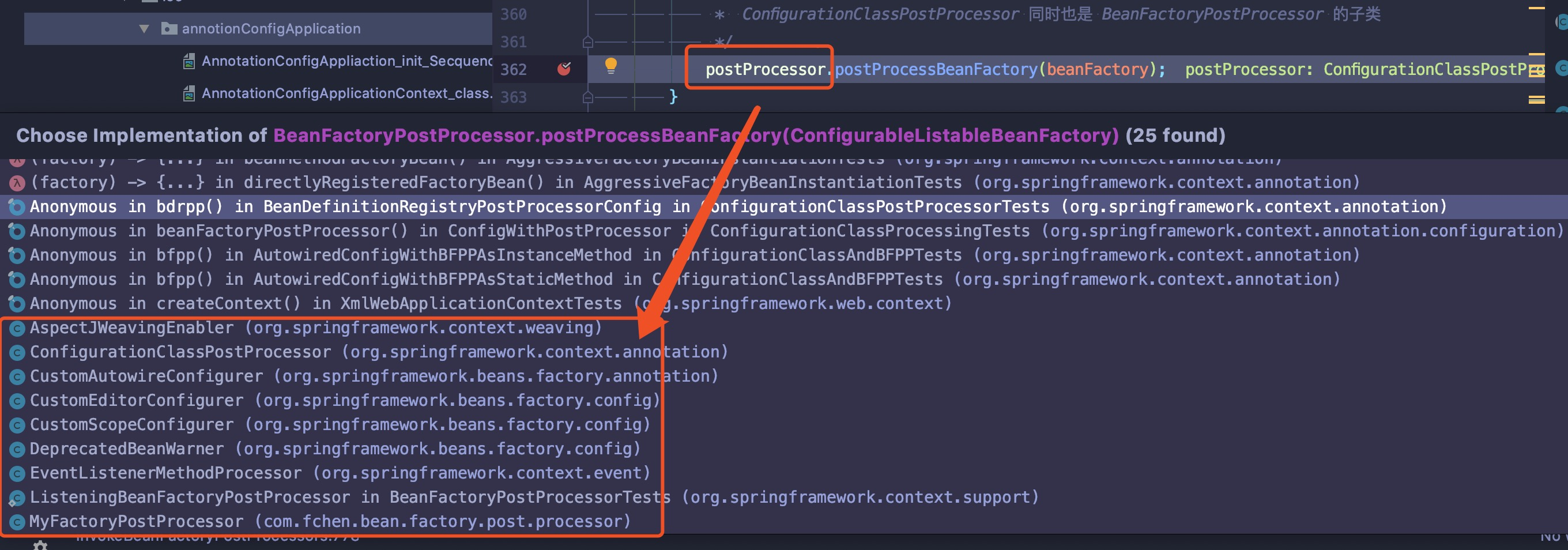
从断点调试图一中可以看出,这里的 postProcessor 对应的子类为 ConfigurationClassPostProcessor,下面的 postProcessBeanFactory()
方法对应子类的实现如下:
public void postProcessBeanFactory(ConfigurableListableBeanFactory beanFactory) {
    int factoryId = System.identityHashCode(beanFactory);
    if (this.factoriesPostProcessed.contains(factoryId)) {
        throw new IllegalStateException(
                "postProcessBeanFactory already called on this post-processor against " + beanFactory);
    }
    this.factoriesPostProcessed.add(factoryId);
    if (!this.registriesPostProcessed.contains(factoryId)) {
        // BeanDefinitionRegistryPostProcessor hook apparently not supported...
        // Simply call processConfigurationClasses lazily at this point then.
        processConfigBeanDefinitions((BeanDefinitionRegistry) beanFactory);
    }
    /**
     * 配置类 产生 cglib 代理
     */
    enhanceConfigurationClasses(beanFactory);
    beanFactory.addBeanPostProcessor(new ImportAwareBeanPostProcessor(beanFactory));
}
上述方法中,主要的功能就是:①增强配置类;②向容器中添加 BeanPsotProcessor 的子类 ImportAwareBeanPostProcessor。
其中对于配置类的增强,是本文要介绍的,这个就和上一篇文章中提及Spring中对于配置类的 Full和Lite 模式的标记。
增强配置类
public void enhanceConfigurationClasses(ConfigurableListableBeanFactory beanFactory) {
    Map<String, AbstractBeanDefinition> configBeanDefs = new LinkedHashMap<>();
    for (String beanName : beanFactory.getBeanDefinitionNames()) {
        BeanDefinition beanDef = beanFactory.getBeanDefinition(beanName);
        /**
         * 判断这个类是不是全注解类,这个地方与前面 {@link Configuration} 注解的类的
         * 处理有关
         */
        if (ConfigurationClassUtils.isFullConfigurationClass(beanDef)) {
            if (!(beanDef instanceof AbstractBeanDefinition)) {
                throw new BeanDefinitionStoreException("Cannot enhance @Configuration bean definition '" +
                        beanName + "' since it is not stored in an AbstractBeanDefinition subclass");
            }
            else if (logger.isInfoEnabled() && beanFactory.containsSingleton(beanName)) {
                logger.info("Cannot enhance @Configuration bean definition '" + beanName +
                        "' since its singleton instance has been created too early. The typical cause " +
                        "is a non-static @Bean method with a BeanDefinitionRegistryPostProcessor " +
                        "return type: Consider declaring such methods as 'static'.");
            }
            /** 如果是全注解类,就将其 put 到 configBeanDefs 中*/
            configBeanDefs.put(beanName, (AbstractBeanDefinition) beanDef);
        }
    }
    if (configBeanDefs.isEmpty()) {
        /**
         * Map 为空 表示没有全注解类,则返回
         */
        // nothing to enhance -> return immediately
        return;
    }

    ConfigurationClassEnhancer enhancer = new ConfigurationClassEnhancer();
    for (Map.Entry<String, AbstractBeanDefinition> entry : configBeanDefs.entrySet()) {
        AbstractBeanDefinition beanDef = entry.getValue();
        // If a @Configuration class gets proxied, always proxy the target class
        beanDef.setAttribute(AutoProxyUtils.PRESERVE_TARGET_CLASS_ATTRIBUTE, Boolean.TRUE);
        try {
            // Set enhanced subclass of the user-specified bean class
            /**
             * 对全注解类 进行 cglib 代理
             * config 类 -> cglib class -> BeanDefinition -> bean
             */
            Class<?> configClass = beanDef.resolveBeanClass(this.beanClassLoader);
            if (configClass != null) {
                Class<?> enhancedClass = enhancer.enhance(configClass, this.beanClassLoader);
                if (configClass != enhancedClass) {
                    if (logger.isTraceEnabled()) {
                        logger.trace(String.format("Replacing bean definition '%s' existing class '%s' with " +
                                "enhanced class '%s'", entry.getKey(), configClass.getName(), enhancedClass.getName()));
                    }
                    beanDef.setBeanClass(enhancedClass);
                }
            }
        }
        catch (Throwable ex) {
            throw new IllegalStateException("Cannot load configuration class: " + beanDef.getBeanClassName(), ex);
        }
    }
}
接上篇文章我们提到配置类的 Full和 Lite两种不同的模式。在这篇文章中,我们可以看到,Full模式,也就是全配置类,Spring 通过使用CGLIB动态代理的
方式对其进行了增强。而 Lite 模式的配置类,没有通过代理的方式增强。我们究其原因发现,对于@Configuration 类的处理,是Spring 的后置处理器的典型应用。纵观整个 Spring,
在器内部只有一个 ConfigurationClassPostProcessor 该类中处理了 BeanDefinitionRegistryPostProcessor 的方法 postProcessBeanDefinitionRegistry()
也处理了 postProcessBeanFactory的方法 postProcessBeanFactory()。通过该类,我们应该也要知道,对于Spring 的扩展点 BeanFactoryPostProcessor 的处理。
对于配置类,先通过 resolveBeanClass() 解析得到类的Class对象,然后通过 enhancer.enhance(configClass, this.beanClassLoader ) 得到增强后的类对象。最后再将这个增强后的类对象,设置回对应的 BeanDefinition中去。
CGLIB 代理增强
public Class<?> enhance(Class<?> configClass, @Nullable ClassLoader classLoader) {
    /** 判断是否被代理过*/
    if (EnhancedConfiguration.class.isAssignableFrom(configClass)) {
        if (logger.isDebugEnabled()) {
            logger.debug(String.format("Ignoring request to enhance %s as it has " +
                    "already been enhanced. This usually indicates that more than one " +
                    "ConfigurationClassPostProcessor has been registered (e.g. via " +
                    "<context:annotation-config>). This is harmless, but you may " +
                    "want check your configuration and remove one CCPP if possible",
                    configClass.getName()));
        }
        return configClass;
    }
    /** 没有被代理 cglib 代理*/
    Class<?> enhancedClass = createClass(newEnhancer(configClass, classLoader));
    if (logger.isTraceEnabled()) {
        logger.trace(String.format("Successfully enhanced %s; enhanced class name is: %s",
                configClass.getName(), enhancedClass.getName()));
    }
    return enhancedClass;
}
newEnhancer() 方法
/**
 * Creates a new CGLIB {@link Enhancer} instance.
 * 创建一个 CGLIB 实例
 */
private Enhancer newEnhancer(Class<?> configSuperClass, @Nullable ClassLoader classLoader) {
    Enhancer enhancer = new Enhancer();
    /** 增强父类 */
    enhancer.setSuperclass(configSuperClass);
    /** 增强接口,
     * 便于判断,表示一个类被增强了
     * EnhancedConfiguration 实现了 BeanFactoryAware 接口
     */
    enhancer.setInterfaces(new Class<?>[] {EnhancedConfiguration.class});
    enhancer.setUseFactory(false);
    /**
     * BeanFactoryAwareGeneratorStrategy 是一个生成策略
     * 主要为生成的 cglib 类中添加成员变量 $beanFactory
     * 同时基于接口 EnhancedConfiguration 的父接口 BeanFactoryAware 中的 setBeanFactory 方法,
     * 设置此变量的值为当前 context 中的 beanFactory,这样一来 cglib 代理的对象就有了 beanFactory
     * 有了 factory 就能获得对象了,不用通过 new 来获取对象了
     * 该BeanFactory 的作用是在 this 调用时拦截该调用,并直接在 beanFactory 中获得目标bean
     *
     */
    enhancer.setNamingPolicy(SpringNamingPolicy.INSTANCE);
    enhancer.setStrategy(new BeanFactoryAwareGeneratorStrategy(classLoader));
    enhancer.setCallbackFilter(CALLBACK_FILTER);
    enhancer.setCallbackTypes(CALLBACK_FILTER.getCallbackTypes());
    return enhancer;
}
createClass()
/**
 * 使用增强器生成超类的子类,
 * 确保新的子类注册了回调
 * Uses enhancer to generate a subclass of superclass,
 * ensuring that callbacks are registered for the new subclass.
 */
private Class<?> createClass(Enhancer enhancer) {
    Class<?> subclass = enhancer.createClass();
    // Registering callbacks statically (as opposed to thread-local)
    // is critical for usage in an OSGi environment (SPR-5932)...
    Enhancer.registerStaticCallbacks(subclass, CALLBACKS);
    return subclass;
}
其中 CALLBACKS 的定义如下:
private static final Callback[] CALLBACKS = new Callback[] {
        /**
         * 增强方法,主要控制bean的作用域,
         * 不用每次都 new
         */
        // Bean 方法来拦截器
        new BeanMethodInterceptor(),
        // 拦截BeanFactoryAware 定义的方法 setBeanFactory
        new BeanFactoryAwareMethodInterceptor(),
        NoOp.INSTANCE
};
对应的 new BeanMethodInterceptor() 拦截方法调用,new BeanFactoryAwareMethodInterceptor() 拦截 BeanFactoryAware
定义的方法 setBeanFactory。对应代码实现如下
拦截方法调用
private static class BeanMethodInterceptor implements MethodInterceptor, ConditionalCallback {

  /**
   * Enhance a {@link Bean @Bean} method to check the supplied BeanFactory for the
   * existence of this bean object.
   * @throws Throwable as a catch-all for any exception that may be thrown when invoking the
   * super implementation of the proxied method i.e., the actual {@code @Bean} method
   */
  @Override
  @Nullable
  public Object intercept(Object enhancedConfigInstance, Method beanMethod, Object[] beanMethodArgs,
     MethodProxy cglibMethodProxy) throws Throwable {
   /**
    * enhancedConfigInstance 代理
    * 通过enhancedConfigInstance 中 CGLIB 生成的成员变量 &&beanFactory 获取 beanFactory
    */
   ConfigurableBeanFactory beanFactory = getBeanFactory(enhancedConfigInstance);
   String beanName = BeanAnnotationHelper.determineBeanNameFor(beanMethod);

   // Determine whether this bean is a scoped-proxy
   if (BeanAnnotationHelper.isScopedProxy(beanMethod)) {
    String scopedBeanName = ScopedProxyCreator.getTargetBeanName(beanName);
    if (beanFactory.isCurrentlyInCreation(scopedBeanName)) {
     beanName = scopedBeanName;
    }
   }

   // To handle the case of an inter-bean method reference, we must explicitly check the
   // container for already cached instances.

   // First, check to see if the requested bean is a FactoryBean. If so, create a subclass
   // proxy that intercepts calls to getObject() and returns any cached bean instance.
   // This ensures that the semantics of calling a FactoryBean from within @Bean methods
   // is the same as that of referring to a FactoryBean within XML. See SPR-6602.
   if (factoryContainsBean(beanFactory, BeanFactory.FACTORY_BEAN_PREFIX + beanName) &&
     factoryContainsBean(beanFactory, beanName)) {
    Object factoryBean = beanFactory.getBean(BeanFactory.FACTORY_BEAN_PREFIX + beanName);
    if (factoryBean instanceof ScopedProxyFactoryBean) {
     // Scoped proxy factory beans are a special case and should not be further proxied
    }
    else {
     // It is a candidate FactoryBean - go ahead with enhancement
     return enhanceFactoryBean(factoryBean, beanMethod.getReturnType(), beanFactory, beanName);
    }
   }
   /**
    * 判断执行的方法 和 调用的方法是不是同一个方法
    */
   if (isCurrentlyInvokedFactoryMethod(beanMethod)) {
    // The factory is calling the bean method in order to instantiate and register the bean
    // (i.e. via a getBean() call) -> invoke the super implementation of the method to actually
    // create the bean instance.
    if (logger.isInfoEnabled() &&
      BeanFactoryPostProcessor.class.isAssignableFrom(beanMethod.getReturnType())) {
     logger.info(String.format("@Bean method %s.%s is non-static and returns an object " +
         "assignable to Spring's BeanFactoryPostProcessor interface. This will " +
         "result in a failure to process annotations such as @Autowired, " +
         "@Resource and @PostConstruct within the method's declaring " +
         "@Configuration class. Add the 'static' modifier to this method to avoid " +
         "these container lifecycle issues; see @Bean javadoc for complete details.",
       beanMethod.getDeclaringClass().getSimpleName(), beanMethod.getName()));
    }
    /**
     * 执行的方法和调用的方法是同一个 执行父类的方法 创建对象
     */
    return cglibMethodProxy.invokeSuper(enhancedConfigInstance, beanMethodArgs);
   }
   /**
    * 执行的方法和调用的方法不是同一个,在 &&BeanFactory 中 get 一个 bean 出来
    */
   return resolveBeanReference(beanMethod, beanMethodArgs, beanFactory, beanName);
  }

  private Object resolveBeanReference(Method beanMethod, Object[] beanMethodArgs,
    ConfigurableBeanFactory beanFactory, String beanName) {

   /**
    * 判断对象是否正在创建
    * 一个对象有三种状态
    *   a. 没有创建
    *   b. 正在创建
    *   c. 创建成功
    */
   boolean alreadyInCreation = beanFactory.isCurrentlyInCreation(beanName);
   try {
    if (alreadyInCreation) {
     beanFactory.setCurrentlyInCreation(beanName, false);
    }
    boolean useArgs = !ObjectUtils.isEmpty(beanMethodArgs);
    if (useArgs && beanFactory.isSingleton(beanName)) {
     // Stubbed null arguments just for reference purposes,
     // expecting them to be autowired for regular singleton references?
     // A safe assumption since @Bean singleton arguments cannot be optional...
     for (Object arg : beanMethodArgs) {
      if (arg == null) {
       useArgs = false;
       break;
      }
     }
    }
    /**
     * 调用 beanFactory.getBean() 获取对象
     */
    Object beanInstance = (useArgs ? beanFactory.getBean(beanName, beanMethodArgs) :
      beanFactory.getBean(beanName));
    if (!ClassUtils.isAssignableValue(beanMethod.getReturnType(), beanInstance)) {
     // Detect package-protected NullBean instance through equals(null) check
     if (beanInstance.equals(null)) {
      if (logger.isDebugEnabled()) {
       logger.debug(String.format("@Bean method %s.%s called as bean reference " +
         "for type [%s] returned null bean; resolving to null value.",
         beanMethod.getDeclaringClass().getSimpleName(), beanMethod.getName(),
         beanMethod.getReturnType().getName()));
      }
      beanInstance = null;
     }
     else {
      String msg = String.format("@Bean method %s.%s called as bean reference " +
        "for type [%s] but overridden by non-compatible bean instance of type [%s].",
        beanMethod.getDeclaringClass().getSimpleName(), beanMethod.getName(),
        beanMethod.getReturnType().getName(), beanInstance.getClass().getName());
      try {
       BeanDefinition beanDefinition = beanFactory.getMergedBeanDefinition(beanName);
       msg += " Overriding bean of same name declared in: " + beanDefinition.getResourceDescription();
      }
      catch (NoSuchBeanDefinitionException ex) {
       // Ignore - simply no detailed message then.
      }
      throw new IllegalStateException(msg);
     }
    }
    Method currentlyInvoked = SimpleInstantiationStrategy.getCurrentlyInvokedFactoryMethod();
    if (currentlyInvoked != null) {
     String outerBeanName = BeanAnnotationHelper.determineBeanNameFor(currentlyInvoked);
     beanFactory.registerDependentBean(beanName, outerBeanName);
    }
    return beanInstance;
   }
   finally {
    if (alreadyInCreation) {
     beanFactory.setCurrentlyInCreation(beanName, true);
    }
   }
  }
}
通过增强以后,配置类中使用@Bean注解的bean定义方法就不再是普通的方法了,它们具有了如下跟bean作用域有关的能力,以单例bean为例 :
- 它们首次被调用时,相应方法逻辑会被执行用于创建bean实例;
- 再次被调用时,不会再执行创建bean实例,而是根据bean名称返回首次该方法被执行时创建的bean实例。
总结
至此,在 refresh()方法中的,invokeBeanFactoryPostProcessors() 部分的代码,已经分析完了。在这一步中,完成了对BeanFactoryPostProcessor的处理,其中有一个极为重要的实现 ConfigurationPostProcessor 对应 Spring中配置类的处理。在这步处理完成的时候,我们定义的Bean,都已经被注册到了 BeanDefinitionMap中。
本文使用 mdnice 排版
