图的存储
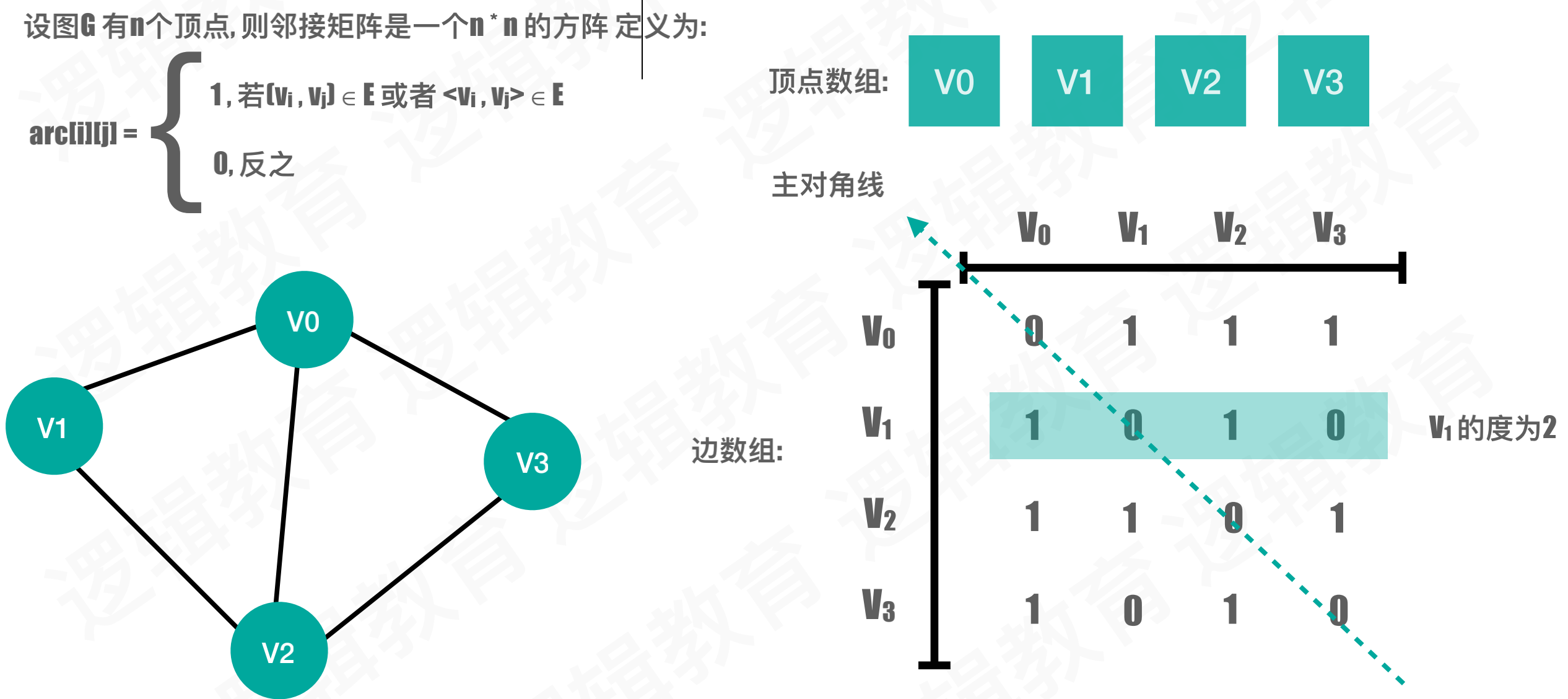
- 邻接矩阵
#define OK 1
#define ERROR 0
#define TRUE 1
#define FALSE 0
#define MAXVEX 100 /* 最大顶点数,应由用户定义 */
#define INFINITYC 0

typedef int Status;    /* Status是函数的类型,其值是函数结果状态代码,如OK等 */
typedef char VertexType; /* 顶点类型应由用户定义  */
typedef int EdgeType; /* 边上的权值类型应由用户定义 */
typedef struct
{
    VertexType vexs[MAXVEX]; /* 顶点表 */
    EdgeType arc[MAXVEX][MAXVEX];/* 邻接矩阵,可看作边表 */
    int numNodes, numEdges; /* 图中当前的顶点数和边数  */
}MGraph;

void CreateMGraph(MGraph *G){

    int i,j,k,w;
    printf("输入顶点数和边数:\n");
    //1. 输入顶点数/边数
    scanf("%d,%d",&G->numNodes,&G->numEdges);
    printf("顶点数:%d,边数:%d\n",G->numNodes,G->numEdges);

    //2.输入顶点信息/顶点表
    for(i = 0; i<= G->numNodes;i++)
        scanf("%c",&G->vexs[i]);

    //3.初始化邻接矩阵
    for(i = 0; i < G->numNodes;i++)
         for(j = 0; j < G->numNodes;j++)
             G->arc[i][j] = INFINITYC;

    //4.输入边表信息
    for(k = 0; k < G->numEdges;k++){
        printf("输入边(vi,vj)上的下标i,下标j,权w\n");
        scanf("%d,%d,%d",&i,&j,&w);

        G->arc[i][j] = w;
        //如果无向图,矩阵对称;
        G->arc[j][i] = G->arc[i][j];

    }
    /*5.打印邻接矩阵*/
    for (int i = 0; i < G->numNodes; i++) {
        printf("\n");
        for (int j = 0; j < G->numNodes; j++) {
            printf("%d ",G->arc[i][j]);
        }
    }
    printf("\n");
}
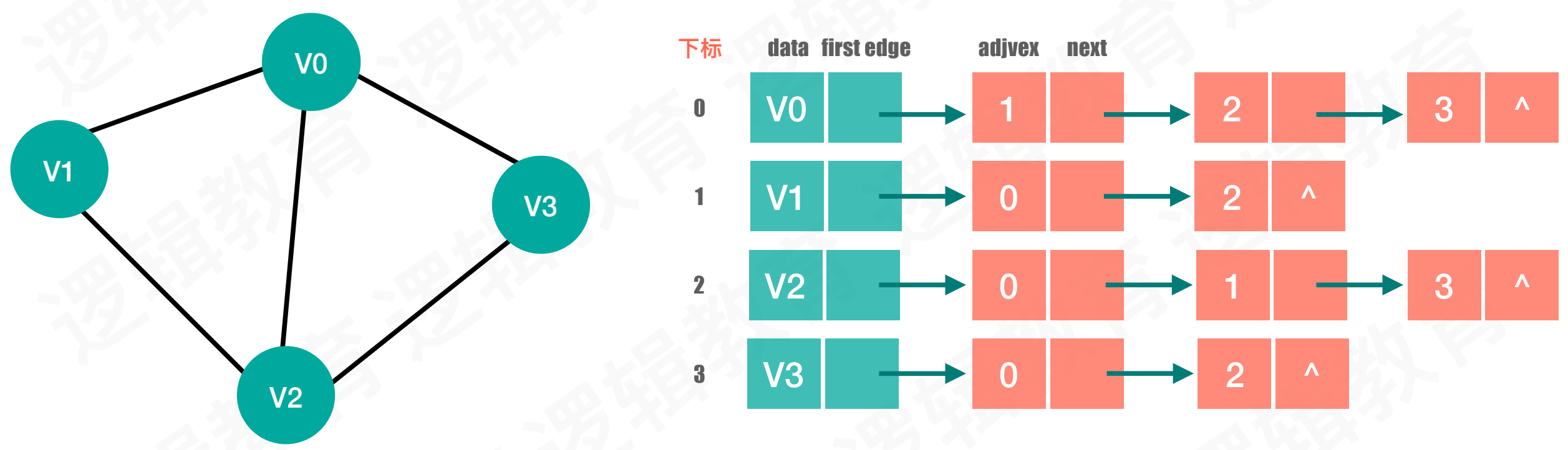
- 邻接表
#define M 100
#define true 1
#define false 0

typedef char Element;
typedef int BOOL;
//邻接表的节点
typedef struct Node{
    int adj_vex_index;  //弧头的下标,也就是被指向的下标
    Element data;       //权重值
    struct Node * next; //边指针
}EdgeNode;

//顶点节点表
typedef struct vNode{
    Element data;          //顶点的权值
    EdgeNode * firstedge;  //顶点下一个是谁?
}VertexNode, Adjlist[M];

//总图的一些信息
typedef struct Graph{
    Adjlist adjlist;       //顶点表
    int arc_num;           //边的个数
    int node_num;          //节点个数
    BOOL is_directed;      //是不是有向图
}Graph, *GraphLink;

void creatGraph(GraphLink *g){
    int i,j,k;
    EdgeNode *p;

    //1. 顶点,边,是否有向
    printf("输入顶点数目,边数和有向?:\n");
    scanf("%d %d %d", &(*g)->node_num, &(*g)->arc_num, &(*g)->is_directed);

    //2.顶点表
     printf("输入顶点信息:\n");
    for (i = 0; i < (*g)->node_num; i++) {
        getchar();
        scanf("%c", &(*g)->adjlist[i].data);
        (*g)->adjlist[i].firstedge = NULL;
    }

    //3.
    printf("输入边信息:\n");
    for (k = 0; k < (*g)->arc_num; k++){
        getchar();
        scanf("%d %d", &i, &j);

        //①新建一个节点
        p = (EdgeNode *)malloc(sizeof(EdgeNode));
        //②弧头的下标
        p->adj_vex_index = j;
        //③头插法插进去,插的时候要找到弧尾,那就是顶点数组的下标i
        p->next = (*g)->adjlist[i].firstedge;
        //④将顶点数组[i].firstedge 设置为p
        (*g)->adjlist[i].firstedge = p;

        //j->i
        if(!(*g)->is_directed)
        {
            // j -----> i
            //①新建一个节点
            p = (EdgeNode *)malloc(sizeof(EdgeNode));
            //②弧头的下标i
            p->adj_vex_index = i;
            //③头插法插进去,插的时候要找到弧尾,那就是顶点数组的下标i
            p->next = (*g)->adjlist[j].firstedge;
            //④将顶点数组[i].firstedge 设置为p
            (*g)->adjlist[j].firstedge = p;
        }
    }
}

void putGraph(GraphLink g){
    int i;
    printf("邻接表中存储信息:\n");
    //遍历一遍顶点坐标,每个再进去走一次
    for (i = 0; i < g->node_num; i++) {
        EdgeNode * p = g->adjlist[i].firstedge;
        while (p) {
            printf("%c->%c ", g->adjlist[i].data, g->adjlist[p->adj_vex_index].data);
            p = p->next;
        }
        printf("\n");
    }
}
图的遍历
-
深度优先遍历
邻接矩阵思路:
1. 将图的顶点和边信息输⼊到图结构中;
2. 创建⼀个visited 数组,⽤来标识顶点是否已经被遍历过.
3. 初始化visited 数组,将数组中元素置为FALSE
4. 选择顶点开始遍历.(注意⾮连通图的情况)
5. 进⼊递归; 打印i 对应的顶点信息. 并将该顶点标识为已遍历.
6. 循环遍历边表,判断当前arc[i][j]是否等于1,并且当前该顶点没有被遍历过,则继续递归DFS;
#define OK 1 #define ERROR 0 #define TRUE 1 #define FALSE 0 typedef int Status; /* Status是函数的类型,其值是函数结果状态代码,如OK等 */ typedef int Boolean; /* Boolean是布尔类型,其值是TRUE或FALSE */ typedef char VertexType; /* 顶点类型应由用户定义 */ typedef int EdgeType; /* 边上的权值类型应由用户定义 */ #define MAXSIZE 9 /* 存储空间初始分配量 */ #define MAXEDGE 15 #define MAXVEX 9 #define INFINITYC 65535 typedef struct { VertexType vexs[MAXVEX]; /* 顶点表 */ EdgeType arc[MAXVEX][MAXVEX];/* 邻接矩阵,可看作边表 */ int numVertexes, numEdges; /* 图中当前的顶点数和边数 */ } MGraph; /*4.1 构建一个邻接矩阵*/ void CreateMGraph(MGraph *G) { int i, j; //1. 确定图的顶点数以及边数 G->numEdges=15; G->numVertexes=9; /*2.读入顶点信息,建立顶点表 */ G->vexs[0]='A'; G->vexs[1]='B'; G->vexs[2]='C'; G->vexs[3]='D'; G->vexs[4]='E'; G->vexs[5]='F'; G->vexs[6]='G'; G->vexs[7]='H'; G->vexs[8]='I'; /*3. 初始化图中的边表*/ for (i = 0; i < G->numVertexes; i++) { for ( j = 0; j < G->numVertexes; j++) { G->arc[i][j]=0; } } /*4.将图中的连接信息输入到边表中*/ G->arc[0][1]=1; G->arc[0][5]=1; G->arc[1][2]=1; G->arc[1][8]=1; G->arc[1][6]=1; G->arc[2][3]=1; G->arc[2][8]=1; G->arc[3][4]=1; G->arc[3][7]=1; G->arc[3][6]=1; G->arc[3][8]=1; G->arc[4][5]=1; G->arc[4][7]=1; G->arc[5][6]=1; G->arc[6][7]=1; /*5.无向图是对称矩阵.构成对称*/ for(i = 0; i < G->numVertexes; i++) { for(j = i; j < G->numVertexes; j++) { G->arc[j][i] =G->arc[i][j]; } } } /*4.2 DFS遍历*/ Boolean visited[MAXVEX]; /* 访问标志的数组 */ //1. 标识顶点是否被标记过; //2. 选择从某一个顶点开始(注意:非连通图的情况) //3. 进入递归,打印i点信息,标识; 边表 //4. [i][j] 是否等于1,没有变遍历过visted void DFS(MGraph G,int i){ //1. visited[i] = TRUE; printf("%c",G.vexs[i]); //2.0~numVertexes for(int j = 0; j < G.numVertexes;j++){ if(G.arc[i][j] == 1 && !visited[j]) DFS(G, j); } } void DFSTravese(MGraph G){ //1.初始化 for(int i=0;i<G.numVertexes;i++){ visited[i] = FALSE; } //2.某一个顶点 for(int i = 0;i<G.numVertexes;i++){ if(!visited[i]){ DFS(G, i); } } }邻接表思路:
1. 利⽤邻接矩阵将信息存储到邻接表中
2. 创建⼀个visited 数组,⽤来标识顶点是否已经被遍历过.
3. 初始化visited 数组,将数组中元素置为FALSE
4. 选择顶点开始遍历.(注意⾮连通图的情况)
5. 进⼊递归; 打印i 对应的顶点信息. 并将该顶点标识为已遍历.
6. 循环遍历边表,判断当前顶点是否等于1,并且当前该顶点没有被遍历过,则继续递归DFS;
#define OK 1 #define ERROR 0 #define TRUE 1 #define FALSE 0 #define MAXSIZE 9 /* 存储空间初始分配量 */ #define MAXEDGE 15 #define MAXVEX 9 #define INFINITYC 65535 typedef int Status; /* Status是函数的类型,其值是函数结果状态代码,如OK等 */ typedef int Boolean; /* Boolean是布尔类型,其值是TRUE或FALSE */ typedef char VertexType; /* 顶点类型应由用户定义 */ typedef int EdgeType; /* 边上的权值类型应由用户定义 */ /* 邻接矩阵结构 */ typedef struct { VertexType vexs[MAXVEX]; /* 顶点表 */ EdgeType arc[MAXVEX][MAXVEX];/* 邻接矩阵,可看作边表 */ int numVertexes, numEdges; /* 图中当前的顶点数和边数 */ } MGraph; /* 邻接表结构****************** */ typedef struct EdgeNode {/* 边表结点 */ int adjvex; /* 邻接点域,存储该顶点对应的下标 */ int weight; /* 用于存储权值,对于非网图可以不需要 */ struct EdgeNode *next; /* 链域,指向下一个邻接点 */ } EdgeNode; typedef struct VertexNode {/* 顶点表结点 */ int in; /* 顶点入度 */ char data; /* 顶点域,存储顶点信息 */ EdgeNode *firstedge;/* 边表头指针 */ } VertexNode, AdjList[MAXVEX]; typedef struct { AdjList adjList; int numVertexes,numEdges; /* 图中当前顶点数和边数 */ }graphAdjList,*GraphAdjList; /*4.1 构建一个邻接矩阵*/ void CreateMGraph(MGraph *G) { int i, j; //1. 确定图的顶点数以及边数 G->numEdges=15; G->numVertexes=9; /*2.读入顶点信息,建立顶点表 */ G->vexs[0]='A'; G->vexs[1]='B'; G->vexs[2]='C'; G->vexs[3]='D'; G->vexs[4]='E'; G->vexs[5]='F'; G->vexs[6]='G'; G->vexs[7]='H'; G->vexs[8]='I'; /*3. 初始化图中的边表*/ for (i = 0; i < G->numVertexes; i++) { for ( j = 0; j < G->numVertexes; j++) { G->arc[i][j]=0; } } /*4.将图中的连接信息输入到边表中*/ G->arc[0][1]=1; G->arc[0][5]=1; G->arc[1][2]=1; G->arc[1][8]=1; G->arc[1][6]=1; G->arc[2][3]=1; G->arc[2][8]=1; G->arc[3][4]=1; G->arc[3][7]=1; G->arc[3][6]=1; G->arc[3][8]=1; G->arc[4][5]=1; G->arc[4][7]=1; G->arc[5][6]=1; G->arc[6][7]=1; /*5.无向图是对称矩阵.构成对称*/ for(i = 0; i < G->numVertexes; i++) { for(j = i; j < G->numVertexes; j++) { G->arc[j][i] =G->arc[i][j]; } } } /*4.2 利用邻接矩阵构建邻接表*/ void CreateALGraph(MGraph G,GraphAdjList *GL) { //1.创建邻接表,并且设计邻接表的顶点数以及弧数 *GL = (GraphAdjList)malloc(sizeof(graphAdjList)); (*GL)->numVertexes = G.numVertexes; (*GL)->numEdges = G.numEdges; //2. 从邻接矩阵中将顶点信息输入 for (int i = 0; i < G.numVertexes; i++) { //顶点入度为0 (*GL)->adjList[i].in = 0; //顶点信息 (*GL)->adjList[i].data = G.vexs[i]; //顶点边表置空 (*GL)->adjList[i].firstedge = NULL; } //3. 建立边表 EdgeNode *e; for (int i = 0; i < G.numVertexes; i++) { for (int j = 0; j < G.numVertexes; j++) { if (G.arc[i][j] == 1) { //创建边表中的邻近结点 i->j e = (EdgeNode *)malloc(sizeof(EdgeNode)); //邻接序号为j e->adjvex = j; //将当前结点的指向adjList[i]的顶点边表上 e->next = (*GL)->adjList[i].firstedge; (*GL)->adjList[i].firstedge = e; //顶点j 上的入度++; (*GL)->adjList[j].in++; // //创建边表中的邻近结点 j->i // e = (EdgeNode *)malloc(sizeof(EdgeNode)); // //邻接序号为j // e->adjvex = i; // //将当前结点的指向adjList[i]的顶点边表上 // e->next = (*GL)->adjList[j].firstedge; // (*GL)->adjList[j].firstedge = e; // //顶点j 上的入度++; // (*GL)->adjList[i].in++; } } } } Boolean visited[MAXSIZE]; /* 访问标志的数组 */ /* 邻接表的深度优先递归算法 */ void DFS(GraphAdjList GL, int i) { EdgeNode *p; visited[i] = TRUE; //2.打印顶点 A printf("%c ",GL->adjList[i].data); p = GL->adjList[i].firstedge; //3. while (p) { if(!visited[p->adjvex]) DFS(GL,p->adjvex); p = p->next; } } /* 邻接表的深度遍历操作 */ void DFSTraverse(GraphAdjList GL) { //1. 将访问记录数组默认置为FALSE for (int i = 0; i < GL->numVertexes; i++) { /*初始化所有顶点状态都是未访问过的状态*/ visited[i] = FALSE; } //2. 选择一个顶点开始DFS遍历. 例如A for(int i = 0; i < GL->numVertexes; i++) //对未访问过的顶点调用DFS, 若是连通图则只会执行一次. if(!visited[i]) DFS(GL, i); } -
广度优先遍历
特点:
1、把根节点放到队列的末尾。
2、每次从队列的头部取出⼀个元素,查看这个元素所有的下⼀级元素,把它们放到队列的末尾。
并把这个元素记为它下⼀级元素的前驱。
3、找到所要找的元素时结束程序。
4、如果遍历整个树还没有找到,结束程序。
邻接矩阵实现:
#define OK 1
#define ERROR 0
#define TRUE 1
#define FALSE 0

typedef int Status;    /* Status是函数的类型,其值是函数结果状态代码,如OK等 */
typedef int Boolean; /* Boolean是布尔类型,其值是TRUE或FALSE */

typedef char VertexType; /* 顶点类型应由用户定义 */
typedef int EdgeType; /* 边上的权值类型应由用户定义 */

#define MAXSIZE 9 /* 存储空间初始分配量 */
#define MAXEDGE 15
#define MAXVEX 9
#define INFINITYC 65535

typedef struct {
    VertexType vexs[MAXVEX]; /* 顶点表 */
    EdgeType arc[MAXVEX][MAXVEX];/* 邻接矩阵,可看作边表 */
    int numVertexes, numEdges; /* 图中当前的顶点数和边数 */
}MGraph;

/* 构建一个邻接矩阵*/
void CreateMGraph(MGraph *G) {
    int i, j;

    //1. 确定图的顶点数以及边数
    G->numEdges=15;
    G->numVertexes=9;

    /*2.读入顶点信息,建立顶点表 */
    G->vexs[0]='A';
    G->vexs[1]='B';
    G->vexs[2]='C';
    G->vexs[3]='D';
    G->vexs[4]='E';
    G->vexs[5]='F';
    G->vexs[6]='G';
    G->vexs[7]='H';
    G->vexs[8]='I';

    /*3. 初始化图中的边表*/
    for (i = 0; i < G->numVertexes; i++)
    {
        for ( j = 0; j < G->numVertexes; j++)
        {
            G->arc[i][j]=0;
        }
    }

    /*4.将图中的连接信息输入到边表中*/
    G->arc[0][1]=1;
    G->arc[0][5]=1;

    G->arc[1][2]=1;
    G->arc[1][8]=1;
    G->arc[1][6]=1;

    G->arc[2][3]=1;
    G->arc[2][8]=1;

    G->arc[3][4]=1;
    G->arc[3][7]=1;
    G->arc[3][6]=1;
    G->arc[3][8]=1;

    G->arc[4][5]=1;
    G->arc[4][7]=1;

    G->arc[5][6]=1;

    G->arc[6][7]=1;

    /*5.无向图是对称矩阵.构成对称*/
    for(i = 0; i < G->numVertexes; i++)
    {
        for(j = i; j < G->numVertexes; j++)
        {
            G->arc[j][i] =G->arc[i][j];
        }
    }
}

/* 循环队列的顺序存储结构 */
typedef struct {
    int data[MAXSIZE];
    int front;        /* 头指针 */
    int rear;        /* 尾指针,若队列不空,指向队列尾元素的下一个位置 */
}Queue;

/* 初始化一个空队列Q */
Status InitQueue(Queue *Q) {
    Q->front=0;
    Q->rear=0;
    return  OK;
}

/* 若队列Q为空队列,则返回TRUE,否则返回FALSE */
Status QueueEmpty(Queue Q) {
    if(Q.front==Q.rear) /* 队列空的标志 */
    return TRUE;
    else
    return FALSE;
}

/* 若队列未满,则插入元素e为Q新的队尾元素 */
Status EnQueue(Queue *Q,int e) {
    if ((Q->rear+1)%MAXSIZE == Q->front)    /* 队列满的判断 */
    return ERROR;
    Q->data[Q->rear]=e;            /* 将元素e赋值给队尾 */
    Q->rear=(Q->rear+1)%MAXSIZE;/* rear指针向后移一位置, */
    /* 若到最后则转到数组头部 */
    return  OK;
}

/* 若队列不空,则删除Q中队头元素,用e返回其值 */
Status DeQueue(Queue *Q,int *e) {
    if (Q->front == Q->rear)            /* 队列空的判断 */
    return ERROR;
    *e=Q->data[Q->front];                /* 将队头元素赋值给e */
    Q->front=(Q->front+1)%MAXSIZE;    /* front指针向后移一位置, */
    /* 若到最后则转到数组头部 */
    return  OK;
}

/* 邻接矩阵广度优先遍历-代码实现*/
Boolean visited[MAXVEX]; /* 访问标志的数组 */
void BFSTraverse(MGraph G) {

    int temp = 0;

    //1.
    Queue Q;
    InitQueue(&Q);

    //2.将访问标志数组全部置为"未访问状态FALSE"
    for (int i = 0 ; i < G.numVertexes; i++) {
        visited[i] = FALSE;
    }

    //3.对遍历邻接表中的每一个顶点(对于连通图只会执行1次,这个循环是针对非连通图)
    for (int i = 0 ; i < G.numVertexes; i++) {

        if(!visited[i]){
            visited[i] = TRUE;
            printf("%c  ",G.vexs[i]);

            //4. 入队
            EnQueue(&Q, i);
            while (!QueueEmpty(Q)) {
                //出队
                DeQueue(&Q, &i);
                for (int j = 0; j < G.numVertexes; j++) {
                    if(G.arc[i][j] == 1 && !visited[j])
                    {    visited[j] = TRUE;
                        printf("%c   ",G.vexs[j]);
                        EnQueue(&Q, j);
                    }
                }
            }
        }
    }
}
邻接表实现:
#define OK 1
#define ERROR 0
#define TRUE 1
#define FALSE 0

#define MAXSIZE 9 /* 存储空间初始分配量 */
#define MAXEDGE 15
#define MAXVEX 9
#define INFINITYC 65535

typedef int Status;    /* Status是函数的类型,其值是函数结果状态代码,如OK等 */
typedef int Boolean; /* Boolean是布尔类型,其值是TRUE或FALSE */

typedef char VertexType; /* 顶点类型应由用户定义 */
typedef int EdgeType; /* 边上的权值类型应由用户定义 */

/* 邻接矩阵结构 */
typedef struct {
    VertexType vexs[MAXVEX]; /* 顶点表 */
    EdgeType arc[MAXVEX][MAXVEX];/* 邻接矩阵,可看作边表 */
    int numVertexes, numEdges; /* 图中当前的顶点数和边数 */
}MGraph;

/* 邻接表结构****************** */
typedef struct EdgeNode {/* 边表结点 */
    int adjvex;    /* 邻接点域,存储该顶点对应的下标 */
    int weight;        /* 用于存储权值,对于非网图可以不需要 */
    struct EdgeNode *next; /* 链域,指向下一个邻接点 */
}EdgeNode;

typedef struct VertexNode {/* 顶点表结点 */
    int in;    /* 顶点入度 */
    char data; /* 顶点域,存储顶点信息 */
    EdgeNode *firstedge;/* 边表头指针 */
}VertexNode, AdjList[MAXVEX];

typedef struct {
    AdjList adjList;
    int numVertexes,numEdges; /* 图中当前顶点数和边数 */
}graphAdjList,*GraphAdjList;

/*构建一个邻接矩阵*/
void CreateMGraph(MGraph *G) {
    int i, j;

    //1. 确定图的顶点数以及边数
    G->numEdges=15;
    G->numVertexes=9;

    /*2.读入顶点信息,建立顶点表 */
    G->vexs[0]='A';
    G->vexs[1]='B';
    G->vexs[2]='C';
    G->vexs[3]='D';
    G->vexs[4]='E';
    G->vexs[5]='F';
    G->vexs[6]='G';
    G->vexs[7]='H';
    G->vexs[8]='I';

    /*3. 初始化图中的边表*/
    for (i = 0; i < G->numVertexes; i++)
    {
        for ( j = 0; j < G->numVertexes; j++)
        {
            G->arc[i][j]=0;
        }
    }

    /*4.将图中的连接信息输入到边表中*/
    G->arc[0][1]=1;
    G->arc[0][5]=1;

    G->arc[1][2]=1;
    G->arc[1][8]=1;
    G->arc[1][6]=1;

    G->arc[2][3]=1;
    G->arc[2][8]=1;

    G->arc[3][4]=1;
    G->arc[3][7]=1;
    G->arc[3][6]=1;
    G->arc[3][8]=1;

    G->arc[4][5]=1;
    G->arc[4][7]=1;

    G->arc[5][6]=1;

    G->arc[6][7]=1;

    /*5.无向图是对称矩阵.构成对称*/
    for(i = 0; i < G->numVertexes; i++)
    {
        for(j = i; j < G->numVertexes; j++)
        {
            G->arc[j][i] =G->arc[i][j];
        }
    }
}

/* 利用邻接矩阵构建邻接表*/
void CreateALGraph(MGraph G,GraphAdjList *GL){

    //1.创建邻接表,并且设计邻接表的顶点数以及弧数
    *GL = (GraphAdjList)malloc(sizeof(graphAdjList));
    (*GL)->numVertexes = G.numVertexes;
    (*GL)->numEdges = G.numEdges;

    //2. 从邻接矩阵中将顶点信息输入
    for (int i = 0; i < G.numVertexes; i++) {
        //顶点入度为0
        (*GL)->adjList[i].in = 0;
        //顶点信息
        (*GL)->adjList[i].data = G.vexs[i];
        //顶点边表置空
        (*GL)->adjList[i].firstedge = NULL;
    }

    //3. 建立边表
    EdgeNode *e;
    for (int i = 0; i < G.numVertexes; i++) {
        for (int j = 0; j < G.numVertexes; j++) {
            if (G.arc[i][j] == 1) {

                //创建边表中的邻近结点 i->j
                e = (EdgeNode *)malloc(sizeof(EdgeNode));
                //邻接序号为j
                e->adjvex = j;
                //将当前结点的指向adjList[i]的顶点边表上
                e->next = (*GL)->adjList[i].firstedge;
                (*GL)->adjList[i].firstedge = e;
                //顶点j 上的入度++;
                (*GL)->adjList[j].in++;

                //                //创建边表中的邻近结点 j->i
                //                e = (EdgeNode *)malloc(sizeof(EdgeNode));
                //                //邻接序号为j
                //                e->adjvex = i;
                //                //将当前结点的指向adjList[i]的顶点边表上
                //                e->next = (*GL)->adjList[j].firstedge;
                //                (*GL)->adjList[j].firstedge = e;
                //                //顶点j 上的入度++;
                //                (*GL)->adjList[i].in++;
            }
        }
    }


}

/* 循环队列的顺序存储结构 */
typedef struct {
    int data[MAXSIZE];
    int front;        /* 头指针 */
    int rear;        /* 尾指针,若队列不空,指向队列尾元素的下一个位置 */
}Queue;

/* 初始化一个空队列Q */
Status InitQueue(Queue *Q)  {
    Q->front=0;
    Q->rear=0;
    return  OK;
}

/* 若队列Q为空队列,则返回TRUE,否则返回FALSE */
Status QueueEmpty(Queue Q)  {
    if(Q.front==Q.rear) /* 队列空的标志 */
    return TRUE;
    else
    return FALSE;
}

/* 若队列未满,则插入元素e为Q新的队尾元素 */
Status EnQueue(Queue *Q,int e) {
    if ((Q->rear+1)%MAXSIZE == Q->front)    /* 队列满的判断 */
    return ERROR;
    Q->data[Q->rear]=e;            /* 将元素e赋值给队尾 */
    Q->rear=(Q->rear+1)%MAXSIZE;/* rear指针向后移一位置, */
    /* 若到最后则转到数组头部 */
    return  OK;
}

/* 若队列不空,则删除Q中队头元素,用e返回其值 */
Status DeQueue(Queue *Q,int *e) {
    if (Q->front == Q->rear)            /* 队列空的判断 */
    return ERROR;
    *e=Q->data[Q->front];                /* 将队头元素赋值给e */
    Q->front=(Q->front+1)%MAXSIZE;    /* front指针向后移一位置, */
    /* 若到最后则转到数组头部 */
    return  OK;
}

/* 邻接表广度优先遍历*/
Boolean visited[MAXSIZE]; /* 访问标志的数组 */
void BFSTraverse(GraphAdjList GL) {
    //1.创建结点
    EdgeNode *p;

    Queue Q;
    InitQueue(&Q);

    //2.将访问标志数组全部置为"未访问状态FALSE"
    for(int i = 0; i < GL->numVertexes; i++)
        visited[i] = FALSE;

    //3.对遍历邻接表中的每一个顶点(对于连通图只会执行1次,这个循环是针对非连通图)
    for (int i = 0 ;i < GL->numVertexes;i++) {
        //4.判断当前结点是否被访问过.
        if(!visited[i]){
            visited[i] = TRUE;
            //打印顶点
            printf("%c ",GL->adjList[i].data);

            EnQueue(&Q, i);
            while (!QueueEmpty(Q)) {
                DeQueue(&Q, &i);
                p = GL->adjList[i].firstedge;
                while (p) {
                    //判断
                    if (!visited[p->adjvex]) {
                        visited[p->adjvex] = TRUE;
                         printf("%c ",GL->adjList[p->adjvex].data);
                        EnQueue(&Q, p->adjvex);
                    }
                    p = p->next;
                }
            }
        }
    }
}