前言
上篇简单整理了block日常使用过程中细节和应用,传送门Block之回炉学习。这节通过开源的代码进一步研究挖掘block,本文中的开源源码libclosure-73版本
生成cpp文件
为了更好的理解,这次我们在main.m文件中,写一个block
#import <UIKit/UIKit.h>
#import "AppDelegate.h"

int main(int argc, char * argv[]) {
    NSString * appDelegateClassName;
    @autoreleasepool {
        // Setup code that might create autoreleased objects goes here.
        appDelegateClassName = NSStringFromClass([AppDelegate class]);

        __block NSString *string = [NSString stringWithFormat:@"hello"];
        void (^block)(void) = ^{ // block_copy
            string = @"hello world";
            NSLog(@"Block - %@", string);
        };
        block();

    }
    return UIApplicationMain(argc, argv, nil, appDelegateClassName);
}
文件中因为引入了UIKit头文件,所以clang命令需要增加指定sdk的路径
clang -x objective-c -rewrite-objc -isysroot /Applications/Xcode.app/Contents/Developer/Platforms/iPhoneSimulator.platform/Developer/SDKs/iPhoneSimulator.sdk main.m
或者使用xcrun命令
xcrun -sdk iphonesimulator clang -rewrite-objc main.m
底层block数据结构
// Values for Block_layout->flags to describe block objects
enum {
    BLOCK_DEALLOCATING =      (0x0001),  // runtime
    BLOCK_REFCOUNT_MASK =     (0xfffe),  // runtime
    BLOCK_NEEDS_FREE =        (1 << 24), // runtime
    BLOCK_HAS_COPY_DISPOSE =  (1 << 25), // compiler
    BLOCK_HAS_CTOR =          (1 << 26), // compiler: helpers have C++ code
    BLOCK_IS_GC =             (1 << 27), // runtime
    BLOCK_IS_GLOBAL =         (1 << 28), // compiler
    BLOCK_USE_STRET =         (1 << 29), // compiler: undefined if !BLOCK_HAS_SIGNATURE
    BLOCK_HAS_SIGNATURE  =    (1 << 30), // compiler
    BLOCK_HAS_EXTENDED_LAYOUT=(1 << 31)  // compiler
};

#define BLOCK_DESCRIPTOR_1 1
struct Block_descriptor_1 {
    uintptr_t reserved;
    uintptr_t size;
};

#define BLOCK_DESCRIPTOR_2 1
struct Block_descriptor_2 {
    // requires BLOCK_HAS_COPY_DISPOSE
    BlockCopyFunction copy;
    BlockDisposeFunction dispose;
};

#define BLOCK_DESCRIPTOR_3 1
struct Block_descriptor_3 {
    // requires BLOCK_HAS_SIGNATURE
    const char *signature;
    const char *layout;     // contents depend on BLOCK_HAS_EXTENDED_LAYOUT
};

struct Block_layout {
    void *isa;
    volatile int32_t flags; // contains ref count
    int32_t reserved;
    BlockInvokeFunction invoke;
    struct Block_descriptor_1 *descriptor;
    // imported variables
};
block拷贝 _Block_copy函数
上面代码中的block类型是NSMallocBlock,是从栈中拷贝到堆中,产看源码runtime.cpp中有**_Block_copy**函数
// Copy, or bump refcount, of a block.  If really copying, call the copy helper if present.
void *_Block_copy(const void *arg) {
    struct Block_layout *aBlock;

    if (!arg) return NULL;

    // The following would be better done as a switch statement
    aBlock = (struct Block_layout *)arg;
    if (aBlock->flags & BLOCK_NEEDS_FREE) {
        // latches on high
        latching_incr_int(&aBlock->flags);
        return aBlock;
    }
    else if (aBlock->flags & BLOCK_IS_GLOBAL) {
        return aBlock;
    }
    else {
        // Its a stack block.  Make a copy.
        struct Block_layout *result =
            (struct Block_layout *)malloc(aBlock->descriptor->size);
        if (!result) return NULL;
        memmove(result, aBlock, aBlock->descriptor->size); // bitcopy first
#if __has_feature(ptrauth_calls)
        // Resign the invoke pointer as it uses address authentication.
        result->invoke = aBlock->invoke;
#endif
        // reset refcount
        result->flags &= ~(BLOCK_REFCOUNT_MASK|BLOCK_DEALLOCATING);    // XXX not needed
        result->flags |= BLOCK_NEEDS_FREE | 2;  // logical refcount 1
        _Block_call_copy_helper(result, aBlock);
        // Set isa last so memory analysis tools see a fully-initialized object.
        result->isa = _NSConcreteMallocBlock;
        return result;
    }
}
该函数就是_NSConcreteStackBlock转换成_NSConcreteMallocBlock的过程,大概思路:
- 用BLOCK_NEEDS_FREE判断是否是堆block,如果是,进行引用计数的增加,通过latching_incr_int函数的实现,我们能看到每次增加2,此处增加2的原因是1的位置被BLOCK_DEALLOCATING占用了。增加后直接返回。
- 用BLOCK_IS_GLOBAL判断是否全局block,如果是直接返回。
- 如果是栈block,就malloc一个block,并把栈block的相关配置赋值到堆block上。此处调用了_Block_call_copy_helper函数,
static struct Block_descriptor_2 * _Block_descriptor_2(struct Block_layout *aBlock)
{
    if (! (aBlock->flags & BLOCK_HAS_COPY_DISPOSE)) return NULL;
    uint8_t *desc = (uint8_t *)aBlock->descriptor;
    desc += sizeof(struct Block_descriptor_1);
    return (struct Block_descriptor_2 *)desc;
}
static void _Block_call_copy_helper(void *result, struct Block_layout *aBlock)
{
    struct Block_descriptor_2 *desc = _Block_descriptor_2(aBlock);
    if (!desc) return;

    (*desc->copy)(result, aBlock); // do fixup
}
通过判断flags中是否有BLOCK_HAS_COPY_DISPOSE标志,进行copy函数的调用。
BLOCK_HAS_COPY_DISPOSE标志的由来
BLOCK_HAS_COPY_DISPOSE标志是编译期确定的,取决于block是否自动获取了自动变量,而且这个自动变量是用__block修饰的。例子中的string变量就是被__block修饰的所以这个标志是存在的。而且在cpp文件中,还有相关函数的生成。
static void __main_block_copy_0(struct __main_block_impl_0*dst, struct __main_block_impl_0*src) {
    _Block_object_assign((void*)&dst->string, (void*)src->string, 8/*BLOCK_FIELD_IS_BYREF*/);
}

static void __main_block_dispose_0(struct __main_block_impl_0*src) {
    _Block_object_dispose((void*)src->string, 8/*BLOCK_FIELD_IS_BYREF*/);
}

static struct __main_block_desc_0 {
  size_t reserved;
  size_t Block_size;
  void (*copy)(struct __main_block_impl_0*, struct __main_block_impl_0*);
  void (*dispose)(struct __main_block_impl_0*);
} __main_block_desc_0_DATA = { 0, sizeof(struct __main_block_impl_0), __main_block_copy_0, __main_block_dispose_0};
BLOCK_HAS_COPY_DISPOSE标志存在,也就是Block_descriptor_2存在,进而就会调用执行
(*desc->copy)(result, aBlock);
最后进入到_Block_object_assign函数,此时传进来的参数是block中的string结构体指针
自动变量的内存管理_Block_object_assign
enum {
    // see function implementation for a more complete description of these fields and combinations
    BLOCK_FIELD_IS_OBJECT   =  3,  // id, NSObject, __attribute__((NSObject)), block, ...
    BLOCK_FIELD_IS_BLOCK    =  7,  // a block variable
    BLOCK_FIELD_IS_BYREF    =  8,  // the on stack structure holding the __block variable
    BLOCK_FIELD_IS_WEAK     = 16,  // declared __weak, only used in byref copy helpers
    BLOCK_BYREF_CALLER      = 128, // called from __block (byref) copy/dispose support routines.
};

enum {
    BLOCK_ALL_COPY_DISPOSE_FLAGS =
        BLOCK_FIELD_IS_OBJECT | BLOCK_FIELD_IS_BLOCK | BLOCK_FIELD_IS_BYREF |
        BLOCK_FIELD_IS_WEAK | BLOCK_BYREF_CALLER
};

void _Block_object_assign(void *destArg, const void *object, const int flags) {
    const void **dest = (const void **)destArg;
    switch (os_assumes(flags & BLOCK_ALL_COPY_DISPOSE_FLAGS)) {
      case BLOCK_FIELD_IS_OBJECT:
        /*******
        id object = ...;
        [^{ object; } copy];
        ********/

        _Block_retain_object(object);
        *dest = object;
        break;

      case BLOCK_FIELD_IS_BLOCK:
        /*******
        void (^object)(void) = ...;
        [^{ object; } copy];
        ********/

        *dest = _Block_copy(object);
        break;

      case BLOCK_FIELD_IS_BYREF | BLOCK_FIELD_IS_WEAK:
      case BLOCK_FIELD_IS_BYREF:
        /*******
         // copy the onstack __block container to the heap
         // Note this __weak is old GC-weak/MRC-unretained.
         // ARC-style __weak is handled by the copy helper directly.
         __block ... x;
         __weak __block ... x;
         [^{ x; } copy];
         ********/

        *dest = _Block_byref_copy(object);
        break;

      case BLOCK_BYREF_CALLER | BLOCK_FIELD_IS_OBJECT:
      case BLOCK_BYREF_CALLER | BLOCK_FIELD_IS_BLOCK:
        /*******
         // copy the actual field held in the __block container
         // Note this is MRC unretained __block only.
         // ARC retained __block is handled by the copy helper directly.
         __block id object;
         __block void (^object)(void);
         [^{ object; } copy];
         ********/

        *dest = object;
        break;

      case BLOCK_BYREF_CALLER | BLOCK_FIELD_IS_OBJECT | BLOCK_FIELD_IS_WEAK:
      case BLOCK_BYREF_CALLER | BLOCK_FIELD_IS_BLOCK  | BLOCK_FIELD_IS_WEAK:
        /*******
         // copy the actual field held in the __block container
         // Note this __weak is old GC-weak/MRC-unretained.
         // ARC-style __weak is handled by the copy helper directly.
         __weak __block id object;
         __weak __block void (^object)(void);
         [^{ object; } copy];
         ********/

        *dest = object;
        break;

      default:
        break;
    }
}
这段代码很简单,通过flags来判断当前的枚举类型,进行相应的处理。我们的例子中是用__block修饰的,所以属于BLOCK_FIELD_IS_BYREF类型,调用 _Block_byref_copy函数
_Block_byref_copy
// Runtime entry points for maintaining the sharing knowledge of byref data blocks.

// A closure has been copied and its fixup routine is asking us to fix up the reference to the shared byref data
// Closures that aren't copied must still work, so everyone always accesses variables after dereferencing the forwarding ptr.
// We ask if the byref pointer that we know about has already been copied to the heap, and if so, increment and return it.
// Otherwise we need to copy it and update the stack forwarding pointer
static struct Block_byref *_Block_byref_copy(const void *arg) {
    struct Block_byref *src = (struct Block_byref *)arg;

    if ((src->forwarding->flags & BLOCK_REFCOUNT_MASK) == 0) {
        // src points to stack
        struct Block_byref *copy = (struct Block_byref *)malloc(src->size);
        copy->isa = NULL;
        // byref value 4 is logical refcount of 2: one for caller, one for stack
        copy->flags = src->flags | BLOCK_BYREF_NEEDS_FREE | 4;

        //栈的forwarding和堆的forwarding同时指向堆区,这样就可以实现了block内部修改__block变量时,可以保持栈和堆同步的原因。
        copy->forwarding = copy; // patch heap copy to point to itself
        src->forwarding = copy;  // patch stack to point to heap copy

        copy->size = src->size;

        if (src->flags & BLOCK_BYREF_HAS_COPY_DISPOSE) {
            // Trust copy helper to copy everything of interest
            // If more than one field shows up in a byref block this is wrong XXX
            struct Block_byref_2 *src2 = (struct Block_byref_2 *)(src+1);
            struct Block_byref_2 *copy2 = (struct Block_byref_2 *)(copy+1);
            copy2->byref_keep = src2->byref_keep;
            copy2->byref_destroy = src2->byref_destroy;

            if (src->flags & BLOCK_BYREF_LAYOUT_EXTENDED) {
                struct Block_byref_3 *src3 = (struct Block_byref_3 *)(src2+1);
                struct Block_byref_3 *copy3 = (struct Block_byref_3*)(copy2+1);
                copy3->layout = src3->layout;
            }

            //主动调用一次keep
            (*src2->byref_keep)(copy, src);
        }
        else {
            // Bitwise copy.
            // This copy includes Block_byref_3, if any.
            memmove(copy+1, src+1, src->size - sizeof(*src));
        }
    }
    // already copied to heap
    else if ((src->forwarding->flags & BLOCK_BYREF_NEEDS_FREE) == BLOCK_BYREF_NEEDS_FREE) {
        latching_incr_int(&src->forwarding->flags);
    }

    return src->forwarding;
}
这个函数就是将栈中的数据复制到堆区的具体函数实现,其中有几个点比较重要,
- forwarding指向
copy->forwarding = copy; // patch heap copy to point to itself
src->forwarding = copy;  // patch stack to point to heap copy
栈的forwarding和堆的forwarding同时指向堆区,这样就可以实现了block内部修改__block变量时,可以保持栈和堆同步的原因。
- 主动调用了一次keep函数
(*src2->byref_keep)(copy, src);
为什么要主动调用一次keep函数呢?我们先来看看Block_byref结构体
// Values for Block_byref->flags to describe __block variables
enum {
    // Byref refcount must use the same bits as Block_layout's refcount.
    // BLOCK_DEALLOCATING =      (0x0001),  // runtime
    // BLOCK_REFCOUNT_MASK =     (0xfffe),  // runtime

    BLOCK_BYREF_LAYOUT_MASK =       (0xf << 28), // compiler
    BLOCK_BYREF_LAYOUT_EXTENDED =   (  1 << 28), // compiler
    BLOCK_BYREF_LAYOUT_NON_OBJECT = (  2 << 28), // compiler
    BLOCK_BYREF_LAYOUT_STRONG =     (  3 << 28), // compiler
    BLOCK_BYREF_LAYOUT_WEAK =       (  4 << 28), // compiler
    BLOCK_BYREF_LAYOUT_UNRETAINED = (  5 << 28), // compiler

    BLOCK_BYREF_IS_GC =             (  1 << 27), // runtime

    BLOCK_BYREF_HAS_COPY_DISPOSE =  (  1 << 25), // compiler
    BLOCK_BYREF_NEEDS_FREE =        (  1 << 24), // runtime
};

struct Block_byref {
    void *isa;
    struct Block_byref *forwarding;
    volatile int32_t flags; // contains ref count
    uint32_t size;
};

struct Block_byref_2 {
    // requires BLOCK_BYREF_HAS_COPY_DISPOSE
    BlockByrefKeepFunction byref_keep;
    BlockByrefDestroyFunction byref_destroy;
};

struct Block_byref_3 {
    // requires BLOCK_BYREF_LAYOUT_EXTENDED
    const char *layout;
};
byref_keep在Block_byref_2中定义的函数指针,相对位置第5个位置,现在我们看看在cpp文件的main函数中捕获的外部变量的第5个参数以及函数实现:
__attribute__((__blocks__(byref))) __Block_byref_string_0 string = {
            (void*)0,//---1
            (__Block_byref_string_0 *)&string,//---2
            33554432,//---3
            sizeof(__Block_byref_string_0),//---4
            __Block_byref_id_object_copy_131,//---5
            __Block_byref_id_object_dispose_131,//---6

            ((NSString * _Nonnull (*)(id, SEL, NSString * _Nonnull, ...))(void *)objc_msgSend)((id)objc_getClass("NSString"), sel_registerName("stringWithFormat:"), (NSString *)&__NSConstantStringImpl__var_folders_60_8_r2m72n2795wn0bkj4xfvwh0000gn_T_main_7333a4_mi_0)
        };
static void __Block_byref_id_object_copy_131(void *dst, void *src) {
 _Block_object_assign((char*)dst + 40, *(void * *) ((char*)src + 40), 131);
}
第二次调用_Block_object_assign
_Block_object_assign((char*)dst + 40, *(void * *) ((char*)src + 40), 131);
此次调用传进来的参数是外部变量的结构体,取结构体中便宜40位置的变量, 也就是获取到的是string变量
struct __Block_byref_string_0 {
  void *__isa;//---8
__Block_byref_string_0 *__forwarding;//---8
 int __flags;//---4
 int __size;//---4
 void (*__Block_byref_id_object_copy)(void*, void*);//---8
 void (*__Block_byref_id_object_dispose)(void*);//---8
 NSString *string;
};
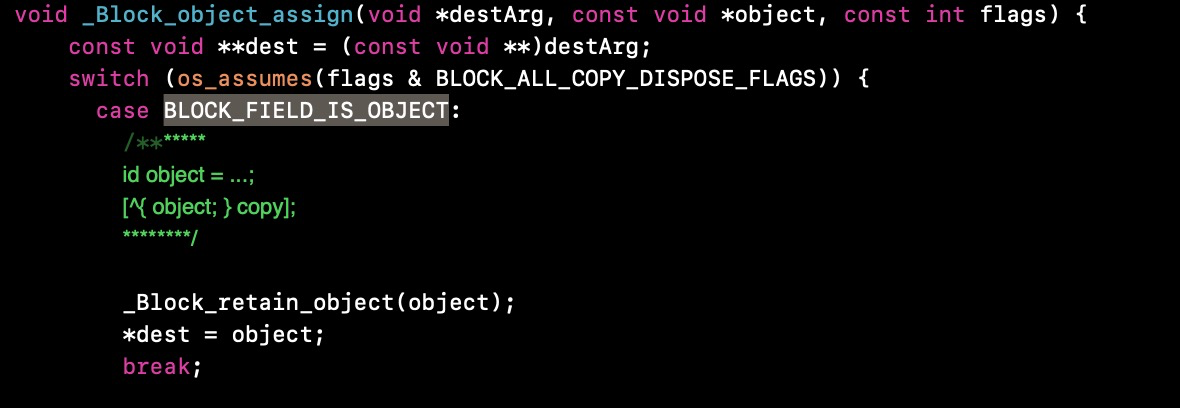
_Block_object_assign实现内部走BLOCK_FIELD_IS_OBJECT分支
总结
这上面的过程中,一共发生了三次拷贝动作
- block从栈到堆的拷贝
- __block修饰的自动变量结构体的拷贝
- 自动变量的拷贝
有拷贝就有对应的释放操作,代码逻辑上其实差不多,这里就不多聊了。 这里只是把相关的函数按调用顺序列出来
- _Block_release --- 源码中
- (*desc->dispose)(aBlock); --- 源码中
- __Block_byref_id_object_dispose_131 --- cpp
- _Block_object_dispose ---cpp
- _Block_byref_release ---源码中
- (*byref2->byref_destroy)(byref); ---源码中
- _Block_object_dispose(*(void * ) ((char)src + 40), 131); --- cpp中