

# 数据结构和算法类目
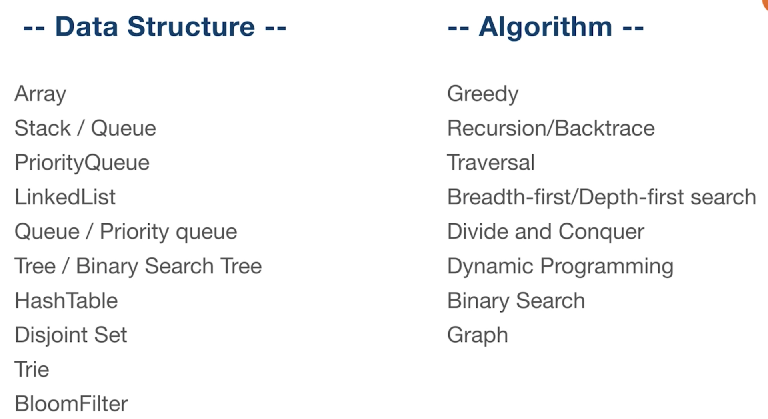
数据结构
剑指Offer
1.找出数组中重复的数字。(数组)
要求:在一个长度为 n 的数组 nums 里的所有数字都在 0~n-1 的范围内。数组中某些数字是重复的,但不知道有几个数字重复了,也不知道每个数字重复了几次。请找出数组中任意一个重复的数字。
思路:由于只需要找出数组中任意一个重复的数字,因此遍历数组,遇到重复的数字即返回。为了判断一个数字是否重复遇到,使用集合存储已经遇到的数字,如果遇到的一个数字已经在集合中,则当前的数字是重复数字。
初始化集合为空集合,重复的数字 repeat = -1 遍历数组中的每个元素: 将该元素加入集合中,判断是否添加成功 如果添加失败,说明该元素已经在集合中,因此该元素是重复元素,将该元素的值赋给 repeat,并结束遍历 返回 repeat
class Solution {
    public int findRepeatNumber(int[] nums) {
        Set<Integer> set=new HashSet<Integer>();
        int repeat=-1;
        for(int num:nums){
        if(!set.add(num)){
           repeat=num;
           break;
        }
    }
    return repeat;
  }
}
2.替换空格(字符串)
要求:请实现一个函数,把字符串 s 中的每个空格替换成"%20"。
思路:由于每次替换从 1 个字符变成 3 个字符,使用字符数组可方便地进行替换。建立字符数组地长度为 s 的长度的 3 倍,这样可保证字符数组可以容纳所有替换后的字符。
class Solution{
    public String replaceSpace(String s) {
        int length = s.length();
        char[] array = new char[length * 3];
        int size = 0;
        for (int i = 0; i < length; i++) {
            char c = s.charAt(i);
            if (c == ' ') {
                array[size++] = '%';
                array[size++] = '2';
                array[size++] = '0';
            } else {
                array[size++] = c;
            }
        }
        String newStr = new String(array, 0, size);
        return newStr;
    }
}
3.二维数组的查找(数组)
要求:在一个 n * m 的二维数组中,每一行都按照从左到右递增的顺序排序,每一列都按照从上到下递增的顺序排序。请完成一个函数,输入这样的一个二维数组和一个整数,判断数组中是否含有该整数。
示例:
现有矩阵 matrix 如下:
[
  [1,   4,  7, 11, 15],
  [2,   5,  8, 12, 19],
  [3,   6,  9, 16, 22],
  [10, 13, 14, 17, 24],
  [18, 21, 23, 26, 30]
]
线性查找法:
class Solution {
    public boolean findNumberIn2DArray(int[][] matrix, int target) {
        if (matrix == null || matrix.length == 0 || matrix[0].length == 0) {
            return false;
        }
        int rows = matrix.length, columns = matrix[0].length;
        for (int i = 0; i < rows; i++) {
            for (int j = 0; j < columns; j++) {
                if (matrix[i][j] == target) {
                    return true;
                }
            }
        }
        return false;
    }
}
4.从尾到头打印链表(栈 链表 数组)
要求:输入一个链表的头节点,从尾到头反过来返回每个节点的值(用数组返回)。 示例 1:
输入:head = [1,3,2]
输出:[2,3,1]
题解中Stack中元素类型为ListNode,可以替换为直接保存val的类型Integer
class Solution {
    public int[] reversePrint(ListNode head) {
        Stack<Integer> stack = new Stack<>();
        while (head != null) {
            stack.push(head.val);//将链表的值压栈
            head = head.next;
        }
        int size = stack.size();
        int[] array = new int[size];
        for (int i = 0; i < size; i++) {
            array[i] = stack.pop();//将栈中的数据以后进相处的方式放入数组
        }
        return array;
    }
}
5.旋转数组中的最小数字(数组)
要求:把一个数组最开始的若干个元素搬到数组的末尾,我们称之为数组的旋转。输入一个递增排序的数组的一个旋转,输出旋转数组的最小元素。例如,数组 [3,4,5,1,2] 为 [1,2,3,4,5] 的一个旋转,该数组的最小值为1。
示例 1:
输入:[3,4,5,1,2]
输出:1
示例 2:
输入:[2,2,2,0,1]
输出:0
class Solution {
    public int minArray(int[] numbers) {
        int i = 0, j = numbers.length - 1;
        while (i < j) {
            int m = (i + j) / 2;
            if (numbers[m] > numbers[j]) i = m + 1;
            else if (numbers[m] < numbers[j]) j = m;
            else j--;
        }
        return numbers[i];
    }
}
