export default class TechnologyDevList extends Vue {
  //多行字符串
  private text:string=`fdj
  djfd
  dfjl`
  private getText():string {
    return this.text
  }
  //字符串模版${变量|方法}
  private str:string=`hello${this.text}${this.getText()}`
  private element:any=`
  <span>${this.text}</span>
  <span>${this.text}</span>
  `
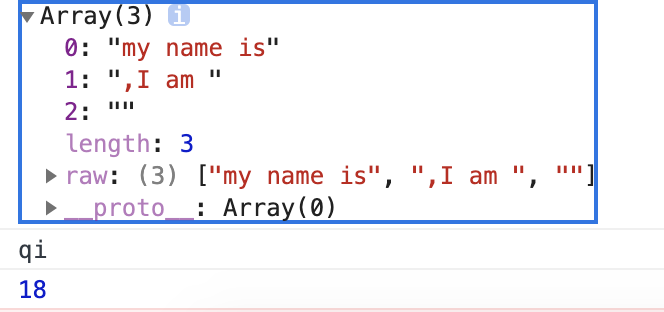
  //自动分割模版字符串,将变量入参
 private test(template,name,age) {
   console.log(template)
   console.log(name)
   console.log(age)
 }
   created(){
    const name:string='qi';
    const age:number=18;
    this.test`my name is${name},I am ${age}`;
  }
方法的可选参数
  private getName(id:number,adress?:any) {//可选参数放后面
  if(adress){ //可选参数判断存在后才可用
    console.log(adress)
  }
  }
将类作为类型声明变量:
class Feature {
  constructor(public id:number,public name:string) {

  }
}
export default class TechnologyDevList extends Vue {
 private feature:Feature[]=[{id:1,name:'dfd'}]
}
接口:
interface Person{
  first:string,
  last:number,
  sayHello() :string
}
//实现接口
class Gretter implements Person {
  constructor(public first='',public last=323) {}
  sayHello(){
    return this.first
  }
}
//面向接口编程
function oprete(person:Person) {
  return person.first+ person.sayHello()
}
const user=new Gretter('q',12)
user.sayHello()
oprete(user)
继承: 子类的构造函数必须执行一次super函数。
class A {
  constructor() {
    console.log(new.target.name);
  }
}
class B extends A {
  constructor() {
    super();
  }
}
new A() // A
new B() // B
类装饰器
function log(target: any): void {
  console.log(target)
  //target是类A的构造函数: ƒ A() {
  //   this.bar = 'qqqq';
  // }
  target.prototype.log = function() {
    console.log(this.bar)
  }
}
@log
class A {
  bar = 'qqqq'
  log() {}
}
let a = new A()
a.log()
方法装饰器
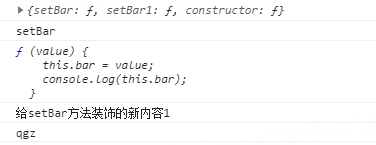
function dong(target: any, name: string, descriptor: any) {
console.log(target)
console.log(name)
console.log(descriptor.value)
let temp=descriptor.value
descriptor.value=function (value: string) {
  console.log('给setBar方法装饰的新内容1')
  temp.call(this,value)
}

}
class A {
bar = 'qqqq'
@dong
setBar(value: string) {
  this.bar = value
  console.log(this.bar)
}
setBar1(value: string) {
  this.bar = value
}
}
let a = new A()
a.setBar('qgz')
属性装饰器
function mua(params: string) {
  return function(target: any, name: string) {
    console.log(target, name)
    target[name] = params
  }
}
class A {
  @mua('shuqin') ns!: string
}
let a = new A()
console.log(a.ns)

泛型:
interface Feature{
  id:number,
  name:string
}
interface Result<T>{
    ok:0|1,
    data:T
  }
function getData<T>():Promise<Result<T>> {
  const data:any=[
    {
    id:12,
    name:'q'
   },
   {
    id:13,
    name:'gz'
   }
  ]
  return Promise.resolve<Result<T>>({ //<Result<T>>是一个对象,Promise.resolve将其转为 Promise 对象
    ok:1,
    data:data
  })
}

@Component({components: { ZnDatepicker, technologyDevAdd }})
export default class TechnologyDevList extends Vue {
  private features:Feature[]=[]//Feature[]指:数组内部元素为Feature类型
  async created(){
   const result= await getData<Feature[]>() //
    this.features = result.data
  }
获取可枚举属性:Object.keys或用for...in循环(还会获取到原型链上的可枚举属性) 获取可枚举属性和不可枚举属性,且过滤掉了原型链上属性:Object.getOwnPropertyNames 返回值:['key1','key2'] hasOwnProperty()也可以过滤原型链上属性
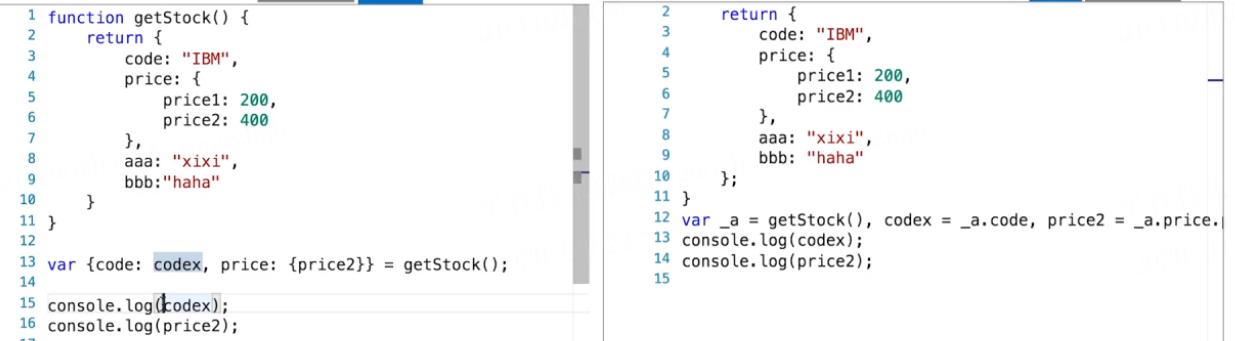
析构表达式:从数组或对象中取值给变量赋值(效果和es6解构赋值一样)
箭头函数:优点:this指向更符合预期

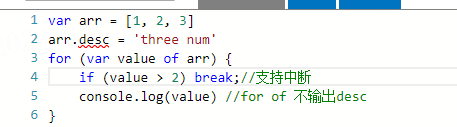
for of