

描述
Implement atoi which converts a string to an integer.
The function first discards as many whitespace characters as necessary until the first non-whitespace character is found. Then, starting from this character, takes an optional initial plus or minus sign followed by as many numerical digits as possible, and interprets them as a numerical value.
The string can contain additional characters after those that form the integral number, which are ignored and have no effect on the behavior of this function.
If the first sequence of non-whitespace characters in str is not a valid integral number, or if no such sequence exists because either str is empty or it contains only whitespace characters, no conversion is performed.
If no valid conversion could be performed, a zero value is returned.
Note:
- Only the space character
' 'is considered as whitespace character. - Assume we are dealing with an environment which could only store integers within the 32-bit signed integer range: [−231, 231 − 1]. If the numerical value is out of the range of representable values, INT_MAX (231 − 1) or INT_MIN (−231) is returned.
Example 1:
Input: "42"
Output: 42
Example 2:
Input: "   -42"
Output: -42
Explanation: The first non-whitespace character is '-', which is the minus sign.
             Then take as many numerical digits as possible, which gets 42.
Example 3:
Input: "4193 with words"
Output: 4193
Explanation: Conversion stops at digit '3' as the next character is not a numerical digit.
Example 4:
Input: "words and 987"
Output: 0
Explanation: The first non-whitespace character is 'w', which is not a numerical
             digit or a +/- sign. Therefore no valid conversion could be performed.
Example 5:
Input: "-91283472332"
Output: -2147483648
Explanation: The number "-91283472332" is out of the range of a 32-bit signed integer.
             Thefore INT_MIN (−231) is returned.
思路
对字符串进行完善的清洗,并转化为int型返回即可。
经过不断的打磨,完成了在各种测试用例下的完备性考验。
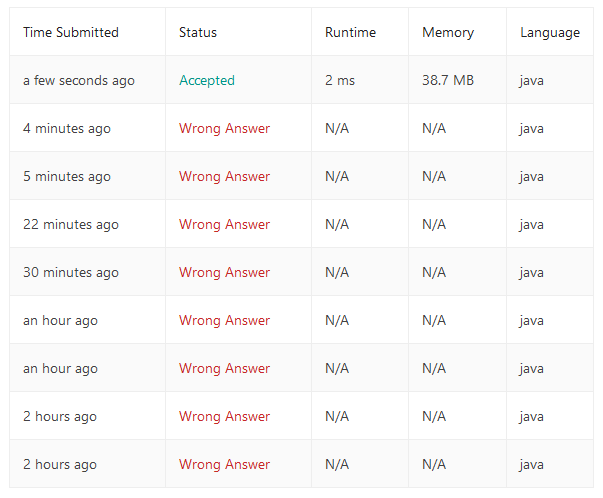
其中有0-1、 00000000000123456、-0 123等用例。
下面的是通过的代码:
class Solution {
    public int myAtoi(String str) {
        //新建StringBuffer暂存清洗过的数据
        StringBuffer sb = new StringBuffer();

        //posi是符号标志,flag记录的是此前有没有有效输入“-”、数字等
        boolean posi = true, flag = true;
        int posicount = 0;
        for(int i =0;i<str.length();i++){

            //有效输入“-”、数字等碰到空格直接退出读取
            if(str.charAt(i) == ' '){
                if(flag){
                   continue;
                }else{
                    break;
                }
            //有效输入后不能碰到符号,下同
            }else if(str.charAt(i) == '-' && flag){
                posi = false;
                posicount++;
                flag = false;
            }else if(str.charAt(i) == '+' && flag){
                posi = true;
                posicount++;
                flag = false;
            //记录数字,并改变有效数字记录位
            }else if(str.charAt(i) >= '0' && str.charAt(i) <= '9'){
                sb.append(str.charAt(i));
                flag = false;
            //非法输入的出口
            }else{
                break;
            }
        }

        //有两个以上符号或者清洗过的数字长度为0
        if(posicount > 1 || sb.length() == 0){
            return 0;
        }

        //防止一些超长的但是没有整型溢出的输入:00000000000000012233444
        double sum = 0;
        for(int i = 0;i < sb.length();i++){
            sum = sum * 10 + sb.charAt(i) - '0';
        }

        //根据符号位调整符号
        if(!posi){
            sum = -sum;
        }

        //判断整型溢出
        if(sum <= (double)Integer.MIN_VALUE){
            return Integer.MIN_VALUE;
        }else if(sum >= (double)Integer.MAX_VALUE){
            return Integer.MAX_VALUE;
        }

        return (int)sum;
    }
}由此可见,好的测试用例是能够大大的提高程序的健壮性和鲁棒性的。
