

剑指offer部分
链表
合并两个排序的链表
public class Solution {
    public ListNode Merge(ListNode list1,ListNode list2) {
        if(list1 == null){
            return list2;
        }
        if(list2 == null){
            return list1;
        }
        if(list1.val <= list2.val){
            list1.next = Merge(list1.next,list2);
            return list1;
        }
        else {
            list2.next = Merge(list1,list2.next);
            return list2;
        }
    }
}
复制复杂的链表
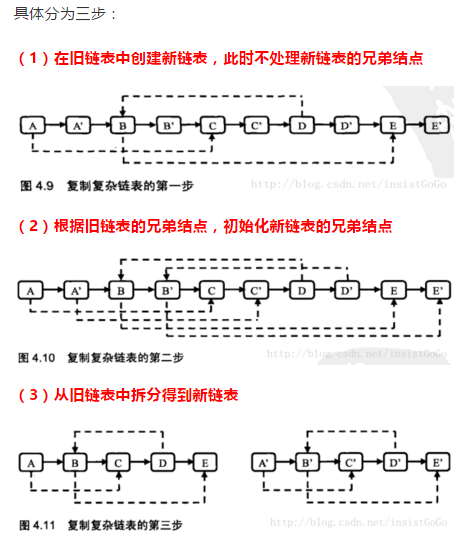
/*
public class RandomListNode {
    int label;
    RandomListNode next = null;
    RandomListNode random = null;

    RandomListNode(int label) {
        this.label = label;
    }
}
*/
public class Solution {
    public RandomListNode Clone(RandomListNode pHead)
    {
        if(pHead == null){
            return null;
        }
        //复制结点,如复制A结点得到A1,将A1插入到A结点后面
        RandomListNode curNode = pHead;
        while(curNode != null){
            RandomListNode cloneNode = new RandomListNode(curNode.label);
            cloneNode.next = curNode.next;
            curNode.next = cloneNode;
            curNode = curNode.next.next;
        }
        //重新遍历链表,复制老结点的随机指针给新结点
        curNode = pHead;
        while(curNode != null){
 //           RandomListNode nextNode = new RandomListNode(curNode.label);
 //           nextNode = curNode.next;
            curNode.next.random = curNode.random == null?null:curNode.random.next;
            curNode = curNode.next.next;
        }
        //拆分链表,将链表拆分成复制后的链表和原链表
        curNode = pHead;
        RandomListNode pclone = curNode.next;
        while(curNode !=null){
            RandomListNode cloneNode = curNode.next;
            curNode.next = cloneNode.next;
            cloneNode.next = cloneNode.next==null?null:cloneNode.next.next;
            curNode=curNode.next;
        }
        return pclone;
    }
}
数组
顺时针打印数组
思路为:先归纳外圈打印规律为4个方向,然后可以归纳内圈与外圈打印的相似点
import java.util.ArrayList;
public class Solution {
    public ArrayList<Integer> printMatrix(int [][] matrix) {
        ArrayList<Integer> printList = new ArrayList<Integer>();
        if(matrix==null || matrix.length==0){
            return printList;
        }
        int rlen = matrix.length-1;
        int clen = matrix[0].length-1;//这个地方要注意
        printMatrix(0,0,rlen,clen,printList,matrix);
        return printList;
    }
    public void printMatrix(int startrow,int startcol,int endrow,int endcol,ArrayList<Integer> printList,int[][] matrix){
        if(startrow < endrow && startcol <endcol){
        //打印的时候最好自己先想清楚打印逻辑,其实可以边写边想思路,不是很复杂的题目可以一边打规律一遍想特点
            for(int j=startcol;j<=endcol;j++) printList.add(matrix[startrow][j]);//右
            for(int i=startrow+1;i<=endrow-1;i++) printList.add(matrix[i][endcol]);//下
            for(int j=endcol;j>=startcol;j--) printList.add(matrix[endrow][j]);//左
            for(int i=endrow-1;i>=startrow+1;i--) printList.add(matrix[i][startcol]);//上
            printMatrix(startrow+1,startcol+1,endrow-1,endcol-1,printList,matrix);
        }
        else if(startrow == endrow && startcol<endcol){
            for(int j=startcol;j<=endcol;j++)printList.add(matrix[startrow][j]);
        }
        else if(startrow<endrow && startcol==endcol){
            for(int i=startrow;i<=endrow;i++)printList.add(matrix[i][startcol]);
        }
        else if(startrow == endrow && startcol == endcol){
            printList.add(matrix[startrow][startcol]);
        }
        else {
            return;
        }
    }
}
/*
     1 2 3 4
     5 6 7 8
     9 10 11 12
     13 14 15 16

*/
栈
包含min函数的栈
有两种方法,一种是借用辅助栈保持栈顶元素始终为最小的数,一种是维护一个记录最小值的变量
- 维护一个记录最小值的变量
import java.util.Stack;
import java.util.Iterator;
public class Solution {
//以下数字标注为自己白板写的时候编译错误
    Stack<Integer> s = new Stack<Integer>();//1
    public void push(int node) {
        s.push(node);
    }

    public void pop() {
        s.pop();
    }

    public int top() {
        return s.peek();
    }

    public int min() {
        int min=s.peek();
        int tmp=0;
        Iterator<Integer> it = s.iterator();//2
        while(it.hasNext()){//3
            tmp=it.next();
            if(min>tmp){
                min=tmp;
            }
        }
        return min;
    }
}
- 借助辅助栈
import java.util.Stack;

public class Solution {

    Stack<Integer> stack1 = new Stack<Integer>();
    Stack<Integer> minStack = new Stack<Integer>();
    public void push(int node) {
        stack1.push(node);
        if(minStack.empty() || node < minStack.peek())
            minStack.push(node);
    }

    public void pop() {
        if(stack1.peek() == minStack.peek()) //因为minStack维护的是stack1的最小值,当stack1不存在该最小值时,minStack也应该弹出该元素
            minStack.pop();
        stack1.pop();
    }

    public int top() {
        return stack1.peek();
    }

    public int min() {
        return minStack.peek();
    }
}
栈的压入,弹出序列
思路:通过实际的栈操作来模拟栈的弹出,压入
import java.util.ArrayList;
import java.util.Stack;
public class Solution {
    public boolean IsPopOrder(int [] pushA,int [] popA) {
       //3 4 5 2 1
        if(pushA==null || popA == null || pushA.length==0||popA.length==0||pushA.length!=popA.length){
            return false;
        }
        Stack<Integer> s = new Stack<Integer>();
        int i=0,j=0;
        s.push(pushA[i++]);
        while(j<=popA.length-1){
            while(popA[j]!=s.peek()){
                if(i == pushA.length) return false;
                s.push(pushA[i++]);
            }
            s.pop();
            j++;
        }
        return true;
    }
}
队列
从上往下打印二叉树
思路:使用队列来实现二叉树的广度遍历,这里可以直接借助ArrayList模拟
public class Solution {
    public ArrayList<Integer> PrintFromTopToBottom(TreeNode root) {
        ArrayList<Integer> result = new ArrayList<>();
        ArrayList<TreeNode> queue = new ArrayList<>();
        if(root == null){
            return result;
        }
        queue.add(root);
        while(queue.size()!=0){
            TreeNode tmp = queue.remove(0);
            if(tmp.left !=null){
                queue.add(tmp.left);
            }
            if(tmp.right !=null){
                queue.add(tmp.right);
            }
            result.add(tmp.val);
        }
        return result;
    }
}
