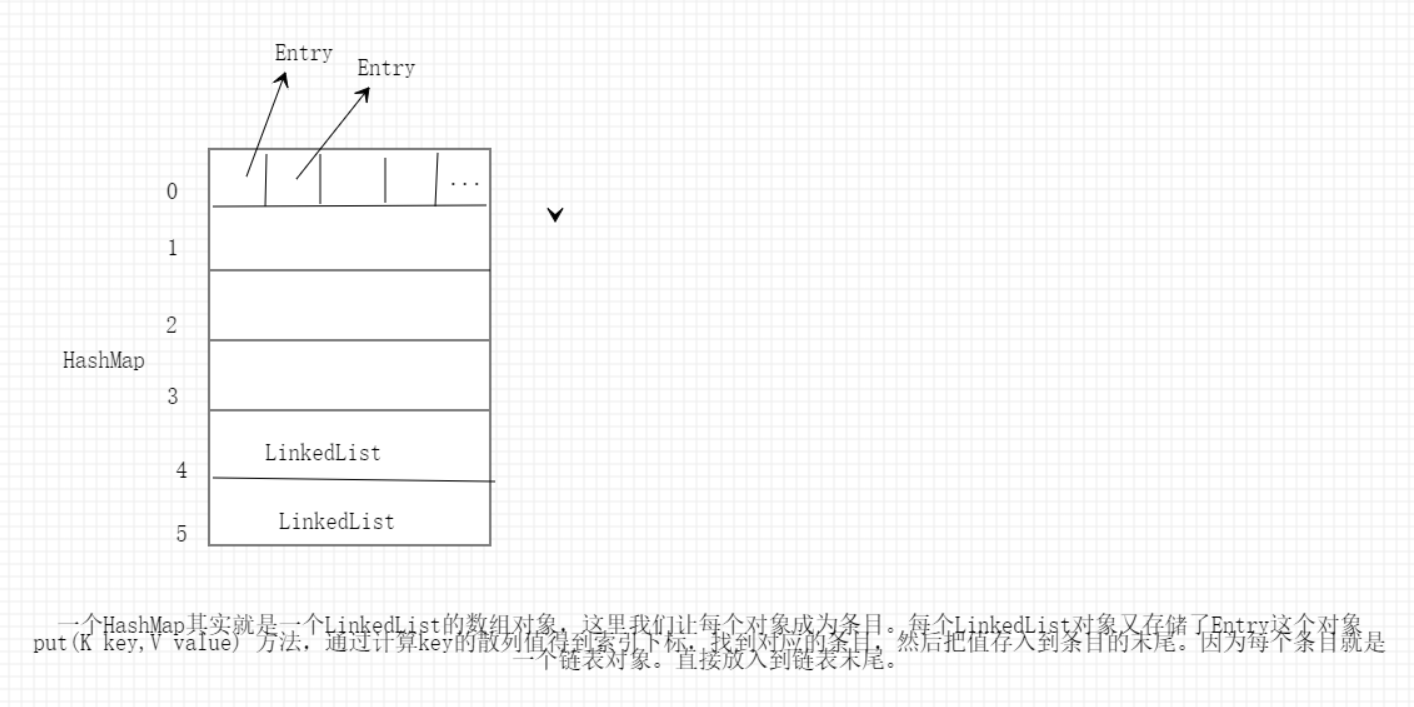
HashMap java代码实现
先上代码
package MyDataStructures.散列;

import java.util.Map;

public interface MyMap<K, V> {
    public void clear();

    public boolean containsKey(K key);

    public boolean containsValue(V value);

    public java.util.Set<Entry<K, V>> entrySet();

    public V get(K key);

    public boolean isEmpty();

    public java.util.Set<K> keySet();

    public V put(K key, V value);

    public void remove(K key);

    public int size();

    public java.util.Set<V> vlaues();

    public static class Entry<K, V> {
        K key;
        V value;
        public Entry(K key, V value) {
            this.key = key;
            this.value = value;
        }
        public K getKey() {
            return key;
        }
        public void setKey(K key) {
            this.key = key;
        }
        public V getValue() {
            return value;
        }
        public void setValue(V value) {
            this.value = value;
        }
        @Override
        public String toString() {
            return "Entry{" +
                    "key=" + key +
                    ", value=" + value +
                    '}';
        }
    }
}
package MyDataStructures.散列;
import java.util.LinkedList;
import java.util.Set;
public class MyHashMap<K, V> implements MyMap<K, V> {
private static int DEFAULT_INITIAL_CAPACITY = 4;
private static int MAXIMUM_CAPACITY = 1 << 30;
private int capacity;
private static float DEFAULT_MAX_LOAD_FACTOR = 0.75f;
private float loadFactorThreshold;
private int size = 0;
LinkedList<MyMap.Entry<K, V>>[] table;
public MyHashMap() {
this(DEFAULT_INITIAL_CAPACITY, DEFAULT_MAX_LOAD_FACTOR);
}
public MyHashMap(int initialCapacity) {
this(initialCapacity, DEFAULT_MAX_LOAD_FACTOR);
}
public MyHashMap(int initialCapacity, float loadFactorThreshold) {
if (initialCapacity > MAXIMUM_CAPACITY) {
this.capacity = MAXIMUM_CAPACITY;
} else {
this.capacity = trimToPowerOf2(initialCapacity);
}
this.loadFactorThreshold = loadFactorThreshold;
table = new LinkedList[capacity];
}
private int trimToPowerOf2(int initialCapacity) {
int capacity = 1;
while (capacity < initialCapacity) {
capacity <<= 1;
}
return capacity;
}
private void removeEntries() {
for (int i = 0; i < capacity; i++) {
if (table[i] != null) {
table[i].clear();
}
}
}
@Override
public void clear() {
size = 0;
removeEntries();
}
@Override
public boolean containsKey(K key) {
if (get(key) != null)
return true;
else
return false;
}
@Override
public boolean containsValue(V value) {
for (int i = 0; i < capacity; i++) {
if (table[i] != null) {
LinkedList<Entry<K, V>> bucket = table[i];
for (Entry<K, V> entry : bucket) {
if (entry.getValue().equals(value))
return true;
}
}
}
return false;
}
@Override
public Set<Entry<K, V>> entrySet() {
java.util.Set<MyMap.Entry<K, V>> set = new java.util.HashSet<>();
for (int i = 0; i < capacity; i++) {
if (table[i] != null) {
LinkedList<Entry<K, V>> bucket = table[i];
for (Entry<K, V> entry : bucket)
set.add(entry);
}
}
return set;
}
@Override
public V get(K key) {
int bucketIndex = hash(key.hashCode());
if (table[bucketIndex] != null) {
LinkedList<Entry<K, V>> bucket = table[bucketIndex];
for (Entry<K, V> entry : bucket) {
if (entry.getKey().equals(key))
return entry.getValue();
}
}
return null;
}
@Override
public boolean isEmpty() {
return size == 0;
}
@Override
public Set<K> keySet() {
java.util.Set<K> set = new java.util.HashSet<>();
for (int i = 0; i < capacity; i++) {
if (table[i] != null) {
LinkedList<Entry<K, V>> bucket = table[i];
for (Entry<K, V> entry : bucket) {
set.add(entry.getKey());
}
}
}
return set;
}
@Override
public V put(K key, V value) {
if (get(key) != null) {
int bucketIndex = hash(key.hashCode());
LinkedList<Entry<K, V>> entries = table[bucketIndex];
for (Entry<K, V> entry : entries) {
if (entry.getKey().equals(key)) {
V oldValue = entry.getValue();
entry.value = value;
return oldValue;
}
}
if (size >= capacity * loadFactorThreshold) {
if (capacity == MAXIMUM_CAPACITY)
throw new RuntimeException("Exceeding maximum capacity");
rehash();
}
}
int bucketIndex = hash(key.hashCode());
if (table[bucketIndex] == null) {
table[bucketIndex] = new LinkedList<Entry<K, V>>();
}
table[bucketIndex].addLast(new MyMap.Entry<K, V>(key, value));
size++;
return value;
}
@Override
public void remove(K key) {
int bucketIndex = hash(key.hashCode());
if (table[bucketIndex] != null) {
LinkedList<Entry<K, V>> bucket = table[bucketIndex];
for (Entry<K, V> entry : bucket) {
if (entry.getKey().equals(key)) {
bucket.remove(entry);
size--;
break;
}
}
}
}
@Override
public int size() {
return size;
}
@Override
public Set<V> vlaues() {
java.util.Set<V> set = new java.util.HashSet<>();
for (int i = 0; i < capacity; i++) {
if (table[i] != null) {
LinkedList<Entry<K, V>> bucket = table[i];
for (Entry<K, V> entry : bucket) {
set.add(entry.getValue());
}
}
}
return set;
}
private int hash(int hashCode) {
return supplementalHash(hashCode) & (capacity - 1);
}
private static int supplementalHash(int h) {
h ^= (h >>> 20) ^ (h >>> 12);
return h ^ (h >>> 7) ^ (h >>> 4);
}
private void rehash() {
java.util.Set<Entry<K, V>> set = entrySet();
capacity <<= 1;
table = new LinkedList[capacity];
size = 0;
for (Entry<K, V> entry : set) {
put(entry.getKey(), entry.getValue());
}
}
@Override
public String toString() {
StringBuilder result = new StringBuilder("[");
for (int i = 0; i < capacity; i++) {
if (table[i] != null && table[i].size() > 0) {
for (Entry<K, V> entry : table[i])
result.append(entry);
}
}
result.append("]");
return result.toString();
}
}
解释在代码中 图片为HashMap的数据结构存储图