1.1 程序在整个启动过程
程序在整个启动过程中会经过编译期和运行期,编译期又分为以下几个阶段 :
预编译 --> 编译 --> 汇编 --> dyld 链接 --> 可执行文件(mach-0).
1.2 什么是dyld?
dyld 全名 The dynamic link editor . 它是苹果的动态链接器,是苹果操作系统一个重要组成部分 ,在应用被编译打包成可执行文件格式的 Mach-O 文件之后 ,交由 dyld 负责链接 , 加载程序 . 其实mach-o文件里都是一些二进制数据,这些二进制数据对应的都是程序中要执行的类以及类里面的方法、属性、协议等等.(本文探究核心点的就是如何将这些二进制文件加载到程序的内存里)
1.3 类的基本结构
看过我之前的文章就会知道 类的本质是个结构体,结构体里有ISA、superclass、cache、bits成员变量以及一些函数,其中 class_data_bits_t bits 里有class_rw_t* data ,class_rw_t 里有 const class_ro_t *ro;method_array_t methods;property_array_t properties;protocol_array_t protocols.
(附:之前文章类的基本结构地址 juejin.cn/post/684490…)
1.4 本文代码比较多,想探索的盆友最好在git上下份libobjc源码,就着源码看文章滋味会更加酸爽哦
二.mach-0 文件加载至内存之初探
2.1 程序加载前的准备条件
程序在刚运行时会把mach-o里的内容映射到相应的表里去,在此之前肯定有相应的准备条件或者配置,我们在git上下一份objc的源码,在源码中你会发现程序在运行是必然的来到 _objc_init:
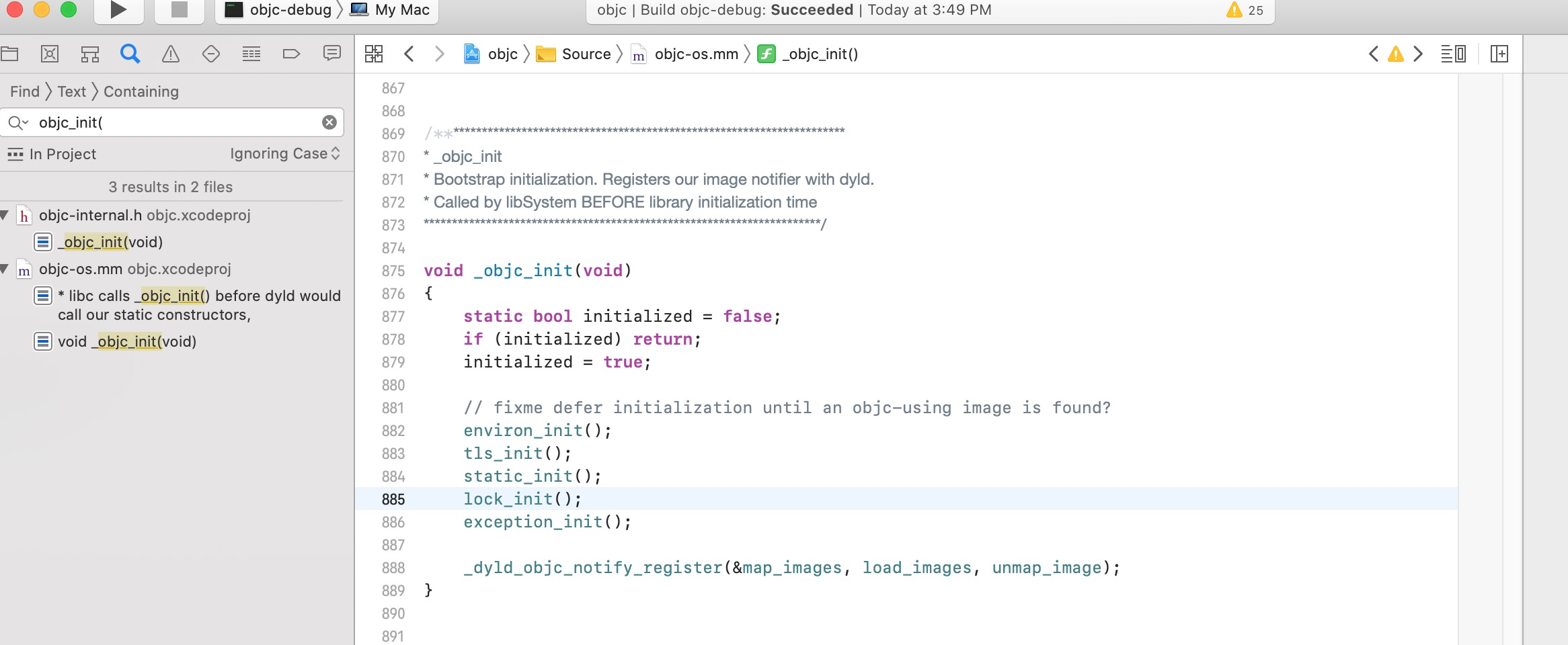
environ_init();
tls_init();
static_init();
lock_init();
exception_init();
environ_init() 对程序做整个环境的配置,看下代码实现:
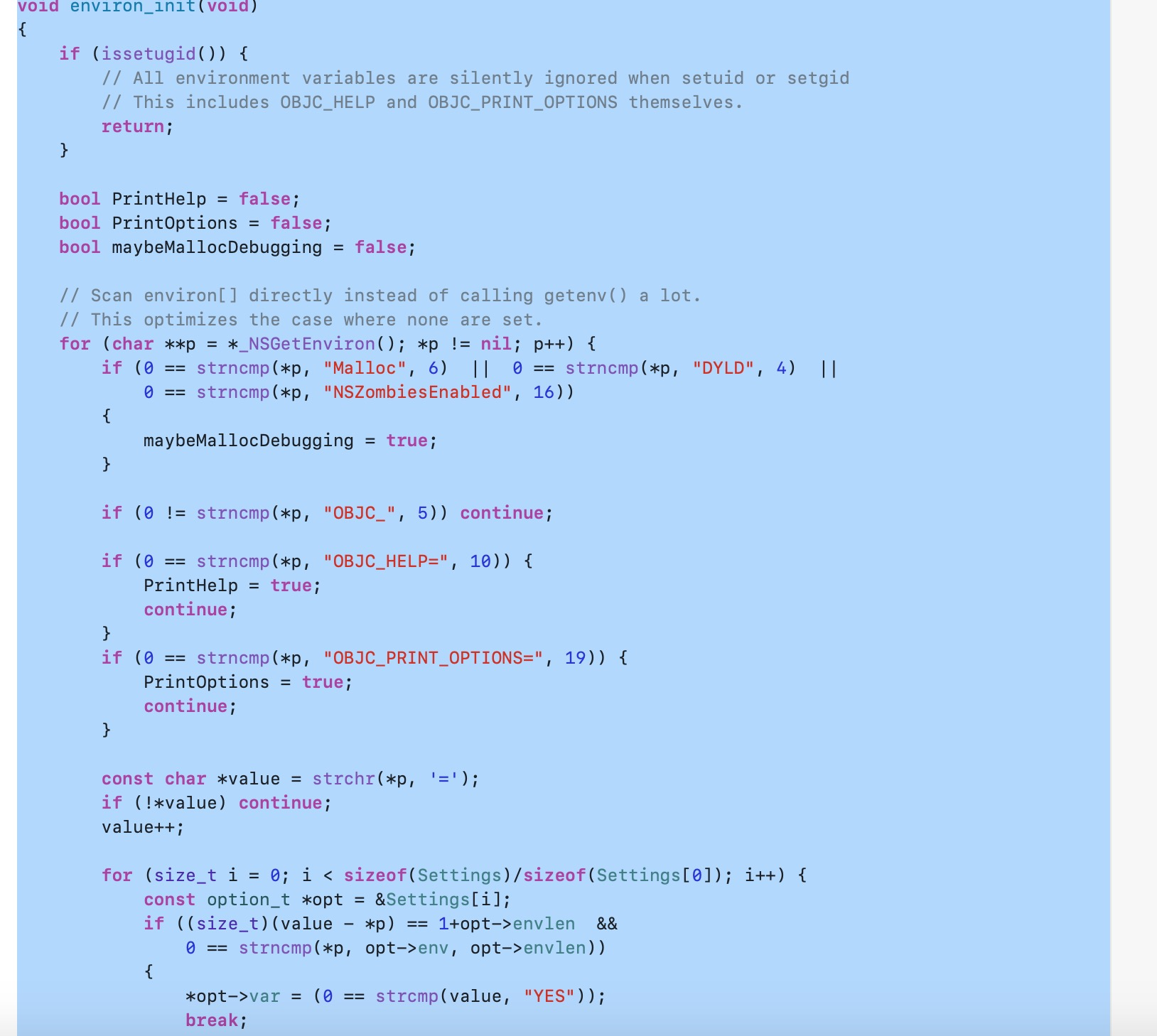
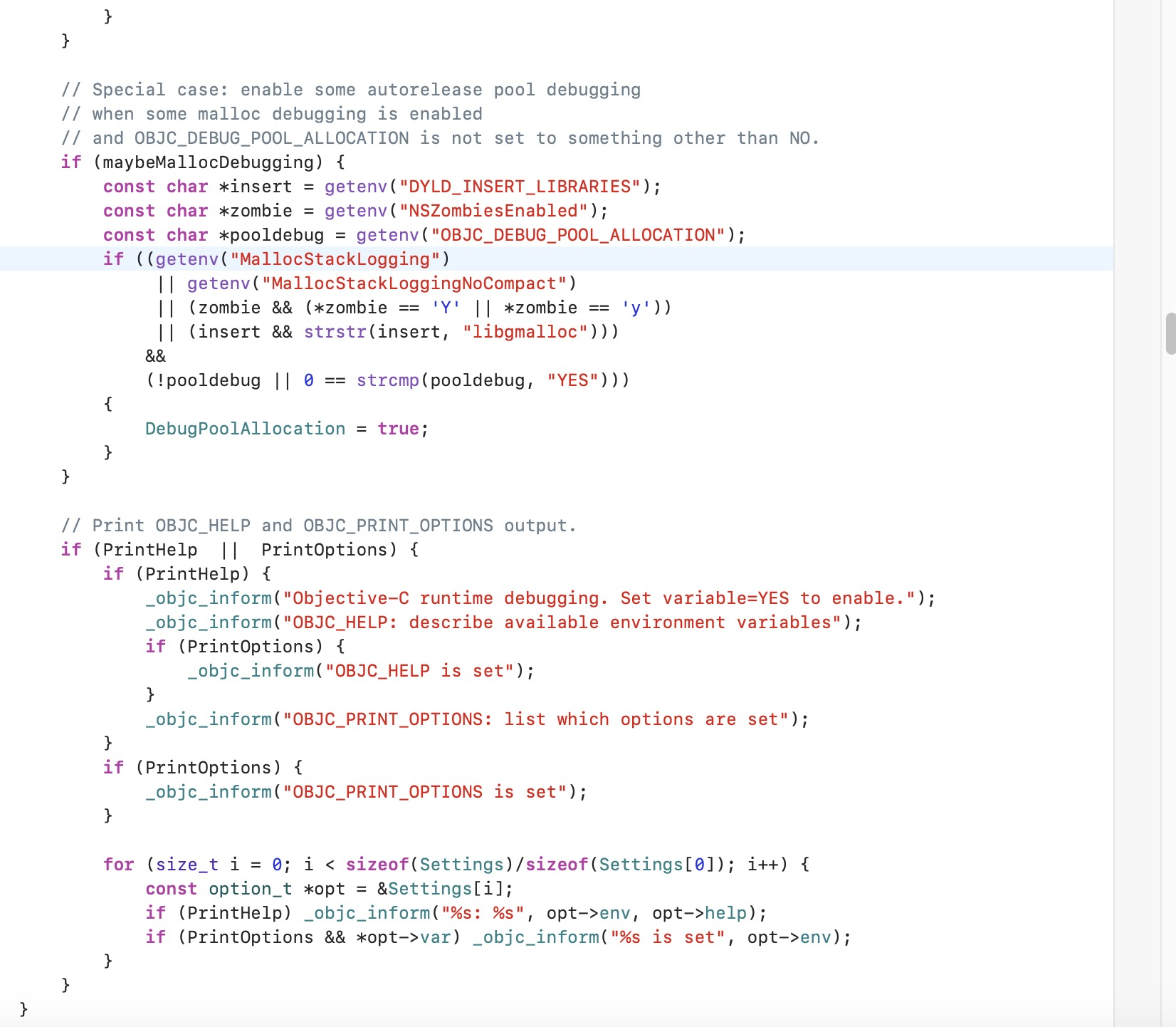
其中代码比较长,我们拿最主要的来看:
for (size_t i = 0; i < sizeof(Settings)/sizeof(Settings[0]); i++) {
            const option_t *opt = &Settings[i];
            if (PrintHelp) _objc_inform("%s: %s", opt->env, opt->help);            if (PrintOptions && *opt->var) _objc_inform("%s is set", opt->env);
    }
    }
这里会将所有我们所有的系统环境配置给打印出来,我们来打印看下(截取一小部分):
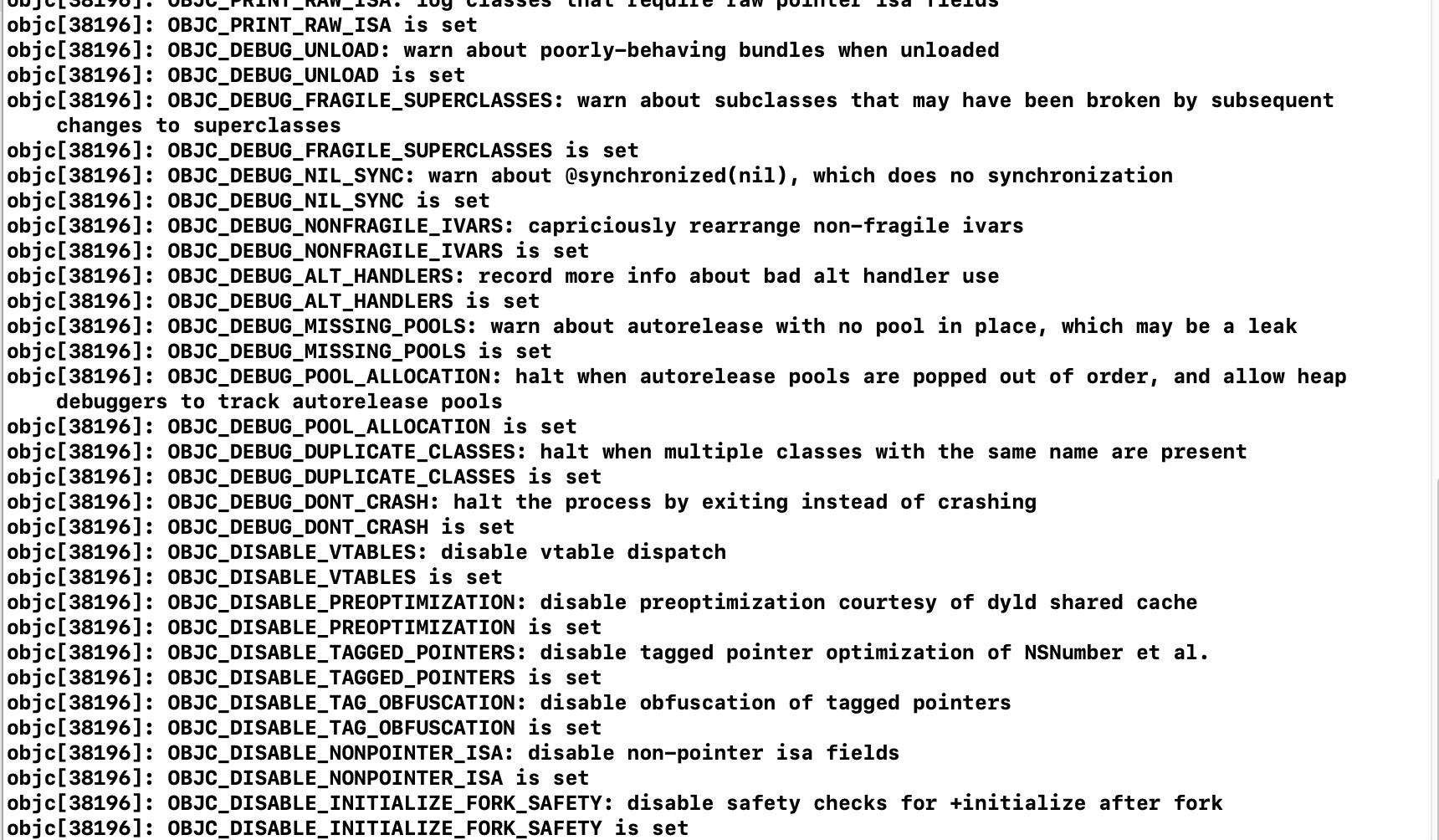
在这里面我们看到objc[38196]: OBJC_PRINT_LOAD_METHODS: log calls to class and category +load methods这个环境配置,既然是环境配置那我们就可以在我们的项目中添加项目配置方便我们平时开发调试,好 那我们一起来玩一下:Product -->Scheme --> Edit Scheme :
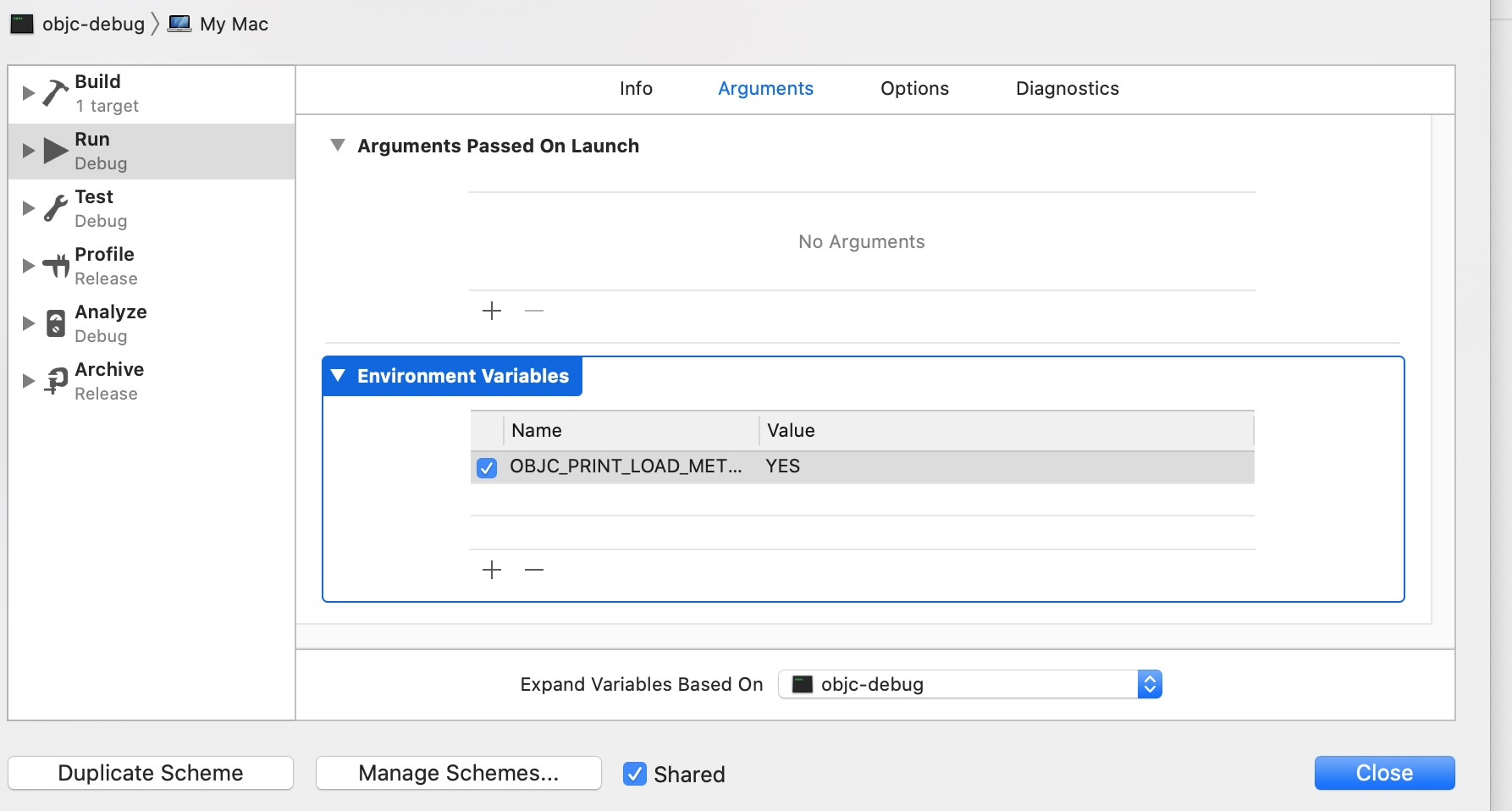
把刚刚那个环境配置输入进去,再运行下程序看看系统控制台会输出什么东西:
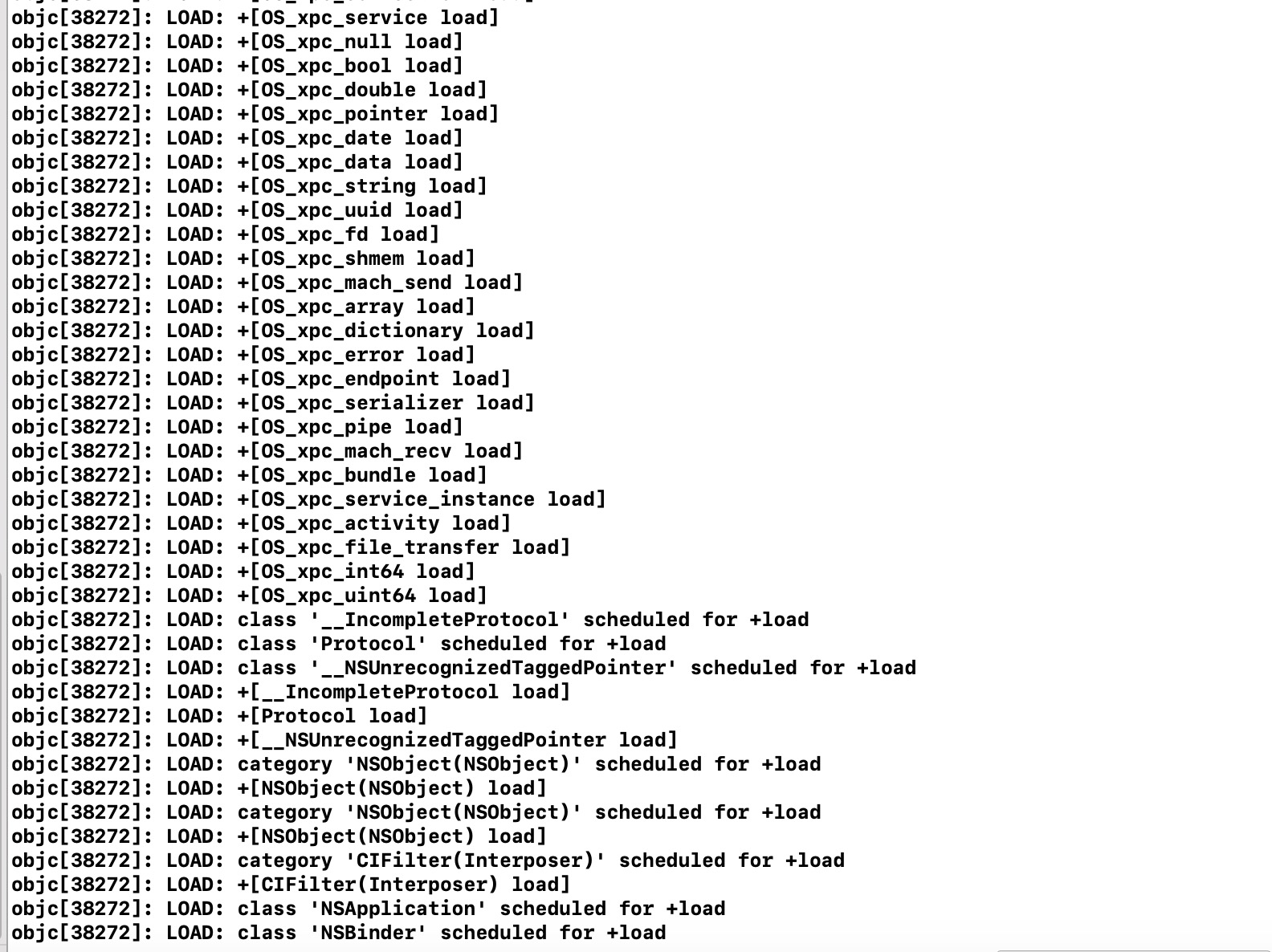
原来这个环境set 可以输出所有实现load函数的类.其它的环境设置大家也可以自己试一下哈,在这里就不做赘述了.
tls_init();对程序的线程初始化
static_init();对程序的构析函数初始化
lock_init();对程序的锁初始化
exception_init();对程序的异常初始化,有的盆友会问到 程序还刚刚在加载到内存为啥就进行异常初始化,其实在这里在这里是对异常的监测,当程序崩溃时 在这里就会监测到.
一些程序配置完之后终于来到我们的主角,上面这些配置只是些开胃菜,
_dyld_objc_notify_register(&map_images, load_images, unmap_image)
话不多说,开干.
三.mach-0 文件加载至内存之进阶
刚刚分析道mach-0里的镜像文件映射到内存里是map_images函数操控着的,我们来看看这个函数做了什么事.

看下map_images_nolock:
void
map_images_nolock(unsigned mhCount, const char * const mhPaths[],
                  const struct mach_header * const mhdrs[])
{
    static bool firstTime = YES;
    header_info *hList[mhCount];
    uint32_t hCount;
    size_t selrefCount = 0;

    // Perform first-time initialization if necessary.
    // This function is called before ordinary library initializers.
    // fixme defer initialization until an objc-using image is found?
    if (firstTime) {
        preopt_init();
    }

    if (PrintImages) {
        _objc_inform("IMAGES: processing %u newly-mapped images...\n", mhCount);
    }


    // Find all images with Objective-C metadata.
    hCount = 0;

    // Count classes. Size various table based on the total.
    int totalClasses = 0;
    int unoptimizedTotalClasses = 0;
    {
        uint32_t i = mhCount;
        while (i--) {
            const headerType *mhdr = (const headerType *)mhdrs[i];

            auto hi = addHeader(mhdr, mhPaths[i], totalClasses, unoptimizedTotalClasses);
            if (!hi) {
                // no objc data in this entry
                continue;
            }

            if (mhdr->filetype == MH_EXECUTE) {
                // Size some data structures based on main executable's size
#if __OBJC2__
                size_t count;
                _getObjc2SelectorRefs(hi, &count);
                selrefCount += count;
                _getObjc2MessageRefs(hi, &count);
                selrefCount += count;
#else
                _getObjcSelectorRefs(hi, &selrefCount);
#endif

#if SUPPORT_GC_COMPAT
                // Halt if this is a GC app.
                if (shouldRejectGCApp(hi)) {
                    _objc_fatal_with_reason
                        (OBJC_EXIT_REASON_GC_NOT_SUPPORTED,
                         OS_REASON_FLAG_CONSISTENT_FAILURE,
                         "Objective-C garbage collection "
                         "is no longer supported.");
                }
#endif
            }

            hList[hCount++] = hi;

            if (PrintImages) {
                _objc_inform("IMAGES: loading image for %s%s%s%s%s\n",
                             hi->fname(),
                             mhdr->filetype == MH_BUNDLE ? " (bundle)" : "",
                             hi->info()->isReplacement() ? " (replacement)" : "",
                             hi->info()->hasCategoryClassProperties() ? " (has class properties)" : "",
                             hi->info()->optimizedByDyld()?" (preoptimized)":"");
            }
        }
    }

    // Perform one-time runtime initialization that must be deferred until
    // the executable itself is found. This needs to be done before
    // further initialization.
    // (The executable may not be present in this infoList if the
    // executable does not contain Objective-C code but Objective-C
    // is dynamically loaded later.
    if (firstTime) {
        sel_init(selrefCount);
        arr_init();

#if SUPPORT_GC_COMPAT
        // Reject any GC images linked to the main executable.
        // We already rejected the app itself above.
        // Images loaded after launch will be rejected by dyld.

        for (uint32_t i = 0; i < hCount; i++) {
            auto hi = hList[i];
            auto mh = hi->mhdr();
            if (mh->filetype != MH_EXECUTE  &&  shouldRejectGCImage(mh)) {
                _objc_fatal_with_reason
                    (OBJC_EXIT_REASON_GC_NOT_SUPPORTED,
                     OS_REASON_FLAG_CONSISTENT_FAILURE,
                     "%s requires Objective-C garbage collection "
                     "which is no longer supported.", hi->fname());
            }
        }
#endif

#if TARGET_OS_OSX
        // Disable +initialize fork safety if the app is too old (< 10.13).
        // Disable +initialize fork safety if the app has a
        //   __DATA,__objc_fork_ok section.

        if (dyld_get_program_sdk_version() < DYLD_MACOSX_VERSION_10_13) {
            DisableInitializeForkSafety = true;
            if (PrintInitializing) {
                _objc_inform("INITIALIZE: disabling +initialize fork "
                             "safety enforcement because the app is "
                             "too old (SDK version " SDK_FORMAT ")",
                             FORMAT_SDK(dyld_get_program_sdk_version()));
            }
        }

        for (uint32_t i = 0; i < hCount; i++) {
            auto hi = hList[i];
            auto mh = hi->mhdr();
            if (mh->filetype != MH_EXECUTE) continue;
            unsigned long size;
            if (getsectiondata(hi->mhdr(), "__DATA", "__objc_fork_ok", &size)) {
                DisableInitializeForkSafety = true;
                if (PrintInitializing) {
                    _objc_inform("INITIALIZE: disabling +initialize fork "
                                 "safety enforcement because the app has "
                                 "a __DATA,__objc_fork_ok section");
                }
            }
            break;  // assume only one MH_EXECUTE image
        }
#endif

    }

    if (hCount > 0) {
        _read_images(hList, hCount, totalClasses, unoptimizedTotalClasses);
    }

    firstTime = NO;
}
咋一看是不是有些吓人,代码太多抓不住重点,没事我们一步步分析:
static bool firstTime = YES;
    header_info *hList[mhCount];
    uint32_t hCount;
    size_t selrefCount = 0;

    // Perform first-time initialization if necessary.
    // This function is called before ordinary library initializers.
    // fixme defer initialization until an objc-using image is found?
    if (firstTime) {
        preopt_init();
    }

    if (PrintImages) {
        _objc_inform("IMAGES: processing %u newly-mapped images...\n", mhCount);
    }
在这里设置一些变量, preopt_init 主要是对共享缓存做一些处理.(在这里只稍微提下,不是本文的重点).
int totalClasses = 0;
    int unoptimizedTotalClasses = 0;
    {
        uint32_t i = mhCount;
        while (i--) {
            const headerType *mhdr = (const headerType *)mhdrs[i];

            auto hi = addHeader(mhdr, mhPaths[i], totalClasses, unoptimizedTotalClasses);
            if (!hi) {
                // no objc data in this entry
                continue;
            }

            if (mhdr->filetype == MH_EXECUTE) {
                // Size some data structures based on main executable's size
#if __OBJC2__
                size_t count;
                _getObjc2SelectorRefs(hi, &count);
                selrefCount += count;
                _getObjc2MessageRefs(hi, &count);
                selrefCount += count;
#else
                _getObjcSelectorRefs(hi, &selrefCount);
#endif

#if SUPPORT_GC_COMPAT
                // Halt if this is a GC app.
                if (shouldRejectGCApp(hi)) {
                    _objc_fatal_with_reason
                        (OBJC_EXIT_REASON_GC_NOT_SUPPORTED,
                         OS_REASON_FLAG_CONSISTENT_FAILURE,
                         "Objective-C garbage collection "
                         "is no longer supported.");
                }
#endif
            }

            hList[hCount++] = hi;

            if (PrintImages) {
                _objc_inform("IMAGES: loading image for %s%s%s%s%s\n",
                             hi->fname(),
                             mhdr->filetype == MH_BUNDLE ? " (bundle)" : "",
                             hi->info()->isReplacement() ? " (replacement)" : "",
                             hi->info()->hasCategoryClassProperties() ? " (has class properties)" : "",
                             hi->info()->optimizedByDyld()?" (preoptimized)":"");
            }
        }
    }
在这里面会有些算法 ,也有些条件判断的打印,_objc_inform(会在控制台打印),但我们最要探究的是如何读取镜像文件的,要这些运算、判断有啥用啊?所以这肯定不是重点代码呀,往下看----- >
if (firstTime) {
        sel_init(selrefCount);
        arr_init();

#if SUPPORT_GC_COMPAT
        // Reject any GC images linked to the main executable.
        // We already rejected the app itself above.
        // Images loaded after launch will be rejected by dyld.

        for (uint32_t i = 0; i < hCount; i++) {
            auto hi = hList[i];
            auto mh = hi->mhdr();
            if (mh->filetype != MH_EXECUTE  &&  shouldRejectGCImage(mh)) {
                _objc_fatal_with_reason
                    (OBJC_EXIT_REASON_GC_NOT_SUPPORTED,
                     OS_REASON_FLAG_CONSISTENT_FAILURE,
                     "%s requires Objective-C garbage collection "
                     "which is no longer supported.", hi->fname());
            }
        }
#endif

#if TARGET_OS_OSX
        // Disable +initialize fork safety if the app is too old (< 10.13).
        // Disable +initialize fork safety if the app has a
        //   __DATA,__objc_fork_ok section.

        if (dyld_get_program_sdk_version() < DYLD_MACOSX_VERSION_10_13) {
            DisableInitializeForkSafety = true;
            if (PrintInitializing) {
                _objc_inform("INITIALIZE: disabling +initialize fork "
                             "safety enforcement because the app is "
                             "too old (SDK version " SDK_FORMAT ")",
                             FORMAT_SDK(dyld_get_program_sdk_version()));
            }
        }

        for (uint32_t i = 0; i < hCount; i++) {
            auto hi = hList[i];
            auto mh = hi->mhdr();
            if (mh->filetype != MH_EXECUTE) continue;
            unsigned long size;
            if (getsectiondata(hi->mhdr(), "__DATA", "__objc_fork_ok", &size)) {
                DisableInitializeForkSafety = true;
                if (PrintInitializing) {
                    _objc_inform("INITIALIZE: disabling +initialize fork "
                                 "safety enforcement because the app has "
                                 "a __DATA,__objc_fork_ok section");
                }
            }
            break;  // assume only one MH_EXECUTE image
        }
#endif

    }
这里面也是一系列的判断打印、其实就是苹果底层代码一些判断容错,和我们要探究的地方不在同一个点上 ,所以继续往下:
if (hCount > 0) {
      _read_images(hList, hCount, totalClasses, unoptimizedTotalClasses);
  }
一看到这个方法名 _read_images 就是读取镜像,一看没跑了 就是它了 点进去:
void _read_images(header_info **hList, uint32_t hCount, int totalClasses, int unoptimizedTotalClasses)
{
    header_info *hi;
    uint32_t hIndex;
    size_t count;
    size_t i;
    Class *resolvedFutureClasses = nil;
    size_t resolvedFutureClassCount = 0;
    static bool doneOnce;
    TimeLogger ts(PrintImageTimes);

    runtimeLock.assertLocked();

#define EACH_HEADER \
    hIndex = 0;         \
    hIndex < hCount && (hi = hList[hIndex]); \
    hIndex++

    if (!doneOnce) {
        doneOnce = YES;

#if SUPPORT_NONPOINTER_ISA
        // Disable non-pointer isa under some conditions.

# if SUPPORT_INDEXED_ISA
        // Disable nonpointer isa if any image contains old Swift code
        for (EACH_HEADER) {
            if (hi->info()->containsSwift()  &&
                hi->info()->swiftUnstableVersion() < objc_image_info::SwiftVersion3)
            {
                DisableNonpointerIsa = true;
                if (PrintRawIsa) {
                    _objc_inform("RAW ISA: disabling non-pointer isa because "
                                 "the app or a framework contains Swift code "
                                 "older than Swift 3.0");
                }
                break;
            }
        }
# endif

# if TARGET_OS_OSX
        // Disable non-pointer isa if the app is too old
        // (linked before OS X 10.11)
        if (dyld_get_program_sdk_version() < DYLD_MACOSX_VERSION_10_11) {
            DisableNonpointerIsa = true;
            if (PrintRawIsa) {
                _objc_inform("RAW ISA: disabling non-pointer isa because "
                             "the app is too old (SDK version " SDK_FORMAT ")",
                             FORMAT_SDK(dyld_get_program_sdk_version()));
            }
        }

        // Disable non-pointer isa if the app has a __DATA,__objc_rawisa section
        // New apps that load old extensions may need this.
        for (EACH_HEADER) {
            if (hi->mhdr()->filetype != MH_EXECUTE) continue;
            unsigned long size;
            if (getsectiondata(hi->mhdr(), "__DATA", "__objc_rawisa", &size)) {
                DisableNonpointerIsa = true;
                if (PrintRawIsa) {
                    _objc_inform("RAW ISA: disabling non-pointer isa because "
                                 "the app has a __DATA,__objc_rawisa section");
                }
            }
            break;  // assume only one MH_EXECUTE image
        }
# endif

#endif

        if (DisableTaggedPointers) {
            disableTaggedPointers();
        }

        initializeTaggedPointerObfuscator();

        if (PrintConnecting) {
            _objc_inform("CLASS: found %d classes during launch", totalClasses);
        }

        // namedClasses
        // Preoptimized classes don't go in this table.
        // 4/3 is NXMapTable's load factor
        int namedClassesSize =
            (isPreoptimized() ? unoptimizedTotalClasses : totalClasses) * 4 / 3;
        gdb_objc_realized_classes =
            NXCreateMapTable(NXStrValueMapPrototype, namedClassesSize);

        allocatedClasses = NXCreateHashTable(NXPtrPrototype, 0, nil);

        ts.log("IMAGE TIMES: first time tasks");
    }


    // Discover classes. Fix up unresolved future classes. Mark bundle classes.

    for (EACH_HEADER) {
        classref_t *classlist = _getObjc2ClassList(hi, &count);

        if (! mustReadClasses(hi)) {
            // Image is sufficiently optimized that we need not call readClass()
            continue;
        }

        bool headerIsBundle = hi->isBundle();
        bool headerIsPreoptimized = hi->isPreoptimized();

        for (i = 0; i < count; i++) {
            Class cls = (Class)classlist[i];
            Class newCls = readClass(cls, headerIsBundle, headerIsPreoptimized);

            if (newCls != cls  &&  newCls) {
                // Class was moved but not deleted. Currently this occurs
                // only when the new class resolved a future class.
                // Non-lazily realize the class below.
                resolvedFutureClasses = (Class *)
                    realloc(resolvedFutureClasses,
                            (resolvedFutureClassCount+1) * sizeof(Class));
                resolvedFutureClasses[resolvedFutureClassCount++] = newCls;
            }
        }
    }

    ts.log("IMAGE TIMES: discover classes");

    // Fix up remapped classes
    // Class list and nonlazy class list remain unremapped.
    // Class refs and super refs are remapped for message dispatching.

    if (!noClassesRemapped()) {
        for (EACH_HEADER) {
            Class *classrefs = _getObjc2ClassRefs(hi, &count);
            for (i = 0; i < count; i++) {
                remapClassRef(&classrefs[i]);
            }
            // fixme why doesn't test future1 catch the absence of this?
            classrefs = _getObjc2SuperRefs(hi, &count);
            for (i = 0; i < count; i++) {
                remapClassRef(&classrefs[i]);
            }
        }
    }

    ts.log("IMAGE TIMES: remap classes");

    // Fix up @selector references
    static size_t UnfixedSelectors;
    {
        mutex_locker_t lock(selLock);
        for (EACH_HEADER) {
            if (hi->isPreoptimized()) continue;

            bool isBundle = hi->isBundle();
            SEL *sels = _getObjc2SelectorRefs(hi, &count);
            UnfixedSelectors += count;
            for (i = 0; i < count; i++) {
                const char *name = sel_cname(sels[i]);
                sels[i] = sel_registerNameNoLock(name, isBundle);
            }
        }
    }

    ts.log("IMAGE TIMES: fix up selector references");

#if SUPPORT_FIXUP
    // Fix up old objc_msgSend_fixup call sites
    for (EACH_HEADER) {
        message_ref_t *refs = _getObjc2MessageRefs(hi, &count);
        if (count == 0) continue;

        if (PrintVtables) {
            _objc_inform("VTABLES: repairing %zu unsupported vtable dispatch "
                         "call sites in %s", count, hi->fname());
        }
        for (i = 0; i < count; i++) {
            fixupMessageRef(refs+i);
        }
    }

    ts.log("IMAGE TIMES: fix up objc_msgSend_fixup");
#endif

    // Discover protocols. Fix up protocol refs.
    for (EACH_HEADER) {
        extern objc_class OBJC_CLASS_$_Protocol;
        Class cls = (Class)&OBJC_CLASS_$_Protocol;
        assert(cls);
        NXMapTable *protocol_map = protocols();
        bool isPreoptimized = hi->isPreoptimized();
        bool isBundle = hi->isBundle();

        protocol_t **protolist = _getObjc2ProtocolList(hi, &count);
        for (i = 0; i < count; i++) {
            readProtocol(protolist[i], cls, protocol_map,
                         isPreoptimized, isBundle);
        }
    }

    ts.log("IMAGE TIMES: discover protocols");

    // Fix up @protocol references
    // Preoptimized images may have the right
    // answer already but we don't know for sure.
    for (EACH_HEADER) {
        protocol_t **protolist = _getObjc2ProtocolRefs(hi, &count);
        for (i = 0; i < count; i++) {
            remapProtocolRef(&protolist[i]);
        }
    }

    ts.log("IMAGE TIMES: fix up @protocol references");

    // Realize non-lazy classes (for +load methods and static instances)
    for (EACH_HEADER) {
        classref_t *classlist =
            _getObjc2NonlazyClassList(hi, &count);
        for (i = 0; i < count; i++) {
            Class cls = remapClass(classlist[i]);
            if (!cls) continue;

            // hack for class __ARCLite__, which didn't get this above
#if TARGET_OS_SIMULATOR
            if (cls->cache._buckets == (void*)&_objc_empty_cache  &&
                (cls->cache._mask  ||  cls->cache._occupied))
            {
                cls->cache._mask = 0;
                cls->cache._occupied = 0;
            }
            if (cls->ISA()->cache._buckets == (void*)&_objc_empty_cache  &&
                (cls->ISA()->cache._mask  ||  cls->ISA()->cache._occupied))
            {
                cls->ISA()->cache._mask = 0;
                cls->ISA()->cache._occupied = 0;
            }
#endif

            addClassTableEntry(cls);

            if (cls->isSwiftStable()) {
                if (cls->swiftMetadataInitializer()) {
                    _objc_fatal("Swift class %s with a metadata initializer "
                                "is not allowed to be non-lazy",
                                cls->nameForLogging());
                }
                // fixme also disallow relocatable classes
                // We can't disallow all Swift classes because of
                // classes like Swift.__EmptyArrayStorage
            }
            realizeClassWithoutSwift(cls);
        }
    }

    ts.log("IMAGE TIMES: realize non-lazy classes");

    // Realize newly-resolved future classes, in case CF manipulates them
    if (resolvedFutureClasses) {
        for (i = 0; i < resolvedFutureClassCount; i++) {
            Class cls = resolvedFutureClasses[i];
            if (cls->isSwiftStable()) {
                _objc_fatal("Swift class is not allowed to be future");
            }
            realizeClassWithoutSwift(cls);
            cls->setInstancesRequireRawIsa(false/*inherited*/);
        }
        free(resolvedFutureClasses);
    }

    ts.log("IMAGE TIMES: realize future classes");

    // Discover categories.
    for (EACH_HEADER) {
        category_t **catlist =
            _getObjc2CategoryList(hi, &count);
        bool hasClassProperties = hi->info()->hasCategoryClassProperties();

        for (i = 0; i < count; i++) {
            category_t *cat = catlist[i];
            Class cls = remapClass(cat->cls);

            if (!cls) {
                // Category's target class is missing (probably weak-linked).
                // Disavow any knowledge of this category.
                catlist[i] = nil;
                if (PrintConnecting) {
                    _objc_inform("CLASS: IGNORING category \?\?\?(%s) %p with "
                                 "missing weak-linked target class",
                                 cat->name, cat);
                }
                continue;
            }

            // Process this category.
            // First, register the category with its target class.
            // Then, rebuild the class's method lists (etc) if
            // the class is realized.
            bool classExists = NO;
            if (cat->instanceMethods ||  cat->protocols
                ||  cat->instanceProperties)
            {
                addUnattachedCategoryForClass(cat, cls, hi);
                if (cls->isRealized()) {
                    remethodizeClass(cls);
                    classExists = YES;
                }
                if (PrintConnecting) {
                    _objc_inform("CLASS: found category -%s(%s) %s",
                                 cls->nameForLogging(), cat->name,
                                 classExists ? "on existing class" : "");
                }
            }

            if (cat->classMethods  ||  cat->protocols
                ||  (hasClassProperties && cat->_classProperties))
            {
                addUnattachedCategoryForClass(cat, cls->ISA(), hi);
                if (cls->ISA()->isRealized()) {
                    remethodizeClass(cls->ISA());
                }
                if (PrintConnecting) {
                    _objc_inform("CLASS: found category +%s(%s)",
                                 cls->nameForLogging(), cat->name);
                }
            }
        }
    }

    ts.log("IMAGE TIMES: discover categories");

    // Category discovery MUST BE LAST to avoid potential races
    // when other threads call the new category code before
    // this thread finishes its fixups.

    // +load handled by prepare_load_methods()

    if (DebugNonFragileIvars) {
        realizeAllClasses();
    }


    // Print preoptimization statistics
    if (PrintPreopt) {
        static unsigned int PreoptTotalMethodLists;
        static unsigned int PreoptOptimizedMethodLists;
        static unsigned int PreoptTotalClasses;
        static unsigned int PreoptOptimizedClasses;

        for (EACH_HEADER) {
            if (hi->isPreoptimized()) {
                _objc_inform("PREOPTIMIZATION: honoring preoptimized selectors "
                             "in %s", hi->fname());
            }
            else if (hi->info()->optimizedByDyld()) {
                _objc_inform("PREOPTIMIZATION: IGNORING preoptimized selectors "
                             "in %s", hi->fname());
            }

            classref_t *classlist = _getObjc2ClassList(hi, &count);
            for (i = 0; i < count; i++) {
                Class cls = remapClass(classlist[i]);
                if (!cls) continue;

                PreoptTotalClasses++;
                if (hi->isPreoptimized()) {
                    PreoptOptimizedClasses++;
                }

                const method_list_t *mlist;
                if ((mlist = ((class_ro_t *)cls->data())->baseMethods())) {
                    PreoptTotalMethodLists++;
                    if (mlist->isFixedUp()) {
                        PreoptOptimizedMethodLists++;
                    }
                }
                if ((mlist=((class_ro_t *)cls->ISA()->data())->baseMethods())) {
                    PreoptTotalMethodLists++;
                    if (mlist->isFixedUp()) {
                        PreoptOptimizedMethodLists++;
                    }
                }
            }
        }

        _objc_inform("PREOPTIMIZATION: %zu selector references not "
                     "pre-optimized", UnfixedSelectors);
        _objc_inform("PREOPTIMIZATION: %u/%u (%.3g%%) method lists pre-sorted",
                     PreoptOptimizedMethodLists, PreoptTotalMethodLists,
                     PreoptTotalMethodLists
                     ? 100.0*PreoptOptimizedMethodLists/PreoptTotalMethodLists
                     : 0.0);
        _objc_inform("PREOPTIMIZATION: %u/%u (%.3g%%) classes pre-registered",
                     PreoptOptimizedClasses, PreoptTotalClasses,
                     PreoptTotalClasses
                     ? 100.0*PreoptOptimizedClasses/PreoptTotalClasses
                     : 0.0);
        _objc_inform("PREOPTIMIZATION: %zu protocol references not "
                     "pre-optimized", UnfixedProtocolReferences);
    }

#undef EACH_HEADER
}
我的天,这么多行代码怎么看,脑壳疼,其实不用怕很多打印,我们去掉,一些公共的我们抽出来:
#endif

        if (DisableTaggedPointers) {
            disableTaggedPointers();
        }

        initializeTaggedPointerObfuscator();

        if (PrintConnecting) {
            _objc_inform("CLASS: found %d classes during launch", totalClasses);
        }

        // namedClasses
        // Preoptimized classes don't go in this table.
        // 4/3 is NXMapTable's load factor
        int namedClassesSize =
            (isPreoptimized() ? unoptimizedTotalClasses : totalClasses) * 4 / 3;
        gdb_objc_realized_classes =
            NXCreateMapTable(NXStrValueMapPrototype, namedClassesSize);

        allocatedClasses = NXCreateHashTable(NXPtrPrototype, 0, nil);

        ts.log("IMAGE TIMES: first time tasks");
    }
IMAGE TIMES: first time tasks
第一次执行任务时,会创建两个表,两个表插入的都是class,不同的是 gdb_objc_realized_classes插入的是程序所有的类,allocatedClasses插入的是已经初始化好的类.
gdb_objc_realized_classes =
   NXCreateMapTable(NXStrValueMapPrototype, namedClassesSize);
allocatedClasses = NXCreateHashTable(NXPtrPrototype, 0, nil);
 // Discover classes. Fix up unresolved future classes. Mark bundle classes.

    for (EACH_HEADER) {

        classref_t *classlist = _getObjc2ClassList(hi, &count);

        if (! mustReadClasses(hi)) {

            // Image is sufficiently optimized that we need not call readClass()

            continue;

        }
        bool headerIsBundle = hi->isBundle();

        bool headerIsPreoptimized = hi->isPreoptimized();

        for (i = 0; i < count; i++) {

            Class cls = (Class)classlist[i];

            Class newCls = readClass(cls, headerIsBundle, headerIsPreoptimized);

            if (newCls != cls  &&  newCls) {

                // Class was moved but not deleted. Currently this occurs

                // only when the new class resolved a future class.

                // Non-lazily realize the class below.

                resolvedFutureClasses = (Class *)

                    realloc(resolvedFutureClasses,

                            (resolvedFutureClassCount+1) * sizeof(Class));

                resolvedFutureClasses[resolvedFutureClassCount++] = newCls;
            }
        }
    }
    ts.log("IMAGE TIMES: discover classes");
gdb_objc_realized_classes表中 :Class cls = (Class)classlist[i];
Class newCls = readClass(cls, headerIsBundle, headerIsPreoptimized);
其中这两句代码,我们着重来分析一下. 第一句里的cls 是从mach-0里面的段给读出来的,它现在只是代表着一个地址段,类里面的结构都还没有赋值.(比如类结构里的ISA、superclass、cache、bits都还没有).
但是下面生成了一个newCls,我们看下在这里生成的newCls 是不是我们平时熟悉的类结构?进去看看:
Class readClass(Class cls, bool headerIsBundle, bool headerIsPreoptimized)
{
    const char *mangledName = cls->mangledName();

    if (missingWeakSuperclass(cls)) {
        // No superclass (probably weak-linked).
        // Disavow any knowledge of this subclass.
        if (PrintConnecting) {
            _objc_inform("CLASS: IGNORING class '%s' with "
                         "missing weak-linked superclass",
                         cls->nameForLogging());
        }
        addRemappedClass(cls, nil);
        cls->superclass = nil;
        return nil;
    }

    // Note: Class __ARCLite__'s hack does not go through here.
    // Class structure fixups that apply to it also need to be
    // performed in non-lazy realization below.

    // These fields should be set to zero because of the
    // binding of _objc_empty_vtable, but OS X 10.8's dyld
    // does not bind shared cache absolute symbols as expected.
    // This (and the __ARCLite__ hack below) can be removed
    // once the simulator drops 10.8 support.
#if TARGET_OS_SIMULATOR
    if (cls->cache._mask) cls->cache._mask = 0;
    if (cls->cache._occupied) cls->cache._occupied = 0;
    if (cls->ISA()->cache._mask) cls->ISA()->cache._mask = 0;
    if (cls->ISA()->cache._occupied) cls->ISA()->cache._occupied = 0;
#endif

    cls->fixupBackwardDeployingStableSwift();

    Class replacing = nil;
    if (Class newCls = popFutureNamedClass(mangledName)) {
        // This name was previously allocated as a future class.
        // Copy objc_class to future class's struct.
        // Preserve future's rw data block.

        if (newCls->isAnySwift()) {
            _objc_fatal("Can't complete future class request for '%s' "
                        "because the real class is too big.",
                        cls->nameForLogging());
        }

        class_rw_t *rw = newCls->data();
        const class_ro_t *old_ro = rw->ro;
        memcpy(newCls, cls, sizeof(objc_class));
        rw->ro = (class_ro_t *)newCls->data();
        newCls->setData(rw);
        freeIfMutable((char *)old_ro->name);
        free((void *)old_ro);

        addRemappedClass(cls, newCls);

        replacing = cls;
        cls = newCls;
    }

    if (headerIsPreoptimized  &&  !replacing) {
        // class list built in shared cache
        // fixme strict assert doesn't work because of duplicates
        // assert(cls == getClass(name));
        assert(getClassExceptSomeSwift(mangledName));
    } else {
        addNamedClass(cls, mangledName, replacing);
        addClassTableEntry(cls);
    }

    // for future reference: shared cache never contains MH_BUNDLEs
    if (headerIsBundle) {
        cls->data()->flags |= RO_FROM_BUNDLE;
        cls->ISA()->data()->flags |= RO_FROM_BUNDLE;
    }

    return cls;
}
里面有一段:
    Class replacing = nil;
    if (Class newCls = popFutureNamedClass(mangledName)) {
        // This name was previously allocated as a future class.
        // Copy objc_class to future class's struct.
        // Preserve future's rw data block.

        if (newCls->isAnySwift()) {
            _objc_fatal("Can't complete future class request for '%s' "
                        "because the real class is too big.",
                        cls->nameForLogging());
        }

        class_rw_t *rw = newCls->data();
        const class_ro_t *old_ro = rw->ro;
        memcpy(newCls, cls, sizeof(objc_class));
        rw->ro = (class_ro_t *)newCls->data();
        newCls->setData(rw);
        freeIfMutable((char *)old_ro->name);
        free((void *)old_ro);

        addRemappedClass(cls, newCls);

        replacing = cls;
        cls = newCls;
    }
对rw、ro进行处理.难道就是在这里对类里面的结构rw、进行赋值的吗?
其实不是,这里面判断进来有个条件.Class newCls = popFutureNamedClass(mangledName),是判断是不是未来的类.我们可以把断点打在里面,看看断点走不走 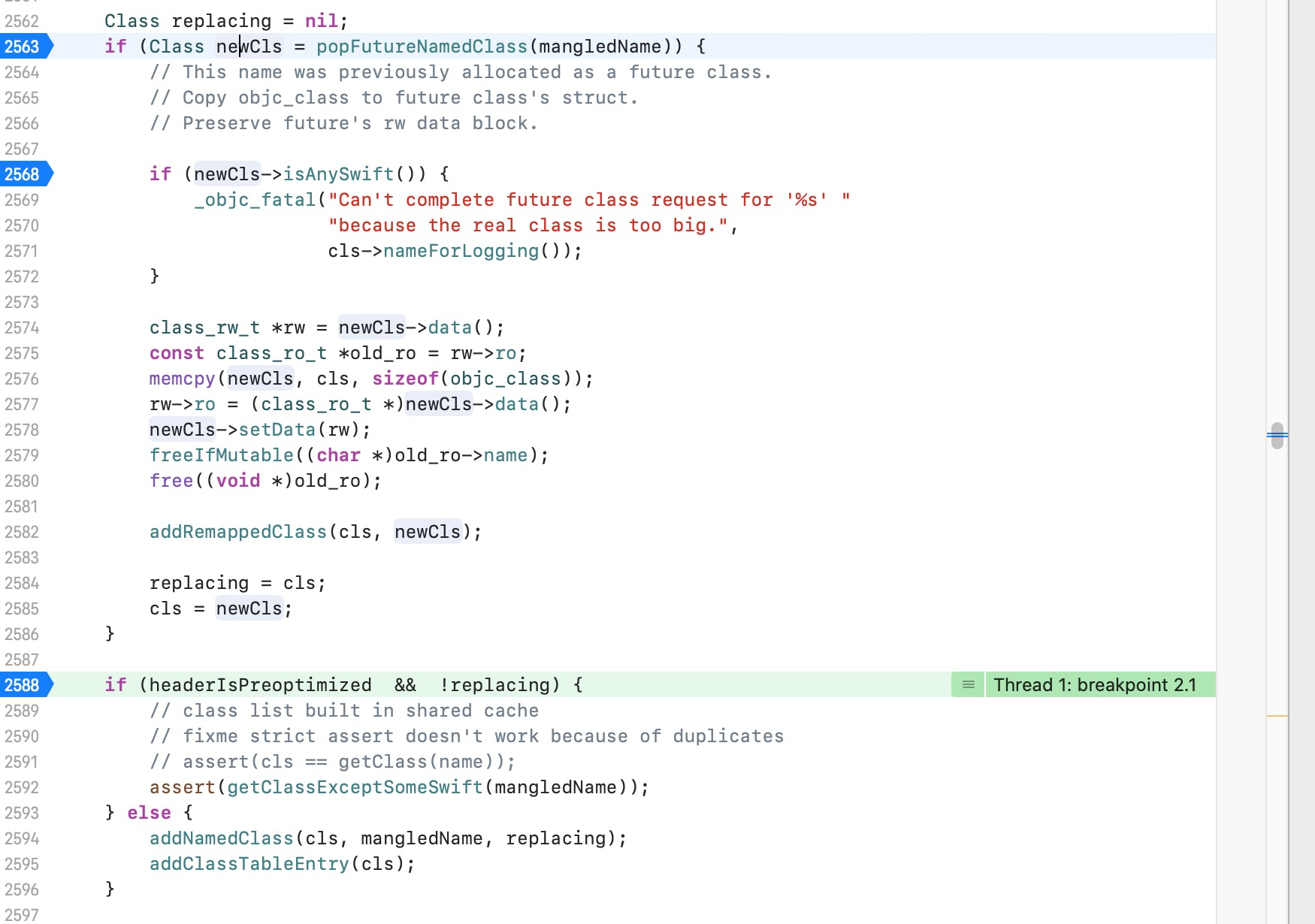
发现Class newCls = popFutureNamedClass(mangledName),判断里的代码不会走,
最后走到:
addNamedClass(cls, mangledName, replacing);
addClassTableEntry(cls);
把当前的类添加到 之前创建好的两个表里,(gdb_objc_realized_classes,allocatedClasses).那类的结构赋值到底在哪里呢?别急返回去接着往下看:
   // Fix up remapped classes
    // Class list and nonlazy class list remain unremapped.
    // Class refs and super refs are remapped for message dispatching.

    if (!noClassesRemapped()) {
        for (EACH_HEADER) {
            Class *classrefs = _getObjc2ClassRefs(hi, &count);
            for (i = 0; i < count; i++) {
                remapClassRef(&classrefs[i]);
            }
            // fixme why doesn't test future1 catch the absence of this?
            classrefs = _getObjc2SuperRefs(hi, &count);
            for (i = 0; i < count; i++) {
                remapClassRef(&classrefs[i]);
            }
        }
    }
这一块主要是对所有类做重映射.
ts.log("IMAGE TIMES: remap classes");
.接下来:
static size_t UnfixedSelectors;
    {
        mutex_locker_t lock(selLock);
        for (EACH_HEADER) {
            if (hi->isPreoptimized()) continue;

            bool isBundle = hi->isBundle();
            SEL *sels = _getObjc2SelectorRefs(hi, &count);
            UnfixedSelectors += count;
            for (i = 0; i < count; i++) {
                const char *name = sel_cname(sels[i]);
                sels[i] = sel_registerNameNoLock(name, isBundle);
            }
        }
    }
    ts.log("IMAGE TIMES: fix up selector references");
这一块主要是SEL都注册到namedSelectors表中.
接下来:
    // Fix up old objc_msgSend_fixup call sites
    for (EACH_HEADER) {
        message_ref_t *refs = _getObjc2MessageRefs(hi, &count);
        if (count == 0) continue;

        if (PrintVtables) {
            _objc_inform("VTABLES: repairing %zu unsupported vtable dispatch "
                         "call sites in %s", count, hi->fname());
        }
        for (i = 0; i < count; i++) {
            fixupMessageRef(refs+i);
        }
    }

    ts.log("IMAGE TIMES: fix up objc_msgSend_fixup");
这一块主要是修复函数指针遗留.
接下来:
for (EACH_HEADER) {
        extern objc_class OBJC_CLASS_$_Protocol;
        Class cls = (Class)&OBJC_CLASS_$_Protocol;
        assert(cls);
        NXMapTable *protocol_map = protocols();
        bool isPreoptimized = hi->isPreoptimized();
        bool isBundle = hi->isBundle();

        protocol_t **protolist = _getObjc2ProtocolList(hi, &count);
        for (i = 0; i < count; i++) {
            readProtocol(protolist[i], cls, protocol_map,
                         isPreoptimized, isBundle);
        }
    }
    ts.log("IMAGE TIMES: discover protocols");
将所有Protocol都添加到protocol_map表中.(协议)
接下来:
 // Fix up @protocol references
    // Preoptimized images may have the right
    // answer already but we don't know for sure.
    for (EACH_HEADER) {
        protocol_t **protolist = _getObjc2ProtocolRefs(hi, &count);
        for (i = 0; i < count; i++) {
            remapProtocolRef(&protolist[i]);
        }
    }
    ts.log("IMAGE TIMES: fix up @protocol references");
对所有Protocol做重映射
接下来:
  // Realize non-lazy classes (for +load methods and static instances)
    for (EACH_HEADER) {
        classref_t *classlist =
            _getObjc2NonlazyClassList(hi, &count);
        for (i = 0; i < count; i++) {
            Class cls = remapClass(classlist[i]);
            if (!cls) continue;

            // hack for class __ARCLite__, which didn't get this above
#if TARGET_OS_SIMULATOR
            if (cls->cache._buckets == (void*)&_objc_empty_cache  &&
                (cls->cache._mask  ||  cls->cache._occupied))
            {
                cls->cache._mask = 0;
                cls->cache._occupied = 0;
            }
            if (cls->ISA()->cache._buckets == (void*)&_objc_empty_cache  &&
                (cls->ISA()->cache._mask  ||  cls->ISA()->cache._occupied))
            {
                cls->ISA()->cache._mask = 0;
                cls->ISA()->cache._occupied = 0;
            }
#endif

            addClassTableEntry(cls);

            if (cls->isSwiftStable()) {
                if (cls->swiftMetadataInitializer()) {
                    _objc_fatal("Swift class %s with a metadata initializer "
                                "is not allowed to be non-lazy",
                                cls->nameForLogging());
                }
                // fixme also disallow relocatable classes
                // We can't disallow all Swift classes because of
                // classes like Swift.__EmptyArrayStorage
            }
            realizeClassWithoutSwift(cls);
        }
    }
    ts.log("IMAGE TIMES: realize non-lazy classes")
这一步苹果的log是 realize non-lazy classes 也就是初始化懒加载的类.
既然在这里初始化懒加载类,那么类所对应的成员属性是不是在这里赋值呢?
我们针对这代码好好看一下:
   classref_t *classlist =
            _getObjc2NonlazyClassList(hi, &count);
        for (i = 0; i < count; i++) {
            Class cls = remapClass(classlist[i]);
            if (!cls) continue;

            // hack for class __ARCLite__, which didn't get this above
#if TARGET_OS_SIMULATOR
            if (cls->cache._buckets == (void*)&_objc_empty_cache  &&
                (cls->cache._mask  ||  cls->cache._occupied))
            {
                cls->cache._mask = 0;
                cls->cache._occupied = 0;
            }
            if (cls->ISA()->cache._buckets == (void*)&_objc_empty_cache  &&
                (cls->ISA()->cache._mask  ||  cls->ISA()->cache._occupied))
            {
                cls->ISA()->cache._mask = 0;
                cls->ISA()->cache._occupied = 0;
            }
这一部分是对类里的cache 里的_buckets、_mask、_occupied初始化,不是初始化类的代码
接着就走到了这里:
realizeClassWithoutSwift(cls);
static Class realizeClassWithoutSwift(Class cls)
{
    runtimeLock.assertLocked();

    const class_ro_t *ro;
    class_rw_t *rw;
    Class supercls;
    Class metacls;
    bool isMeta;

    if (!cls) return nil;
    if (cls->isRealized()) return cls;
    assert(cls == remapClass(cls));

    // fixme verify class is not in an un-dlopened part of the shared cache?

    ro = (const class_ro_t *)cls->data();
    if (ro->flags & RO_FUTURE) {
        // This was a future class. rw data is already allocated.
        rw = cls->data();
        ro = cls->data()->ro;
        cls->changeInfo(RW_REALIZED|RW_REALIZING, RW_FUTURE);
    } else {
        // Normal class. Allocate writeable class data.
        rw = (class_rw_t *)calloc(sizeof(class_rw_t), 1);
        rw->ro = ro;
        rw->flags = RW_REALIZED|RW_REALIZING;
        cls->setData(rw);
    }

    isMeta = ro->flags & RO_META;

    rw->version = isMeta ? 7 : 0;  // old runtime went up to 6


    // Choose an index for this class.
    // Sets cls->instancesRequireRawIsa if indexes no more indexes are available
    cls->chooseClassArrayIndex();

    if (PrintConnecting) {
        _objc_inform("CLASS: realizing class '%s'%s %p %p #%u %s%s",
                     cls->nameForLogging(), isMeta ? " (meta)" : "",
                     (void*)cls, ro, cls->classArrayIndex(),
                     cls->isSwiftStable() ? "(swift)" : "",
                     cls->isSwiftLegacy() ? "(pre-stable swift)" : "");
    }

    // Realize superclass and metaclass, if they aren't already.
    // This needs to be done after RW_REALIZED is set above, for root classes.
    // This needs to be done after class index is chosen, for root metaclasses.
    // This assumes that none of those classes have Swift contents,
    //   or that Swift's initializers have already been called.
    //   fixme that assumption will be wrong if we add support
    //   for ObjC subclasses of Swift classes.
    supercls = realizeClassWithoutSwift(remapClass(cls->superclass));
    metacls = realizeClassWithoutSwift(remapClass(cls->ISA()));

#if SUPPORT_NONPOINTER_ISA
    // Disable non-pointer isa for some classes and/or platforms.
    // Set instancesRequireRawIsa.
    bool instancesRequireRawIsa = cls->instancesRequireRawIsa();
    bool rawIsaIsInherited = false;
    static bool hackedDispatch = false;

    if (DisableNonpointerIsa) {
        // Non-pointer isa disabled by environment or app SDK version
        instancesRequireRawIsa = true;
    }
    else if (!hackedDispatch  &&  !(ro->flags & RO_META)  &&
             0 == strcmp(ro->name, "OS_object"))
    {
        // hack for libdispatch et al - isa also acts as vtable pointer
        hackedDispatch = true;
        instancesRequireRawIsa = true;
    }
    else if (supercls  &&  supercls->superclass  &&
             supercls->instancesRequireRawIsa())
    {
        // This is also propagated by addSubclass()
        // but nonpointer isa setup needs it earlier.
        // Special case: instancesRequireRawIsa does not propagate
        // from root class to root metaclass
        instancesRequireRawIsa = true;
        rawIsaIsInherited = true;
    }

    if (instancesRequireRawIsa) {
        cls->setInstancesRequireRawIsa(rawIsaIsInherited);
    }
// SUPPORT_NONPOINTER_ISA
#endif

    // Update superclass and metaclass in case of remapping
    cls->superclass = supercls;
    cls->initClassIsa(metacls);

    // Reconcile instance variable offsets / layout.
    // This may reallocate class_ro_t, updating our ro variable.
    if (supercls  &&  !isMeta) reconcileInstanceVariables(cls, supercls, ro);

    // Set fastInstanceSize if it wasn't set already.
    cls->setInstanceSize(ro->instanceSize);

    // Copy some flags from ro to rw
    if (ro->flags & RO_HAS_CXX_STRUCTORS) {
        cls->setHasCxxDtor();
        if (! (ro->flags & RO_HAS_CXX_DTOR_ONLY)) {
            cls->setHasCxxCtor();
        }
    }

    // Propagate the associated objects forbidden flag from ro or from
    // the superclass.
    if ((ro->flags & RO_FORBIDS_ASSOCIATED_OBJECTS) ||
        (supercls && supercls->forbidsAssociatedObjects()))
    {
        rw->flags |= RW_FORBIDS_ASSOCIATED_OBJECTS;
    }

    // Connect this class to its superclass's subclass lists
    if (supercls) {
        addSubclass(supercls, cls);
    } else {
        addRootClass(cls);
    }

    // Attach categories
    methodizeClass(cls);

    return cls;
}
把代码删减一下如下:
static Class realizeClassWithoutSwift(Class cls)
{
    runtimeLock.assertLocked();

    const class_ro_t *ro;
    class_rw_t *rw;
    Class supercls;
    Class metacls;
    bool isMeta;

    if (!cls) return nil;
    if (cls->isRealized()) return cls;
    assert(cls == remapClass(cls));

    // fixme verify class is not in an un-dlopened part of the shared cache?

    ro = (const class_ro_t *)cls->data();
    if (ro->flags & RO_FUTURE) {
        // This was a future class. rw data is already allocated.
        rw = cls->data();
        ro = cls->data()->ro;
        cls->changeInfo(RW_REALIZED|RW_REALIZING, RW_FUTURE);
    } else {
        // Normal class. Allocate writeable class data.
        rw = (class_rw_t *)calloc(sizeof(class_rw_t), 1);
        rw->ro = ro;
        rw->flags = RW_REALIZED|RW_REALIZING;
        cls->setData(rw);
    }
 // Update superclass and metaclass in case of remapping
    cls->superclass = supercls;
    cls->initClassIsa(metacls);

    // Reconcile instance variable offsets / layout.
    // This may reallocate class_ro_t, updating our ro variable.
    if (supercls  &&  !isMeta) reconcileInstanceVariables(cls, supercls, ro);

    // Set fastInstanceSize if it wasn't set already.
    cls->setInstanceSize(ro->instanceSize);

    // Copy some flags from ro to rw
    if (ro->flags & RO_HAS_CXX_STRUCTORS) {
        cls->setHasCxxDtor();
        if (! (ro->flags & RO_HAS_CXX_DTOR_ONLY)) {
            cls->setHasCxxCtor();
        }
    }

    // Propagate the associated objects forbidden flag from ro or from
    // the superclass.
    if ((ro->flags & RO_FORBIDS_ASSOCIATED_OBJECTS) ||
        (supercls && supercls->forbidsAssociatedObjects()))
    {
        rw->flags |= RW_FORBIDS_ASSOCIATED_OBJECTS;
    }

    // Connect this class to its superclass's subclass lists
    if (supercls) {
        addSubclass(supercls, cls);
    } else {
        addRootClass(cls);
    }

    // Attach categories
    methodizeClass(cls);
    return cls;
原来是在这里面进行了rw的赋值:
 rw = (class_rw_t *)calloc(sizeof(class_rw_t), 1);
        rw->ro = ro;
        rw->flags = RW_REALIZED|RW_REALIZING;
        cls->setData(rw);
递归找类的父类、类的元类 (就是把类的所有父类、元类的所有父类都找到):
当 if (!cls) return nil;
   supercls = realizeClassWithoutSwift(remapClass(cls->superclass));
    metacls = realizeClassWithoutSwift(remapClass(cls->ISA()));
并且对类的ISA和superClass 进行赋值:
  cls->superclass = supercls;
cls->initClassIsa(metacls);并且进行双向绑定(父类也和子类绑下关系):
if (supercls) {
        addSubclass(supercls, cls);
    } else {
        addRootClass(cls);
    }
最后:
methodizeClass(cls);
看下代码实现:
static void methodizeClass(Class cls)
{
    runtimeLock.assertLocked();

    bool isMeta = cls->isMetaClass();
    auto rw = cls->data();
    auto ro = rw->ro;

    // Methodizing for the first time
    if (PrintConnecting) {
        _objc_inform("CLASS: methodizing class '%s' %s",
                     cls->nameForLogging(), isMeta ? "(meta)" : "");
    }

    // Install methods and properties that the class implements itself.
    method_list_t *list = ro->baseMethods();
    if (list) {
        prepareMethodLists(cls, &list, 1, YES, isBundleClass(cls));
        rw->methods.attachLists(&list, 1);
    }

    property_list_t *proplist = ro->baseProperties;
    if (proplist) {
        rw->properties.attachLists(&proplist, 1);
    }

    protocol_list_t *protolist = ro->baseProtocols;
    if (protolist) {
        rw->protocols.attachLists(&protolist, 1);
    }

    // Root classes get bonus method implementations if they don't have
    // them already. These apply before category replacements.
    if (cls->isRootMetaclass()) {
        // root metaclass
        addMethod(cls, SEL_initialize, (IMP)&objc_noop_imp, "", NO);
    }

    // Attach categories.
    category_list *cats = unattachedCategoriesForClass(cls, true /*realizing*/);
    attachCategories(cls, cats, false /*don't flush caches*/);

    if (PrintConnecting) {
        if (cats) {
            for (uint32_t i = 0; i < cats->count; i++) {
                _objc_inform("CLASS: attached category %c%s(%s)",
                             isMeta ? '+' : '-',
                             cls->nameForLogging(), cats->list[i].cat->name);
            }
        }
    }

    if (cats) free(cats);

#if DEBUG
    // Debug: sanity-check all SELs; log method list contents
    for (const auto& meth : rw->methods) {
        if (PrintConnecting) {
            _objc_inform("METHOD %c[%s %s]", isMeta ? '+' : '-',
                         cls->nameForLogging(), sel_getName(meth.name));
        }
        assert(sel_registerName(sel_getName(meth.name)) == meth.name);
    }
#endif
}
挑出最重要的代码:
  // Install methods and properties that the class implements itself.
    method_list_t *list = ro->baseMethods();
    if (list) {
        prepareMethodLists(cls, &list, 1, YES, isBundleClass(cls));
        rw->methods.attachLists(&list, 1);
    }

    property_list_t *proplist = ro->baseProperties;
    if (proplist) {
        rw->properties.attachLists(&proplist, 1);
    }

    protocol_list_t *protolist = ro->baseProtocols;
    if (protolist) {
        rw->protocols.attachLists(&protolist, 1);
    }

    // Root classes get bonus method implementations if they don't have
    // them already. These apply before category replacements.
    if (cls->isRootMetaclass()) {
        // root metaclass
        addMethod(cls, SEL_initialize, (IMP)&objc_noop_imp, "", NO);
    }
原来在这里是对ro 里的methods、proplist、protolist 添加到rw里. 所有的一切都是那么亲切且真实。
好的,我们返回_read_images 还有几个方法没有走完哈.
加载非懒加载类之后:
 // Realize newly-resolved future classes, in case CF manipulates them
    if (resolvedFutureClasses) {
        for (i = 0; i < resolvedFutureClassCount; i++) {
            Class cls = resolvedFutureClasses[i];
            if (cls->isSwiftStable()) {
                _objc_fatal("Swift class is not allowed to be future");
            }
            realizeClassWithoutSwift(cls);
            cls->setInstancesRequireRawIsa(false/*inherited*/);
        }
        free(resolvedFutureClasses);
    }

    ts.log("IMAGE TIMES: realize future classes");
遍历已标记的懒加载的类,并做初始化操作
接下来:
  // Discover categories.
    for (EACH_HEADER) {
        category_t **catlist =
            _getObjc2CategoryList(hi, &count);
        bool hasClassProperties = hi->info()->hasCategoryClassProperties();

        for (i = 0; i < count; i++) {
            category_t *cat = catlist[i];
            Class cls = remapClass(cat->cls);

            if (!cls) {
                // Category's target class is missing (probably weak-linked).
                // Disavow any knowledge of this category.
                catlist[i] = nil;
                if (PrintConnecting) {
                    _objc_inform("CLASS: IGNORING category \?\?\?(%s) %p with "
                                 "missing weak-linked target class",
                                 cat->name, cat);
                }
                continue;
            }

            // Process this category.
            // First, register the category with its target class.
            // Then, rebuild the class's method lists (etc) if
            // the class is realized.
            bool classExists = NO;
            if (cat->instanceMethods ||  cat->protocols
                ||  cat->instanceProperties)
            {
                addUnattachedCategoryForClass(cat, cls, hi);
                if (cls->isRealized()) {
                    remethodizeClass(cls);
                    classExists = YES;
                }
                if (PrintConnecting) {
                    _objc_inform("CLASS: found category -%s(%s) %s",
                                 cls->nameForLogging(), cat->name,
                                 classExists ? "on existing class" : "");
                }
            }

            if (cat->classMethods  ||  cat->protocols
                ||  (hasClassProperties && cat->_classProperties))
            {
                addUnattachedCategoryForClass(cat, cls->ISA(), hi);
                if (cls->ISA()->isRealized()) {
                    remethodizeClass(cls->ISA());
                }
                if (PrintConnecting) {
                    _objc_inform("CLASS: found category +%s(%s)",
                                 cls->nameForLogging(), cat->name);
                }
            }
        }
    }

    ts.log("IMAGE TIMES: discover categories");
处理所有Category,包括Class和Meta Class
至此、mach-o里的数据段映射到内存的过程基本算完毕.
四. 思维发散
4.1 系统在运行时阶段为何要讲ro 里的内容复制给 rw.不是多此一举吗?直接操作ro不就可以了吗?
首先苹果是门动态语言,分为编译时和运行时,ro是编译时就确定好的 写在了mach-o文件里的数据段上,等于是不变的了.并且ro(readonly)是只读的,操作起来会有限制. 比如我想在运行时动态添加方法、属性、协议怎么办,只有ro 复制 一份 给rw 上,rw具有(readwrite)读写的特性,把这些方法、属性、协议 添加到rw 上.
五.总结
mach-o文件加载到内存,读取镜像_read_images会经过以下几个过程:
- 加载所有类到类的
gdb_objc_realized_classes表中。 - 对所有类做重映射。
- 将所有
SEL都注册到namedSelectors表中。 - 修复函数指针遗留。
- 将所有
Protocol都添加到protocol_map表中。 - 对所有
Protocol做重映射。 - 初始化所有非懒加载的类,进行
rw、ro等操作。 - 遍历已标记的懒加载的类,并做初始化操作。
- 处理所有
Category,包括Class和Meta Class。 - 初始化所有未初始化的类。