上一篇文章中我们已经简单分享过了k8s的各个组件,我们已经知道了pod是由运行在各个node上的kubelet拉起来的,那么这次我们主要从源码(1.10版本)来分析kubelet主要是怎么工作的。
k8s的代码结构比较清晰,如下图所示
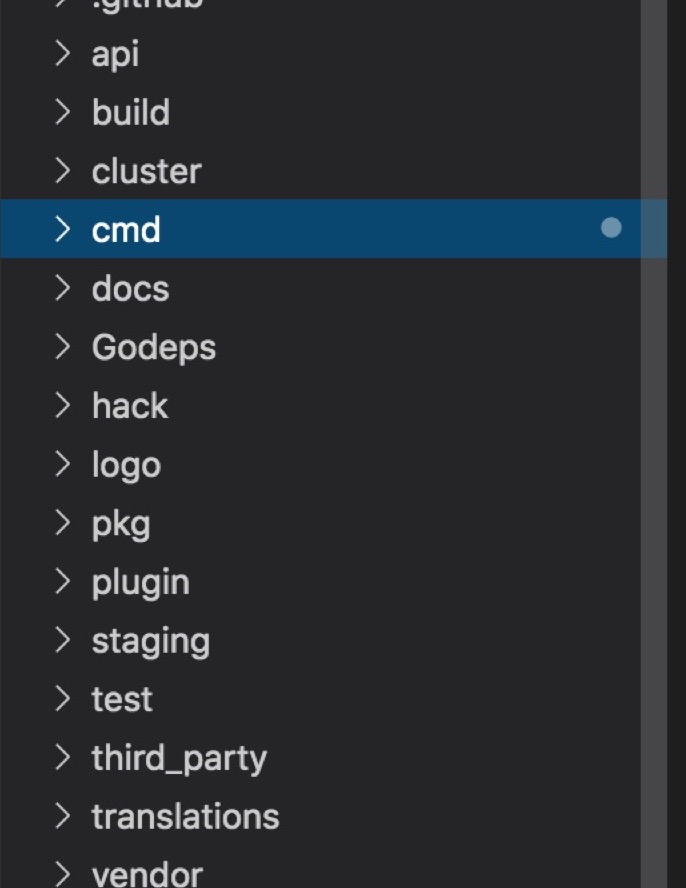
我们先看cmd/kubelet/kubelet.go,这个是kubelet的main入口,代码如下:
func main() {
	rand.Seed(time.Now().UnixNano())

	command := app.NewKubeletCommand()
	logs.InitLogs()
	defer logs.FlushLogs()

	if err := command.Execute(); err != nil {
		os.Exit(1)
	}
}
在这里我们关心的是RunKubelet的实现
func RunKubelet(kubeServer *options.KubeletServer, kubeDeps *kubelet.Dependencies, runOnce bool) error {
	hostname, err := nodeutil.GetHostname(kubeServer.HostnameOverride)
	if err != nil {
		return err
	}
	// Query the cloud provider for our node name, default to hostname if kubeDeps.Cloud == nil
	nodeName, err := getNodeName(kubeDeps.Cloud, hostname)
	if err != nil {
		return err
	}
	// Setup event recorder if required.
	makeEventRecorder(kubeDeps, nodeName)

	capabilities.Initialize(capabilities.Capabilities{
		AllowPrivileged: true,
	})

	credentialprovider.SetPreferredDockercfgPath(kubeServer.RootDirectory)
	klog.V(2).Infof("Using root directory: %v", kubeServer.RootDirectory)

	if kubeDeps.OSInterface == nil {
		kubeDeps.OSInterface = kubecontainer.RealOS{}
	}

	k, err := createAndInitKubelet(&kubeServer.KubeletConfiguration,
		kubeDeps,
		&kubeServer.ContainerRuntimeOptions,
		kubeServer.ContainerRuntime,
		kubeServer.RuntimeCgroups,
		kubeServer.HostnameOverride,
		kubeServer.NodeIP,
		kubeServer.ProviderID,
		kubeServer.CloudProvider,
		kubeServer.CertDirectory,
		kubeServer.RootDirectory,
		kubeServer.RegisterNode,
		kubeServer.RegisterWithTaints,
		kubeServer.AllowedUnsafeSysctls,
		kubeServer.RemoteRuntimeEndpoint,
		kubeServer.RemoteImageEndpoint,
		kubeServer.ExperimentalMounterPath,
		kubeServer.ExperimentalKernelMemcgNotification,
		kubeServer.ExperimentalCheckNodeCapabilitiesBeforeMount,
		kubeServer.ExperimentalNodeAllocatableIgnoreEvictionThreshold,
		kubeServer.MinimumGCAge,
		kubeServer.MaxPerPodContainerCount,
		kubeServer.MaxContainerCount,
		kubeServer.MasterServiceNamespace,
		kubeServer.RegisterSchedulable,
		kubeServer.NonMasqueradeCIDR,
		kubeServer.KeepTerminatedPodVolumes,
		kubeServer.NodeLabels,
		kubeServer.SeccompProfileRoot,
		kubeServer.BootstrapCheckpointPath,
		kubeServer.NodeStatusMaxImages)
	if err != nil {
		return fmt.Errorf("failed to create kubelet: %v", err)
	}

	// NewMainKubelet should have set up a pod source config if one didn't exist
	// when the builder was run. This is just a precaution.
	if kubeDeps.PodConfig == nil {
		return fmt.Errorf("failed to create kubelet, pod source config was nil")
	}
	podCfg := kubeDeps.PodConfig

	rlimit.RlimitNumFiles(uint64(kubeServer.MaxOpenFiles))

	// process pods and exit.
	if runOnce {
		if _, err := k.RunOnce(podCfg.Updates()); err != nil {
			return fmt.Errorf("runonce failed: %v", err)
		}
		klog.Info("Started kubelet as runonce")
	} else {
		startKubelet(k, podCfg, &kubeServer.KubeletConfiguration, kubeDeps, kubeServer.EnableCAdvisorJSONEndpoints, kubeServer.EnableServer)
		klog.Info("Started kubelet")
	}
	return nil
}
- createAndInitKubelet,这个方法初始化了一个kubelet的实例,该函数里面调用的makePodSourceConfig颇为值得注意,该函数会调用NewListWatchFromClient(后面会单开文章再写list-watch的实现),然后监听从apiserver获取的pods更新信息。
- startKubelet,里面最主要的方法是
k.Run(podCfg.Updates()),然后还有一些http的服务,暂时忽略。先说说k.Run,代码实现如下。
// Run starts the kubelet reacting to config updates
func (kl *Kubelet) Run(updates <-chan kubetypes.PodUpdate) {
	if kl.logServer == nil {
		kl.logServer = http.StripPrefix("/logs/", http.FileServer(http.Dir("/var/log/")))
	}
	if kl.kubeClient == nil {
		klog.Warning("No api server defined - no node status update will be sent.")
	}

	// Start the cloud provider sync manager
	if kl.cloudResourceSyncManager != nil {
		go kl.cloudResourceSyncManager.Run(wait.NeverStop)
	}

	if err := kl.initializeModules(); err != nil {
		kl.recorder.Eventf(kl.nodeRef, v1.EventTypeWarning, events.KubeletSetupFailed, err.Error())
		klog.Fatal(err)
	}

	// Start volume manager
	go kl.volumeManager.Run(kl.sourcesReady, wait.NeverStop)

	if kl.kubeClient != nil {
		// Start syncing node status immediately, this may set up things the runtime needs to run.
		go wait.Until(kl.syncNodeStatus, kl.nodeStatusUpdateFrequency, wait.NeverStop)
		go kl.fastStatusUpdateOnce()

		// start syncing lease
		if utilfeature.DefaultFeatureGate.Enabled(features.NodeLease) {
			go kl.nodeLeaseController.Run(wait.NeverStop)
		}
	}
	go wait.Until(kl.updateRuntimeUp, 5*time.Second, wait.NeverStop)

	// Start loop to sync iptables util rules
	if kl.makeIPTablesUtilChains {
		go wait.Until(kl.syncNetworkUtil, 1*time.Minute, wait.NeverStop)
	}

	// Start a goroutine responsible for killing pods (that are not properly
	// handled by pod workers).
	go wait.Until(kl.podKiller, 1*time.Second, wait.NeverStop)

	// Start component sync loops.
	kl.statusManager.Start()
	kl.probeManager.Start()

	// Start syncing RuntimeClasses if enabled.
	if kl.runtimeClassManager != nil {
		kl.runtimeClassManager.Start(wait.NeverStop)
	}

	// Start the pod lifecycle event generator.
	kl.pleg.Start()
	kl.syncLoop(updates, kl)
}
在这个方法内,完成的是kubelet的最主要流程。主要包括以下:
- volumeManager,volume相关管理;
- syncNodeStatus,定时同步Node状态;
- fastStatusUpdateOnce,定时检查indexer cache,并且更新相关状态;
- nodeLeaseController,Run 同步租约;
- updateRuntimeUp,定时更新Runtime状态;
- syncNetworkUtil,定时同步网络状态;
- podKiller,定时清理死亡的pod;
- statusManager,pod状态管理;
- probeManager,pod探针管理;
- syncLoop
syncLoop,是这里面的主循环,监听不同channel(http, file, apiserver)的podupdate数据,如果发现有更新,就将pod同步到期望状态。这里面的主要操作是通过syncLoopIteration实现的。代码如下
func (kl *Kubelet) syncLoopIteration(configCh <-chan kubetypes.PodUpdate, handler SyncHandler,
	syncCh <-chan time.Time, housekeepingCh <-chan time.Time, plegCh <-chan *pleg.PodLifecycleEvent) bool {
	select {
	case u, open := <-configCh:
		// Update from a config source; dispatch it to the right handler
		// callback.
		if !open {
			klog.Errorf("Update channel is closed. Exiting the sync loop.")
			return false
		}

		switch u.Op {
		case kubetypes.ADD:
			klog.V(2).Infof("SyncLoop (ADD, %q): %q", u.Source, format.Pods(u.Pods))
			// After restarting, kubelet will get all existing pods through
			// ADD as if they are new pods. These pods will then go through the
			// admission process and *may* be rejected. This can be resolved
			// once we have checkpointing.
			handler.HandlePodAdditions(u.Pods)
		case kubetypes.UPDATE:
			klog.V(2).Infof("SyncLoop (UPDATE, %q): %q", u.Source, format.PodsWithDeletionTimestamps(u.Pods))
			handler.HandlePodUpdates(u.Pods)
		case kubetypes.REMOVE:
			klog.V(2).Infof("SyncLoop (REMOVE, %q): %q", u.Source, format.Pods(u.Pods))
			handler.HandlePodRemoves(u.Pods)
		case kubetypes.RECONCILE:
			klog.V(4).Infof("SyncLoop (RECONCILE, %q): %q", u.Source, format.Pods(u.Pods))
			handler.HandlePodReconcile(u.Pods)
		case kubetypes.DELETE:
			klog.V(2).Infof("SyncLoop (DELETE, %q): %q", u.Source, format.Pods(u.Pods))
			// DELETE is treated as a UPDATE because of graceful deletion.
			handler.HandlePodUpdates(u.Pods)
		case kubetypes.RESTORE:
			klog.V(2).Infof("SyncLoop (RESTORE, %q): %q", u.Source, format.Pods(u.Pods))
			// These are pods restored from the checkpoint. Treat them as new
			// pods.
			handler.HandlePodAdditions(u.Pods)
		case kubetypes.SET:
			// TODO: Do we want to support this?
			klog.Errorf("Kubelet does not support snapshot update")
		}

		if u.Op != kubetypes.RESTORE {
			// If the update type is RESTORE, it means that the update is from
			// the pod checkpoints and may be incomplete. Do not mark the
			// source as ready.

			// Mark the source ready after receiving at least one update from the
			// source. Once all the sources are marked ready, various cleanup
			// routines will start reclaiming resources. It is important that this
			// takes place only after kubelet calls the update handler to process
			// the update to ensure the internal pod cache is up-to-date.
			kl.sourcesReady.AddSource(u.Source)
		}
	case e := <-plegCh:
		if isSyncPodWorthy(e) {
			// PLEG event for a pod; sync it.
			if pod, ok := kl.podManager.GetPodByUID(e.ID); ok {
				klog.V(2).Infof("SyncLoop (PLEG): %q, event: %#v", format.Pod(pod), e)
				handler.HandlePodSyncs([]*v1.Pod{pod})
			} else {
				// If the pod no longer exists, ignore the event.
				klog.V(4).Infof("SyncLoop (PLEG): ignore irrelevant event: %#v", e)
			}
		}

		if e.Type == pleg.ContainerDied {
			if containerID, ok := e.Data.(string); ok {
				kl.cleanUpContainersInPod(e.ID, containerID)
			}
		}
	case <-syncCh:
		// Sync pods waiting for sync
		podsToSync := kl.getPodsToSync()
		if len(podsToSync) == 0 {
			break
		}
		klog.V(4).Infof("SyncLoop (SYNC): %d pods; %s", len(podsToSync), format.Pods(podsToSync))
		handler.HandlePodSyncs(podsToSync)
	case update := <-kl.livenessManager.Updates():
		if update.Result == proberesults.Failure {
			// The liveness manager detected a failure; sync the pod.

			// We should not use the pod from livenessManager, because it is never updated after
			// initialization.
			pod, ok := kl.podManager.GetPodByUID(update.PodUID)
			if !ok {
				// If the pod no longer exists, ignore the update.
				klog.V(4).Infof("SyncLoop (container unhealthy): ignore irrelevant update: %#v", update)
				break
			}
			klog.V(1).Infof("SyncLoop (container unhealthy): %q", format.Pod(pod))
			handler.HandlePodSyncs([]*v1.Pod{pod})
		}
	case <-housekeepingCh:
		if !kl.sourcesReady.AllReady() {
			// If the sources aren't ready or volume manager has not yet synced the states,
			// skip housekeeping, as we may accidentally delete pods from unready sources.
			klog.V(4).Infof("SyncLoop (housekeeping, skipped): sources aren't ready yet.")
		} else {
			klog.V(4).Infof("SyncLoop (housekeeping)")
			if err := handler.HandlePodCleanups(); err != nil {
				klog.Errorf("Failed cleaning pods: %v", err)
			}
		}
	}
	return true
}
到这里,基本上应该都清楚了。接下来就是调用runtime去做对应的操作。