在上篇 Future & Promise 实现分析(Swift) 我们简单的阐述了下 future 和 Promise 的一些概念,并简单的用了个样例来体会这种处理异步的模式。本文接着上文遗留的一个话题 SwiftNIO 中如何实现 Future 和 Promise?。
Future 是一个只读的值的容器,它的值在未来某个时刻会被计算出来(产生这个值的行为是异步操作)。 Promise 是一个可写的容器,可以设置 Future 的值。
带着上面这句话,我们来看看 SwiftNIO 中如何实现的。
概述
并发代码和同步代码之间最主要的区别在于并非所有的动作都能够立即完成。例如,在向一个 Channel 写入数据时,EventLoop 有可能不会立即将数据冲刷到网络上。为此,SwiftNIO 提供了 EventLoopPromise 和 EventLoopFuture,用于管理异步操作。
EventLoopFuture 实际上是一个容器,用于存放函数在未来某个时刻的返回值。每个 EventLoopFuture<T> 对象都有一个对应的 EventLoopPromise<T>,用于存放实际的结果。只要 EventLoopPromise 执行成功,EventLoopFuture 也就完成了。
通过轮询的方式检查 EventLoopFuture 是否完成是一种非常低效的方式,所以 EventLoopFuture 被设计成可以接收回调函数。也就是说,在有结果的时候回调函数会被执行。
EventLoopFuture 负责处理调度工作,确保回调函数是在最初创建 EventLoopPromise 的那个 EventLoop 上执行,所以就没有必要再针对回调函数做任何同步操作。
EventLoopFuture
我们看下面例子来感受一下 EventLoopFuture & EventLoopPromise 的使用方式:
func someAsyncOperation(args) -> EventLoopFuture<ResultType> {
    let promise = eventLoop.makePromise(of: ResultType.self)
    someAsyncOperationWithACallback(args) { result -> Void in
        // when finished...
        promise.succeed(result)
        // if error...
        promise.fail(error)
    }
    return promise.futureResult
}
在 someAsyncOperation 里面首先是创建一个 promise, 然后在 someAsyncOperationWithACallback 异步操作的会回调中根据各种场景执行 promise 的 successed 或者 fail 方法。someAsyncOperation 返回一个 EventLoopFuture<ResultType>, 而这个值从 promise.futureResult 中获取。EventLoopFuture 一个只读的值的容器,它的值在未来某个时刻会被计算出来。而它的值通过 EvnetLoopPromise 进行设置。 完全符合我们本文开篇提到的那句话。
如果我们在调用一个方法,它返回 EventLoopFuture<Value>, 我们该如何操作这个值?
map & flatMap
可以通过调用 flatMap() 或者 map() 可以获取到 EventLoopFuture 中真实的值。
let networkData = getNetworkData(args)

// When network data is received, convert it.
let processedResult: EventLoopFuture<Processed> = networkData.map { (n: NetworkResponse) -> Processed in
    ... parse network data ....
    return processedResult
}
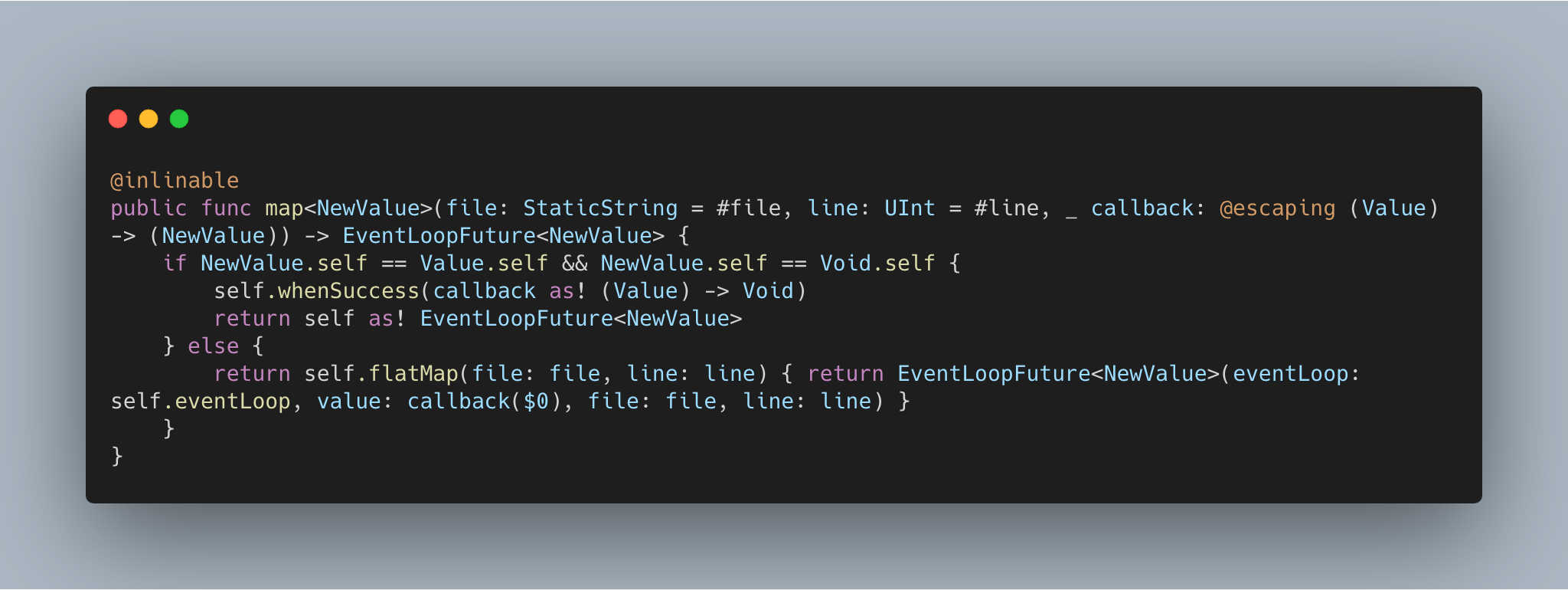
map 的 callback 是将 Value 类型的结果转换为 NewValue 类型。它是个 Functor。
但是在 flatMap 中 flatMap :
let d1 = networkRequest(args).future()
let d2 = d1.flatMap { t -> EventLoopFuture<NewValue> in
    . . . something with t . . .
    return netWorkRequest(args)
}
d2.whenSuccess { u in
    NSLog("Result of second request: \(u)")
}
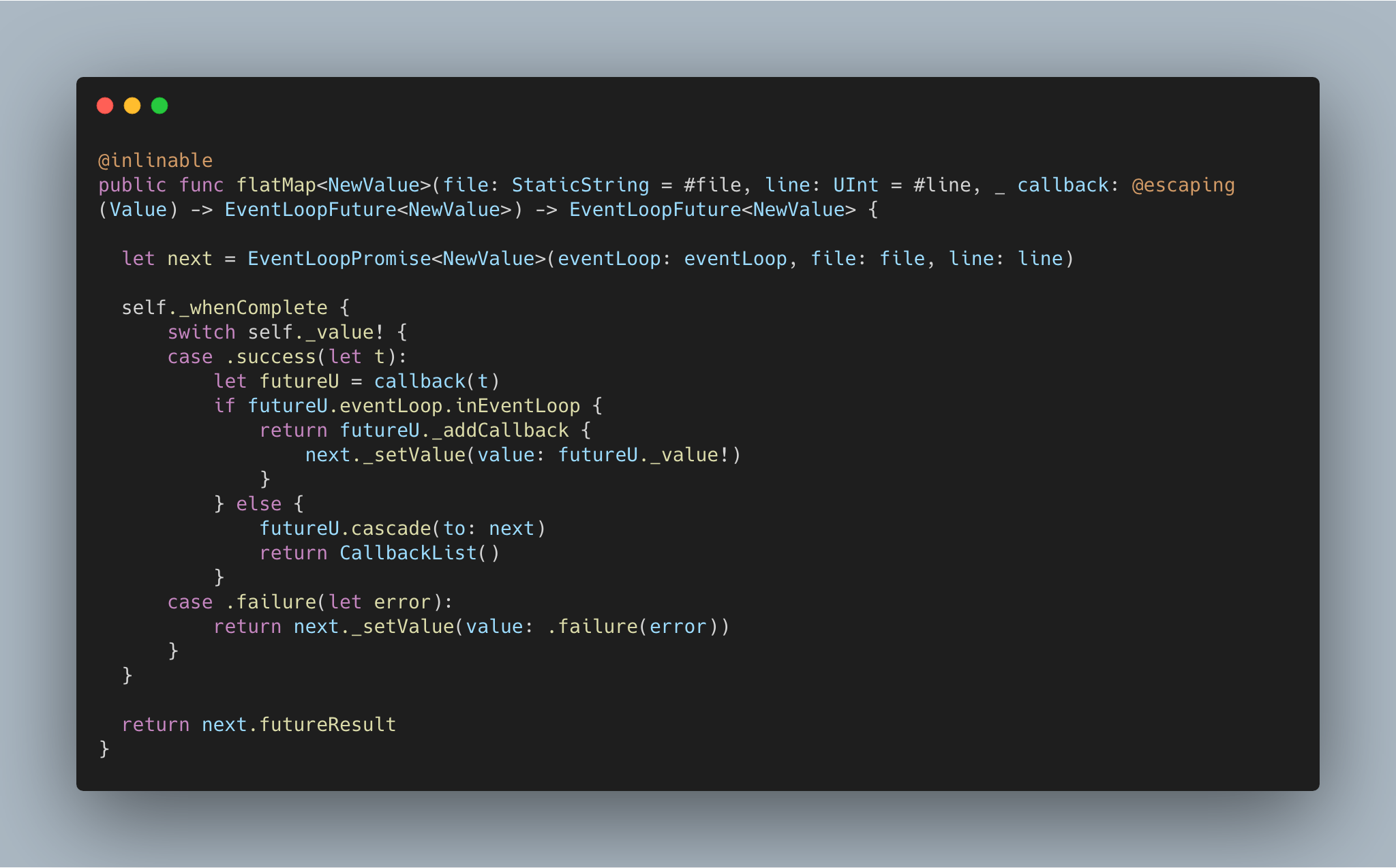
flatMap 的 callback 是将 Value 类型的结果转化为 EventLoopFuture<NewValue>, 它是一个 Monads
为了更好的理解两者的差异,我们一起看看他们的实现代码:
源码浅析
public final class EventLoopFuture<Value> {
    @usableFromInline
    internal var _value: Result<Value, Error>? {
        didSet {
            self._isFulfilled.store(true)
        }
    }

    @usableFromInline
    internal let _isFulfilled: UnsafeEmbeddedAtomic<Bool>

    /// The `EventLoop` which is tied to the `EventLoopFuture` and is used to notify all registered callbacks.
    public let eventLoop: EventLoop

    /// Whether this `EventLoopFuture` has been fulfilled. This is a thread-safe
    /// computed-property.
    internal var isFulfilled: Bool {
        return self._isFulfilled.load()
    }

    @usableFromInline
    internal var _callbacks: CallbackList = CallbackList()
}
EventLoopFuture 的 fulfilled 状态通过 _isFulfilled (线程安全的)进行管理。在初始化的时候也会进行初始化
 @inlinable
internal init(_eventLoop eventLoop: EventLoop, value: Result<Value, Error>?, file: StaticString, line: UInt) {
    self.eventLoop = eventLoop
    self._value = value
    self._isFulfilled = UnsafeEmbeddedAtomic(value: value != nil)

    debugOnly {
        if let me = eventLoop as? SelectableEventLoop {
            me.promiseCreationStoreAdd(future: self, file: file, line: line)
        }
    }
}
在给 _value 设置值的时候,会设置 _isFulfilled 为 true。
@usableFromInline
internal var _value: Result<Value, Error>? {
    didSet {
        self._isFulfilled.store(true)
    }

}
EventLoopPromise
EventLoopPromise 设计是比较简单的,我们直接看它的源码:
public struct EventLoopPromise<Value> {
    public let futureResult: EventLoopFuture<Value>
    @inlinable
    internal init(eventLoop: EventLoop, file: StaticString, line: UInt) {
        self.futureResult = EventLoopFuture<Value>(_eventLoop: eventLoop, file: file, line: line)
    }

    @inlinable
    public func succeed(_ value: Value) {
        self._resolve(value: .success(value))
    }

    @inlinable
    public func fail(_ error: Error) {
        self._resolve(value: .failure(error))
    }

    @inlinable
    public func completeWith(_ future: EventLoopFuture<Value>) {
        future.cascade(to: self)
    }

    @inlinable
    public func completeWith(_ result: Result<Value, Error>) {
        self._resolve(value: result)
    }

    @inlinable
    internal func _resolve(value: Result<Value, Error>) {
        if self.futureResult.eventLoop.inEventLoop {
            self._setValue(value: value)._run()
        } else {
            self.futureResult.eventLoop.execute {
                self._setValue(value: value)._run()
            }
        }
    }

    @inlinable
    internal func _setValue(value: Result<Value, Error>) -> CallbackList {
        return self.futureResult._setValue(value: value)
    }
}
通过 Eventloop 初始化其内部的 futureResult(EventLoopFuture), 这个时候的 futureResult 的 filfulled 是 false 的。 然后提供了一些操作 futureResult 的方法,而这些方法都间接调用了 _resolve —— 确保回调都在创建 promise 这个 EventLoop 上进行执行。
EventLoop 是 SwfitNIO 最基本的 IO 原语,它等待事件的发生,在发生事件时触发某种回调操作。
在下起文章我们来解读下这个 EventLoop,本文就不进行过多阐述。
Vapor 的 Future & Promise 真面目
Vapor 的官方文档中,有个 Async 的模块, 它有 Future 和 Promise。
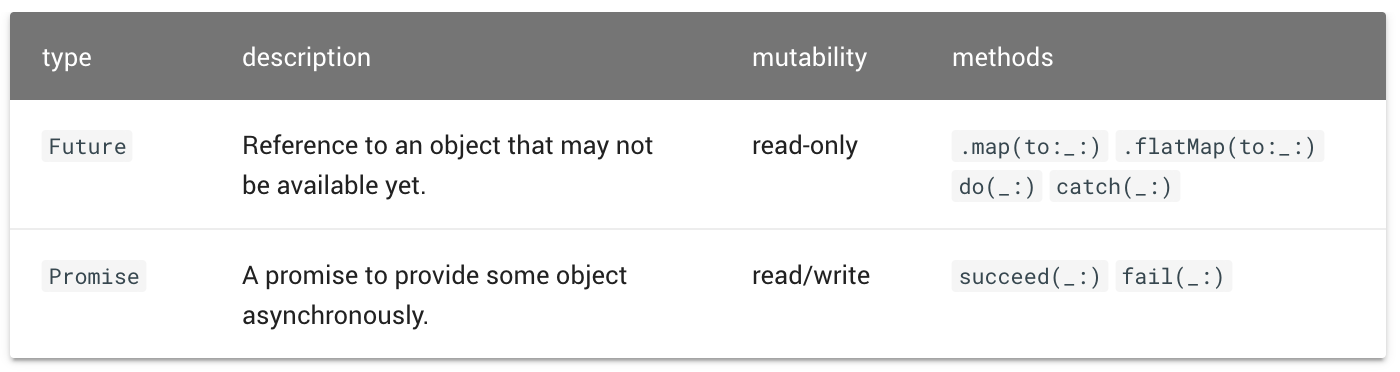
我们可以使用它提供操作 Future 的方法:
- map
- flatMap
- transform
- always
- wait
- do / catch
对 Future 进行转换, 或者阻塞等待 Future 的值的确定。
使用 Promise:
/// 创建一个 promise
let promiseString = req.eventLoop.newPromise(String.self)
print(promiseString) // Promise<String>
print(promiseString.futureResult) // Future<String>

/// Completes the associated future
promiseString.succeed(result: "Hello")

/// Fails the associated future
promiseString.fail(error: ...)
Future 和 Promise 在 Vapor 中的详细用法请到 Async。
上面的用法是不是非常的熟悉?我们一起看看它们的如山真面目。
在 Async+NIO.swift 中:
import Dispatch
import NIO

/// Convenience shorthand for `EventLoopFuture`.
public typealias Future = EventLoopFuture

/// Convenience shorthand for `EventLoopPromise`.
public typealias Promise = EventLoopPromise

extension EventLoop {
    /// Creates a new promise for the specified type.
    public func newPromise<T>(_ type: T.Type, file: StaticString = #file, line: UInt = #line) -> Promise<T> {
        return newPromise(file: file, line: line)
    }
}
Vapor 中的 Future 就是 SwiftNIO 的 EventLoopFuture,Promise 就是 SwiftNIO 中的 EventLoopPromise。
map vs flatMap
map 和 flatMap 在 Vapor 实践中是常用到的方法,两者很容易理解的一个区别:
- map 中的 callback 是
Value -> NewValue - flatMap 中的 callback 是
Value -> EventLoopFuture<NewValue>
let futureString: Future<String> = ...

/// Assume we have created an HTTP client
let client: Client = ...

/// Flat-map the future string to a future response
let futureResponse = futureString.flatMap(to: Response.self) { string in
    return client.get(string) // Future<Response>
}
futureResponse 是 Future<Response> 类型, 如果 flatMap 替换为 map:
let futureResponse = futureString.map(to: Response.self) { string in
    return client.get(string) // Future<Response>
}
那么这时候 futureResponse 是 Future<Future<Response>> 类型,显然这不是我们想要的。
提前预告 Vapor 中 Worker, 它是 SwiftNIO 中的 EventLoopGrop
public typealias Worker = EventLoopGroup
想了解更多 Vapor 对 SwiftNIO 的包装,可以点击查看源码 vapor/core
API 学习
既然 Vapor 中 Future 和 Promise 是同一样东西,那么学习 SwiftNIO 中 EventLoopFuture 和 EventLoopPromise 提供的 API 是非常有必要的
EventLoopFuture API
flatMap(file:line:_:)
@inlinable
public func flatMap<NewValue>(file: StaticString = #file, line: UInt = #line, _ callback: @escaping (Value) -> EventLoopFuture<NewValue>) -> EventLoopFuture<NewValue>
可以将 EventLoopFuture<Value> 的转换为 EventLoopFuture<NewValue> ,callback 参数需要返回 EventLoopFuture<NewValue>
flatMapThrowing(file:line:_:)
@inlinable
public func flatMapThrowing<NewValue>(file: StaticString = #file,
                            line: UInt = #line,
                            _ callback: @escaping (Value) throws -> NewValue) -> EventLoopFuture<NewValue>
当 EventLoopFuture<Value> fulfilled 状态的时候,会运行 callback。callback 可以抛出异常,当 callback 抛出异常,该方法返回的 EventLoopFuture 的值为 error。
flatMapErrorThrowing(file:line:_:)
@inlinable
public func flatMapErrorThrowing(file: StaticString = #file, line: UInt = #line, _ callback: @escaping (Error) throws -> Value) -> EventLoopFuture<Value>
当 EventLoopFuture<Value> 是个 error 状态,callback 会运行,callback 接受一个 error, 返回一个新的 Value 类型的值。
map(file:line:_:)
@inlinable
public func map<NewValue>(file: StaticString = #file, line: UInt = #line, _ callback: @escaping (Value) -> (NewValue)) -> EventLoopFuture<NewValue>
当 EventLoopFuture<Value> fulfilled
flatMapError(file:line:_:)
@inlinable
public func flatMapError(file: StaticString = #file, line: UInt = #line, _ callback: @escaping (Error) -> EventLoopFuture<Value>) -> EventLoopFuture<Value>
flatMapResult(file:line:_:)
@inlinable
public func flatMapResult<NewValue, SomeError: Error>(file: StaticString = #file,
                                                      line: UInt = #line,
                                                      _ body: @escaping (Value) -> Result<NewValue, SomeError>) -> EventLoopFuture<NewValue>
recover(file:line:_:)
@inlinable
public func recover(file: StaticString = #file, line: UInt = #line, _ callback: @escaping (Error) -> Value) -> EventLoopFuture<Value>
whenSuccess(_:)
@inlinable
public func whenSuccess(_ callback: @escaping (Value) -> Void)
whenFailure(_:)
@inlinable
public func whenFailure(_ callback: @escaping (Error) -> Void)
whenComplete(_:)
@inlinable
public func whenComplete(_ callback: @escaping (Result<Value, Error>) -> Void)
and(_:file:line:)
@inlinable
public func and<OtherValue>(_ other: EventLoopFuture<OtherValue>,
                            file: StaticString = #file,
                            line: UInt = #line) -> EventLoopFuture<(Value, OtherValue)>
and(value:file:line:)
@inlinable
public func and<OtherValue>(value: OtherValue,
                            file: StaticString = #file,
                            line: UInt = #line) -> EventLoopFuture<(Value, OtherValue)>
cascade(to:)
@inlinable
public func cascade(to promise: EventLoopPromise<Value>?)
cascadeSuccess(to:)
@inlinable
public func cascadeSuccess(to promise: EventLoopPromise<Value>?)
cascadeFailure(to:)
@inlinable
public func cascadeFailure<NewValue>(to promise: EventLoopPromise<NewValue>?)
wait(file:line:)
public func wait(file: StaticString = #file, line: UInt = #line) throws -> Value
通过阻塞当前线程直到 resolve。
fold(_:with:)
@inlinable
public func fold<OtherValue>(_ futures: [EventLoopFuture<OtherValue>],
                             with combiningFunction: @escaping (Value, OtherValue) -> EventLoopFuture<Value>) -> EventLoopFuture<Value>
全部的 futures 完成触发返回一个新的 EventLoopFuture。 一旦遇到 future 失败将立马失败。
reduce(::on:_:)
public static func reduce<InputValue>(_ initialResult: Value,
                                      _ futures: [EventLoopFuture<InputValue>],
                                      on eventLoop: EventLoop,
                                      _ nextPartialResult: @escaping (Value, InputValue) -> Value) -> EventLoopFuture<Value>
reduce(into::on::)
public static func reduce<InputValue>(into initialResult: Value,
                                      _ futures: [EventLoopFuture<InputValue>],
                                      on eventLoop: EventLoop,
                                      _ updateAccumulatingResult: @escaping (inout Value, InputValue) -> Void) -> EventLoopFuture<Value>
所有的 EventLoopFutures 成功后,返回一个新的 EventLoopFuture。新的 EveentLoopFuture 的值是每个Future 的值组成的数组。
andAllSucceed(_:on:)
public static func andAllSucceed(_ futures: [EventLoopFuture<Value>], on eventLoop: EventLoop) -> EventLoopFuture<Void>
所有的 EventLoopFutures 成功后,返回一个新的 EventLoopFuture。忽略每个 Future 的值。
whenAllSucceed(_:on:)
public static func whenAllSucceed(_ futures: [EventLoopFuture<Value>], on eventLoop: EventLoop) -> EventLoopFuture<[Value]>
所有的 EventLoopFutures 完成后,返回一个新的 EventLoopFuture。
这个返回的 EventLoopFuture 总是成功的,不管这些 futures 是否成功还是失败。忽略每个 Future 的值。
andAllComplete(_:on:)
public static func andAllComplete(_ futures: [EventLoopFuture<Value>], on eventLoop: EventLoop) -> EventLoopFuture<Void>
在所有的 EventLoopFutures 完成后,返回一个新的 EventLoopFuture, 这个 EventLoopFuture 的值是这些 futures 的结果数组。
这个返回的 EventLoopFuture 总是成功的,不管这些 futures 是否成功还是失败。
如果希望将它们展平单个 EventLoopFuture,且遇到第一个 future 失败也将失败,建议使用 reduce 方法。
whenAllComplete(_:on:)
public static func whenAllComplete(_ futures: [EventLoopFuture<Value>],
                                   on eventLoop: EventLoop) -> EventLoopFuture<[Result<Value, Error>]>
hop(to:)
@inlinable
public func hop(to target: EventLoop) -> EventLoopFuture<Value>
当这个 future 完成时会触发返回一个 EventLoopFuture。 但是执行回调是在 target 这个 Eventloop 上而不是在原来的那个。
在某些场合你需要切换 Eventloop: 比如, 你需要在另一个 eventloop 去关闭一个 channel。然后关闭完成时候需要切回到当前的 eventloop。它还有一个优化,避免两个 eventloop 是同一个 eventloop 重新分配的情况。
always(_:)
public func always(_ callback: @escaping (Result<Value, Error>) -> Void) -> EventLoopFuture<Value>
给 EventLoopFuture 添加一个监听的回调,该回调在 EventLoopFuture 有任何值的时候运行。
EventLoopPromise API
futureResult
public let futureResult: EventLoopFuture<Value>
通过 EventLoopPromise 获取 EventLoopFuture。 你可以使用它来添加回调,这些回调会在 EventLoopPromise 完成立马调用。
succeed(_:)
@inlinable
public func succeed(_ value: Value)
将成功的结果传递给关联的 EventLoopFuture<Value>。
fail(_:)
@inlinable
public func fail(_ error: Error)
将失败的结果传递给关联的 EventLoopFuture<Value>
completeWith(_:)
@inlinable
public func completeWith(_ future: EventLoopFuture<Value>)
通过传入 EventLoopFuture<Value> 完成 promise。
间接调用 EventLoopFuture 的 eascade 方法。
completeWith(_:)
@inlinable
public func completeWith(_ result: Result<Value, Error>)
通过传入 Result<Value, Error> 完成 promise。
此方法相当于调用
switch result {
case .success(let value):
    promise.succeed(value)
case .failure(let error):
    promise.fail(error)
}
总结
SwiftNIO 中的 Promise 和 Future 的前缀都是 EventLoop,在 Netty 的源码里没有这俩名字,它有很多 Future 类。这应该和 Netty 的设计不同。EventLoopFuture 可以通过 flatMap 生成一个新的 EventLoopFuture(间接通过 EventLoopPromise), 也可以通过初始化方式进行生成。EventLoopFuture 对象都有一个对应的 EventLoopPromise, 只要 EventLoopPromise 执行成功,EventLoopFuture 也就完成,完成后会触发回调,而这些回调函数都在最初创建 EventLoopPromise 的那个 EventLoop 上执行。 Vapor 的 Future 和 Promise 仅仅是 EventLoopFuture 和 EventLoopPromise 的一个别称,理解了它俩,也基本上了解 Vapor 很多方法需要返回一个 Future 的这样的设计, 为啥要用 map & flatMap 实现链式调用。
本文到此完结,更多阅读,可以关注 SwiftOldBird 微信公众号: