1,哈希表的基本概念
- 散列表(Hash table,也叫哈希表),是根据键(Key)而直接访问在内存存储位置的数据结构。也就是说,它通过计算一个关于键值的函数,将所需查询的数据映射到表中一个位置来访问记录,这加快了查找速度。这个映射函数称做散列函数,存放记录的数组称做散列表。
- 哈希函数:也称为是散列函数,是Hash表的映射函数,它可以把任意长度的输入变换成固定长度的输出,该输出就是哈希值。哈希函数能使对一个数据序列的访问过程变得更加迅速有效,通过哈希函数,数据元素能够被很快的进行定位。
- 解决冲突的办法:1:链地址法,2:开放地址法
2,哈希表的结构
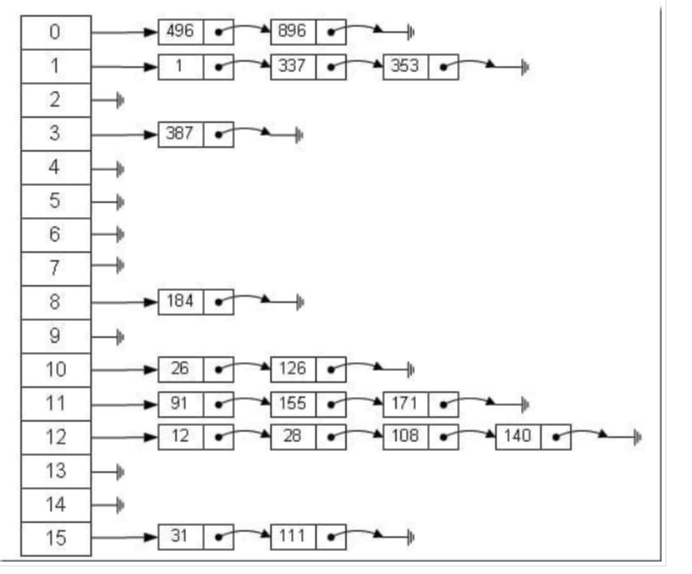
3,哈希表的实现
class HashTable{
    //属性
    constructor(){
        this.storage=[]//作为数组,存放元素
        this.count=0//用于记录HashTable存放的数量
        this.limit=7//表示数组当前的常数
    }
    //Hash函数
    hashFunc(str,size){
        /*1,将字符串转换成比较大的数字:hashCode,2,将数字大的hashCode压缩到数组的(大小)范围内,size:代表传入的字符串,size:代表数组的大小*/
        //1,定义hashCode的变量
        var hashCode=0
        //2,霍纳算法,来计算hashCode的值
        for(var i=0;i<str.length;i++){
            hashCode=37*hashCode+str.charCodeAt(i)
        }
        //3,取余操作
        var index=hashCode % size
        return index
    }
    //hashTable的插入和修改
    /*
    1,根据key获取索引值,目的:将数据插入到对应的位置
    2,根据索引值取出bucket,如果bucket(桶)不在,创建bucket(桶)
    3,判断是新增,还是修改,如果有只,那么修改,没有就是新增
    */
    put(key,value){
        //1,根据key获取相对应的index
        var index=this.hashFunc(key,this.limit)
        //2,根据index取出相对应的bucket,bucket是一个数组
        var bucket=this.storage[index]
        //判断bucket是否存在
        if(bucket==null){
            bucket=[]
            this.storage[index]=bucket
        }
        //4,判断是否为修改数据
        for(var i=0;i<bucket.length;i++){
            var tuple=bucket[i]
            if(tuple[0]==key){
                tuple[1]=value
                return
            }
        }
        //5,进行添加操作
        bucket.push([key,value])
        this.count+=1
        //判断是否需要扩容
        if(this.count>this.limit*0.75){
            var newPrime=this.getPrime(this.limit*2)
            this.resize(newPrime)
        }
    }
    //获取操作
    /*
    1,根据key获取相对应的index
    2,根据index获取相对应的bucket
    3,判断bucket是否为null,如果为null,直接返回null
    4,线性查找bucket中的每一个key是否等于传入的key,如果等于直接返回value
    5,遍历后,依然没有找到相对应的key,直接返回null
    */
    get(key){
        //根据Key获取相对应的index
        var index=this.hashFunc(key,this.limit)
        //根据index获取相对应的bucket
        var bucket=this.storage[index]
        //判断bucket是否存在
        if(bucket==null){
            return null
        }
        for(var i=0;i<bucket.length;i++){
            var tuple=bucket[i]
            if(tuple[0]==key){
                return tuple[1]
            }
        }
        //依然没有找到
        return null
    }
    //删除操作
    /*
    1,根据key获取相对应的index
    2,根据index获取相对应的bucket
    3,判断bucket是否为null,如果不存在,直接返回null
    4,线性查找bucket,寻找相对应的key,并且删除
    5,依然没有找到那么返回null
    */
    remove(key){
        //根据key获取相对应的index
        var index=this.hashFunc(key,this.limit)
        //根据index获取相对应的bucket
        var bucket=this.storage[index]
        //判断bucket是否存在
        if(bucket==null){
            return null
        }
        //有bucket,那么进行线性查找,并且删除
        for(var i=0;i<bucket.length;i++){
            var tuple=bucket[i]
            if(tuple[0]==key){
                bucket.splice(i,1)
                this.count-=1
                //缩小容量
                if(this.limit>7 && this.count<this.limit*0.25){
                    var newPrime=this.getPrime(Math.floor(this.limit/2))//用Math.floor确保为整数
                    this.resize(newPrime)
                }
                return tuple[1]
            }
        }
        //5,遍历后没有找到
        return null
    }
    //判断HashTable是否为空
    isEmpty(){
        return this.count==0
    }
    //获取HashTable元素的个数
    size(){
        return this.count
    }
    //HashTable的扩容
    resize(newLimit){
        //1,保存旧的数组
        var oldStorage=this.storage
        //重置所有属性
        this.storage=[]
        this.count=0
        this.limit=0
        //遍历获取oldStorage所有的bucket
        for(var i=0;i<oldStorage.length;i++){
            //3.1取出相对应的bucket
            var bucket=oldStorage[i]
            //3.2判断bucket是否为空
            if(bucket==null){
                continue
            }
            //3.3,bucket中有数据,取出数据重新插入
            for(var j=0;j<bucket.length;j++){
                var tuple=bucket[j]
                this.put(tuple[0],tuple[1])
            }
        }
    }
    //判断数字是否为质数
    isPrime(num){
        var temp=parseInt(Math.sqrt(num))
        for(var i=2;i<=temp;i++){
            if(num % 2==0){
                return false
            }
        }
        return true
    }
    //如果不是质数让其自增,得到质数
    getPrime(num){
        while(!this.isPrime(num)){
            num++
        }
        return num//这个数为质数
    }
}
//创建HashTable
var ht=new HashTable()
ht.put('one','1')
ht.put('two','2')
ht.put('three','3')
ht.put('four','4')
ht.put('five','5')
ht.put('six',6)
ht.put('seven','7')
console.log(ht)