[TOC]
代码居多,没有过的分析,主要是缕缕线索
RxSwift之调度器
Scheduler作为RxSwift中的核心之一的调度者,主要是切换任务在线程或者队列的工作机制
####调度器的种类
CurrentThreadScheduler:获取当前调度MainScheduler:主调度,主要是切换到主线程的SerialDispatchQueueScheduler:串行调度,使用这个调度运行串行任务,基于GCD的串行队列封装ConcurrentDispatchQueueScheduler:并行调度,使用这个调度器运行并行任务,基于GCD的并行队列封装OperationQueueScheduler: 操作队列调度,基于NSOperationQueue封装
调度器的继承结构
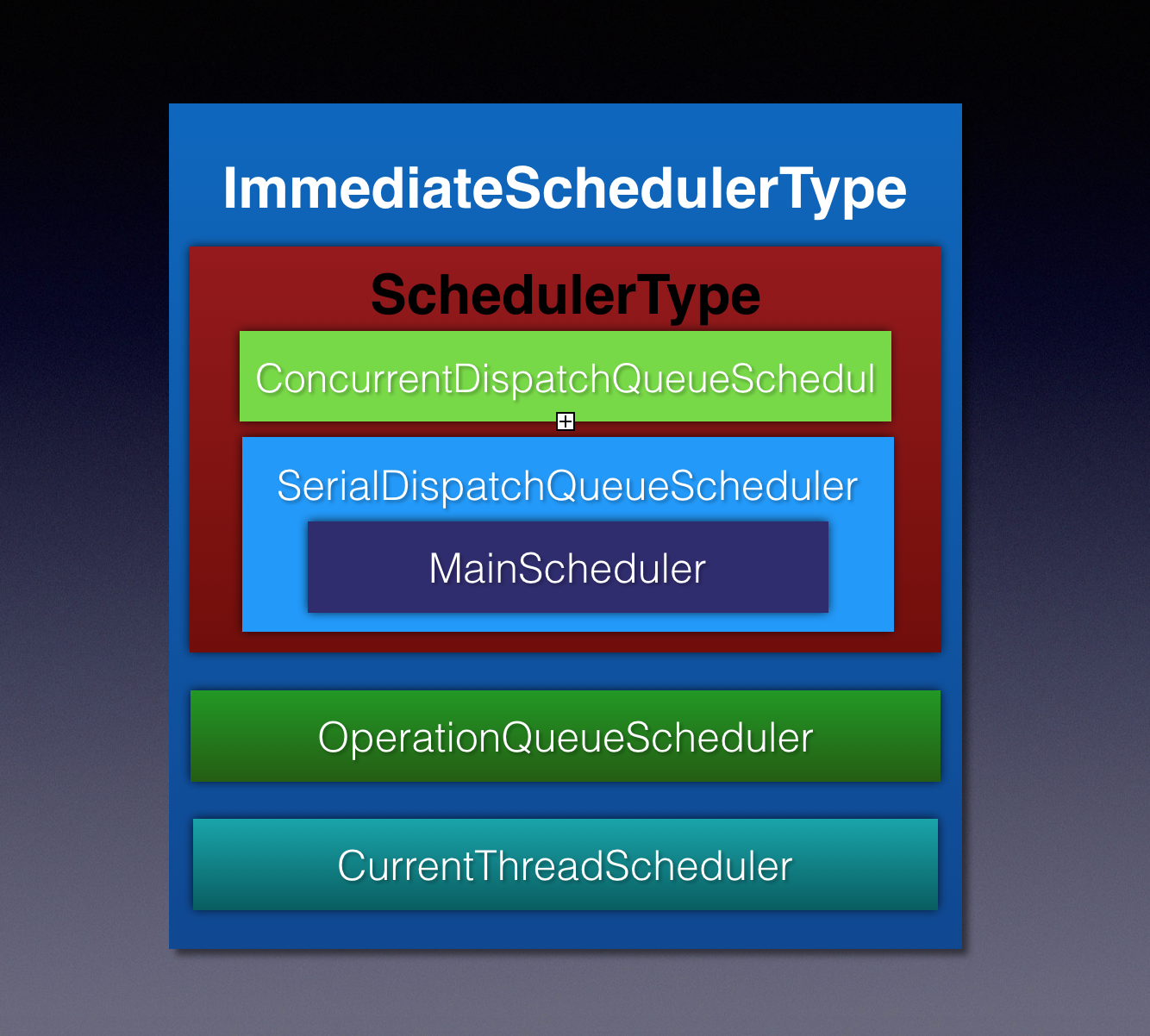
各调度器的实现
MainSheduler调度器
public final class MainScheduler : SerialDispatchQueueScheduler {

    private let _mainQueue: DispatchQueue

    var numberEnqueued = AtomicInt(0)

    /// Initializes new instance of `MainScheduler`.
    public init() {
        self._mainQueue = DispatchQueue.main
        super.init(serialQueue: self._mainQueue)
    }
}
代码分析
MainScheduler继承自SerialDispatchQueueScheduler串行调度器,在构造函数中主队列的确定根据是self._mainQueue = DispatchQueue.main,和调用父类的构造方法,传入队列类型
2.SerialDispatchQueueScheduler调度器
public class SerialDispatchQueueScheduler : SchedulerType {
    public typealias TimeInterval = Foundation.TimeInterval
    public typealias Time = Date

    /// - returns: Current time.
    public var now : Date {
        return Date()
    }

    let configuration: DispatchQueueConfiguration

    /**
    Constructs new `SerialDispatchQueueScheduler` that wraps `serialQueue`.

    - parameter serialQueue: Target dispatch queue.
    - parameter leeway: The amount of time, in nanoseconds, that the system will defer the timer.
    */
    init(serialQueue: DispatchQueue, leeway: DispatchTimeInterval = DispatchTimeInterval.nanoseconds(0)) {
        self.configuration = DispatchQueueConfiguration(queue: serialQueue, leeway: leeway)
    }

    public convenience init(internalSerialQueueName: String, serialQueueConfiguration: ((DispatchQueue) -> Void)? = nil, leeway: DispatchTimeInterval = DispatchTimeInterval.nanoseconds(0)) {
        let queue = DispatchQueue(label: internalSerialQueueName, attributes: [])
        serialQueueConfiguration?(queue)
        self.init(serialQueue: queue, leeway: leeway)
    }
}
代码分析
这段代码说实话啥也没看出来,只是把传进来的queue和leeway存起来,这里应该的具体使用在父类中有具体实现或者对应的扩展中
3.ConcurrentDispatchQueueScheduler调度器
public class ConcurrentDispatchQueueScheduler: SchedulerType {
    public typealias TimeInterval = Foundation.TimeInterval
    public typealias Time = Date

    public var now : Date {
        return Date()
    }

    let configuration: DispatchQueueConfiguration

    public init(queue: DispatchQueue, leeway: DispatchTimeInterval = DispatchTimeInterval.nanoseconds(0)) {
        self.configuration = DispatchQueueConfiguration(queue: queue, leeway: leeway)
    }
    @available(iOS 8, OSX 10.10, *)
    public convenience init(qos: DispatchQoS, leeway: DispatchTimeInterval = DispatchTimeInterval.nanoseconds(0)) {
        self.init(queue: DispatchQueue(
            label: "rxswift.queue.\(qos)",
            qos: qos,
            attributes: [DispatchQueue.Attributes.concurrent],
            target: nil),
            leeway: leeway
        )
    }
}
代码分析
设置了队列类型attributes的设置,concurrent为并行
4.OperationQueueScheduler调度器
public class OperationQueueScheduler: ImmediateSchedulerType {
    public let operationQueue: OperationQueue
    public let queuePriority: Operation.QueuePriority

    public init(operationQueue: OperationQueue, queuePriority: Operation.QueuePriority = .normal) {
        self.operationQueue = operationQueue
        self.queuePriority = queuePriority
    }
}
5.CurrentThreadScheduler调度器
public class CurrentThreadScheduler : ImmediateSchedulerType {
    typealias ScheduleQueue = RxMutableBox<Queue<ScheduledItemType>>

    /// The singleton instance of the current thread scheduler.
    public static let instance = CurrentThreadScheduler()

    private static var isScheduleRequiredKey: pthread_key_t = { () -> pthread_key_t in
        let key = UnsafeMutablePointer<pthread_key_t>.allocate(capacity: 1)
        defer {
#if swift(>=4.1)
            key.deallocate()
#else
            key.deallocate(capacity: 1)
#endif
        }

    static var queue : ScheduleQueue? {
        get {
            return Thread.getThreadLocalStorageValueForKey(CurrentThreadSchedulerQueueKey.instance)
        }
        set {
            Thread.setThreadLocalStorageValue(newValue, forKey: CurrentThreadSchedulerQueueKey.instance)
        }
    }

    /// Gets a value that indicates whether the caller must call a `schedule` method.
    public static fileprivate(set) var isScheduleRequired: Bool {
        get {
            return pthread_getspecific(CurrentThreadScheduler.isScheduleRequiredKey) == nil
        }
        set(isScheduleRequired) {
            if pthread_setspecific(CurrentThreadScheduler.isScheduleRequiredKey, isScheduleRequired ? nil : scheduleInProgressSentinel) != 0 {
                rxFatalError("pthread_setspecific failed")
            }
        }
    }

    /**
    Schedules an action to be executed as soon as possible on current thread.

    If this method is called on some thread that doesn't have `CurrentThreadScheduler` installed, scheduler will be
    automatically installed and uninstalled after all work is performed.

    - parameter state: State passed to the action to be executed.
    - parameter action: Action to be executed.
    - returns: The disposable object used to cancel the scheduled action (best effort).
    */
    public func schedule<StateType>(_ state: StateType, action: @escaping (StateType) -> Disposable) -> Disposable {
        if CurrentThreadScheduler.isScheduleRequired {
            CurrentThreadScheduler.isScheduleRequired = false

            let disposable = action(state)

            defer {
                CurrentThreadScheduler.isScheduleRequired = true
                CurrentThreadScheduler.queue = nil
            }

            guard let queue = CurrentThreadScheduler.queue else {
                return disposable
            }

            while let latest = queue.value.dequeue() {
                if latest.isDisposed {
                    continue
                }
                latest.invoke()
            }

            return disposable
        }

        let existingQueue = CurrentThreadScheduler.queue

        let queue: RxMutableBox<Queue<ScheduledItemType>>
        if let existingQueue = existingQueue {
            queue = existingQueue
        }
        else {
            queue = RxMutableBox(Queue<ScheduledItemType>(capacity: 1))
            CurrentThreadScheduler.queue = queue
        }

        let scheduledItem = ScheduledItem(action: action, state: state)
        queue.value.enqueue(scheduledItem)

        return scheduledItem
    }
}
代码分许
当前调度,默认就是在当前线程调度执行,内部有绑定queue的机制以及存储和判断要不要调用schedule
6.SchedulerType协议及扩展实现
public protocol SchedulerType: ImmediateSchedulerType {

    /// - returns: Current time.
    var now : RxTime {
        get
    }
    /**
    Schedules an action to be executed.

    - parameter state: State passed to the action to be executed.
    - parameter dueTime: Relative time after which to execute the action.
    - parameter action: Action to be executed.
    - returns: The disposable object used to cancel the scheduled action (best effort).
    */
    func scheduleRelative<StateType>(_ state: StateType, dueTime: RxTimeInterval, action: @escaping (StateType) -> Disposable) -> Disposable

    /**
    Schedules a periodic piece of work.

    - parameter state: State passed to the action to be executed.
    - parameter startAfter: Period after which initial work should be run.
    - parameter period: Period for running the work periodically.
    - parameter action: Action to be executed.
    - returns: The disposable object used to cancel the scheduled action (best effort).
    */
    func schedulePeriodic<StateType>(_ state: StateType, startAfter: RxTimeInterval, period: RxTimeInterval, action: @escaping (StateType) -> StateType) -> Disposable
}
extension SchedulerType {

    /**
    Periodic task will be emulated using recursive scheduling.

    - parameter state: Initial state passed to the action upon the first iteration.
    - parameter startAfter: Period after which initial work should be run.
    - parameter period: Period for running the work periodically.
    - returns: The disposable object used to cancel the scheduled recurring action (best effort).
    */
    public func schedulePeriodic<StateType>(_ state: StateType, startAfter: RxTimeInterval, period: RxTimeInterval, action: @escaping (StateType) -> StateType) -> Disposable {
        let schedule = SchedulePeriodicRecursive(scheduler: self, startAfter: startAfter, period: period, action: action, state: state)

        return schedule.start()
    }

    func scheduleRecursive<State>(_ state: State, dueTime: RxTimeInterval, action: @escaping (State, AnyRecursiveScheduler<State>) -> Void) -> Disposable {
        let scheduler = AnyRecursiveScheduler(scheduler: self, action: action)

        scheduler.schedule(state, dueTime: dueTime)

        return Disposables.create(with: scheduler.dispose)
    }
}
7.ImmediateSchedulerType调度协议实现
 extension ImmediateSchedulerType {
    /**
    Schedules an action to be executed recursively.

    - parameter state: State passed to the action to be executed.
    - parameter action: Action to execute recursively. The last parameter passed to the action is used to trigger recursive scheduling of the action, passing in recursive invocation state.
    - returns: The disposable object used to cancel the scheduled action (best effort).
    */
    public func scheduleRecursive<State>(_ state: State, action: @escaping (_ state: State, _ recurse: (State) -> Void) -> Void) -> Disposable {
        let recursiveScheduler = RecursiveImmediateScheduler(action: action, scheduler: self)

        recursiveScheduler.schedule(state)

        return Disposables.create(with: recursiveScheduler.dispose)
    }
}
代码分析
在6是通过构造了一个SchedulePeriodicRecursive或者AnyRecursiveScheduler;在7中RecursiveImmediateScheduler
SchedulePeriodicRecursive和RecursiveImmediateScheduler是在一个swift文件中,内部主要的实现使用过实现了一个schedule方法,具体这里就不赘述了,也没特别仔细看,AnyRecursiveScheduler也是类似的
GCD实现一个异步处理后回到主线程
DispatchQueue.init(label: "com.baozi.testGCD",qos: .default,attributes:.concurrent).async {
    var num = 0
    for i in 0...250{
        num += I
    }
    DispatchQueue.main.sync {
        print("total Baozi count :\(num)  \(Thread.current)")
    }
}
RxSwift实现异步回到主线程🌰
Observable<Any>.create { (observer) -> Disposable in
        var num = 0
        for i in 0...250{
            num += I
        }
        observer.onNext(num)
        return Disposables.create()
    }
    .subscribeOn(SerialDispatchQueueScheduler.init(internalSerialQueueName: "com.baozi.rxswift"))
    .observeOn(MainScheduler.instance)
    .subscribe(onNext: { (val) in
        print(val)
    }).disposed(by: disposeBag)
调度器的原理逻辑
写个小🌰,开始探究一番吧
let _ = Observable.of(1,2,3,4,5).subscribeOn(SerialDispatchQueueScheduler.init(internalSerialQueueName: "com.baozi.rxswift"))
    .subscribe(onNext: { (val) in
        print(val)
    }).disposed(by: disposeBag)

    let _ = Observable.of(1,2,3,4,5)
    .observeOn(MainScheduler.instance)
    .subscribe(onNext: { (val) in
        print(val)
    }).disposed(by: disposeBag)
怎么实现的多线程的调度,可以清楚地看到主要是依靠subscribeOn和observeOn指定相关的调度,实际就是制定了相关的线程
Now,两者差不多感觉,看看subscribeOn吧
public func subscribeOn(_ scheduler: ImmediateSchedulerType)
    -> Observable<Element> {
    return SubscribeOn(source: self, scheduler: scheduler)
}
SubscribeOn的实现如下
final private class SubscribeOn<Ob: ObservableType>: Producer<Ob.Element> {
    let source: Ob
    let scheduler: ImmediateSchedulerType

    init(source: Ob, scheduler: ImmediateSchedulerType) {
        self.source = source
        self.scheduler = scheduler
    }

    override func run<Observer: ObserverType>(_ observer: Observer, cancel: Cancelable) -> (sink: Disposable, subscription: Disposable) where Observer.Element == Ob.Element {
        let sink = SubscribeOnSink(parent: self, observer: observer, cancel: cancel)
        let subscription = sink.run()
        return (sink: sink, subscription: subscription)
    }
}
看起来和核心的逻辑很像,还有对应的Sink,源码上边确实有对应的Sink的实现,应该是同理的逻辑,这块应该还是核心逻辑的基础,还是要扎实下基础的