概述
前文「JDK源码分析-BlockingQueue」简要分析了 BlockingQueue 接口的主要方法,ArrayBlockingQueue 就是该接口的一个主要实现类,本文分析该类的常用方法实现。
ArrayBlockingQueue 的类继承结构如下:
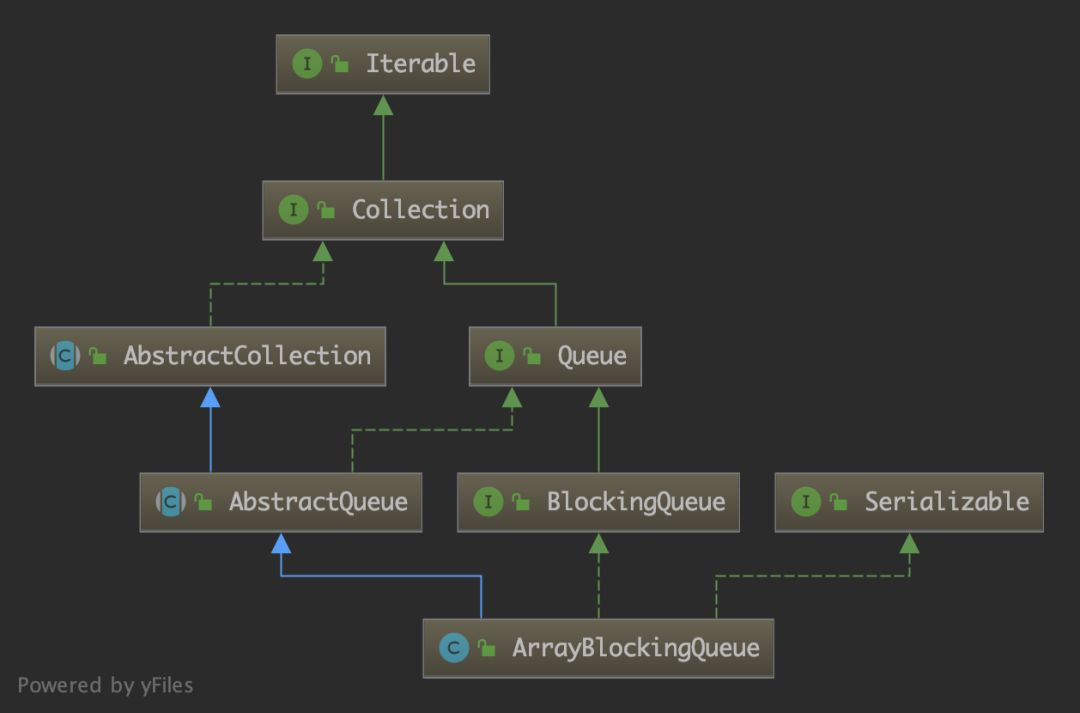
从 ArrayBlockingQueue 的名字大概可以猜出来,它的内部是由数组实现的,下面分析其代码实现。
代码分析
构造器
构造器 1:
// 构造器 1:初始化 ArrayBlockingQueue 对象,使用给定的容量public ArrayBlockingQueue(int capacity) { // 调用构造器 2 进行初始化,默认使用非公平锁 this(capacity, false);}构造器 2:
// 构造器 2:使用给定容量及是否公平初始化 ArrayBlockingQueue 对象public ArrayBlockingQueue(int capacity, boolean fair) { if (capacity <= 0) throw new IllegalArgumentException(); // 用给定的容量初始化内部数组 this.items = new Object[capacity]; // 创建锁对象(根据 fair 参数确定是否公平锁) lock = new ReentrantLock(fair); // lock 绑定两个 Condition 条件 notEmpty = lock.newCondition(); notFull = lock.newCondition();}构造器 3:
// 构造器 3:使用给定的容量、是否公平,及给定的集合初始化 ArrayBlockingQueuepublic ArrayBlockingQueue(int capacity, boolean fair, Collection<? extends E> c) { // 使用构造器 2 初始化 ArrayBlockingQueue 对象 this(capacity, fair); final ReentrantLock lock = this.lock; lock.lock(); // Lock only for visibility, not mutual exclusion try { int i = 0; try { // 遍历给定集合的元素,将其插入数组 for (E e : c) { checkNotNull(e); items[i++] = e; } // 注意可能会发生数组越界 } catch (ArrayIndexOutOfBoundsException ex) { throw new IllegalArgumentException(); } // 数组中元素的数量 count = i; // 入队操作(put、offer 等方法)的数组下标,若数组已满则为 0 putIndex = (i == capacity) ? 0 : i; } finally { // 注意释放锁 lock.unlock(); }}
主要成员变量
/** The queued items */// 内部保存元素的数组final Object[] items;/** items index for next take, poll, peek or remove */// 出队操作索引int takeIndex;/** items index for next put, offer, or add */// 入队操作索引int putIndex;/** Number of elements in the queue */int count;/* * Concurrency control uses the classic two-condition algorithm * found in any textbook. * 双条件(notEmpty、notFull)算法用于并发控制 */ /** Main lock guarding all access */// 使用 ReentrantLock 保证线程安全final ReentrantLock lock;/** Condition for waiting takes */// 等待 take 操作(消费)的条件private final Condition notEmpty;/** Condition for waiting puts */// 等待 put 操作(生产)的条件private final Condition notFull;
主要入队方法:add(E), offer(E), offer(E, timeout, Unit), put(E)
1. add(E) 方法
public boolean add(E e) { // 调用父类 AbstractQueue 的 add 方法 return super.add(e);}// AbstractQueue 的 add 方法public boolean add(E e) { if (offer(e)) return true; else throw new IllegalStateException("Queue full");}add(E) 方法调用了父类 AbstractQueue 的 add(E) 方法,可以看到,实际上还是调用了 offer(E) 方法。因此 add(E) 和 offer(E) 实现基本是一致的,下面分析 offer(E) 方法。
2. offer(E), offer(E, timeout, Unit) 方法
public boolean offer(E e) { checkNotNull(e); final ReentrantLock lock = this.lock; lock.lock(); try { // 若队列已满,立即返回 false if (count == items.length) return false; else { // 入队 enqueue(e); return true; } } finally { lock.unlock(); }}enqueue 方法:
// 入队操作private void enqueue(E x) { // assert lock.getHoldCount() == 1; // assert items[putIndex] == null; final Object[] items = this.items; items[putIndex] = x; // 若队列已满,则下标置为 0 if (++putIndex == items.length) putIndex = 0; count++; // 唤醒 notEmpty 条件下等待的线程 notEmpty.signal();}offer(E) 方法是将一个元素入队:若队列已满直接返回 false,否则执行入队操作,并唤醒 notEmpty 条件下等待的线程。
以“生产者-消费者”模型类比,执行 offer(E) 操作后表示队列已经有产品了(不为空,即 notEmpty),消费者可以消费了。
offer(E, timeout, Unit) 方法操作与 offer(E) 类似,只是多了超时等待,如下:
public boolean offer(E e, long timeout, TimeUnit unit) throws InterruptedException { checkNotNull(e); long nanos = unit.toNanos(timeout); final ReentrantLock lock = this.lock; lock.lockInterruptibly(); try { while (count == items.length) { if (nanos <= 0) return false; nanos = notFull.awaitNanos(nanos); } enqueue(e); return true; } finally { lock.unlock(); }}3. put(E) 方法
public void put(E e) throws InterruptedException { checkNotNull(e); final ReentrantLock lock = this.lock; lock.lockInterruptibly(); try { // 队列满的时候,notFull 条件等待 while (count == items.length) notFull.await(); // 入队 enqueue(e); } finally { lock.unlock(); }}put(E) 也是将一个元素入队:若队列已满,则 notFull 条件下的线程等待。
以“生产者-消费者”模型类比,就是容器已满,生产者等待;否则执行入队,并唤醒消费者。
入队方法小结
1. add(E): 入队成功返回 true,否则抛出 IllegalStateException 异常;
2. offer(E): 入队成功返回 true,失败返回 false;
3. offer(E, timeout, Unit ): 同 offer(E),加了超时等待;
4. put(E): 无返回值,队列满的时候等待。
主要出队方法:poll(), poll(long, unit), take(), peek()
1. poll() 方法
public E poll() { final ReentrantLock lock = this.lock; lock.lock(); try { // 队列为空时返回 null,否则将 takeIndex 位置元素出队 return (count == 0) ? null : dequeue(); } finally { lock.unlock(); }}2. take(E) 方法
public E take() throws InterruptedException { final ReentrantLock lock = this.lock; lock.lockInterruptibly(); try { // 队列为空时等待 while (count == 0) notEmpty.await(); return dequeue(); } finally { lock.unlock(); }}3. poll(E, unit) 方法
public E poll(long timeout, TimeUnit unit) throws InterruptedException { long nanos = unit.toNanos(timeout); final ReentrantLock lock = this.lock; lock.lockInterruptibly(); try { while (count == 0) { if (nanos <= 0) return null; nanos = notEmpty.awaitNanos(nanos); } return dequeue(); } finally { lock.unlock(); }}与 poll() 方法操作类似,只是多了超时等待。
上述三个方法都使用 dequeue 方法进行出队,如下:
// 出队操作private E dequeue() { // assert lock.getHoldCount() == 1; // assert items[takeIndex] != null; final Object[] items = this.items; @SuppressWarnings("unchecked") // 获取 takeIndex 位置的元素 E x = (E) items[takeIndex]; // 将 该位置清空 items[takeIndex] = null; // 队列已经空了 if (++takeIndex == items.length) takeIndex = 0; count--; // 迭代器操作用到,本文暂不深入分析 if (itrs != null) itrs.elementDequeued(); // 队列已经不满(not full)了,可以继续生产 notFull.signal(); return x;}4. peek() 方法
public E peek() { final ReentrantLock lock = this.lock; lock.lock(); try { return itemAt(takeIndex); // null when queue is empty } finally { lock.unlock(); }}// 返回数组中指定位置的元素final E itemAt(int i) { return (E) items[i];}peek() 方法与前面几个出队操作不同,peek 方法只会获取队列的头元素,而不会将其删除。
出队方法小结
1. poll(): 获取队列头部元素,并将其移除,队列为空时返回 null;
2. take(): 获取队列头部 元素,并将其移除,队列为空时阻塞等待;
3. poll(long, unit): 获取队列头部元素,并将其移除,队列为空时等待一段时间,若超时返回 null;
4. peek(): 获取队列头部元素,但不移除该元素。
小结
1. ArrayBlockingQueue 是基于数组的阻塞队列实现,它在初始化时需要指定容量;
2. 内部使用了 ReentrantLock 保证线程安全;
3. 常用方法:
入队:add, offer, put
出队:poll, take, peek
本文分析了其常用的方法,此外,还有一些方法使用频率没那么高且稍微复杂,例如 iterator() 和 drainTo(),后文再进行分析。
相关阅读:
Stay hungry, stay foolish.