注:在继承之前我们需要了解一下构造函数和原型链的相关知识,下面我通过例子来说明一下
/*
 * 所谓的构造函数,顾明思议就是函数,但其与普通函数也有不同
 *  1.构造函数是通过 new 关键字创建对象时调用的函数
 *  2.通常构造函数我们会将函数名字的首字母大写
 */
  function Animal(name){
    this.name = name; // 实例上的属性
    this.ability = ['吃饭', '睡觉', '打豆豆']; // 实例上的属性
    this.eat = function(){ // 实例上的方法
        console.log('吃')
    }
  }
  Animal.prototype.address = {location: '大山'}; // 原型上的属性(公有属性)
  let animal1 = new Animal('老虎');
  console.log(animal1) // Animal { name: '老虎', ability: [ '吃饭', '睡觉', '打豆豆' ], eat: [Function] }
  let animal2 = new Animal('猫');
  console.log(animal2) // Animal { name: '猫', ability: [ '吃饭', '睡觉', '打豆豆' ], eat: [Function] }
  console.log(animal1.ability === animal2.ability); // false
  console.log(animal1.address === animal2.address); // true
  console.log(animal1.__proto__ === Animal.prototype); // true
  console.log(Animal.prototype.constructor === Animal); // true
  console.log(Animal.__proto__ === Function.prototype); // true
  console.log(Function.prototype.__proto__ === Object.prototype); // true
  console.log(Object.prototype.__proto__); // null
  /*
   * 一句话总结原型链:每一个实例都有一个__proto__属性,指向该实例所属类的原型(prototype)【需要注意的是原型是Object的实例哦】;每一个类的原型上都有一个constructor属性指向类的本身
   */
继承的定义
- 【官方】继承是面向对象软件技术当中的一个概念。如果一个类别A“继承自”另一个类别B,就把这个A称为“B的子类别”,而把B称为“A的父类别”也可以称“B是A的超类”。继承可以使得子类别具有父类别的各种属性和方法,而不需要再次编写相同的代码。在令子类别继承父类别的同时,可以重新定义某些属性,并重写某些方法,即覆盖父类别的原有属性和方法,使其获得与父类别不同的功能。另外,为子类别追加新的属性和方法也是常见的做法。 一般静态的面向对象编程语言,继承属于静态的,意即在子类别的行为在编译期就已经决定,无法在执行期扩充。(注:文本内容来源某度)
- 【我】我理解的继承无非就是两个互不相关的类通过一些特定的方法使其中一个类拥有另一个类的属性或者方法,
JS中我总结了为有三种继承场景- 1、子类继承父类实例上的属性/方法
- 2、子类继承父类原型上的属性/方法
- 3、子类继承父类实例和原型上的属性/方法
一、子类继承父类实例上的属性/方法(所谓的call继承)
function Animal(name){ // 父类
    this.name = name;
    this.eat = '吃肉'
}
Animal.prototype.address = {location: '大山'};

function Tiger(name){
    Animal.call(this);
    this.name = name;
    this.age = 5;
}
Tiger.prototype.say = function(){ // 子类
    console.log('说话')
}
let tiger = new Tiger('老虎')
console.log(tiger) // Tiger { name: '老虎', eat: '吃肉', age: 10 }
console.log(tiger.say) // [Function]
console.log(tiger.address) // undefined
二、子类继承父类原型上的属性/方法
实现方式一(所谓的原型链继承)
function Animal(name){ // 父类
    this.name = name;
    this.eat = '吃肉';
}
Animal.prototype.address = {location: '大山'};

function Tiger(name){ // 子类
    this.name = name;
    this.age = 5;
}
Tiger.prototype.say = function(){
    console.log('说话');
}
Tiger.prototype.__proto__ = Animal.prototype;
let tiger = new Tiger('老虎');
console.log(tiger); // Tiger {name: '老虎', age: 10}
console.log(tiger.say); // [Function]
console.log(tiger.address) // {location: '大山'}
实现方式二(通过Object.create/Object.setPrototypeOf)
function Animal(name){
    this.name = name;
    this.eat =  '吃肉';
}
Animal.prototype.address = {location: '大山'};

function Tiger(name){
    this.name = name;
    this.age = 5;
}
Tiger.prototype = Object.create(Animal.prototype);
// Tiger.prototype = Object.create(Animal.prototype,{constructor:{value:Tiger}});
// 上行代码等价于Object.setPrototypeOf(Tiger.prototype,Animal.prototype) ES6
Tiger.prototype.say = function(){
    console.log('说话')
}
let tiger = new Tiger('老虎')
console.log(tiger) // Animal { name: '老虎', age: 10 }
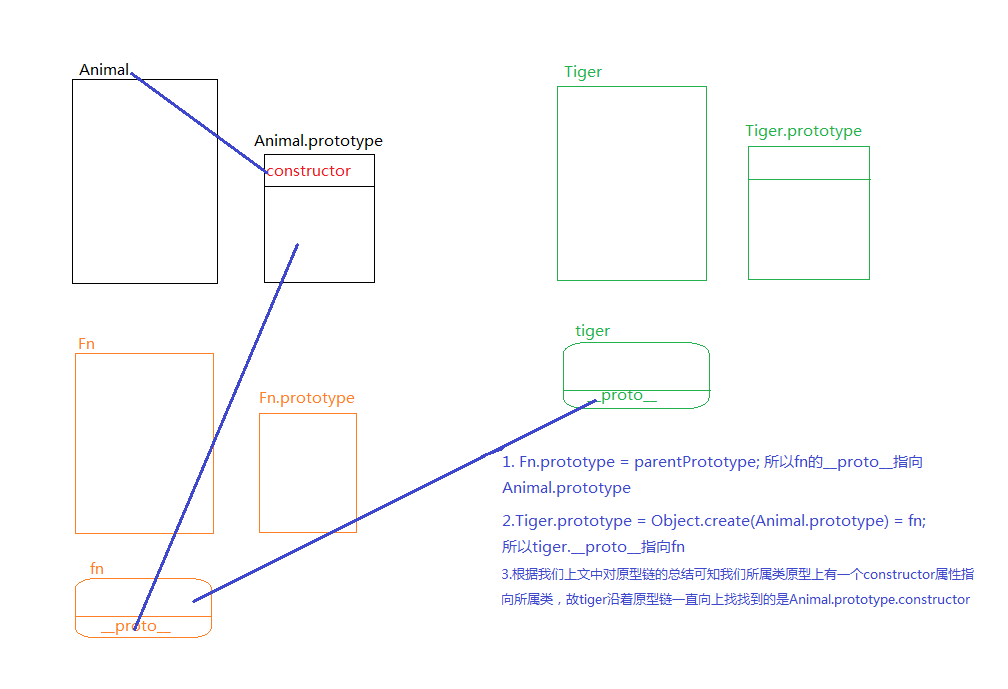
/* 这时候你会发现我们明明创建的是Tiger的实例,但是我们输出的缺是Animal的实例,这就关系到Object.create方法的实现了,
 * 下面代码我们手写一版简单的Object.create方法(结合下文参考图)
 */
Object.create = function(parentPrototype,options={}){
    let Fn = function(){};
    Fn.prototype = parentPrototype;
    let fn = new Fn();
    if(options.constructor){
        fn.constructor = options.constructor.value
    }
    return fn;
}
/*不难看出我们可以给Object.create传入options来改变constructor*/
三、子类继承父类实例和原型上的属性/方法
实现方式一(所谓的寄生组合继承——上述的结合)
- 这里我就不罗列代码了,相信文章前的你一定能通过上述来实现
实现方法二(ES6的class语法糖)
class Animal{
    static address(){ // 静态方法(只能原型调用) 在ES7中可以直接添加静态属性 static address = {location: '大山'}
        return {location: '大山'}
    }
    constructor(name){ // 实例属性
        this.name = name;
        this.eat = '吃肉'
    }
    say(){ // 原型上的方法
        return '说话'
    }
}

class Tiger extends Animal{
    constructor(name){
        super(name)
        this.name = name;
        this.age = 5;
    }
    sleep(){
        return '睡觉'
    }
}
let tiger = new Tiger('老虎');
console.log(tiger) // Tiger { name: '老虎', eat: '吃肉', age: 5 }
console.log(tiger.say()) // 说话
console.log(tiger.sleep()) // 睡觉
console.log(Animal.address()) // { location: '大山' }
console.log(Tiger.address()) // { location: '大山' }