bind
<!DOCTYPE html>
<html lang="en">
<head>
    <meta charset="UTF-8">
    <title>Title</title>
</head>
<body>
<script>
    // 1.call\apply\bind 可以改变this指向;
    // 1) : call 和apply传参不同
    // 2) : bind预处理this;在IE8以下是不兼容的;

    function fn(a,b,c) {
        console.log(a);
        console.log(b);
        console.log(c);
        console.log(this);
    }
    var obj = {num:1}
    var f = fn.bind(obj,1,2);
    f(3);
    // 1. 如果bind不传参数,那么fn执行的this指向window;
    // 2.  bind 可以分开传参;在bind中的第二个参数以后,有占位作用;
    // 1) 在bind中使用call或apply;
    // 2) myBind中一定返回一个函数;这个函数执行时,才是真正的函数执行
    // 3) 参数需要合并;

    Function.prototype.myBind = function () {
        // this--> fn;
        var  that = this;
        // 如果myBind有第一个参数,那么指向第一个参数,没有指向window;
        var  arg = arguments[0]||window;
        // 截图arguments中从索引1开始之后的项
        var ary1 = [].slice.call(arguments,1)//把类数组转数组,从传参的第二项把类数组转数组
        return function () {
            // 类数组转数组
            var ary2 = [].slice.call(arguments);
            // apply 可以传数组,concat将数组连接在一起;
            that.apply(arg,ary1.concat(ary2));
        }
    }
</script>
</body>
</html>
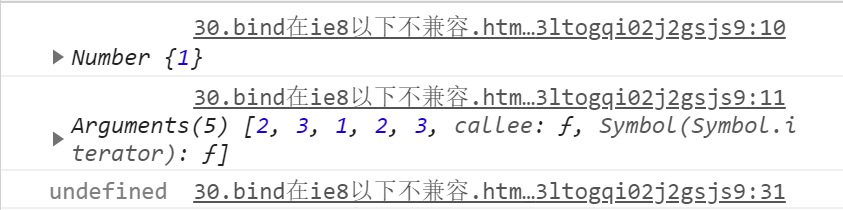
自己修改了一下,bind兼容ie8及以下的浏览器
  function fn(){
        console.log(this);
        console.log(arguments);
    }

    Function.prototype.myBind=function(){
        // this--> fn;
        var  that = this;
        // 如果myBind有第一个参数,那么指向第一个参数,没有指向window;
        var  arg = arguments[0]||window;
        // 截图arguments中从索引1开始之后的项
        var ary1 = [].slice.call(arguments,1)
        return function () {
            // 类数组转数组
            var ary2 = [].slice.call(arguments);
            // apply 可以传数组,concat将数组连接在一起;
            that.apply(arg,ary1.concat(ary2));
        }
    };
    var f=fn.myBind(1,2,3);
    console.log(f(1,2,3));