

简介
Trie是一种用来高效存储字符串以及搜索字符串的结构。当我们使用一般的平衡查找二叉树来完成这个任务时,一般的时间复杂度为M*log(N), 其中M为字符串的长度,N为字符串的数量。而当我们用Trie的时候,复杂度可以降到O(M).
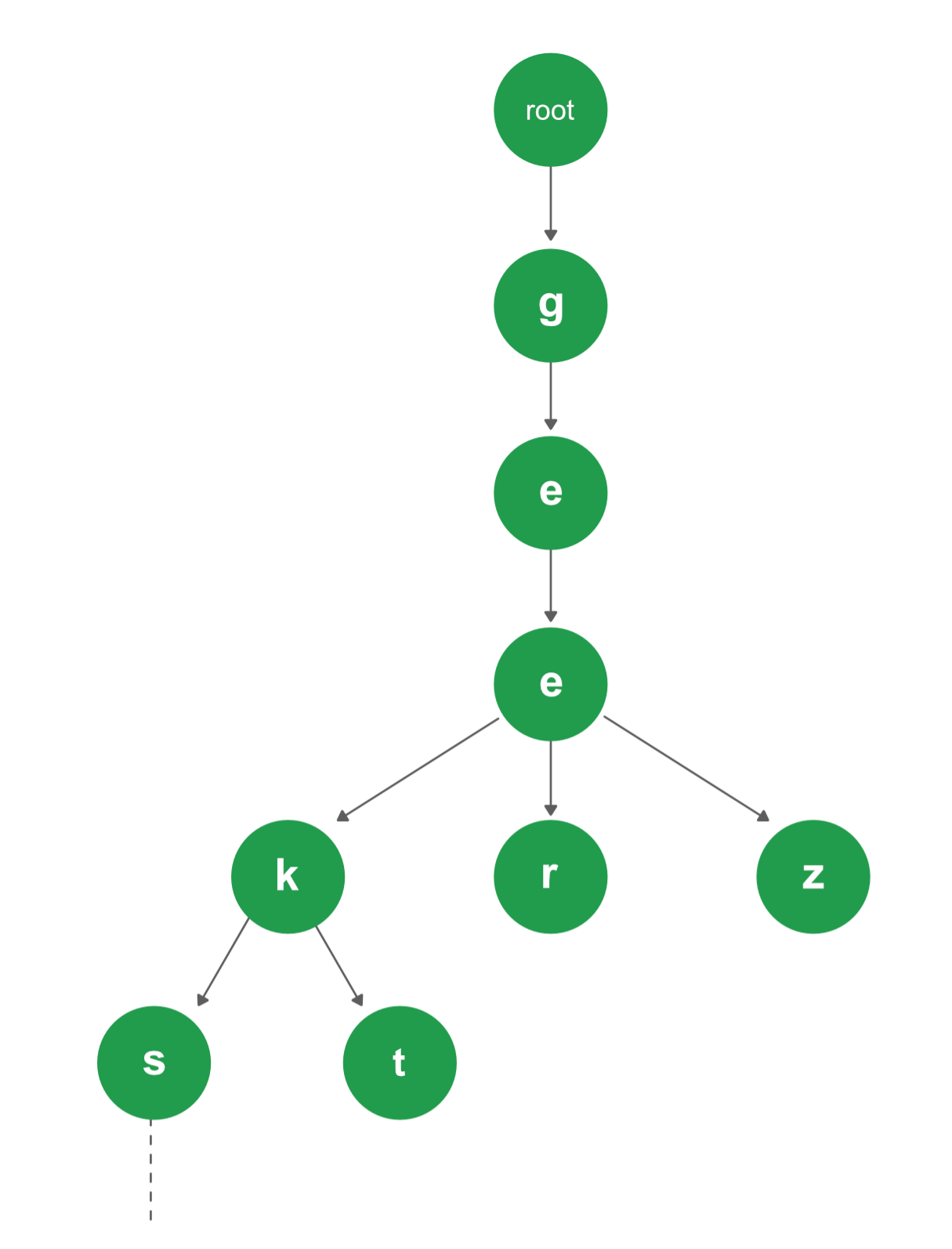
Trie的ADT
// Trie node
struct TrieNode
{
     struct TrieNode *children[ALPHABET_SIZE];

     // isEndOfWord is true if the node
     // represents end of a word
     bool isEndOfWord;
};
isEndOfWord的布尔值用以指示字符串末尾的那个char.
Trie的插入
直接插入children的数组,如果不存在这个char则新建一个TrieNode, 如果已经是末尾字符就把isEndOfWord设为True.
Trie的搜索
自顶向下的搜索,通过isEndOfWord来判断命中情况.
Java实现(来自Leetcode)
class TrieNode {

    // R links to node children
    private TrieNode[] links;

    private final int R = 26;

    private boolean isEnd;

    public TrieNode() {
        links = new TrieNode[R];
    }

    public boolean containsKey(char ch) {
        return links[ch -'a'] != null;
    }
    public TrieNode get(char ch) {
        return links[ch -'a'];
    }
    public void put(char ch, TrieNode node) {
        links[ch -'a'] = node;
    }
    public void setEnd() {
        isEnd = true;
    }
    public boolean isEnd() {
        return isEnd;
    }
}

class Trie {
    private TrieNode root;

    public Trie() {
        root = new TrieNode();
    }

    // Inserts a word into the trie.
    public void insert(String word) {
        TrieNode node = root;
        for (int i = 0; i < word.length(); i++) {
            char currentChar = word.charAt(i);
            if (!node.containsKey(currentChar)) {
                node.put(currentChar, new TrieNode());
            }
            node = node.get(currentChar);
        }
        node.setEnd();
    }

    // search a prefix or whole key in trie and
    // returns the node where search ends
    private TrieNode searchPrefix(String word) {
        TrieNode node = root;
        for (int i = 0; i < word.length(); i++) {
           char curLetter = word.charAt(i);
           if (node.containsKey(curLetter)) {
               node = node.get(curLetter);
           } else {
               return null;
           }
        }
        return node;
    }

    // Returns if the word is in the trie.
    public boolean search(String word) {
       TrieNode node = searchPrefix(word);
       return node != null && node.isEnd();
    }

    // Returns if there is any word in the trie
    // that starts with the given prefix.
    public boolean startsWith(String prefix) {
        TrieNode node = searchPrefix(prefix);
        return node != null;
    }
}
实例1: LeetCode 211
class TrieNode(object):

    def __init__(self):
        self.trienode = {}
        self.end = False

    def containsKey(self, ch):
        return self.trienode.get(ch) != None


class WordDictionary:

    def __init__(self):
        """
        Initialize your data structure here.
        """
        self.root = TrieNode()


    def addWord(self, word):
        """
        Adds a word into the data structure.
        :type word: str
        :rtype: void
        """
        start = self.root
        for i in word:
            if(not start.containsKey(i)):
                start.trienode[i] = TrieNode()
            start = start.trienode[i]
        start.end = True


    # def searchPrefix(self, word):
    #     """
    #     Returns true if the prefix is included in the data structure.
    #     :type word:str
    #     :rtype: str
    #     """


    def search(self, word, curr = None):
        """
        Returns if the word is in the data structure. A word could contain the dot character '.' to represent any one letter.
        :type word: str
        :rtype: bool
        """
        if not curr:
            curr = self.root
        for i, c in enumerate(word):
            is_last_char = i == len(word) - 1
            if c == ".":
                if is_last_char:
                    return self.wildcard_terminate(curr)
                else:
                    return self.wildcard_recursive(word[i+1:], curr)
            else:
                if not curr.containsKey(c):
                    return False
                curr = curr.trienode[c]
        return curr.end == True


    def wildcard_recursive(self, word, node):
        return any(map(lambda x: self.search(word, x), node.trienode.values()))
    def wildcard_terminate(self, node):
        return any(map(lambda x: x.end, node.trienode.values()))


# Your WordDictionary object will be instantiated and called as such:
# obj = WordDictionary()
# obj.addWord(word)
# param_2 = obj.search(word)
