若文中代码格式阅读困难,可点击文末"阅读原文"链接友好阅读。
要点解说
CountDownLatch允许一个或者多个线程一直等待,直到一组其它操作执行完成。在使用CountDownLatch时,需要指定一个整数值,此值是线程将要等待的操作数。当某个线程为了要执行这些操作而等待时,需要调用await方法。await方法让线程进入休眠状态直到所有等待的操作完成为止。当等待的某个操作执行完成,它使用countDown方法来减少CountDownLatch类的内部计数器。当内部计数器递减为0时,CountDownLatch会唤醒所有调用await方法而休眠的线程们。
实例演示
下面代码演示了CountDownLatch简单使用。演示的场景是5位运动员参加跑步比赛,发令枪打响后,5个计时器开始分别计时,直到所有运动员都到达终点。
public class CountDownLatchDemo {
public static void main(String[] args) {
Timer timer = new Timer(5);
new Thread(timer).start();
for (int athleteNo = 0; athleteNo < 5; athleteNo++) {
new Thread(new Athlete(timer, "athlete" + athleteNo)).start();
}
}
}
class Timer implements Runnable {
CountDownLatch timerController;
public Timer(int numOfAthlete) {
this.timerController = new CountDownLatch(numOfAthlete);
}
public void recordResult(String athleteName) {
System.out.println(athleteName + " has arrived");
timerController.countDown();
System.out.println("There are " + timerController.getCount() + " athletes did not reach the end");
}
@Override
public void run() {
try {
System.out.println("Start...");
timerController.await();
System.out.println("All the athletes have arrived");
} catch (InterruptedException e) {
e.printStackTrace();
}
}
}
class Athlete implements Runnable {
Timer timer;
String athleteName;
public Athlete(Timer timer, String athleteName) {
this.timer = timer;
this.athleteName = athleteName;
}
@Override
public void run() {
try {
System.out.println(athleteName + " start running");
long duration = (long) (Math.random() * 10);
Thread.sleep(duration * 1000);
timer.recordResult(athleteName);
} catch (InterruptedException e) {
e.printStackTrace();
}
}
}
输出结果如下所示:
Start...
athlete0 start running
athlete1 start running
athlete2 start running
athlete3 start running
athlete4 start running
athlete0 has arrived
There are 4 athletes did not reach the end
athlete3 has arrived
There are 3 athletes did not reach the end
athlete2 has arrived
athlete1 has arrived
There are 1 athletes did not reach the end
There are 2 athletes did not reach the end
athlete4 has arrived
There are 0 athletes did not reach the end
All the athletes have arrived
方法解析
1.构造方法 CountDownLatch(int count)构造一个指定计数的CountDownLatch,count为线程将要等待的操作数。
2.await() 调用await方法后,使当前线程在锁存器(内部计数器)倒计数至零之前一直等待,进入休眠状态,除非线程被中断。如果当前计数递减为零,则此方法立即返回,继续执行。
3.await(long timeout, TimeUnit unit) 调用await方法后,使当前线程在锁存器(内部计数器)倒计数至零之前一直等待,进入休眠状态,除非线程被 中断或超出了指定的等待时间。如果当前计数为零,则此方法立刻返回true值。
3.acountDown() acountDown方法递减锁存器的计数,如果计数到达零,则释放所有等待的线程。如果当前计数大于零,则将计数减少。如果新的计数为零,出于线程调度目的,将重新启用所有的等待线程。
4.getCount() 调用此方法后,返回当前计数,即还未完成的操作数,此方法通常用于调试和测试。
源码解析
进入源码分析之前先看一下CountDownLatch的类图,
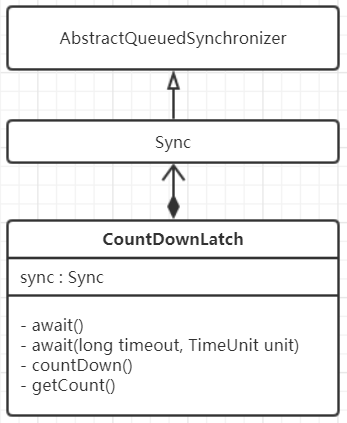
Sync是CountDownLatch的一个内部类,它继承了AbstractQueuedSynchronizer。
CountDownLatch(int count)、await()和countDown()三个方法是CountDownLatch的核心方法,本篇将深入分析这三个方法的具体实现原理。
1.CountDownLatch(int count)
public CountDownLatch(int count) {
if (count < 0) throw new IllegalArgumentException("count < 0");
this.sync = new Sync(count);
}
该构造方法根据给定count参数构造一个CountDownLatch,内部创建了一个Sync实例。Sync是CountDownLatch的一个内部类,其构造方法代码如下:
Sync(int count) {
setState(count);
}
setState方法继承自AQS,给Sync实例的state属性赋值。
protected final void setState(int newState) {
state = newState;
}
这个state就是CountDownLatch的内部计数器。
2.await() 当await()方法被调用时,当前线程会阻塞,直到内部计数器的值等于零或当前线程被中断,下面深入代码分析。
public void await() throws InterruptedException {
sync.acquireSharedInterruptibly(1);
}
public final void acquireSharedInterruptibly(int arg)
throws InterruptedException {
//如果当前线程中断,则抛出InterruptedException
if (Thread.interrupted())
throw new InterruptedException();
//尝试获取共享锁,如果可以获取到锁直接返回;
//如果获取不到锁,执行doAcquireSharedInterruptibly
if (tryAcquireShared(arg) < 0)
doAcquireSharedInterruptibly(arg);
}
//如果当前内部计数器等于零返回1,否则返回-1;
//内部计数器等于零表示可以获取共享锁,否则不可以;
protected int tryAcquireShared(int acquires) {
return (getState() == 0) ? 1 : -1;
}
//返回内部计数器当前值
protected final int getState() {
return state;
}
//该方法使当前线程一直等待,直到当前线程获取到共享锁或被中断才返回
private void doAcquireSharedInterruptibly(int arg)
throws InterruptedException {
//根据当前线程创建一个共享模式的Node节点
//并把这个节点添加到等待队列的尾部
//AQS等待队列不熟悉的可以查看AQS深入解析的内容
final Node node = addWaiter(Node.SHARED);
boolean failed = true;
try {
for (;;) {
//获取新建节点的前驱节点
final Node p = node.predecessor();
//如果前驱节点是头结点
if (p == head) {
//尝试获取共享锁
int r = tryAcquireShared(arg);
//获取到共享锁
if (r >= 0) {
//将前驱节点从等待队列中释放
//同时使用LockSupport.unpark方法唤醒前驱节点的后继节点中的线程
setHeadAndPropagate(node, r);
p.next = null; // help GC
failed = false;
return;
}
}
//当前节点的前驱节点不是头结点,或不可以获取到锁
//shouldParkAfterFailedAcquire方法检查当前节点在获取锁失败后是否要被阻塞
//如果shouldParkAfterFailedAcquire方法执行结果是当前节点线程需要被阻塞,则执行parkAndCheckInterrupt方法阻塞当前线程
if (shouldParkAfterFailedAcquire(p, node) &&
parkAndCheckInterrupt())
throw new InterruptedException();
}
} finally {
if (failed)
cancelAcquire(node);
}
}
private Node addWaiter(Node mode) {
//根据当前线程创建一个共享模式的Node节点
Node node = new Node(Thread.currentThread(), mode);
// Try the fast path of enq; backup to full enq on failure
Node pred = tail;
//如果尾节点不为空(等待队列不为空),则新节点的前驱节点指向这个尾节点
//同时尾节点指向新节点
if (pred != null) {
node.prev = pred;
if (compareAndSetTail(pred, node)) {
pred.next = node;
return node;
}
}
//如果尾节点为空(等待队列是空的)
//执行enq方法将节点插入到等待队列尾部
enq(node);
return node;
}
//这里如果不熟悉的可以查看AQS深入解析的内容
Node(Thread thread, Node mode) { // Used by addWaiter
this.nextWaiter = mode;
this.thread = thread;
}
private Node enq(final Node node) {
//使用循环插入尾节点,确保成功插入
for (;;) {
Node t = tail;
//尾节点为空(等待队列是空的)
//新建节点并设置为头结点
if (t == null) { // Must initialize
if (compareAndSetHead(new Node()))
tail = head;
} else {
//否则,将节点插入到等待队列尾部
node.prev = t;
if (compareAndSetTail(t, node)) {
t.next = node;
return t;
}
}
}
}
//获取当前节点的前驱节点
final Node predecessor() throws NullPointerException {
Node p = prev;
if (p == null)
throw new NullPointerException();
else
return p;
}
//判断当前节点里的线程是否需要被阻塞
private static boolean shouldParkAfterFailedAcquire(Node pred, Node node) {
//前驱节点线程的状态
int ws = pred.waitStatus;
//如果前驱节点线程的状态是SIGNAL,返回true,需要阻塞线程
if (ws == Node.SIGNAL)
return true;
//如果前驱节点线程的状态是CANCELLED,则设置当前节点的前去节点为"原前驱节点的前驱节点"
//因为当前节点的前驱节点线程已经被取消了
if (ws > 0) {
do {
node.prev = pred = pred.prev;
} while (pred.waitStatus > 0);
pred.next = node;
} else {
//其它状态的都设置前驱节点为SIGNAL状态
compareAndSetWaitStatus(pred, ws, Node.SIGNAL);
}
return false;
}
//通过使用LockSupport.park阻塞当前线程
//同时返回当前线程是否中断
private final boolean parkAndCheckInterrupt() {
LockSupport.park(this);
return Thread.interrupted();
}
3.countDown() 内部计数器减一,如果计数达到零,唤醒所有等待的线程。
public void countDown() {
sync.releaseShared(1);
}
public final boolean releaseShared(int arg) {
//如果内部计数器状态值递减后等于零
if (tryReleaseShared(arg)) {
//唤醒等待队列节点中的线程
doReleaseShared();
return true;
}
return false;
}
//尝试释放共享锁,即将内部计数器值减一
protected boolean tryReleaseShared(int releases) {
for (;;) {
//获取内部计数器状态值
int c = getState();
if (c == 0)
return false;
//计数器减一
int nextc = c-1;
//使用CAS修改state值
if (compareAndSetState(c, nextc))
return nextc == 0;
}
}
private void doReleaseShared() {
for (;;) {
//从头结点开始
Node h = head;
//头结点不为空,并且不是尾节点
if (h != null && h != tail) {
int ws = h.waitStatus;
if (ws == Node.SIGNAL) {
if (!compareAndSetWaitStatus(h, Node.SIGNAL, 0))
continue;
//唤醒阻塞的线程
unparkSuccessor(h);
}
else if (ws == 0 &&
!compareAndSetWaitStatus(h, 0, Node.PROPAGATE))
continue;
}
if (h == head)
break;
}
}
private void unparkSuccessor(Node node) {
int ws = node.waitStatus;
if (ws < 0)
compareAndSetWaitStatus(node, ws, 0);
Node s = node.next;
if (s == null || s.waitStatus > 0) {
s = null;
for (Node t = tail; t != null && t != node; t = t.prev)
if (t.waitStatus <= 0)
s = t;
}
if (s != null)
//通过使用LockSupport.unpark唤醒线程
LockSupport.unpark(s.thread);
}
原理总结
使用CountDownLatch(int count)构建CountDownLatch实例,将count参数赋值给内部计数器state,调用await()方法阻塞当前线程,并将当前线程封装加入到等待队列中,直到state等于零或当前线程被中断;调用countDown()方法使state值减一,如果state等于零则唤醒等待队列中的线程。
实战经验
实际工作中,CountDownLatch适用于如下使用场景: 客户端的一个同步请求查询用户的风险等级,服务端收到请求后会请求多个子系统获取数据,然后使用风险评估规则模型进行风险评估。如果使用单线程去完成这些操作,这个同步请求超时的可能性会很大,因为服务端请求多个子系统是依次排队的,请求子系统获取数据的时间是线性累加的。此时可以使用CountDownLatch,让多个线程并发请求多个子系统,当获取到多个子系统数据之后,再进行风险评估,这样请求子系统获取数据的时间就等于最耗时的那个请求的时间,可以大大减少处理时间。
面试考点
CountDownLatch和CyclicBarrier的异同?
相同点:都可以实现线程间的等待。 不同点: 1.侧重点不同,CountDownLatch一般用于一个线程等待一组其它线程;而CyclicBarrier一般是一组线程间的相互等待至某同步点; 2.CyclicBarrier的计数器是可以重用的,而CountDownLatch不可以。
如果觉得有收获,记得关注、点赞、转发。