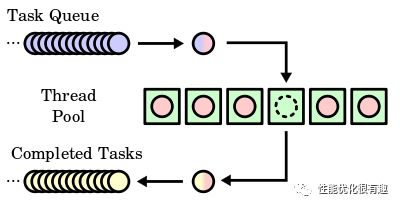
启动优化中,尽量能不在主线程就不在主线程。放到子线程又尽量不要密集并发,挨个来,给主线程多一些执行机会。那么一种方法是使用线程池。
介绍
这是Wikipedia上的定义:
In computer programming, a thread pool is a software design pattern for achieving concurrency of execution in a computer program. Often also called a replicated workers or worker-crew model,[1] a thread pool maintains multiple threads waiting for tasks to be allocated for concurrent execution by the supervising program. By maintaining a pool of threads, the model increases performance and avoids latency in execution due to frequent creation and destruction of threads for short-lived tasks.[2] The number of available threads is tuned to the computing resources available to the program, such as parallel processors, cores, memory, and network sockets.[3]
中文
一种线程使用模式。线程过多会带来调度开销,进而影响缓存局部性和整体性能。而线程池维护着多个线程,等待着监督管理者分配可并发执行的任务。这避免了在处理短时间任务时创建与销毁线程的代价。线程池不仅能够保证内核的充分利用,还能防止过分调度。可用线程数量应该取决于可用的并发处理器、处理器内核、内存、网络sockets等的数量。 例如,线程数一般取cpu数量+2比较合适,线程数过多会导致额外的线程切换开销。
-
英文 https://en.wikipedia.org/wiki/Thread_pool
-
中文 https://zh.wikipedia.org/wiki/%E7%BA%BF%E7%A8%8B%E6%B1%A0
如图:
实现
这篇2012年的文章 http://progsch.net/wordpress/?p=81 讲了一种简单的实现,是使用 C++11 实现的。下面的实现在这篇文章的代码上稍微进行了一点优化。
直接放代码了。
ThreadPool.h
#include <thread>#include <mutex>#include <condition_variable>#include <queue>class ThreadPool {public: ThreadPool(size_t); template<class F> void enqueue(F f); ~ThreadPool();private: void Task(); // need to keep track of threads so we can join them std::vector< std::thread > workers; // the task queue std::deque< std::function<void()> > tasks; // synchronization std::mutex queue_mutex; std::condition_variable condition; bool stop;};// add new work item to the pooltemplate<class F>void ThreadPool::enqueue(F f){ { // acquire lock std::unique_lock<std::mutex> lock(queue_mutex); // add the task tasks.push_back(std::function<void()>(f)); } // release lock // wake up one thread condition.notify_one();}ThreadPool.mm
#import "ThreadPool.h"void ThreadPool::Task(){ std::function<void()> task; while(true) { { // acquire lock std::unique_lock<std::mutex> lock(this->queue_mutex); // look for a work item while(!this->stop && this->tasks.empty()) { // if there are none wait for notification this->condition.wait(lock); } if(this->stop) // exit if the pool is stopped return; // get the task from the queue task = this->tasks.front(); this->tasks.pop_front(); } // release lock // execute the task task(); }}// the constructor just launches some amount of workersThreadPool::ThreadPool(size_t threads): stop(false){ for(size_t i = 0;i<threads;++i){ workers.push_back(std::thread([this]{this->Task();})); }}// the destructor joins all threadsThreadPool::~ThreadPool(){ // stop all threads stop = true; condition.notify_all(); // join them for(size_t i = 0;i<workers.size();++i){ workers[i].join(); }}使用方法
参考代码位置: https://github.com/bukuzao/bukuzao/tree/master/sample/ThreadPoolSample
ThreadPool pool(2); pool.enqueue([]{ // todo: workload });测试代码如下:
static ThreadPool pool(2); NSInteger idx = 0; pool.enqueue([idx]{ NSLog(@"begin%@",@(idx)); sleep(arc4random() % 10); NSLog(@"end%@",@(idx)); }); idx++; pool.enqueue([idx]{ NSLog(@"begin%@",@(idx)); sleep(arc4random() % 10); NSLog(@"end%@",@(idx)); }); idx++; pool.enqueue([idx]{ NSLog(@"begin%@",@(idx)); sleep(arc4random() % 10); NSLog(@"end%@",@(idx)); }); idx++; pool.enqueue([idx]{ NSLog(@"begin%@",@(idx)); sleep(arc4random() % 10); NSLog(@"end%@",@(idx)); }); idx++; pool.enqueue([idx]{ NSLog(@"begin%@",@(idx)); sleep(arc4random() % 10); NSLog(@"end%@",@(idx)); }); idx++; pool.enqueue([idx]{ NSLog(@"begin%@",@(idx)); sleep(arc4random() % 10); NSLog(@"end%@",@(idx)); }); idx++; pool.enqueue([idx]{ NSLog(@"begin%@",@(idx)); sleep(arc4random() % 10); NSLog(@"end%@",@(idx)); }); idx++; pool.enqueue([idx]{ NSLog(@"begin%@",@(idx)); sleep(arc4random() % 10); NSLog(@"end%@",@(idx)); }); idx++;其他
iOS上有多种线程创建方法,上面只是一种C++的实现。GitHub还有其他简单的实现:
-
https://github.com/nbsdx/ThreadPool
-
https://github.com/tghosgor/threadpool11
晚安 Smile