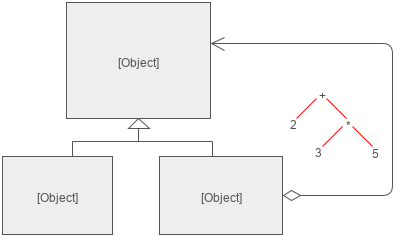
Composite模式,可以帮助客户代码以一致的方式来操作复合对象和单体对象。
比如说,对一个shape对象设置颜色,和对一组被选中的shape设置颜色时使用的操作是一致的:
rect.setColor(red)
circle.setColor(red)
和:
shapes.add(rect)
shapes.add(cirle)
shapes.setColor(red)
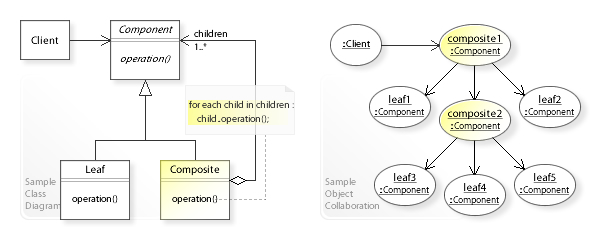
具体做法就是一个Component基类提供复合对象和单体对象一致需要提供的操作接口,然后由复合对象和单体对象实现这个操作接口。并令复合对象可以包含Component类型的对象。此模式以树形结构来构建一组对象。一个类可以包含它自己的一组对象。当对一个Composite操作时,对其内涵的对象集合做一个循环,即可以对操作一个对象相似的方式来操作一组对象。
代码:
interface Graphic {
    //Prints the graphic.
    public void print();
}
/** "Composite" */
class CompositeGraphic implements Graphic {
    //Collection of child graphics.
    private List<Graphic> childGraphics = new ArrayList<Graphic>();
    //Prints the graphic.
    public void print() {
        for (Graphic graphic : childGraphics) {
            graphic.print();
        }
    }
    //Adds the graphic to the composition.
    public void add(Graphic graphic) {
        childGraphics.add(graphic);
    }
    //Removes the graphic from the composition.
    public void remove(Graphic graphic) {
        childGraphics.remove(graphic);
    }
}
/** "Leaf" */
class Ellipse implements Graphic {
    //Prints the graphic.
    public void print() {
        System.out.println("Ellipse");
    }
}
/** Client */
public class Program {
    public static void main(String[] args) {
        //Initialize four ellipses
        Ellipse ellipse1 = new Ellipse();
        Ellipse ellipse2 = new Ellipse();
        Ellipse ellipse3 = new Ellipse();
        Ellipse ellipse4 = new Ellipse();
        //Initialize three composite graphics
        CompositeGraphic graphic = new CompositeGraphic();
        CompositeGraphic graphic1 = new CompositeGraphic();
        CompositeGraphic graphic2 = new CompositeGraphic();
        //Composes the graphics
        graphic1.add(ellipse1);
        graphic1.add(ellipse2);
        graphic1.add(ellipse3);
        graphic2.add(ellipse4);
        graphic.add(graphic1);
        graphic.add(graphic2);
        //Prints the complete graphic (two times the string "Ellipse").
        graphic.print();
    }
}
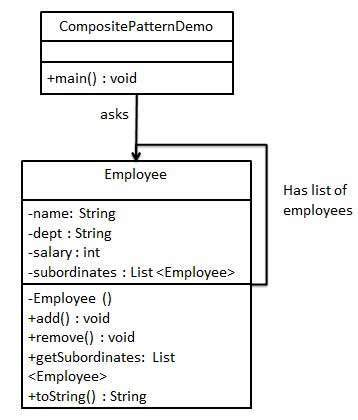
一个日常生活中常常遇到的案例是雇员和它的下属:
另一个常见的例子是表达式计算。"2+3X5" 就是一个合法的表达式,它的,其中的2就是一个NumbricOperand,"3X5"就是一个CompositeOperand。无论是复合操作数,还是单体操作数,都支持一个计算的操作。每个CompositeOperand都包括多个NumbricOperand。