On a typical day, developers ask over 8,000 questions on Stack Overflow about programming problems they run into in their work. Which technologies are they asking about, and how has that changed over time?
Today, we’re introducing the Stack Overflow Trends tool to track interest in programming languages and technologies, based on the number of Stack Overflow questions asked per month. For example, we could compare the relative usage of three programming languages.
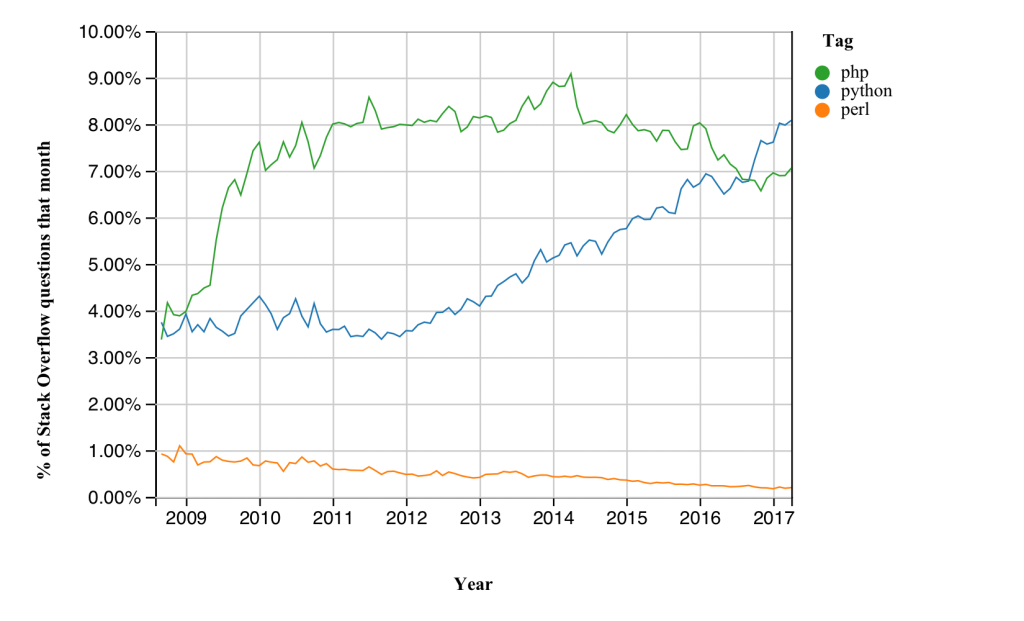
Here, we can see that questions about the Python programming language have become rapidly more common over the last few years. (In data from Stack Overflow Talent we’ve seen the same expansion in companies looking for Python developers). PHP was growing for several years, but has since leveled off. Perl was never as big a presence on Stack Overflow, and questions about it have become steadily less common in the last 9 years.
Measuring developer interest based on Stack Overflow questions isn’t perfect: some technologies might inspire more questions among its users than others. But we’ve found it’s a simple measure that gives useful insights into the developer ecosystem. It’s especially useful for measuring changes over time: when we see a rapid growth in the number of questions about a technology, it usually reflects a real change in what developers are using and learning.
Here we’ll share a few examples of insights we can extract from the Stack Overflow trends tool.
Javascript frameworks
Javascript open-source web frameworks show some of the most interesting patterns of growth and decline.
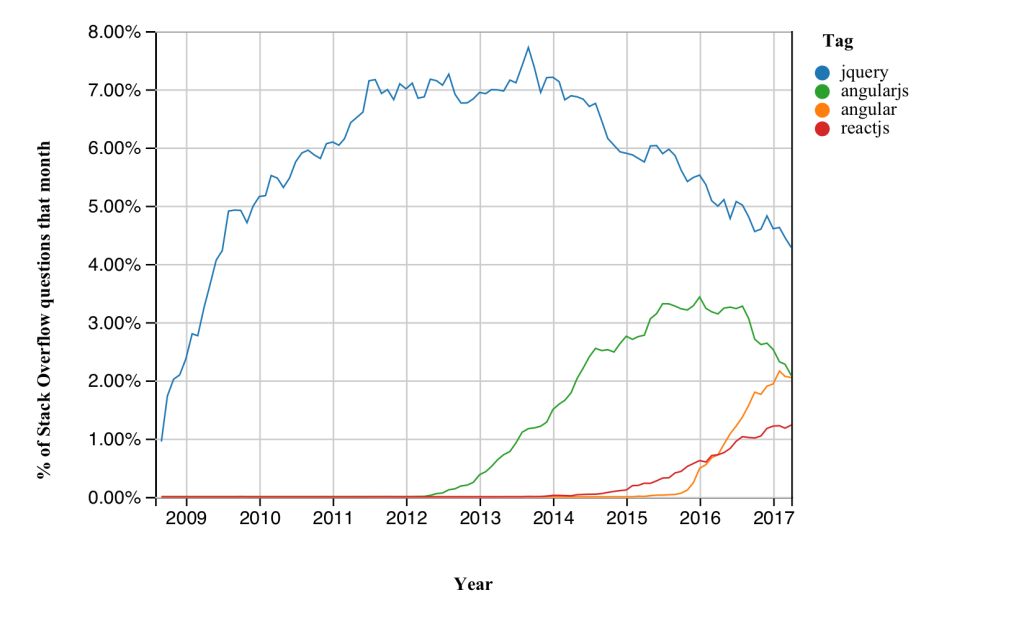
JQuery used to be among the most popular tags on Stack Overflow (as some have humorously observed), but it has made up a smaller share of questions as newer web frameworks have been introduced. There’s been extraordinary growth of the angularjs tag (representing the first version of the framework) since 2013, then a quick shift to the angular tag (representing subsequent versions). We also see fast growth in the React library. These tags are among the most prominent Javascript projects on the site.
Smaller web frameworks show a brutal life cycle, where some show rapid growth then decline over the span of a few years.
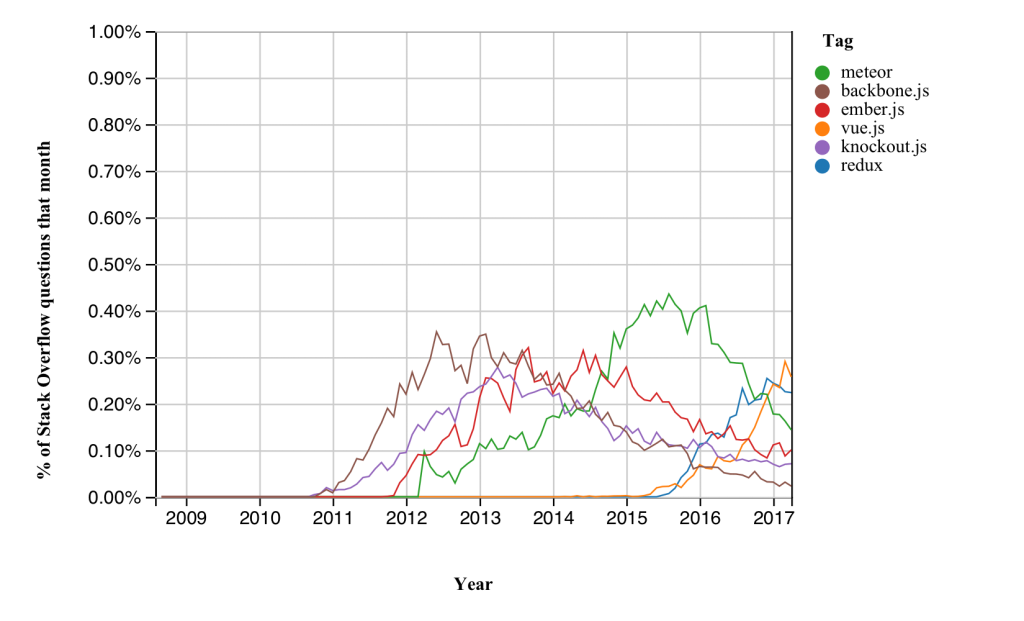
The Vue.js framework have shown quick adoption (and in terms of year-over-year growth is one of the fastest growing tags on the site). Frameworks like Backbone.js, Ember.js, and more recently Meteor appear to be in the later stages of the life cycle.
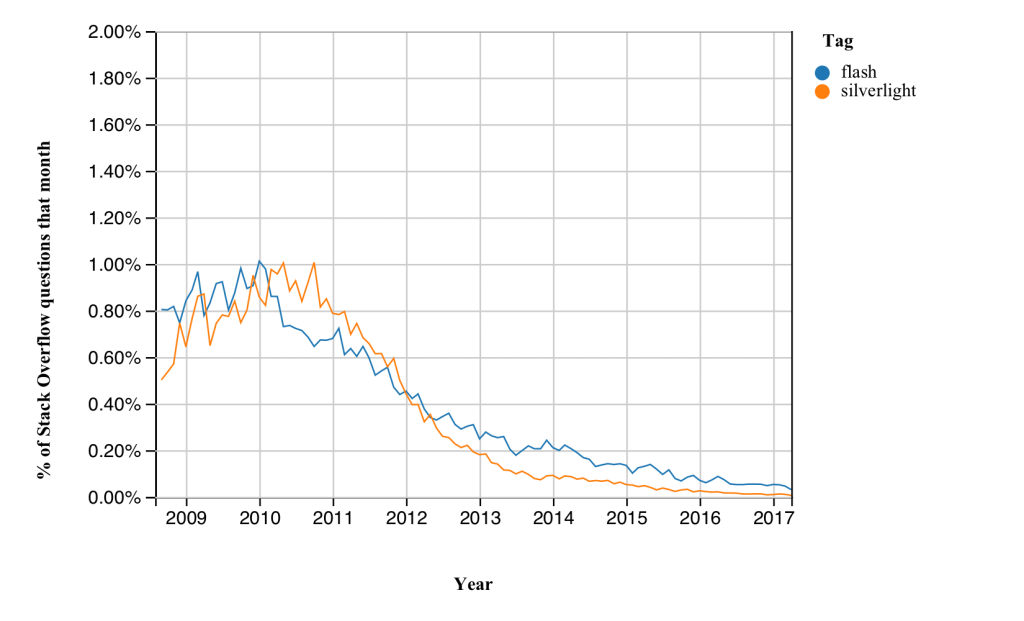
Overall, front-end web development has largely been moving away from closed-source plugins, including Adobe Flash or the now-deprecated Microsoft Silverlight. In 2016 these each made up less than .1% of Stack Overflow questions.
Data Science and Big Data
Technologies used for data science have shown particularly rapid growth over the last few years.
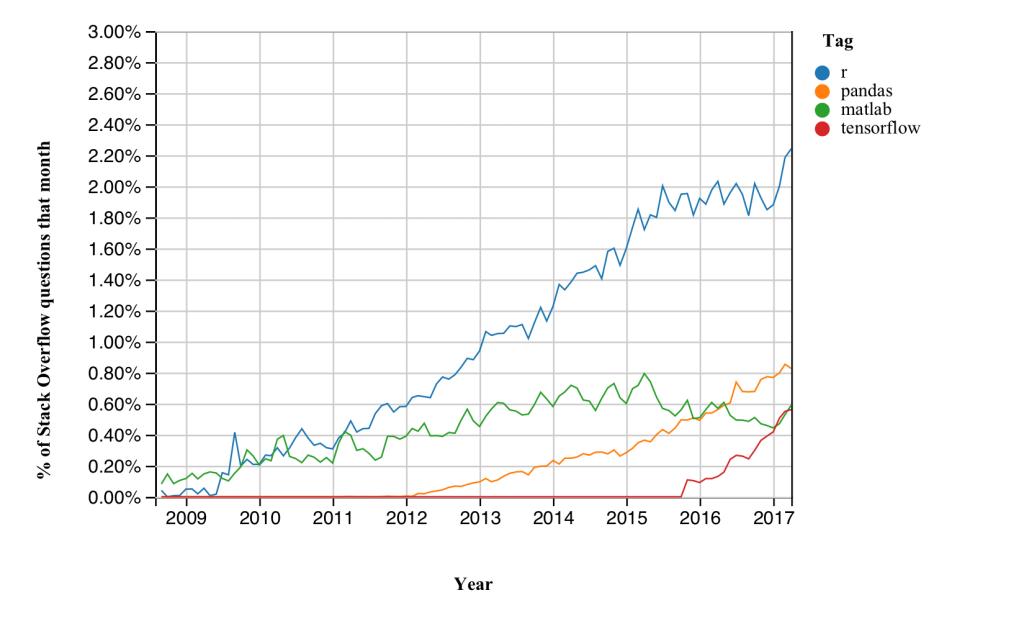
The R statistical programming language has shown consistent growth, as has pandas, a popular library for data science in Python. The closed source MATLAB language was growing for most of the lifetime of the site, but has more recently leveled off and may be shrinking.
TensorFlow, Google’s open-source machine learning framework, was introduced only in late 2015, but it’s been growing at an extraordinary pace. Among the 500 largest tags, only swift3 has shown faster growth in the last year.
Similarly, there’s been expansion of interest in big data frameworks. We can compare several major Apache open-source projects for storing and processing large datasets.
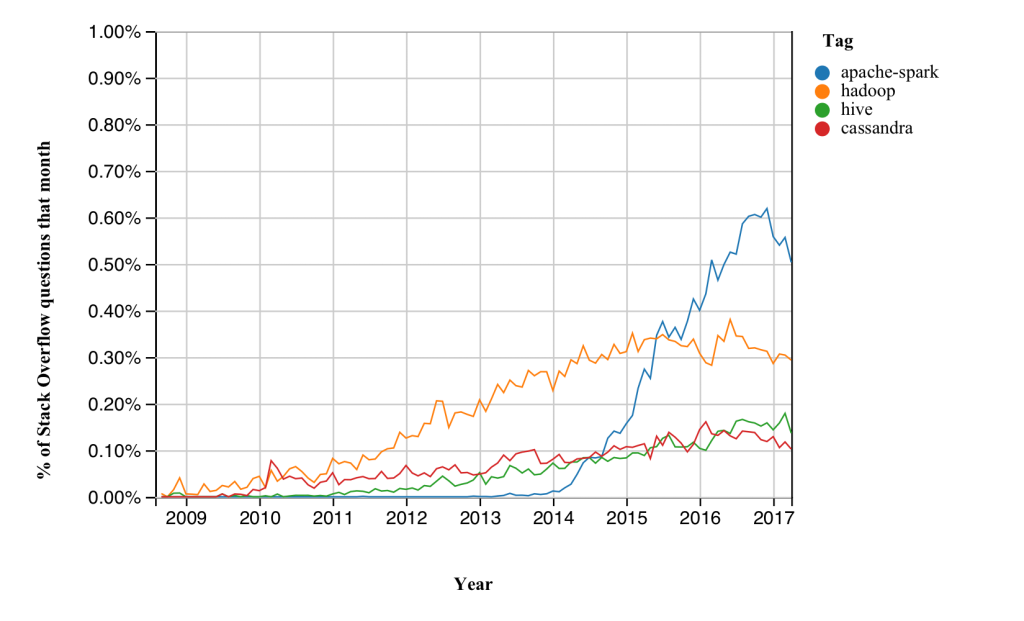
Hadoop has grown since 2009, and so more recently has Hive, a query system built on top of Hadoop. Interest in Cassandra has remained steady for several years. But Spark shows the fastest surge of adoption, becoming the most asked about technology just a few years after its introduction.
Try it yourself!
Don’t see your favorite language, technology, or framework in this post? Use the Stack Overflow Trends tool to create your own graphs, and see what you can learn about how the developer ecosystem is changing and where it might be going in the future.
By David Robinson, Data Scientist
Tagged in Announcements Company Data Engineering
-
Hariram N
The steep inclination in the R definitely does ring a bell. A big fat church bell probably.
-
Marc Köhlbrugge
Very cool! I happened to make the same thing, but for startup jobs: betalist.com/jobs/trends
-
Jorge Castro
Are the tags available only a subset? I wasn’t able to add `mesos` for example.
-
David Robinson
Yep- only ones with at least 2000 questions on Stack Overflow, I’m afraid
-
David Robinson
-
Paintedgauthier
Php questions being asked is in decline, but is the frequency of existing question views going down?
-
dm
In addition to showing questions asked, it might be good to show page-views — i.e., people who googled a question and landed on the stackoverflow page and found their question answered.
-
Bhatt Bhaskar
It will bring earth quake on every ones mind.
-
Omar Soufiane
it looks a bit wired to see php loose share to python after php7 which is way faster than python
-
Fishy
Still not threaded though

-
Matteo Italia
I think that speed is one of the least interesting factors when choosing Python over PHP; besides, it’s not like web development is the only kind development happening, and outside it PHP is virtually nonexistant (unlike Python).
-
Fishy
-
Vasiliy
StackOverflow keeps delighting us. Keep up the good work, guys!!!
P.S. Long live language wars supported by statistical data ) -
Basil McDonnell
As several others here suggest, I think that the frequency of questions is an inaccurate measure of popularity. The frequency of questions could reflect several factors other than popularity. Complexity, version changes, new user influx, immaturity of the technology. Experienced users don’t ask (as many) questions. So the user base for a technology could be vast- but the experts who are current users will not be posting questions.
Even page accesses don’t tell the whole story. I very rarely, if ever, have to ask questions of anyone about systems I’ve used the longest- but those systems are the backbone of my paying work. For example, a very experienced developer would have no occasion to post a Transact-SQL question. But SQL Server might be at the core of all of their work.
To score high on this questions-posted measure, a technology would have to be complex: it would have to be new, it would have to be sufficiently complex to compel a user to seek outside help, it would have to be complex enough to give rise to vast numbers of non-repeated questions, and so complex that even experts never become so comfortable with the tool that they stop asking questions.
As a technology matures the frequency of questions ought to drop. Page views ought to drop.
So I’d say that it’s a very, very indirect measure of popularity.
-
Adrocked
Backbone is still the only MV* framework worth using.
-
svick
It’s interesting that C# has been declining steadily pretty much single the start: insights.stackoverflow.com/trends?tags…
Is C# actually losing popularity? Or is it because SO was most popular among C# programmers in the beginning?
-
Bob
I think that highlights that tracking ‘interest’ in these technologies by tag activity needs to be taken with a HUGE pinch of salt
-
Bob
-
Grant Winney
Does the vertical metric represent the percentage of all Stack Overflow questions for a particular time period?
So could it be, for example, that
jqueryquestions are holding completely steady month-to-month (hypothetically), while the total number of questions in all other languages are going up and down in the same time period?If that’s the case, then the above metrics aren’t as indicative of language popularity as they might seem at first.
-
Xiao Ling
Thanks for sharing the trends tool.
-
LaiChuanfeng
Very cool tool, thanks for sharing.
-
Ryan Sattler
Please make the graph in the generator go down to 0 instead of just the lowest point in the line. Right now it’s very misleading.