

本文已经翻译成中文《【译】互联网公司真的是「看重能力,不看重学历」吗?》,欢迎参加「掘金翻译计划」,翻译优质的技术文章。
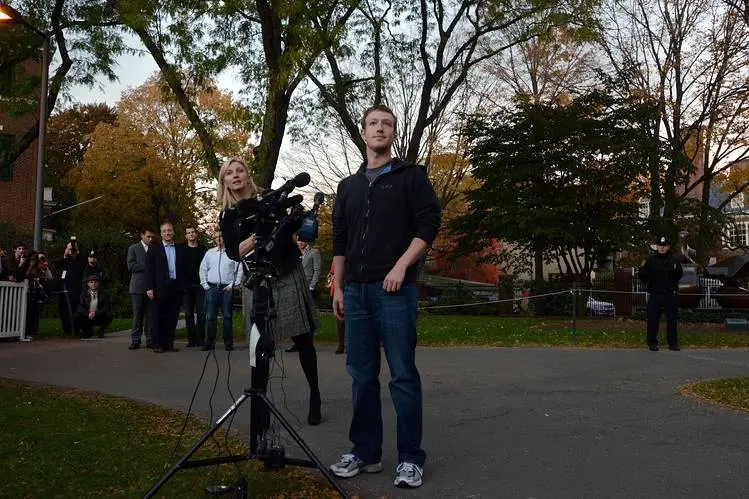
Facebook founder Mark Zuckerberg chats with reporters at Harvard University in 2011. He famously left the school without a degree in 2005. Silicon Valley employers are actually more likely to require a degree or advanced degree, according to new data from Burning Glass Technologies.
There’s a long-lived myth that Silicon Valley and the technology industry are meritocracies where all that matters is the caliber of your code. But it turns out that tech companies are more likely than other employers to require college degrees when hiring software developers.
Seventy-five percent of job ads for those roles at technology companies specify an educational requirement, compared with 58% of openings posted by the full universe of employers that are hiring software developers, according to Burning Glass Technologies, a labor-market data firm that analyzed 1.6 million ads for software-developer jobs nationwide.
And in 95% of the tech-sector job ads that list a minimum credential, the employer calls for a bachelor’s degree or higher, versus 92% of the ads from all employers seeking developers.
Matt Sigelman, Burning Glass’s chief executive, said he was struck by “the extent of the discord between, on the one side, the meritocratic mystique and the lore of the Bill Gateses and Mark Zuckerbergs”—both Harvard University dropouts[1]—“and on the other side, the reality of so many of the best kinds of jobs being closed to those who don’t have a college degree.”
Nationally, 68% of adults over age 25 don’t have bachelor’s degrees.
Burning Glass found employers in Silicon Valley were the most exacting in terms of credentials, listing education requirements in 77% of developer job postings, and in those ads, demanding a bachelor’s or advanced degree 98% of the time.
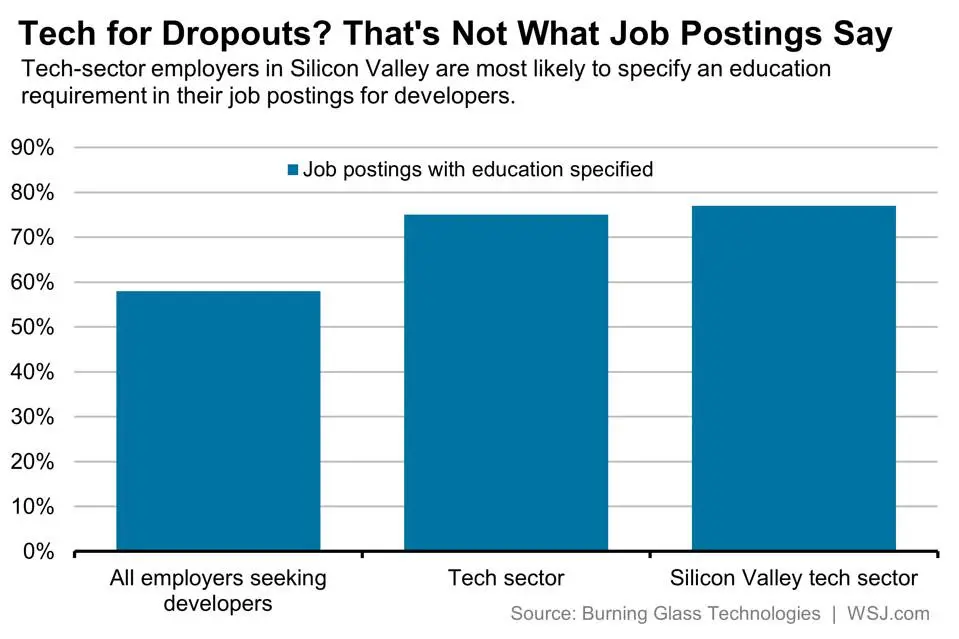
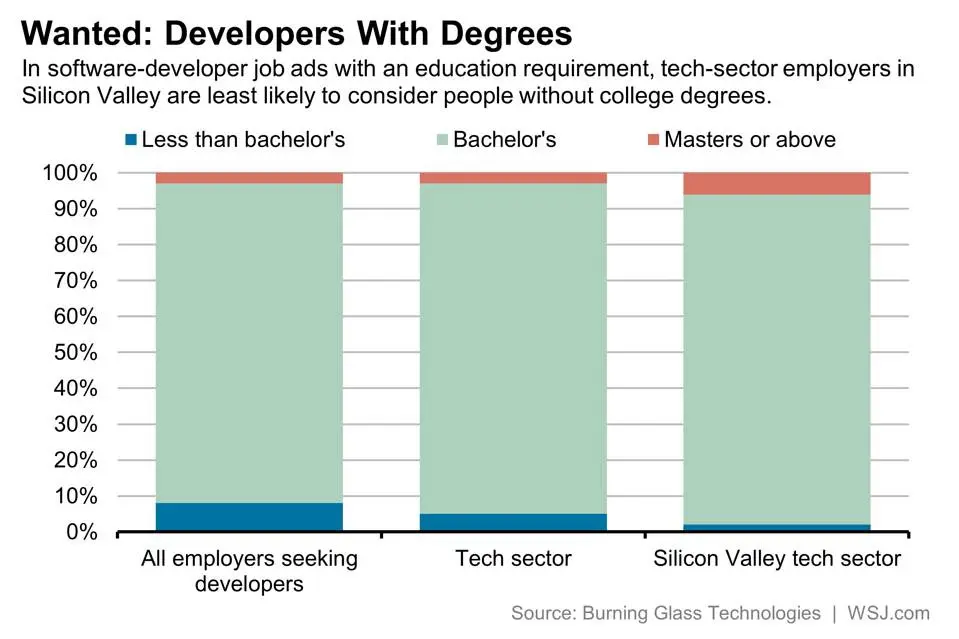
By contrast, Portland, Ore., employers asked for a college degree in 88% of job ads with a credential requirement; in Dallas and Minneapolis, 90% did.
Companies pay a high premium for those credentials, offering salaries an average of 29% higher for college grads across all employers, and 36% higher among tech-sector employers, Burning Glass found.
The firm also looked at the skill requirements of job ads seeking college graduates and those that didn’t, but found that the five skills in highest demand in both sets were the same. So what accounts for the difference?
Many employers view a bachelor’s as evidence of soft skills like collaboration and critical thinking, talents that might be especially useful in the kinds of high-growth companies that populate Silicon Valley. But “it’s not necessarily clear that college degrees are good proxies” for those skills, Mr. Sigelman said.
While some firms are experimenting with “blind hiring[2]” processes—designed to judge job applicants purely based on work samples rather than resumes—the practice hasn’t penetrated deeply yet.
It’s unfortunate that the tech sector is using college degrees as a screening mechanism for so many well-paying jobs, said Mr. Sigelman, whose company is contributing data and analysis to the White House TechHire Initiative, an effort to skill up Americans for jobs in the industry. “The sector is such an engine of growth and dynamism in the job market, and we’re interested in how it can be a point of opportunity for the majority of Americans.”
