

Truth 是一个测试框架,可以改进测试用例以及错误日志的可读性,而且可侦测型更强。不仅如此,它对自定义类型也有很好的扩展性。
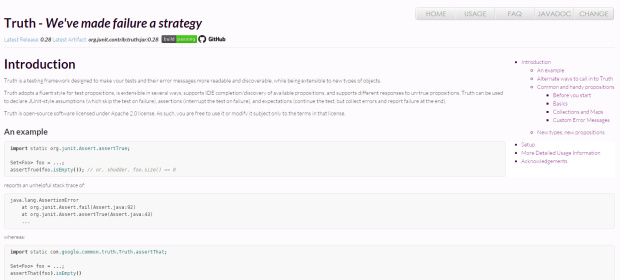
Truth对测试命题有一套流畅的测试风格,并且具有良好的扩展性。Truth能够在IDE中完整运行命题(proposition)或者跟踪侦测等模式,在非真命题上有多种不同的反馈方式。Truth可以声明JUnit风格的常见操作,诸如:
- Junit风格的假设(Assume,如果指定语句执行失败则直接跳过测试)
- 断言(Assert,如果指定语句执行失败则中断测试)
- 预期(Expect,持续完成测试,只是将错误和失败收集起来最后集中显示)。
Truth是一个开源项目,采用Apache 2.0开源许可。因此,可以在遵循本许可条款的前提下免费使用和修改。
示例
这是我们平常使用JUnit的场景
importstaticorg.junit.Assert.assertTrue; Setfoo=...; assertTrue(foo.isEmpty());// or, shudder, foo.size() == 0 |
如果出现异常, 这时候会打印出一些用处不大的异常堆栈信息,
java.lang.AssertionError atorg.junit.Assert.fail(Assert.java:92) atorg.junit.Assert.assertTrue(Assert.java:43) ... |
使用Truth后:
importstaticcom.google.common.truth.Truth.assertThat; Setfoo=...; assertThat(foo).isEmpty() |
反馈信息:
org.truth0.FailureStrategy$ThrowableAssertionError:Nottruethat isempty atorg.truth0.FailureStrategy.fail(FailureStrategy.java:33) ... |
Truth的命题方式(多多少少)接近英语,这样以来更加容易看懂,并且测试报告中显示的内容也更有意义。
使用Truth的其它方式
这里给大家提供两种使用Truth的方式。
首先,Truth的主要操作是围绕一个具有不同表现形式的动作(断言、假定、预计)来开展工作。由于assert是最常用的,又偏偏是Java的一个保留关键字,所以我们采用了类似Hamcrest和FEST的做法,创建了一个独立而简短的方法,以下是它的常见用法:
assertThat(someInt).isEqualTo(5);// Convenience method to access assert_().that() |
而在非assert需要对这个测试动作增加额外功能时,还可以使用一种更加纯净的调用方式,通过返回这个测试动作对象来进行自定义设置,再进行测试。
assert_().that(someInt).isEqualTo(5);// Assert is a keyword in java, so no assert().that() assert_().about(...).that(...)...// Extensibility (see later in this page) assume().that(someValue).isNotNull();// JUnit-style Assume behavior. |
Truth的帮助文档里会使用assertThat(…)来作为所有的断言例子的操作方式,除非有必须进行一些方法定义的情况。当然,assert_().that(…)的方式也是完全可用的。
所有assert_()能够做到的操作,assume()也能做到。而且,所有能够拿到“测试动作”的方式也都能做到这些。
一些常见的命题
准备
assertThat 是Truth类中的一个方法,所以一开始记得要 import static com.google.common.truth.Truth.assertThat
基本用法
assertThat(someInt).isEqualTo(5); assertThat(aString).isEqualTo("Blah Foo"); assertThat(aString).contains("lah"); assertThat(foo).isNotNull(); |
集合用法
assertThat(someCollection).contains("a");// contains this item assertThat(someCollection).containsAllOf("a","b").inOrder();// contains items in the given order assertThat(someCollection).containsExactly("a","b","c","d");// contains all and only these items assertThat(someCollection).containsNoneOf("q","r","s");// contains none of these items assertThat(aMap).containsKey("foo");// has a key assertThat(aMap).containsEntry("foo","bar");// has a key, with given value assertThat(aMap).doesNotContainEntry("foo","Bar");// does not have the given entry |
自定义错误信息
// Reports: The subject is unexpectedly false assertThat(myBooleanResult).isTrue(); // Reports: "hasError()" is unexpectedly false assertThat(myBooleanResult).named("hasError()").isTrue(); // Reports: My custom Message assert_().withFailureMessage("My arbitrary custom message") .that(myBooleanResult).named("hasError()").isTrue(); |
新对象,新命题
Truth对新的数据类型有很好的扩展性,开发者可以创建自定义的“主题(Subject)”,像下面这样
// customType() returns an adapter (SubjectFactory). assert_().about(customType()).that(theObject).hasSomeComplexProperty();// specialized assertion assert_().about(customType()).that(theObject).isEqualTo(anotherObject);// overridden equality |
安装配置
要使用Truth,在maven中这样配置
com.google.truth truth 0.28 |
或者直接通过下方的链接下载jar包,并将它加入到你测试工程的classpath中
http://search.maven.org/remotecontent?filepath=org/truth0/truth/0.28/truth-0.28.jar |
更多的信息
需要了解更多信息,点击查看Truth到底如何工作的,还可以查看更多内置已有的命题详情。
